Tag Archives: Mark and Abbie Jury

Plant Collector: Magnolia Iolanthe

The inimitable Magnolia Iolanthe

The inimitable Magnolia Iolanthe

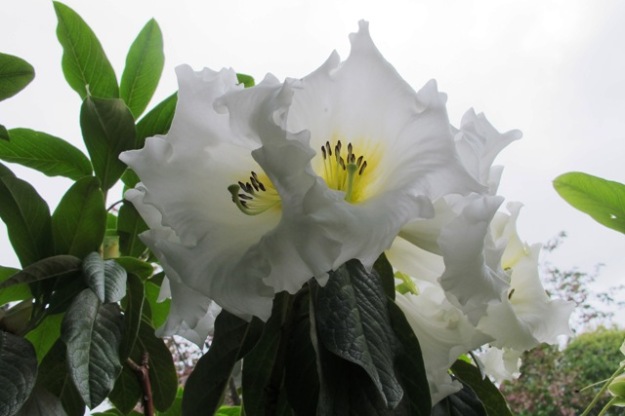
I cannot let the season pass without celebrating magnolias. At this time of the year we live and breathe these flowering trees and the settled weather has meant a particularly good season this year. Not all of them get as large as this glorious specimen of ‘Iolanthe’. In this country, it is a lucky tree that is permitted to survive into its sixth decade without being unceremoniously severed from its roots.

Iolanthe was the product of Felix Jury’s first attempts to hybridise magnolias. He was looking for larger blooms with good colour. Certainly the bloom is still exceptional with its large cup and saucer form. The colour has been criticised for its lavender hue, but I can tell you that it remains spectacular. Because it sets flower buds down the stem, it has one of the longest season of any of our many magnolias here. Some only set buds on the tips where they all come out at once. As soon as they pass over – or if they are hit by strong wind, heavy rain or frost – that is it for the year as far as floral display goes. Not so with Iolanthe. Twice we have seen the display turned to mush by extraordinary frost events but a few days later, a fresh flush of blooms has opened and the display is back. From first to last spring bloom, we get about two months of flowering, of which maybe three weeks is full glory. It repeat flowers in summer, though as the tree is then in full leaf, it is nowhere near as showy or prolific – more a bonus than a mainstay.

Iolanthe and Serene are the only plants for which Felix ever received external payment. We recall this because it was in our early married days when we were impoverished students. He gave the fee of a couple of hundred dollars to Mark. It was not the sort of event one ever forgets.
???????????????????????????????
First published in the Waikato Times and reprinted here with their permission.
Floral Skypaper – the garden in August

Magnolia Felix Jury

Magnolia Felix Jury

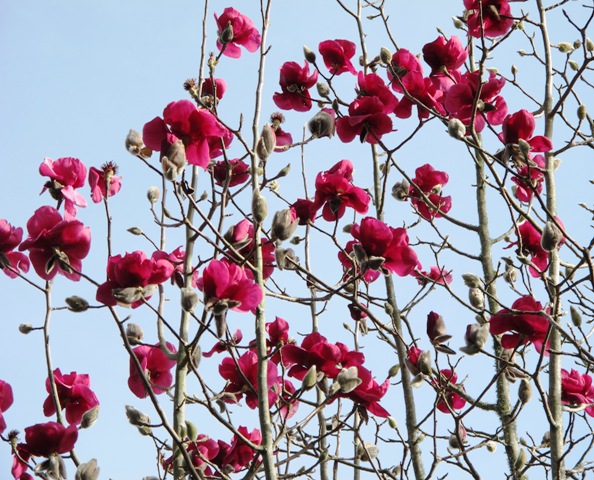
Not for us the refinement of declaring we garden for foliage and form. Give us floral extravaganza, we say, and August obliges. In the deciduous magnolias, it is the reds that dominate. By the end of the month and well into September, the softer pinks and whites come into their own but at the start, we have an unrivalled display of the stronger colours which just gets better every year as the trees get ever larger. Floral sky-paper, I call it when looking up from below. I say it is an unrivalled display because nowhere else in the world gets the same intensity of red in these magnolia, nor have they done the breeding on them that has been done in this country over the past 40 years. First Felix Jury, now Mark Jury and also Vance Hooper have pushed the boundaries with the reds. Mark was very pleased to find recently that Britain’s Royal Horticultural Society has given an Award of Garden Merit to the magnolia he bred and named for his father, ‘Felix Jury’. While we admit to being biased, it still takes our breath away each season.

Mark's new 'Fairy Magnolia White'

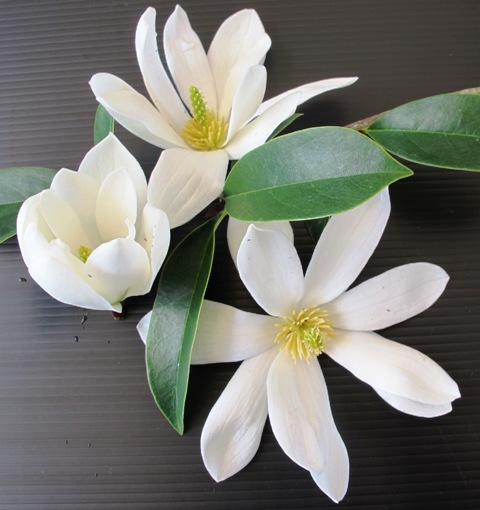
Mark’s new ‘Fairy Magnolia White’

It is also michelia time – or as they have been reclassified botanically, magnolias. Do not confuse them with the evergreen grandiflora magnolias which are the summer flowering trees with big, glossy, leathery leaves. I admit we still call them michelias in conversation or we go with the “Fairy Magnolia” branding that has been placed on Mark’s new cultivars. Because michelias flower with their leaves, they are not as individually spectacular as the deciduous magnolias but they are a wonderful addition to the spring garden.

Mark has been breeding michelias for coming up to two decades now and we have many hundreds, maybe over 1000 of them, planted around our property. Out of all those, he has only named and released three so far. Fairy Magnolia White is the earliest of the season to open and has the loveliest star flower as well as being strongly fragrant. There is a purity in such white flowers, especially when contrasted with deep green foliage and wonderful velvet brown buds. One of the breeding advances has been to eliminate the tendency of some cultivars to drop their leaves and defoliate after flowering. Readers with Michelia doltsopa ‘Silver Clouds’ may recognise this trait.

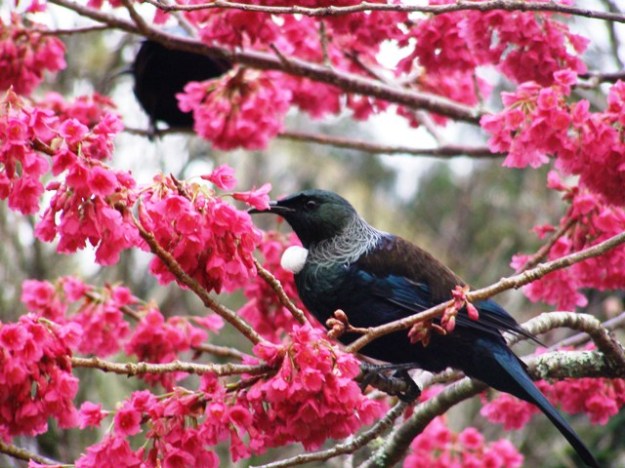
???????????????????????????????Nothing excites the tui more than the Prunus campanulata. These are somewhat controversial, especially in warm northern areas, because too many of them set seed freely, threatening to become noxious weeds. Both the tui and we would be grieved to see all campanulatas banned, though we are vigilant weeders on the germinating seed. We have a number of different trees that come into flower in sequence and we can have literally scores of fiercely territorial tui bickering and fighting in these trees as they try and claim their feeding space. There are times it can appear as if the trees are dancing with the tui.

Until a whole lot more work is done on selecting and marketing sterile forms of campanulatas (in other words, they don’t set viable seed so will never become weedy), if you live in Northland, Auckland, Waikato, Bay of Plenty, Marlborough or the West Coast, where regional councils are understandably touchy on this topic, look for Prunus Pink Clouds or Prunus Mimosa which are sterile options.
???????????????????????????????
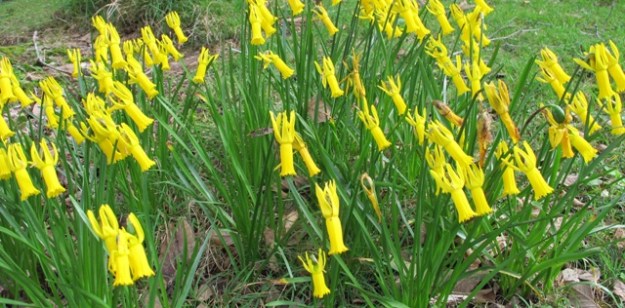
From the big to the small – narcissi season is in full swing here. The little pictures they create give wonderful detail in a big garden. We have such a problem with narcissi fly that we struggle with the later flowering hybrids which comprise most of what is sold through garden centres (commonly called daffodils). The dwarf forms tend to flower earlier so they are over and going dormant when the narcissi fly are on the wing later in spring. The little cyclamineus ones, with their swept back skirts, seem to have a look of perpetual surprise. We are delighted with how well they are naturalising on our grassy banks where conditions are harder than in cultivated garden areas.
???????????????????????????????
We looked enviously at Russell Fransham’s magnificent bananas in the June issue.
They are a pretty marginal crop this far south and as we live 5 km from the coast, we have to take extra care and cover them in winter. We do this with giant bamboo frames and old shade cloth. A bunch of 50 is a triumph for us so we were in awe of Russell’s 200. We won’t remove the covers from ours until later in spring, just to be on the safe side. I call these constructions here the Theatre of the Banana.

First published in the August issue of New Zealand Gardener and reprinted here with their permission.

Grasses, anyone?

 These are New Zealand grasses, seen at their best in a North Devon garden, Wildside


These are New Zealand grasses, seen at their best in a North Devon garden, Wildside

Grasses. There is nothing new about using grasses in the ornamental garden. So why are they being hailed as one of the hallmarks of the New Perennials Movement? It is how they are used, not what is used and that derives from the whole prairie and meadow inspirations which underpin the new styles of freer planting.

It is not without its pitfalls, NABS even. That is the Not Another Bloody Stipa.

Stipa gigantea looks ethereal seen here with phlomis but it looks equally ethereal in everybody else's garden

Stipa gigantea looks ethereal seen here with phlomis but it looks equally ethereal in everybody else’s garden

Stipas are beautiful, feathery grasses. It is just that they seem to be in every single UK garden, particularly Stipa gigantea, also known as giant feather grass (it is large with ethereal golden spires of seed heads) and Stipa tenuissima which is soft with shimmering ripples in the lightest of breezes. The latter is often called Mexican feather grass and has now been reclassified as a nassella, not a stipa. It is a bit of a shame that it is already on the Weedbusters website in this country as a pest.

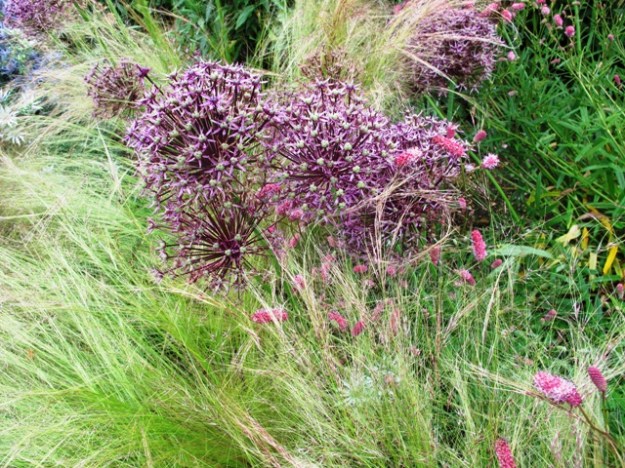
The shimmering Stipa tenuissima, seen here with alliums, but not a good choice for New Zealand where it has already been determined an invasive variety

The shimmering Stipa tenuissima, seen here with alliums, but not a good choice for New Zealand where it has already been determined an invasive variety

The good news is that grasses are easily substituted and there are many excellent options which are not dangerously invasive. Some are even native to this country. We saw one garden making extensive use of a New Zealand chionocloa. The English have a love affair with Argentine pampas grass. Both Cortaderia selloana and jubata are on our banned list but we have a ready substitute in our native toe toe.

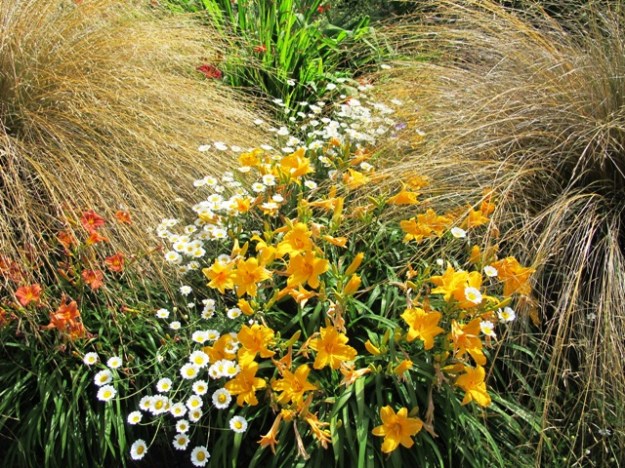
We are guilty of being a bit sniffy about grasses generally in the past. We put this down to the over-use of our native varieties in particularly stodgy and unimaginative amenity plantings from the 1980s onwards. What we learned is that it is how they are used that makes all the difference. Let them get some size and they add the dimension of movement to a garden in all but dead calm conditions. They also provide a superb foil to other plants, particularly larger flowering bulbs, annuals or perennials.

Rivers of a grass at Scampston - a little too conceptual for our gardening taste

Rivers of a grass at Scampston – a little too conceptual for our gardening taste

Alas we did not think to start counting until quite late in our trip but I can tell you that the ratio of flowering perennials to grasses in the Oudolf river borders at Wisley was 3 to 1. However the Oudolf rivers of grass at Scampston were 0 to 1. That is to say there was only the one grass used and no perennials at all. We didn’t like it. It was contrived – part way between temporary show garden and motorway siding. A conceptual garden, perhaps? In contrast, the elegant grass garden at Bury Court was closer to a 1 to 8 ratio. The complexity of multiple different grasses and a scattering of flowering perennials gave much more visual interest and variation with movement.

Mostly we saw bold grasses of some size, integrated with other perennials in sunny conditions. Problems come when similar grasses are used in all herbaceous plantings. It can make them look very similar, as we realised after looking at a number of gardens. There is a school of thought that this is good because it unifies a garden but we have never subscribed to that belief. We will be choosing to keep the use of mixed grasses and perennials to one garden only, not repeated throughout. I also think the 3 to 1 ratio is quite low. We are more likely to go for maybe 5 flowering plants to each clump of a decorative grass. But then we prefer more detailed plantings.

Nowhere, dear reader, did we see tidy little grasses being used as tidy little edgings. I will be happy to see New Zealanders move on from the thinking that a row of tidy mondo grass, blue festuca or liriope will define a border nicely. I am afraid it will just make your garden look suburban and straitjacketed.

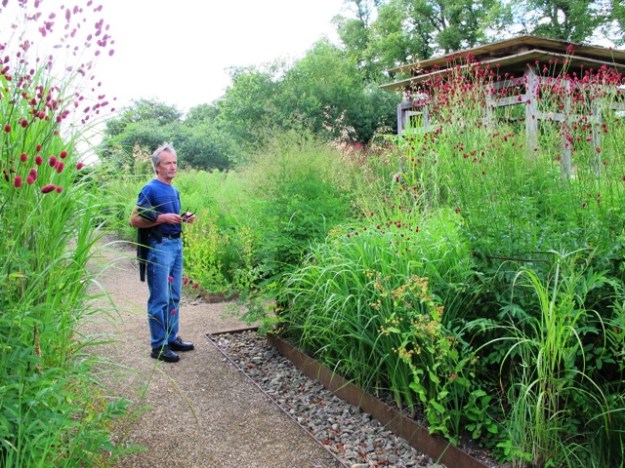
Mark, standing in the elegant grass garden at Bury Court

Mark, standing in the elegant grass garden at Bury Court

First published in the Waikato Times and reprinted here with their permission.

Garden Lore

“A little studied negligence is becoming to a garden.”

Eleanor Perenyi Green Thoughts (1981)

Neither spray damaged nor sickly - just hard to use well

Neither spray damaged nor sickly – just hard to use well

Modern heucheras

Having used Plant Collector this week to whole heartedly recommend a new plant, the same can not be said for the yellow and orange heucheras which you will also see in almost every garden centre. I have long raised my eyebrows at these and photographed some clumps on our recent garden ambles, garnering agreement from a number of other gardeners that not all heucheras are equal and some may be best avoided.

Heucheras are North American leafy perennials and have proven most amenable to the whims of the hybridists. Not all are a triumph in terms of garden performance and appearance. The lime green form looks attractive and useful but a retailer told me it is not as reliable as the others. This discouraged me because, despite considerable efforts, I have never been very successful growing the handsome deep burgundy foliaged ones. I have, however, admired them in others’ gardens where they make an attractive show.

It is just those yellow and orange autumn tones. Novelty plants, I call them. Plant them out and how do they look? Spray damaged, is Mark’s verdict. Sickly, I say. I have never seen those particular coloured heucheras used in a way that is attractive. Be cautious of novelties. I am reserving judgement on the coral shades at this stage.

Just don’t do what I saw one gardener do – buy one of each colour and plant them in a ring around the base of a deciduous tree. Not only will they suffer from root competition, it is the look of a novice gardener.

Great nursery plants - the autumn-toned heucheras look so interesting in the garden centre but I have yet to see them perform as garden plants

Great nursery plants – the autumn-toned heucheras look so interesting in the garden centre but I have yet to see them perform as garden plants

First published in the Waikato Times and reprinted here with their permission.

Modern directions in perennial planting patterns

Hampstead Heath1) Confining planting to geometric blocks (Mondrian-style perhaps, for students of art), has been evident in show gardens in recent years but has now become mainstream. This is a new planting on Hampstead Heath, done by the public authorities. The sharp lines will blur over time. It is a shame about the buxus blight that is already evident. A different clipped shrub may have been a better choice.
Wisley2) Piet Oudolf’s rivers of colour in the modern borders at Wisley have been controversial since they were planted in 2000, but we think they are glorious. They also take much less labour to maintain than the traditional twin herbaceous borders. Each ribbon of colour has about four different plants in it and the colours will change through the season. You need to be able to look up or look down on this type of planting (or both). Viewed on the flat, you would not see the diagonal effect.
A river effect3) Less ambitious may be to snake a river of one perennial through clumping plantings. In this case it is an erigeron daisy but I have already done it in my own garden with irises (the blue sibirican ones and also Higo iris). A river effect alters the dynamic of big, round clumps of plants or can give some visual unity to an otherwise disorganised planting.
Tom Stuart Smith4) Big generous clumps of perennial plants, each standing in its own space, are one of the hallmarks of the New Perennials Style that has been widely adopted in modern UK and northern European gardens. This is a private garden, the work of British designer, Tom Stuart Smith. It takes a big area to carry out well. Each plant is occupying an area at least a metre across, sometimes more. Clipped shrubs act as punctuation points.
Dorset garden5) The classic cottage garden mix and match style is harder to manage than it looks if you are determined to keep both a succession of flowers and good coverage – to avoid bare patches – throughout the warmer months. This is in a Dorset garden owned by a good gardener. In lesser hands, it can become a hodge podge with bare bits and small plants of potted colour added in an effort to fill in the gaps.
Gresgarth, near Lancaster6) The classic twin herbaceous borders adapted to a more personalised, private garden (in this case Gresgarth, near Lancaster) by breaking up the expanse into shorter sections using clipped hedging in battlement style and strategic topiary. In line with modern expectations, planting is now deliberately colour-toned and separate sections allow the colour palettes to be kept apart. The effect is deliberately refined.
007 - Copy7) Grasses! Grasses! More grasses! And many meadows, let alone prairie plantings. No discussion about modern perennials is complete with referencing these major trends. These deserve attention in greater detail and are part of a bigger picture of focussing on more environmentally friendly approaches to gardening.

First published in the Waikato Times and reprinted here with their permission.