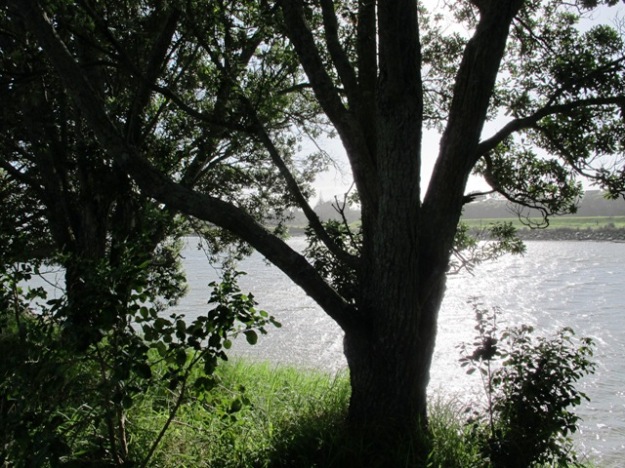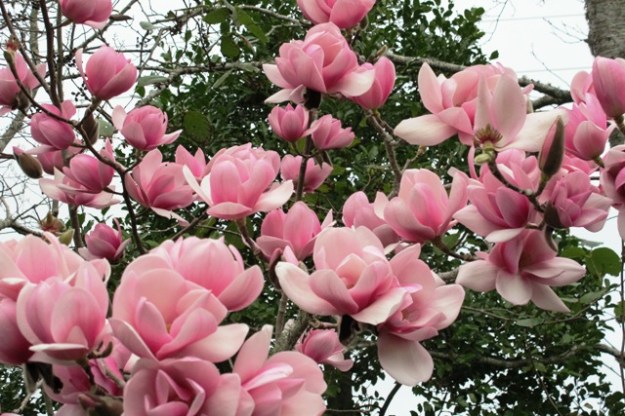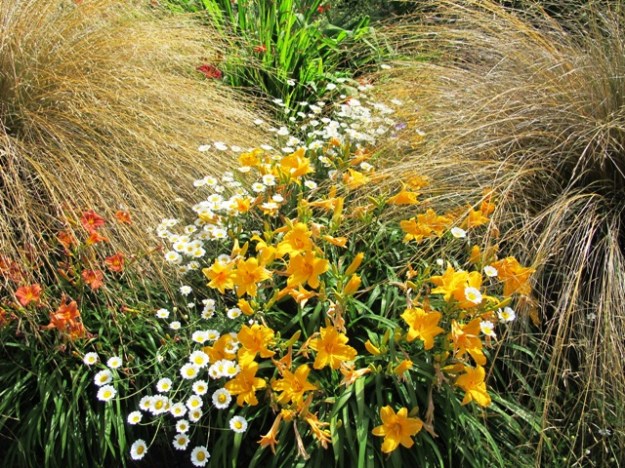
These are New Zealand grasses, seen at their best in a North Devon garden, Wildside
Grasses. There is nothing new about using grasses in the ornamental garden. So why are they being hailed as one of the hallmarks of the New Perennials Movement? It is how they are used, not what is used and that derives from the whole prairie and meadow inspirations which underpin the new styles of freer planting.
It is not without its pitfalls, NABS even. That is the Not Another Bloody Stipa.

Stipa gigantea looks ethereal seen here with phlomis but it looks equally ethereal in everybody else’s garden
Stipas are beautiful, feathery grasses. It is just that they seem to be in every single UK garden, particularly Stipa gigantea, also known as giant feather grass (it is large with ethereal golden spires of seed heads) and Stipa tenuissima which is soft with shimmering ripples in the lightest of breezes. The latter is often called Mexican feather grass and has now been reclassified as a nassella, not a stipa. It is a bit of a shame that it is already on the Weedbusters website in this country as a pest.
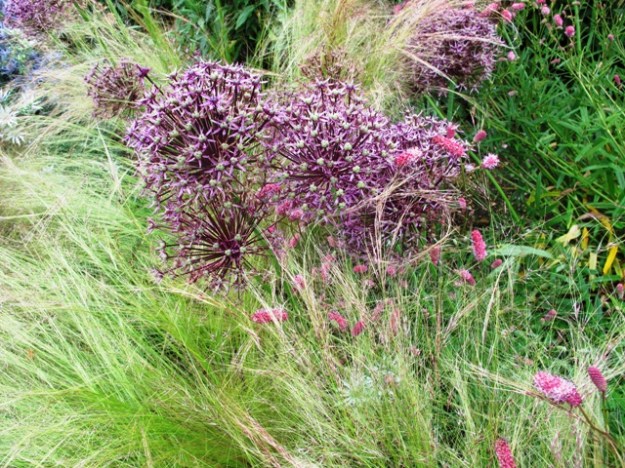
The shimmering Stipa tenuissima, seen here with alliums, but not a good choice for New Zealand where it has already been determined an invasive variety
The good news is that grasses are easily substituted and there are many excellent options which are not dangerously invasive. Some are even native to this country. We saw one garden making extensive use of a New Zealand chionocloa. The English have a love affair with Argentine pampas grass. Both Cortaderia selloana and jubata are on our banned list but we have a ready substitute in our native toe toe.
We are guilty of being a bit sniffy about grasses generally in the past. We put this down to the over-use of our native varieties in particularly stodgy and unimaginative amenity plantings from the 1980s onwards. What we learned is that it is how they are used that makes all the difference. Let them get some size and they add the dimension of movement to a garden in all but dead calm conditions. They also provide a superb foil to other plants, particularly larger flowering bulbs, annuals or perennials.

Rivers of a grass at Scampston – a little too conceptual for our gardening taste
Alas we did not think to start counting until quite late in our trip but I can tell you that the ratio of flowering perennials to grasses in the Oudolf river borders at Wisley was 3 to 1. However the Oudolf rivers of grass at Scampston were 0 to 1. That is to say there was only the one grass used and no perennials at all. We didn’t like it. It was contrived – part way between temporary show garden and motorway siding. A conceptual garden, perhaps? In contrast, the elegant grass garden at Bury Court was closer to a 1 to 8 ratio. The complexity of multiple different grasses and a scattering of flowering perennials gave much more visual interest and variation with movement.
Mostly we saw bold grasses of some size, integrated with other perennials in sunny conditions. Problems come when similar grasses are used in all herbaceous plantings. It can make them look very similar, as we realised after looking at a number of gardens. There is a school of thought that this is good because it unifies a garden but we have never subscribed to that belief. We will be choosing to keep the use of mixed grasses and perennials to one garden only, not repeated throughout. I also think the 3 to 1 ratio is quite low. We are more likely to go for maybe 5 flowering plants to each clump of a decorative grass. But then we prefer more detailed plantings.
Nowhere, dear reader, did we see tidy little grasses being used as tidy little edgings. I will be happy to see New Zealanders move on from the thinking that a row of tidy mondo grass, blue festuca or liriope will define a border nicely. I am afraid it will just make your garden look suburban and straitjacketed.
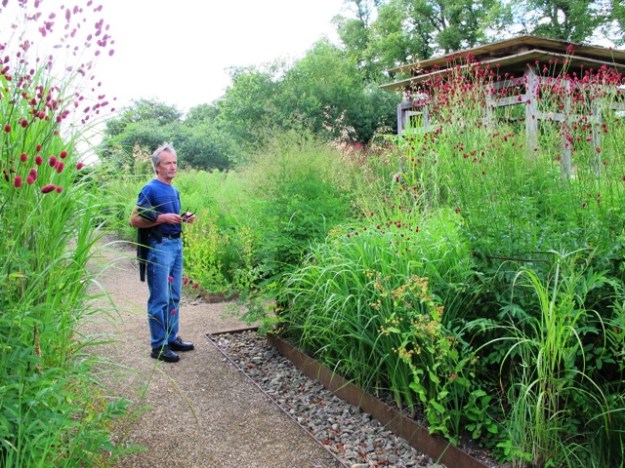
Mark, standing in the elegant grass garden at Bury Court
First published in the Waikato Times and reprinted here with their permission.
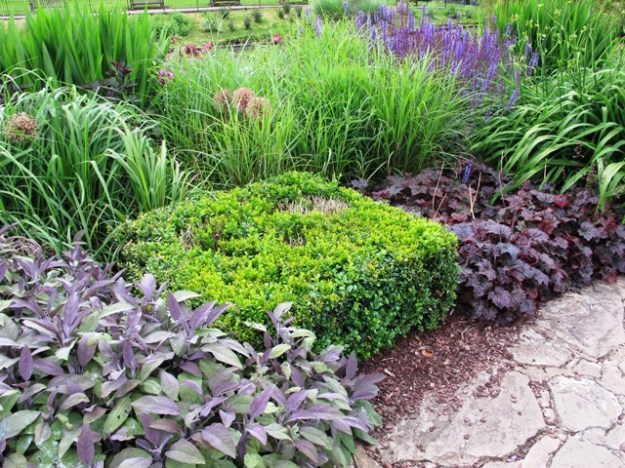 1) Confining planting to geometric blocks (Mondrian-style perhaps, for students of art), has been evident in show gardens in recent years but has now become mainstream. This is a new planting on Hampstead Heath, done by the public authorities. The sharp lines will blur over time. It is a shame about the buxus blight that is already evident. A different clipped shrub may have been a better choice.
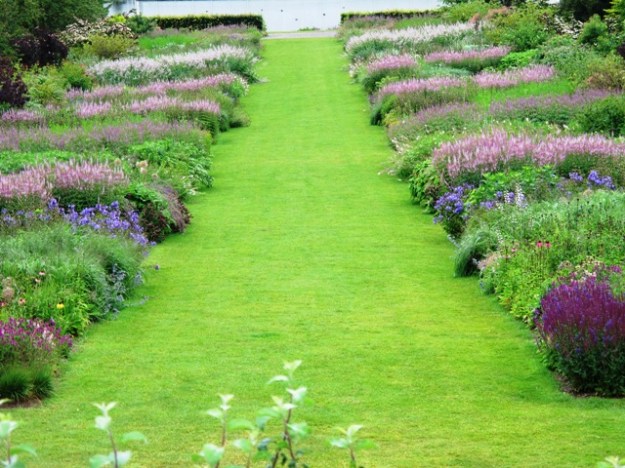 2) Piet Oudolf’s rivers of colour in the modern borders at Wisley have been controversial since they were planted in 2000, but we think they are glorious. They also take much less labour to maintain than the traditional twin herbaceous borders. Each ribbon of colour has about four different plants in it and the colours will change through the season. You need to be able to look up or look down on this type of planting (or both). Viewed on the flat, you would not see the diagonal effect.
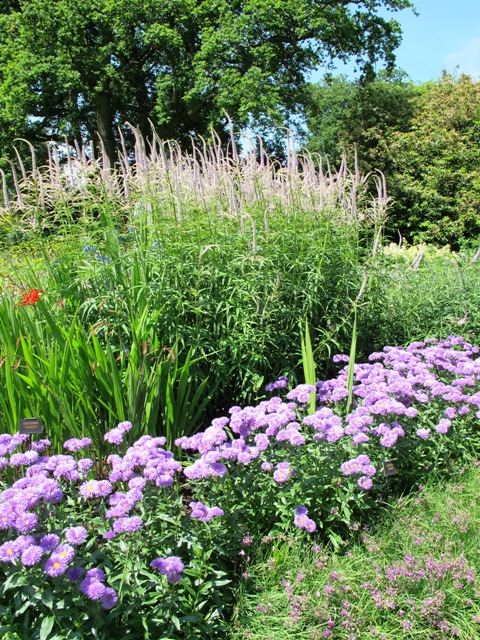 3) Less ambitious may be to snake a river of one perennial through clumping plantings. In this case it is an erigeron daisy but I have already done it in my own garden with irises (the blue sibirican ones and also Higo iris). A river effect alters the dynamic of big, round clumps of plants or can give some visual unity to an otherwise disorganised planting.
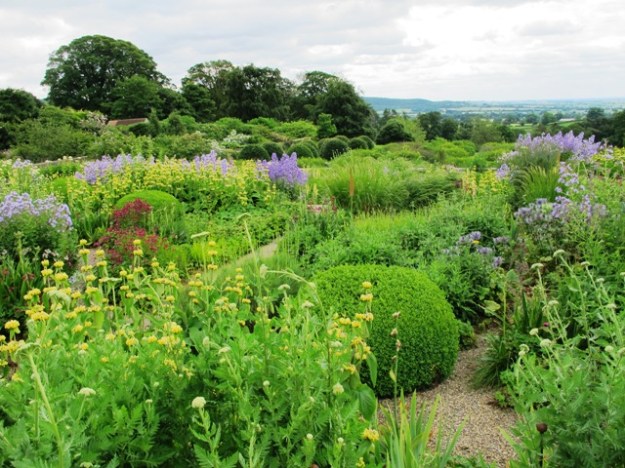 4) Big generous clumps of perennial plants, each standing in its own space, are one of the hallmarks of the New Perennials Style that has been widely adopted in modern UK and northern European gardens. This is a private garden, the work of British designer, Tom Stuart Smith. It takes a big area to carry out well. Each plant is occupying an area at least a metre across, sometimes more. Clipped shrubs act as punctuation points.
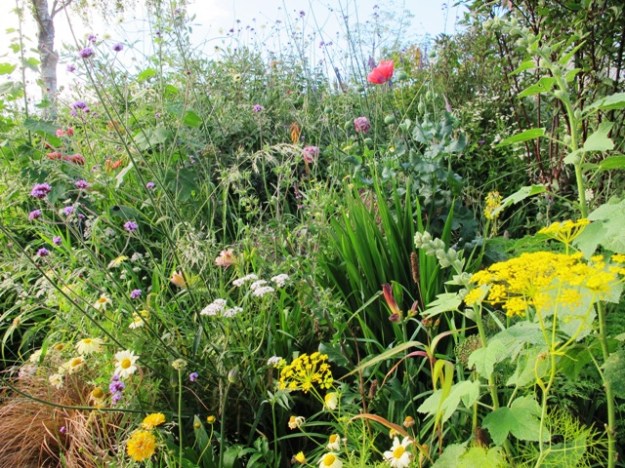 5) The classic cottage garden mix and match style is harder to manage than it looks if you are determined to keep both a succession of flowers and good coverage – to avoid bare patches – throughout the warmer months. This is in a Dorset garden owned by a good gardener. In lesser hands, it can become a hodge podge with bare bits and small plants of potted colour added in an effort to fill in the gaps.
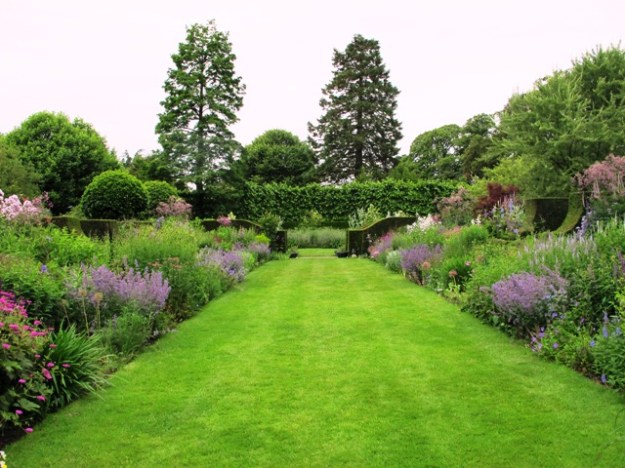 6) The classic twin herbaceous borders adapted to a more personalised, private garden (in this case Gresgarth, near Lancaster) by breaking up the expanse into shorter sections using clipped hedging in battlement style and strategic topiary. In line with modern expectations, planting is now deliberately colour-toned and separate sections allow the colour palettes to be kept apart. The effect is deliberately refined.
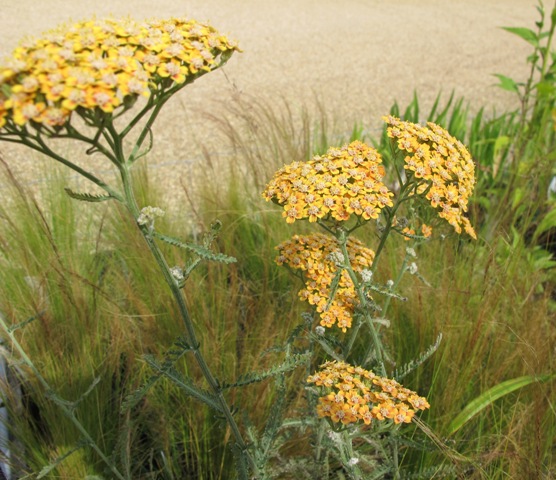 7) Grasses! Grasses! More grasses! And many meadows, let alone prairie plantings. No discussion about modern perennials is complete with referencing these major trends. These deserve attention in greater detail and are part of a bigger picture of focussing on more environmentally friendly approaches to gardening.