Tag Archives: Mark and Abbie Jury

The Giverny Experience – Monet’s Garden

The iconic bridge at Giverny is recognisable from many Monet paintings.

The iconic bridge at Giverny is recognisable from many Monet paintings.

In the world of gardening pilgrimages, Monet’s garden at Giverny rules supreme. His water lily paintings, the evocative scenes of irises, beds of summer flowers in the French countryside – could there be anything more romantic? Many were inspired, we know, from his personal garden. Surely in visiting, we will be able to absorb some of this magic? Maybe.

To get maximum enjoyment from the experience, it helps to be A Believer. But be humble. You will be but one believer amongst the half million who visit over the seven months of the year that the garden is open. That is over 2300 a day.
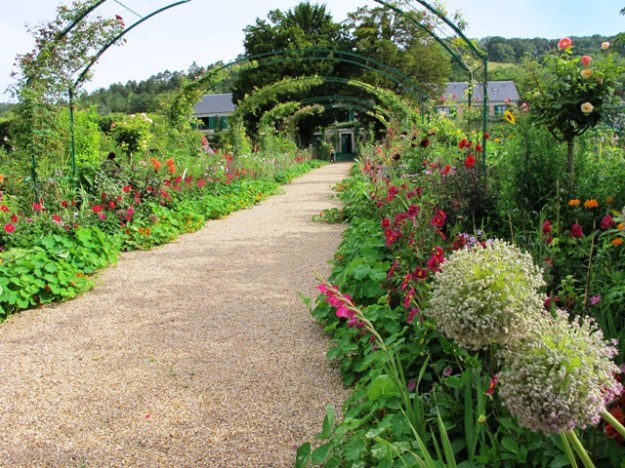
A rare sight - the garden not full of people

A rare sight – the garden not full of people

As we lined up for opening with our tickets pre-purchased on line, a phalanx of 95 Swiss bore down upon us in the tiny lane. We resolutely held our pole position and were directed left upon entry whereas they were headed right. This sent them to the water lily garden and us to the house gardens where we had the unusual experience of having the place entirely to ourselves for a few precious minutes. I even managed some photos without people in them but this state of affairs was not to last and soon equal numbers were pouring in from the top entrance too.
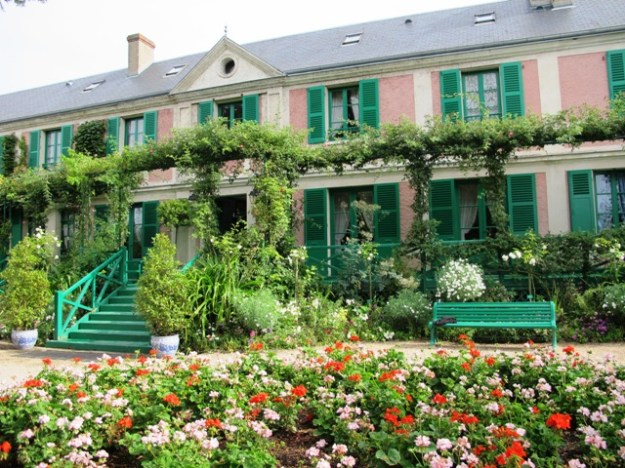
Entry to the garden includes entry to Monet’s house which is presented as it was in his day

Entry to the garden includes entry to Monet’s house which is presented as it was in his day

We had worked out that it may be wise to traverse the house interior early and so proved to be the case. Goodness knows how that poor house stands up to the beat-beat-beat of a million feet but it is an interesting place in terms of its interior decor and the art. The yellow dining room was pretty astonishing.

There is a very good collection of Japanese prints which were a source of inspiration to Monet, though the print count was exceeded by the number of Japanese visitors on the day we were there. Some fine examples of Impressionist art are on display but don’t expect originals. This is a re-creation of Monet’s house as it was in his day and so too are the paintings reproductions, albeit some good ones.
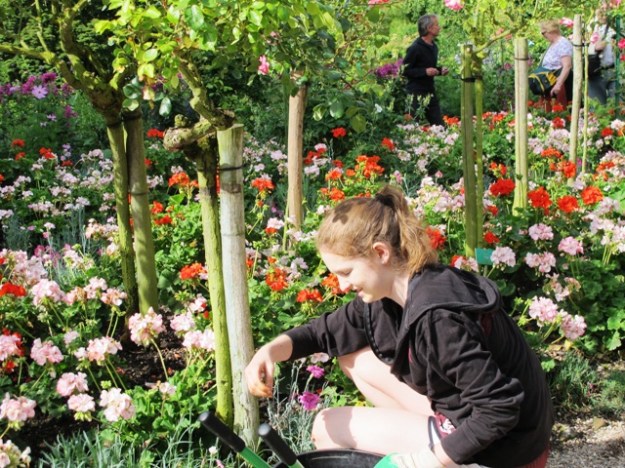
Almost Madonna-like in the garden, one of a small tribe of young women grooming the pelargoniums petal by petal

Almost Madonna-like in the garden, one of a small tribe of young women grooming the pelargoniums petal by petal

The garden? I probably have to whisper this, but if you are a keen and knowledgeable gardener, you may find it a little underwhelming. Monet is said to have taken inspiration for many of his paintings from the garden and to have played with colour to make it zing. Private gardens are private visions. Once they pass into public ownership, that dissipates over time and it has had 88 years to do so. In midsummer, there is a heavy emphasis on annuals and some “interesting” plant choices. We rather doubted that Monet would ever have gone for enormous, overblown modern dahlia hybrids. The flower gardens were reminiscent of English cottage garden style but with strong colours. And immaculately maintained. Hordes of gardeners were picking over the pelargonium florets to remove individual spoiled petals.

The water lily gardens were somewhat wilder and charming for that. There are two Monet bridges there but smaller in scale than they appear in his paintings. The mistake is to expect the gardens to reproduce the paintings in real life. They were an inspiration for an Impressionist artist, never a detailed representation of what he saw before him.

About the coaches... just a few and yes, some of these are parked two deep

About the coaches… just a few and yes, some of these are parked two deep

It is the whole Giverny package that makes it a special experience. If you simply arrive on a coach tour, shuffle around the garden, then the house followed by the gift shop before boarding your coach for the next attraction, you may secretly wonder what the fuss is all about. It is different if you make the time to stay.

We spent two nights in Giverny, staying in a rustic mill house B&B. This gave us time to walk the streets, to bike the countryside and to soak up the romance which still lies below the tourist machine. The first night we dined at the historic Restaurant Baudy which is reputedly largely unchanged from the days when Monet and his friends used to patronise it. The garden out the back was dishevelled and had no plant interest but was utterly romantic in the way we associate with the French.

On the second day we pedalled the 5km to nearby Vernon, along a flat cycle way. “Bonjour,” all the oncoming cyclists and pedestrians called and we replied in kind. We found that it is possible to buy a perfectly acceptable bottle of plonk at the supermarket for €2.50. That evening we had the table d’hote offered at our B&B – freshly cooked local fare eaten al fresco where we talked broken French and some English with our hosts and their friend.

There is still huge charm to be found in Giverny but Monet’s garden, despite all the history and the hype, is only one part of that.
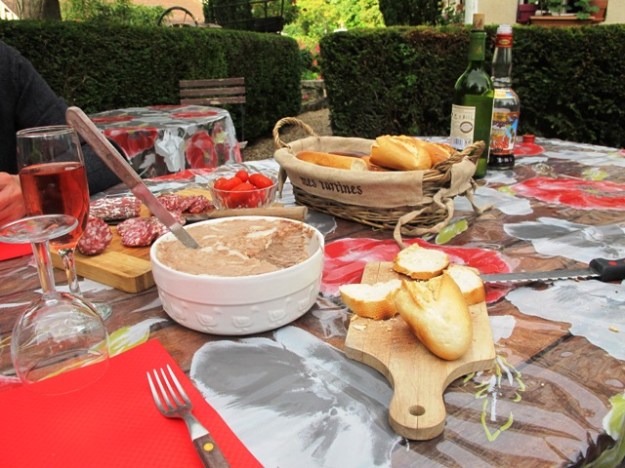
The table d’hote dinner at our bed and breakfast was home-cooked rustic fare and particularly delicious

The table d’hote dinner at our bed and breakfast was home-cooked rustic fare and particularly delicious

Monet’s Garden is open daily from 9.30am to 6.00pm from April 1 to November 1. Further details on all matters related to visiting the garden, transport, accommodation, the village and surrounding areas can be found on http://giverny.org/ Tickets to Monet’s garden cost €10.20 and can be purchased on line through this site.

Giverny is reached easily from either Paris or Rouen. The train journey from Gare St Lazare in Paris to the nearest station at Vernon takes 50 minutes and costs €14.30 each way.

We stayed in an impossibly romantic converted mill house, Moulin des Chennevieres in the village of Giverny paying €90 per night double for bed and breakfast.


First published in the Sunday Star Times.
The October Garden

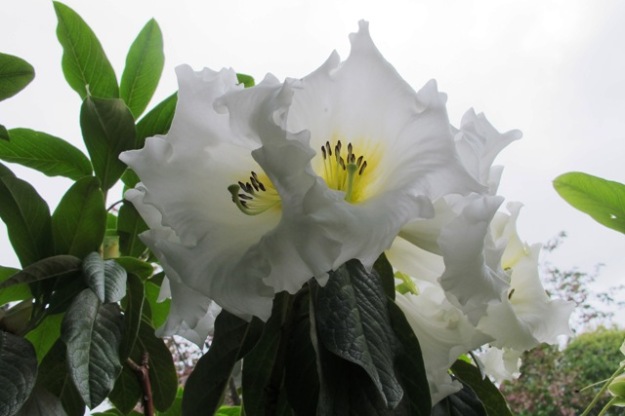
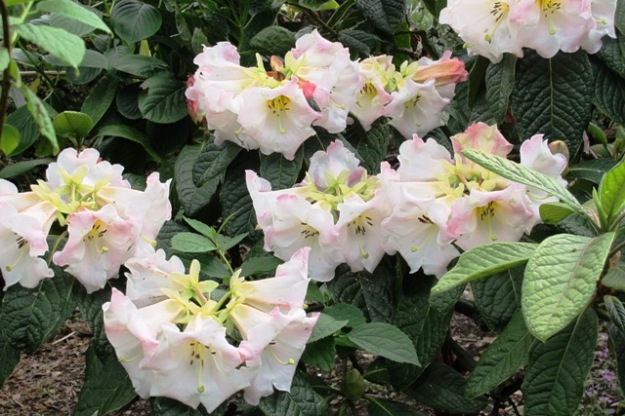
The glory of the sino nuttallii rhododendrons

The glory of the sino nuttallii rhododendrons

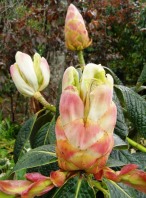
Floral Legacy in bud

Floral Legacy in bud

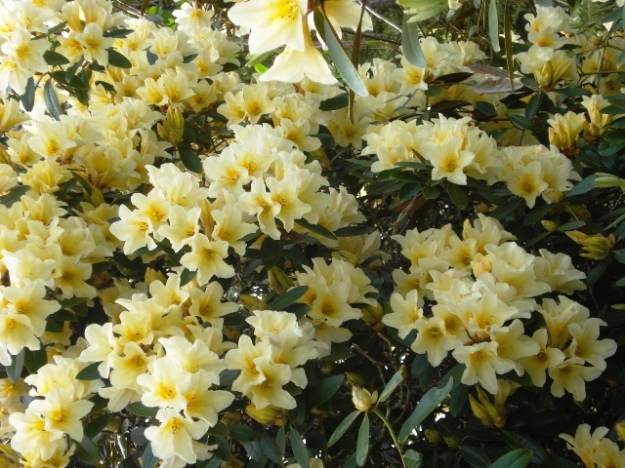
Rhododendons may no longer be the elite fashion item they were for so many decades, but we still love them.

When we started in the plant business back in the early 80s, rhododendrons were a hot ticket item. We were but one of several rhododendron nurseries in Taranaki and to survive, we needed to find our own niche. To this end, we grew a different range, specialising in varieties that would perform well in warmer climates – like Auckland. After all, even back then, one in four New Zealanders lived in greater Auckland and we figured that if we were going to sell them rhododendrons, we might as well sell them ones that would do better for them. Mark’s father just happened to have done some breeding to find varieties that were more resistant to thrips, didn’t get that burned and crispy edging to their foliage and were predominantly fragrant as well as floriferous. It gave us a good place to start.

Nowadays there are no specialist rhododendron growers in Taranaki at all and the demand has melted away. I no longer have to try and convince people that not all rhododendrons have a big full truss in the shape of a ball but many have loose trumpets in curtains of bloom instead.

Rhododendrons are one of the backbones of our garden and we wouldn’t have it any other way. While they have a relatively short season in full bloom, the anticipation of fattening buds stretches out the weeks with the promise of delights to come. They are as fine a shrub as any we grow here and a great deal more spectacular than most.

The nuttalliis! Oh the nuttalliis!

The nuttalliis! Oh the nuttalliis!

The nuttalliis. Oh the nuttalliis. Peak nuttallii season doesn’t start until closer to the end of the month, taking us into November but some varieties have already done their dash for this year. If we could grow only one type of rhododendron, we’d choose a nuttallii and even more specifically, the sino nuttallii from China. You can keep your big red rhodos (most people’s favourite pick). We love the fragrant, long, white trumpets which look as if they are made from waxed fabric, the lovely peeling bark and the heavy textured foliage. These are rarely offered commercially now so grab one if you ever find it for sale.

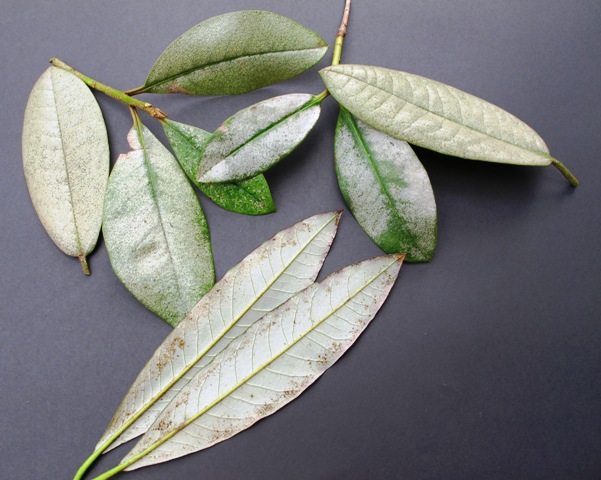
Thrips!

Thrips!

It is, by the way, nasty little leaf-sucking thrips that turn foliage silver and no, you can never turn those silver leaves green again. If you look at the underside of the leaf, you can see dark thread-like marks – these are the critters that do the damage. All you can do is to try and prevent the new season’s growth from getting similarly infested. We are not at all keen on spraying insecticide these days and you need a systemic insecticide that the plant absorbs into its system to get a thorough kill. If you must go down this path, spray in mid November, early January and late February for maximum effect. Others praise Neem oil instead but we haven’t tried it.

We favour choosing more thrip-resistant varieties, keeping them growing strongly and opening up around them to let more air and light in. Thrips prefer shade and shelter. Unless it is really
special, if it is badly thrip-prone, we replace it with a better variety. Not every plant is precious.

In the longer term, plants come and go in the fashion stakes. Goodness, even red hot pokers are having a resurgence of popularity. We don’t worry about the fashion status of the rhododendron and Mark continues hybridising for better performing cultivars. If there is no commercial market for the results, it doesn’t matter. We will continue to enjoy them in our own garden.

First published in the New Zealand Gardener and reprinted here with their permission.

Rhododendron Barbara Jury - one of Felix's  hybrids

Rhododendron Barbara Jury – one of Felix’s hybrids

The Splendour of the Tree by Noel Kingsbury

58195Despite the subtitle, An Illustrated History, this handsome book is more for the coffee table than a library reference. The selection of trees – and there are about 100 different tree species, each given at least a double page spread, sometimes more – is a little too random and eclectic to make this useful as a reference book. It is more testimony to a love affair than a work of scholarship.

The entries are put into six categories – antiquity (trees with very long histories including gingko and magnolia), ecology (such as the swamp cypress or Taxodium distichum), sacred, utility, food and ornament. Sometimes the tree species is generalised. The Japanese cherry is described as ‘Prunus x yedoensis and related varieties’ which is pretty broad. Yet the magnolia entry is limited to just one species, M. sprengeri. I was perhaps a little surprised to see the jacaranda missing from the section on ornamental trees given the international focus. But any selection is going to be arbitrary when the world of trees is to be narrowed down to 100.

The photography is beautiful at first glance, with many full page spreads. Some are magnificent images but not all. At times the field of focus is not sharp throughout. The selection of image is sometimes more about looking good than being helpful. The carob tree, for example, has a full page shot of a carob bean only which is in sharp focus on the bean itself but blurred top and bottom. The appearance of the tree itself remains a mystery.

The text is engaging and filled with some wonderfully random, fascinating pieces of information. While one can be picky (well, I can be picky I admit), in the context of a handsome coffee table book, it is unreasonable to expect the rigour of a work of scholarship. In terms of an interesting and rewarding browsing experience, it delivers well.

The high quality, large format, hard-covered coffee table garden book has all but disappeared in this country so it will come as no surprise that this is an English production. In fact, Mark met the author briefly when we were over there last June.

The Splendour of the Tree by Noel Kingsbury, photography by Andrea Jones. (Frances Lincoln; ISBN: 9780711235809).

First published by the Waikato Times and reprinted here with their permission.

Plant Collector: Magnolia Iolanthe

The inimitable Magnolia Iolanthe

The inimitable Magnolia Iolanthe

I cannot let the season pass without celebrating magnolias. At this time of the year we live and breathe these flowering trees and the settled weather has meant a particularly good season this year. Not all of them get as large as this glorious specimen of ‘Iolanthe’. In this country, it is a lucky tree that is permitted to survive into its sixth decade without being unceremoniously severed from its roots.

Iolanthe was the product of Felix Jury’s first attempts to hybridise magnolias. He was looking for larger blooms with good colour. Certainly the bloom is still exceptional with its large cup and saucer form. The colour has been criticised for its lavender hue, but I can tell you that it remains spectacular. Because it sets flower buds down the stem, it has one of the longest season of any of our many magnolias here. Some only set buds on the tips where they all come out at once. As soon as they pass over – or if they are hit by strong wind, heavy rain or frost – that is it for the year as far as floral display goes. Not so with Iolanthe. Twice we have seen the display turned to mush by extraordinary frost events but a few days later, a fresh flush of blooms has opened and the display is back. From first to last spring bloom, we get about two months of flowering, of which maybe three weeks is full glory. It repeat flowers in summer, though as the tree is then in full leaf, it is nowhere near as showy or prolific – more a bonus than a mainstay.

Iolanthe and Serene are the only plants for which Felix ever received external payment. We recall this because it was in our early married days when we were impoverished students. He gave the fee of a couple of hundred dollars to Mark. It was not the sort of event one ever forgets.
???????????????????????????????
First published in the Waikato Times and reprinted here with their permission.

Floral Skypaper – the garden in August

Magnolia Felix Jury

Magnolia Felix Jury

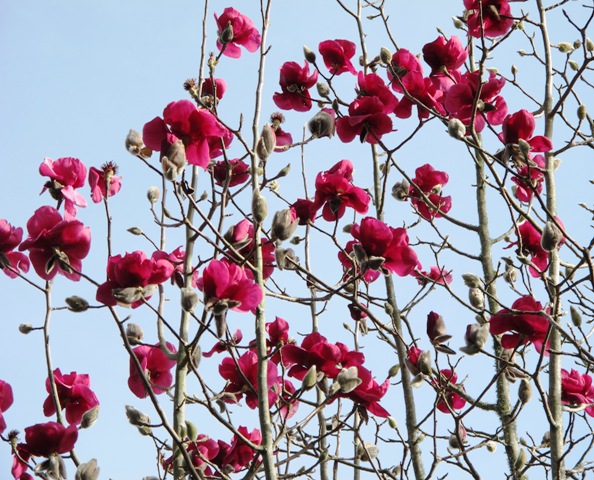
Not for us the refinement of declaring we garden for foliage and form. Give us floral extravaganza, we say, and August obliges. In the deciduous magnolias, it is the reds that dominate. By the end of the month and well into September, the softer pinks and whites come into their own but at the start, we have an unrivalled display of the stronger colours which just gets better every year as the trees get ever larger. Floral sky-paper, I call it when looking up from below. I say it is an unrivalled display because nowhere else in the world gets the same intensity of red in these magnolia, nor have they done the breeding on them that has been done in this country over the past 40 years. First Felix Jury, now Mark Jury and also Vance Hooper have pushed the boundaries with the reds. Mark was very pleased to find recently that Britain’s Royal Horticultural Society has given an Award of Garden Merit to the magnolia he bred and named for his father, ‘Felix Jury’. While we admit to being biased, it still takes our breath away each season.

Mark's new 'Fairy Magnolia White'

Mark’s new ‘Fairy Magnolia White’

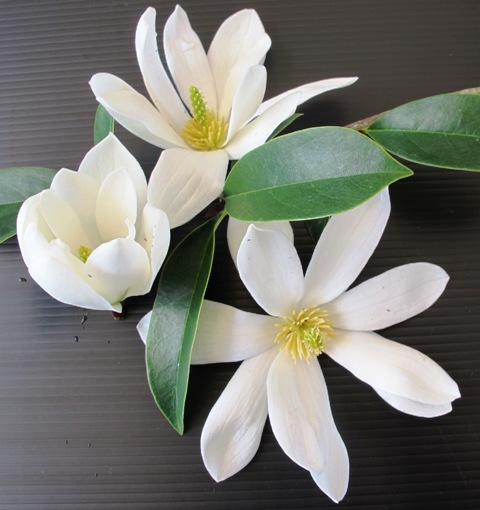
It is also michelia time – or as they have been reclassified botanically, magnolias. Do not confuse them with the evergreen grandiflora magnolias which are the summer flowering trees with big, glossy, leathery leaves. I admit we still call them michelias in conversation or we go with the “Fairy Magnolia” branding that has been placed on Mark’s new cultivars. Because michelias flower with their leaves, they are not as individually spectacular as the deciduous magnolias but they are a wonderful addition to the spring garden.

Mark has been breeding michelias for coming up to two decades now and we have many hundreds, maybe over 1000 of them, planted around our property. Out of all those, he has only named and released three so far. Fairy Magnolia White is the earliest of the season to open and has the loveliest star flower as well as being strongly fragrant. There is a purity in such white flowers, especially when contrasted with deep green foliage and wonderful velvet brown buds. One of the breeding advances has been to eliminate the tendency of some cultivars to drop their leaves and defoliate after flowering. Readers with Michelia doltsopa ‘Silver Clouds’ may recognise this trait.

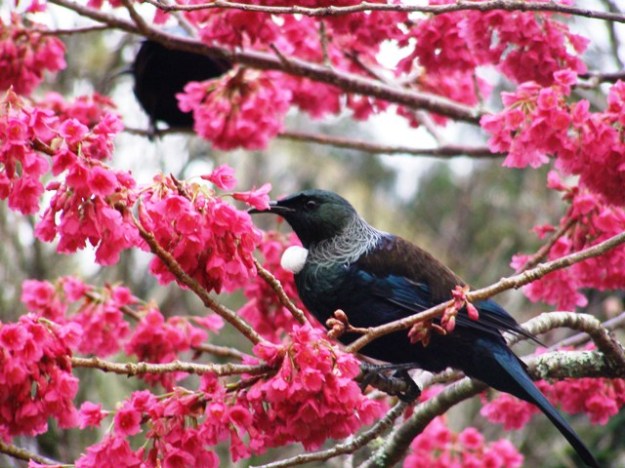
???????????????????????????????Nothing excites the tui more than the Prunus campanulata. These are somewhat controversial, especially in warm northern areas, because too many of them set seed freely, threatening to become noxious weeds. Both the tui and we would be grieved to see all campanulatas banned, though we are vigilant weeders on the germinating seed. We have a number of different trees that come into flower in sequence and we can have literally scores of fiercely territorial tui bickering and fighting in these trees as they try and claim their feeding space. There are times it can appear as if the trees are dancing with the tui.
Until a whole lot more work is done on selecting and marketing sterile forms of campanulatas (in other words, they don’t set viable seed so will never become weedy), if you live in Northland, Auckland, Waikato, Bay of Plenty, Marlborough or the West Coast, where regional councils are understandably touchy on this topic, look for Prunus Pink Clouds or Prunus Mimosa which are sterile options.
???????????????????????????????
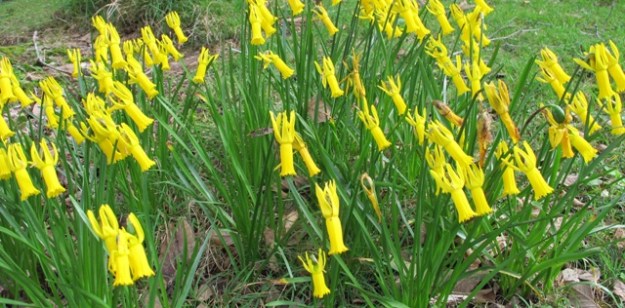
From the big to the small – narcissi season is in full swing here. The little pictures they create give wonderful detail in a big garden. We have such a problem with narcissi fly that we struggle with the later flowering hybrids which comprise most of what is sold through garden centres (commonly called daffodils). The dwarf forms tend to flower earlier so they are over and going dormant when the narcissi fly are on the wing later in spring. The little cyclamineus ones, with their swept back skirts, seem to have a look of perpetual surprise. We are delighted with how well they are naturalising on our grassy banks where conditions are harder than in cultivated garden areas.
???????????????????????????????
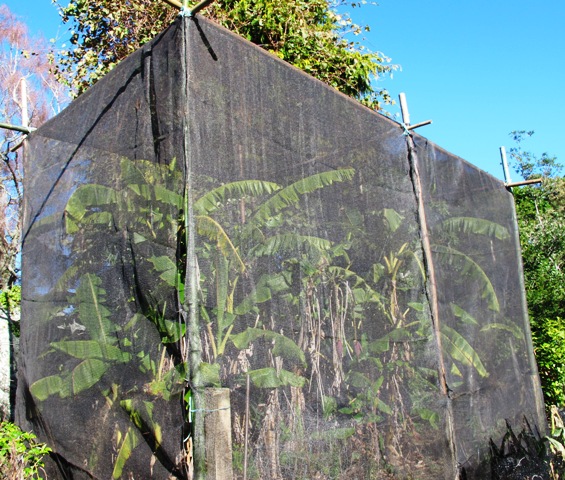
We looked enviously at Russell Fransham’s magnificent bananas in the June issue.
They are a pretty marginal crop this far south and as we live 5 km from the coast, we have to take extra care and cover them in winter. We do this with giant bamboo frames and old shade cloth. A bunch of 50 is a triumph for us so we were in awe of Russell’s 200. We won’t remove the covers from ours until later in spring, just to be on the safe side. I call these constructions here the Theatre of the Banana.

First published in the August issue of New Zealand Gardener and reprinted here with their permission.