
To the left has been “beautified”. To the right are the 60 year old trees to be clear-felled for more such “beautification”
“Imagine if trees gave off wi-fi signals, we’d be planting so many trees and we would probably save the planet too. Too bad they only produce the oxygen we breathe.” So runs the meme that swept social media recently. Truly we despair here at how hard it is to keep established trees and how ready are so many people to take the chainsaw to them.
Perhaps it is due to our recent pioneer history that we have failed to develop a reverence for big trees. That, and the fact that our houses are notoriously cold in winter and we want every bit of sun and warmth we can get.
There is no argument that large trees in suburban settings can be a problem for residents, especially as sections get ever smaller. That is why we have always advocated for trees in public areas where they have the space to reach maturity and to give grace to our environment. All power to council arborists and parks staff who are tasked with looking after such vegetative assets. For assets they are, although not in a financial sense. A tree can be chainsawed down in a morning but it may have taken a very long time for it to ever attain stature.

What would Cambridge be like without its street trees like these on Taylor Street (Photo: Michael Jeans)
Leave it to the populace – the ignorati – and we would have nothing taller than 3 metres and older than 20 years in urban settings. Can you imagine the main streets of Cambridge without the trees? I do not know the history of those trees but it is a fair bet that there have been efforts by some people over time to take the chainsaw to them. Thank goodness those tasked with the civic environment have stood firm for, without those trees, Cambridge would just be like any other unmemorable small town in New Zealand.
There is no doubt that trees can make a mess. It is called the cycle of nature. Do they make a bigger mess than humans? Would we rather live in paved, concrete wastelands to avoid the leaf drop, the seed dispersal, the spent flowers, birds’ nests and occasional fallen branches?

Imagine the lake scene at Te Ko Utu in Cambridge Domain without big trees (Photo: Michael Jeans)
I write from the heart. We are truly distressed because it appears that we have lost a local battle to save the row of handsome pohutukawa that line the Waitara riverbank. They are sixty years old, just achieving the beauty and stature of established trees, but they are to be clear felled.
“Those trees are past their use-by date.” Ah, no. Pohutukawa have no use-by date. They are a very long-lived tree. “We don’t want them getting too big.” “They are messy.” The fact that they are in a position where they do not shade any buildings and their natural fall of litter does not affect any private property is irrelevant to these folk. “They are not native to this area.” That argument is specious. Not only is the natural occurrence of pohutukawa a mere 10km north of here, but these same folk will think nothing of replacing them with a golden robinia or flowering cherry.
In a battle of jurisdiction between local authorities, where power has been vested in an engineer, the good burghers of our local community board have reportedly been out asking people: “Do you want to keep the trees or do you want the area beautified?” That is a Tui billboard moment.
There is no way to reason with people who see no merit in trees. There’s none so blind as those who will not see and minds have been made up. To such people, trees are completely expendable and of no beauty. They will be long dead before any replacement plants can reach maturity and in the interim there will be decades of a windswept, bare riverbank. It will have an expensive boardwalk and some seats painted sky blue, however, for beauty and history lie only in man-made objects. We could weep.
This is not a story unique to our area. It is repeated often up and down the country in some form or other. Trees need human protection if they are to hold the chainsaw massacre brigade at bay.
First published in the Waikato Times and reprinted here with their permission.
POSTSCRIPT
I see back at the start of 2007, I wrote about these trees in the Taranaki Daily News, saying: “Waitara would be a bleak little town without these splendid trees.”
These trees were planted to hide the ugly sight of the old freezing works. Unfortunately the trees are to be removed but the arse-end of the freezing works will remain. This is, apparently, “beautifying the area”.


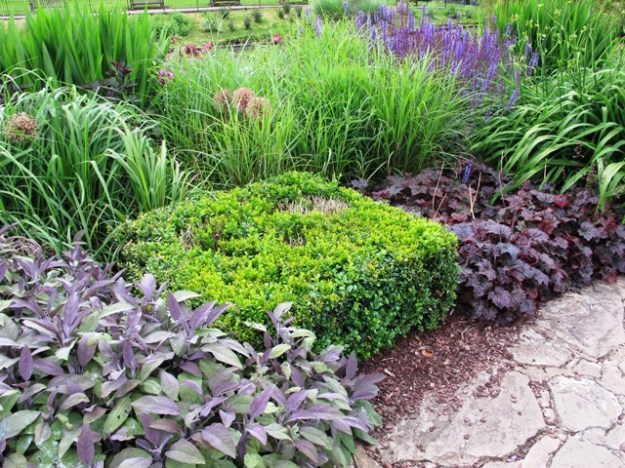 1) Confining planting to geometric blocks (Mondrian-style perhaps, for students of art), has been evident in show gardens in recent years but has now become mainstream. This is a new planting on Hampstead Heath, done by the public authorities. The sharp lines will blur over time. It is a shame about the buxus blight that is already evident. A different clipped shrub may have been a better choice.
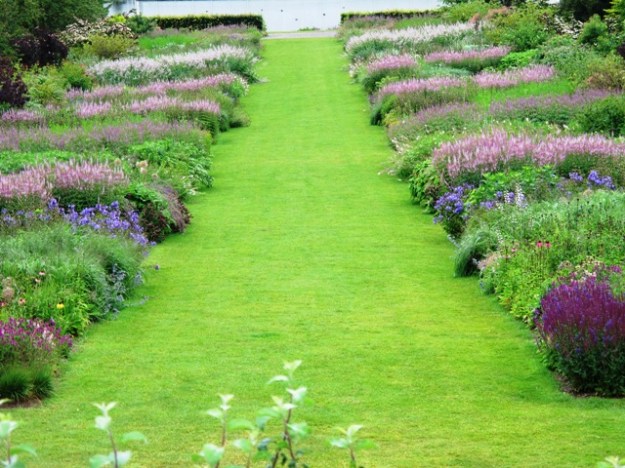 2) Piet Oudolf’s rivers of colour in the modern borders at Wisley have been controversial since they were planted in 2000, but we think they are glorious. They also take much less labour to maintain than the traditional twin herbaceous borders. Each ribbon of colour has about four different plants in it and the colours will change through the season. You need to be able to look up or look down on this type of planting (or both). Viewed on the flat, you would not see the diagonal effect.
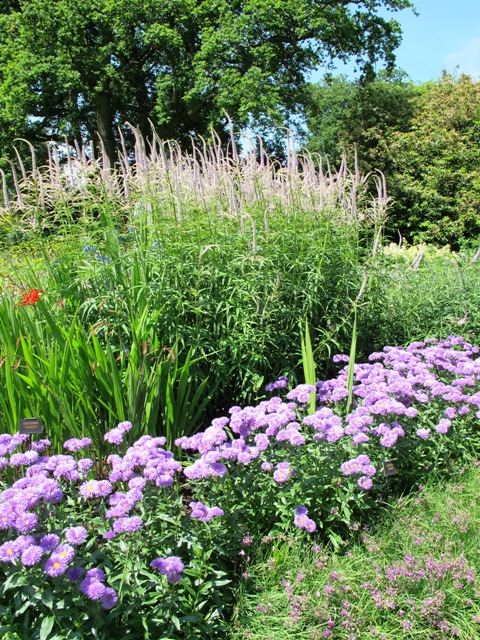 3) Less ambitious may be to snake a river of one perennial through clumping plantings. In this case it is an erigeron daisy but I have already done it in my own garden with irises (the blue sibirican ones and also Higo iris). A river effect alters the dynamic of big, round clumps of plants or can give some visual unity to an otherwise disorganised planting.
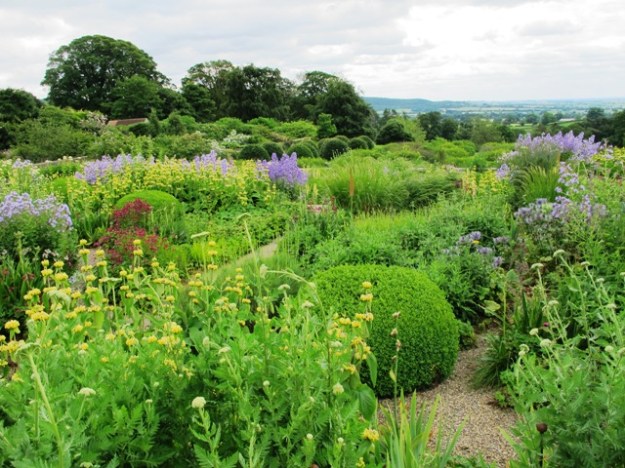 4) Big generous clumps of perennial plants, each standing in its own space, are one of the hallmarks of the New Perennials Style that has been widely adopted in modern UK and northern European gardens. This is a private garden, the work of British designer, Tom Stuart Smith. It takes a big area to carry out well. Each plant is occupying an area at least a metre across, sometimes more. Clipped shrubs act as punctuation points.
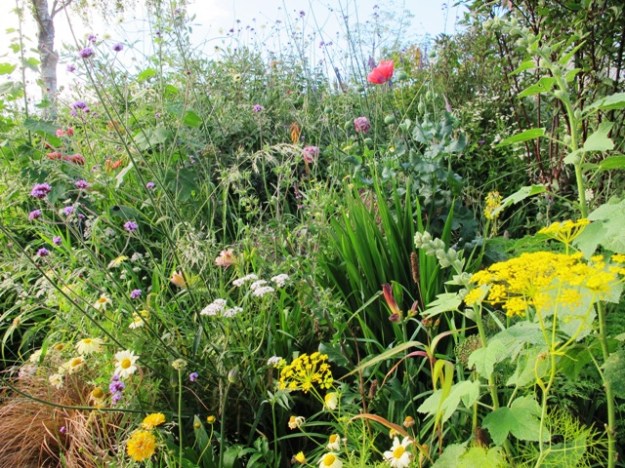 5) The classic cottage garden mix and match style is harder to manage than it looks if you are determined to keep both a succession of flowers and good coverage – to avoid bare patches – throughout the warmer months. This is in a Dorset garden owned by a good gardener. In lesser hands, it can become a hodge podge with bare bits and small plants of potted colour added in an effort to fill in the gaps.
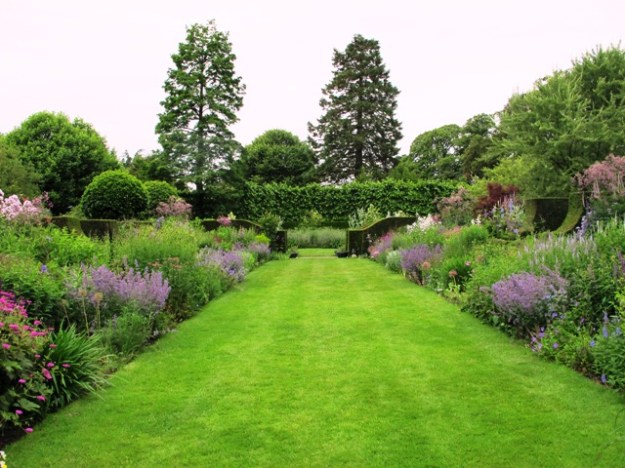 6) The classic twin herbaceous borders adapted to a more personalised, private garden (in this case Gresgarth, near Lancaster) by breaking up the expanse into shorter sections using clipped hedging in battlement style and strategic topiary. In line with modern expectations, planting is now deliberately colour-toned and separate sections allow the colour palettes to be kept apart. The effect is deliberately refined.
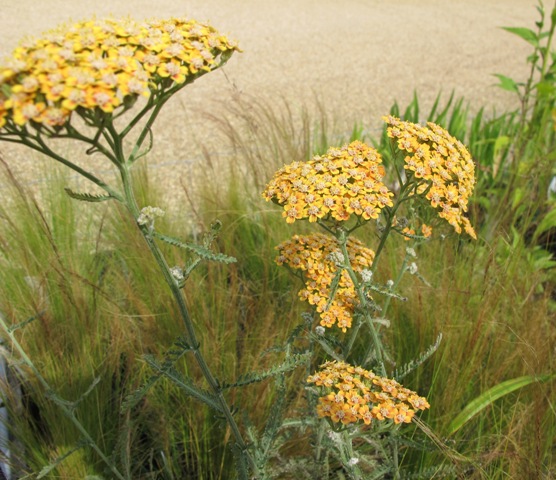 7) Grasses! Grasses! More grasses! And many meadows, let alone prairie plantings. No discussion about modern perennials is complete with referencing these major trends. These deserve attention in greater detail and are part of a bigger picture of focussing on more environmentally friendly approaches to gardening.
 Garden Lore
 Tikorangi The Jury Garden