Tag Archives: Mark and Abbie Jury

The Yellow Magnolias and Honey Tulip

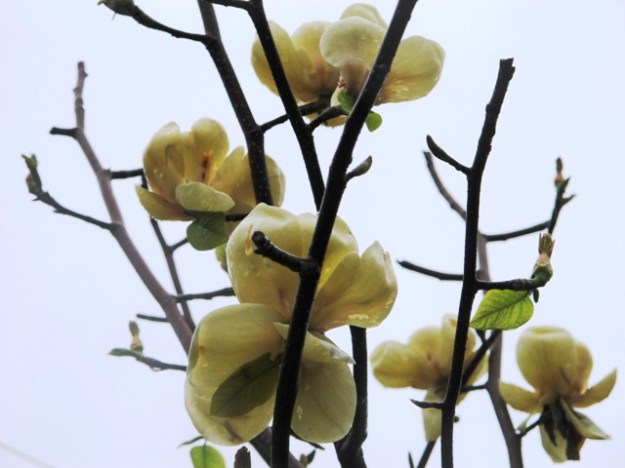
Honey Tulip - looking very good this week

Honey Tulip – looking very good this week

There is some relief here this week as our newest magnolia, Honey Tulip, is looking particularly good. It is always a bit nerve wracking releasing a new cultivar on the market and hoping we have it right.

We are still a little bemused by a communication from some random person when Honey Tulip was first shown in an overseas publication. I will have to paraphrase it because I must have deleted it in irritation at the time, but it said something along the lines of: “It is good that Mark Jury is discerning in the magnolias he names, but the world has enough yellow magnolias already….” It then proceeded to instruct my Mark on what he should be breeding for instead.

The international world of magnolias is pretty small, the number of international magnolia breeders even fewer. We know most of them by repute, if not personally. This email did not come from anyone we had heard of before. What was galling was that in the heady world of new magnolias, Honey Tulip represents a genuine step in flower form for the yellows.

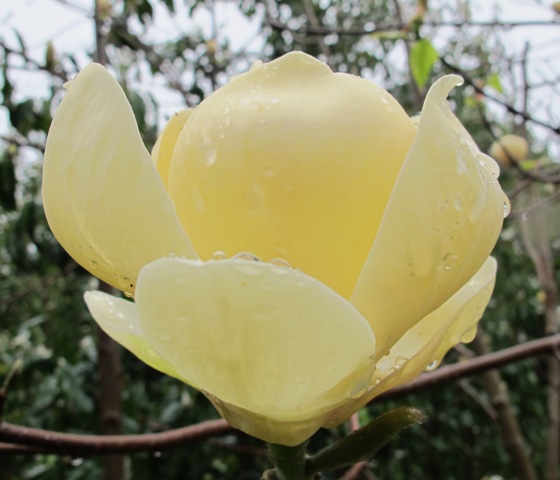
Honey Tulip - a lucky break in flower form and performance

Honey Tulip – a lucky break in flower form and performance

The yellow magnolias descend from a single species and while most magnolias originate from parts of Asia, the yellow deciduous M. acuminata and the evergreen grandiflora magnolias are from USA. M. acuminata is from eastern USA up into southern Ontario in Canada. We can remember when it first came into this country maybe 25 years ago, along with four of the earliest yellow hybrids – Yellow Bird, Yellow Fever, Elizabeth and Koban Dori. They were a collector’s novelty. Who knew that magnolia flowers could be yellow?

It did not take that long to realise that the yellow magnolias were not quite like the big pink, red, purple and white ones. There are a few problems yet to be solved. M. acuminata itself grows very rapidly and very large which takes it beyond the size most gardens can accommodate. The flowers are small, very small by magnolia standards, though they have good fragrance. Mind you, it has to be a very strong scent to mean anything when the blooms are 20 metres up above.

However, the biggest problem with acuminata and most of the hybrids is that the flowers come so late in the season that they coincide with the new foliage which then hides them. We are of the opinion that the whole point of a deciduous magnolia is to have all those fat, furry buds exploding into a mass of blooms on a bare tree in late winter and early spring. So little flowers, no matter what colour, obscured by masses of fresh foliage, are not going to set the world on fire.

Magnolia Yellow Fever planted on our road boundary

Magnolia Yellow Fever planted on our road boundary

We have not kept buying the many new yellow hybrids that have come on the market. There is a limit to how much space we have and too many of them show the same flaws. In a large garden, the best performer we have seen so far remains the early American hybrid with the unfortunate name of Yellow Fever. It is not the strongest yellow but it does flower on bare wood and is a pretty primrose, unlike Elizabeth which is more cream.

There is yellow form of the Asian M. denudata but we have not heard of it being imported to this country yet and have not seen it in person. It is difficult to judge colour from the range of hues shown on the internet. A form called ‘Yellow River’ is being sold overseas but the nature of its breeding and origin is unclear. Certainly it came out of China and it has denudata origins but whether it is a yellow sport of that species, a natural hybrid or a controlled cross seems unclear. Even less clear is when or if it will become available in this country. Only time will tell whether international breeders get the jump on different yellow magnolias using denudata yellow, with or without acuminata.

For all these reasons, our Honey Tulip represented a significant breeding step. It flowers on bare wood, before the foliage. It does not appear that it is going to be of timber tree stature. The colour is a pretty butterscotch but the big breakthrough is the form. While not huge flowers, the tulip shaped blooms are larger than most other yellows – very similar in fact to a soft yellow form of Magnolia Black Tulip. It was also a lucky break because it was the only one of the plants from that particular cross that flowered in that form and colour.

The ultimate challenge is to get a pretty yellow Iolanthe with big cup and saucer flowers. Mark has about 20 years left in him to work towards this goal. I wonder then if the overseas critic who saw himself as an expert on yellow magnolias will concede that there is always room for improvement.

The ultimate breeding challenge - is a yellow Iolanthe even possible?

The ultimate breeding challenge – is a yellow Iolanthe even possible?

First published in the Waikato Times and reprinted here with their permission.
Pruning and shaping

Ulmus Jacqueline Hillier after pruning. For the avoidance of confusion, this plant is only 3m by 3m, not a forest giant.

Ulmus Jacqueline Hillier after pruning. For the avoidance of confusion, this plant is only 3m by 3m, not a forest giant.

I am married to a master pruner. I recognise his skills are hugely greater than mine. This was reinforced when he pruned the Ulmus Jacqueline Hillier at the weekend. This plant is meant to be a dwarf but it is looking less and less dwarf-like in our rockery and needs attention most years to keep it to a suitable size for that location.

At the end of the better part of half a day, he asked me how I thought it looked. In fact it looked very similar to how it had looked when he started. It is a plant with a lovely characterful shape and fan like sprays which hold the tiny leaves. There was close to as much lying cut off on the lawn as there was left on the shrub but you would not pick that. It had been reduced considerably in size and scale but had lost none of its form or shape. That is good pruning, dear Readers, as opposed to the butchery carried out by lesser mortals.

There was almost as much on the ground as left on the plant but you could not tell that by looking.

There was almost as much on the ground as left on the plant but you could not tell that by looking.

Such dedicated and meticulous pruning takes time, skill and sharp hand tools.

We joined a garden tour in the north of Italy some years ago and anyone who has visited those grand Italian gardens will know that most are clipped and shaped to within an inch of their lives. In fact they are so heavily clipped and groomed that plant health is often not that great. It is all about form and shape and very labour intensive.

Similarly, we have looked at the meticulous bonsai specimens in the Chinese gardens in Singapore. These are tended constantly by people with nail scissors, I kid you not. It may not be nail scissors exactly, but they were definitely nipping and snipping with scissors of some description. Surgical precision and detail. Again, labour intensive.

We lack the personpower here to carry out that sort of heavy clipping and shaping. Oh, to have a small army of serfs that we could upskill and then reward with a hovel in which to live and the occasional sack of spuds. But even then, we would not want a heavily contrived and clipped garden, preferring instead to go with some degree of natural harmony. It is all about degrees, however. Gardening involves a whole lot of management and manipulation to get desired effects.

Once the initial shaping and training is done, it does not take huge skill to maintain it. These are just camellias used as shapes in the garden.

Once the initial shaping and training is done, it does not take huge skill to maintain it. These are just camellias used as shapes in the garden.

Getting the initial shaping on plants is the skill, or bringing an over-sized specimen back to a more manageable size and shape. Once it is done, it only takes a moderate level of skill and care to maintain it.

I have watched Mark bring a wayward plant into line and that is why I am happy to concede his skills are so much greater than mine. He takes his time and he concentrates. He is up and down the ladder repeatedly (despite this playing havoc with a dodgy knee joint), viewing the plant from all angles at all stages. Major cuts are very carefully considered because you can’t glue a branch back on if you make a mistake. It is all about finding the natural shapes within the plant and highlighting those.

Frankly, it would often be faster to cut a plant out, even if it then involves major work removing stumps and roots. But if one forever removes plants when they get some size and maturity, then there is never a chance for them to develop character and the garden will remain perpetually juvenile.

All this comes back to the fact that we use plants as features and focal points in our garden, not ornaments. We prefer to clip a strategic plant here and there than to paint the outdoor furniture a different colour or place an urn.

First published in the Waikato Times and reprinted here with their permission.
Garden lore

“When Lord Teviot had despatched his letters, he found her in her garden,,, [it was] a first-rate gardener’s garden, every plant forming part of a group, and not to be picked or touched on any account; all of them forced into bloom at the wrong time of the year; and each bearing a name that it was difficult to pronounce, and impossible to remember.”

Emily Eden The Semi-Attached Couple (1830)

Dealing to wandering jew

Of all the pesky, invasive and difficult weeds to eradicate, wandering jew – also known as wandering willie or tradescantia – is right up there with the worst. It is usually impossible to eliminate in one hit and every single bit you miss or drop will grow again. Turn your back, and you will have a carpet of smothering foliage returning. It takes great persistence – either the removal of every single piece for alternative destruction or repeated chemical nuking.

Whether you are spraying or hand pulling, rake the top layers off first and remove. I hesitate to say send to landfill because I do not think that is what landfill is for. Piling it into black rubbish sacks, sealing them and then laying them on concrete under hot sun will kill it. Then you can compost the remains. If you are confident that you make a hot compost, you can put it straight into the heap but a cold compost mix won’t kill it. If you are not going to spray, then you just have to keep repeating this process.

If you are willing to spray, the bad news is that glyphosate is largely ineffective. You need a spray with the active ingredients of either triclopyr or amitrol. Grazon is probably the best known triclopyr brand but your garden centre will have other commercial sprays with these active ingredients. It will take at least two or three applications over several months to get rid of the regrowth.

Apparently this weed can cause terrible skin irritation to dogs and cats which is another good reason for eradicating it. Just don’t ever do it by chucking the bits over the fence. They will grow and return to your place to reinvade as well.

First published in the Waikato Times and reprinted here with their permission.
The story of the red magnolias

Vulcan to the left, Lanarth to the right

Vulcan to the left, Lanarth to the right

Few people realise that the story of the red magnolias is a New Zealand story. Probably even fewer realise that when it comes to stronger colours in magnolias, we get the best colour in the world here.

I am talking about deciduous magnolias. The evergreen grandiflora types are resolutely white in bloom and adding colour to the softer-leafed, evergreen michelias is very much a work in progress. But deciduous reds, we do well.

Most deciduous magnolias are in the white and pink colour range and very lovely many of them are too. But with many plant genus, there is always that quest to extend the range of flower form and colour, to build on what happens in nature to get a better performing, showier garden plant. Some of it is about pushing boundaries to see what can be done. A truly blue rose is still an unfulfilled quest but it is highly likely it will come sooner or later.

Some would argue that we do not yet have truly red magnolias and there is truth in that. There is no scarlet, no fire engine red. All the red varieties on the market still retain a blue cast to them and fade out to pink or purple tones rather than to the orange end of the colour spectrum. But if you line one of the red magnolias up against a purple one, it is clear that they are a different colour.

This (liliiflora 'Nigra')

This (liliiflora ‘Nigra’)

I started by saying that the story of red magnolias is a New Zealand story. In fact it started as our family story. Back in the 1970s, Felix Jury wondered if he could get a large flowered, solid coloured red magnolia on a smaller growing tree. He started with the red species – M. liliifora ‘Nigra’. In itself, ‘Nigra’ is a nice enough, low spreading magnolia but nothing showy. He crossed it with the very showy, indubitably purple ‘Lanarth’ (technically M. campbellii var. mollicamata ‘Lanarth’). The rest, as they say, is history.

crossed with this (Lanarth)

crossed with this (Lanarth)

‘Vulcan’ took the magnolia world by storm. This was the break in colour and form. It is not perfect. We know that. The flowers do not age gracefully. It flowers too early in the season for some areas. It does not develop its depth of colour or size of bloom in colder climates and is a shadow of its own self in most UK and European destinations. But after more than 20 years, it is still hugely popular and very distinctive, particularly in Australia and New Zealand. It set the standard and it opened the door to other cultivars.

... and the result was this: Vulcan

… and the result was this: Vulcan

In due course, but slowly, slowly, Mark followed on from his father. He raised hundreds of seedlings and named ‘Black Tulip’ (the darkest of the reds), ‘Felix Jury’ and ‘Burgundy Star’.

Fellow breeder, Vance Hooper, started his programme on the reds and he has named several. The best known is ‘Genie’. Like Mark, he is continuing determinedly down the red magnolia line in the quest for perfection, although improvement or variation will do as steps along the way.

There are other reds on the NZ market now, though none from sustained breeding programmes to match those undertaken by Mark and Vance.

Black Tulip - the first of the second generation red magnolias

Black Tulip – the first of the second generation red magnolias

It appears that it is ‘Black Tulip’ that has enabled the rise of new selections in UK and Europe. It sets seed and every man and their dog is now raising seed and naming selections. Mark is a little wry as he comments that he raised hundreds of plants to get one ‘Black Tulip’ whereas others raise a few seed and name several. He has an ever-decreasing level of patience for amateurs who, as he says, “raise five seedlings and name six of them” based on the first or second flowering only, when he is still assessing seedlings which are 20 years old and showing their adult form, habit and performance.

So New Zealand is about to lose its position of world domination in the red magnolias. But we still get better colour here than others do overseas. There is no certainty yet as to whether that is related to our mild climate, our soils, the root stock used or the quality of light – likely a combination of all. ‘Felix Jury’, which can flower strong red for us is more an over-sized pink flamingo so far in European gardens. We are just relieved that it achieves full-sized flowers and plenty of them, even if it is not red in their conditions.

Magnolia Felix Jury at its best here

Magnolia Felix Jury at its best here

The quest for truer reds continues. A red that loses the magenta hue. Mark is assessing several with which he is quietly very pleased. They are not scarlet but they are an improvement in colour. Just don’t hold your breath. This is a long haul.

Finally, while NZ leads the world in reds, it was USA which gave us yellow magnolias. These all descend from one yellow American species – M. acuminata. I just say that for the record. Credit where credit is due.

First published in the Waikato Times and reprinted here with their permission.

The pros and cons of the campanulata cherries

Manna from heaven for the tui

Manna from heaven for the tui

Taiwanese cherries, Fomosan cherries, Prunus campanulata – they are one and the same and around this time of the year are explosions of candy pink which bring tui to the garden. In our case, it is not one or two tui. We could count them by the score if they would just sit still long enough for us to carry out a census.

Mark was not too sure about the tui which seems to have mastered the sound of vuvuzela. But I digress.

Love the trees or hate them, the tui have no qualms at all. The nectar is manna from heaven to them. And therein lies the problem. I was contacted recently by someone who is crusading against the sale and planting of campanulata cherries and I was only relatively sympathetic because I think we are in danger of throwing out the baby with the bathwater.

The problem is the seeding habits of some campanulatas. Many set prodigious amounts of seed which is then spread far and wide by our bird population. There is an alarmingly high rate of germination. The seedlings grow rapidly and after the second season, plants are too big to hand pull out. If you cut them off, they grow again. So bad is the problem that they have been banned in Northland and this correspondent would like to see them banned everywhere.

“There are loads of better trees for Tui such as Kowhai, Rewarewa that can be available at the same time” he claimed. I don’t want to be picky with someone who genuinely cares for the environment, but on a property packed with food for the birds, I have never seen a plant as attractive to tui as the campanulata cherries. Besides, in late winter, neither kowhai nor rewarewa are in flower yet.

I mentioned babies and bathwater because the problem is seeding. There are sterile forms of campanulata and both gardeners and tui alike may rue the day if ALL campanulatas get banned, even the named forms that never set seed. This is a problem we gardeners have brought upon ourselves. The record of garden escapes into the wild is not a proud one and too many gardeners don’t take responsibility for their weeds.

Prunus Pink Clouds - one of the sterile forms raised here by Felix Jury

Prunus Pink Clouds – one of the sterile forms raised here by Felix Jury

Mark’s father, Felix, was a fan of the campanulatas and he bred a few. “Pink Clouds” has an attractive weeping habit and an avenue of them has been a feature at Auckland Regional Botanical Gardens. I assume it is still there. “Mimosa” is more upright and flowers a little later. “Petite Pink” is probably no longer available commercially but is a dear little tree that never gets much over two metres in height but has all the appearance and shape of a proper tree. The thing that sets these three apart is that they are all sterile. They don’t set seed so are never going to become weeds. All three are in that candy floss pink colour range.

Prunus “Felix Jury” was named for him by Duncan and Davies (it is not the done thing, dear readers, to ever name a plant after yourself) but it was of his raising. It is a much deeper colour, carmine red, and a small growing tree. What it is not, alas, is sterile so if you see it being advertised as that, the nursery or garden centre is wrong.

It seems to be quite difficult to find reliable information on the seeding habits of other cultivars on the NZ market. If anybody knows more on this topic, please let me know. Every year at this time, Mark starts to talk about doing some more work with campanulatas to raise more sterile forms. We know which ones are sterile in the garden but the best one is a rather large tree for most people on small urban sections. It would not allow you to fit your house on the plot as well.

Petal carpets supreme

Petal carpets supreme

I can also tell you that one of our most common weeds here is seedling cherries and we are vigilant and persistent. If you live anywhere near native bush or a reserve, you should take great care to grow only sterile forms or to avoid them altogether if you are not sure. If you live in town with a seeding specimen, your neighbours probably grit their teeth at the seedlings that pop up in their place.

If you can manage the weed potential, the explosion of bloom in late winter is wonderful. Taiwanese cherries flower much earlier than their Japanese counterparts and are nowhere near as susceptible to root problems in wetter climates, so they live longer. Nor do they suffer from witches’ broom which can take over the Japanese types. It is when part of the tree grows much more densely and vigorously and fails entirely to flower. Left to its own devices, witches’ broom can take over the entire tree and the only way to deal with it is to cut out affected sections. It is very obliging of the campanulatas to be resistant.

The tui would be most grateful if we could just get this right for them before all campanulata are banned are noxious weeds.

First published in the Waikato Times and reprinted here with their permission.