Tag Archives: Mark and Abbie Jury

Tikorangi Notes: Friday 15 June, 2012

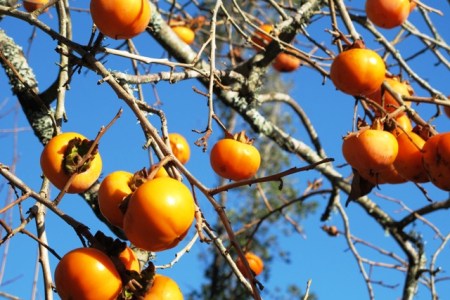
And the winner for colour this week - the persimmons

And the winner for colour this week – the persimmons

Latest posts:

1) The sweet smell of daphne in winter (though the showiest is D. genkwa which has no scent at all).

2) Good things come in small packages and may take a long, long time to reach maturity. Chamaecyparis obtusa “Caespitosa”

3) Taking another look at your common or garden radish (of the European persuasion).

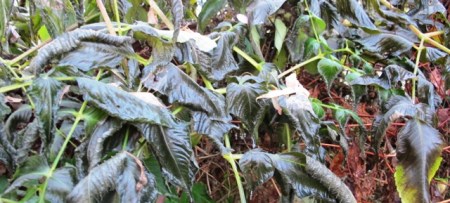
What a difference a week makes... frost damage

What a difference a week makes… frost damage

What a difference a few days can make. Last Friday, I wrote about the tree dahlias. One frost and now they are mush and over for the year. Frosts are an unpredictable event here. Some years there are none (or no visible frost at least), other years we might get two or three rippers. It was a ripper on Wednesday. On the bright side, there has been remarkably little damage and our run of calm, sunny weather continues. We are making great progress in the garden and I am thinking about perennial combinations and more active management to keep them looking good. Mark and Lloyd entertained themselves bringing an old shed across the road to convert into a pigeon house. Lloyd is now replacing the door and re-roofing it. I am hoping new sides will be next so by then there will only be the framework and the window left of the original.

Plant Collector: Chamaecyparis obtusa ‘Caespitosa’

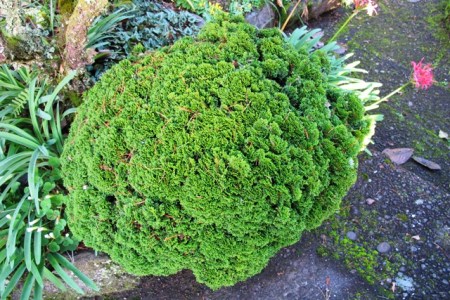
Chamaecyparis obtusa 'Caespitosa' is a little honey bun of a plant... after 50 years

Chamaecyparis obtusa ‘Caespitosa’ is a little honey bun of a plant… after 50 years

I can’t help but think that if conifers had user-friendly common names, they might have staged more of a revival as desirable plants. There is nothing easy about this name. Even the pronunciation of ‘Caespitosa’ is problematic. But it is the cutest little honey bun of a plant. We once produced a line of these to sell. After about 7 years, they measured no more than 10cm across. It is difficult to sell tiny gems like that. After 50 years or more, the ones in our rockery are about 40cm high and 50cm wide. They are like dense mushrooms and have never been clipped or shaped in any way. I sometimes clean out some of the dead debris in the middle and I clip off the occasional larger leafed stem but that is all the care these plants get.

The reason I clip off any odd looking foliage is because this is a bit of a freak seedling derived from what was a timber tree in its native Japan – commonly referred to as the Hinoki Cypress, though it would be more correct to refer to it as the Hinoki False Cypress because chamaecyparis are known as false cypress. It is obviously highly variable and prone to throwing sports because there are a host of different named selections. Such sports can revert to larger and stronger growing forms which is why it pays to clip out any peculiar, larger foliaged branches on a dwarf like this.

This is such a wonderfully tactile plant. The instinct is to pat it as you pass and it completely dense and firm. ‘Caespitosa’ was raised from seed before 1920 in England so it has been around for a while. It is still seen as a gem for alpine gardens. Cold climate gems that also tolerate the mild humid conditions that have here are not common.

First published in the Waikato Times and reprinted here with their permission.

Plant Collector: Picea albertiana 'Conica'

Picea albertiana 'Conica' after a mere 20 years

Picea albertiana ‘Conica’ after a mere 20 years

“So how old is the small Picea albertiana ‘Conica’?” I asked. “Not very old,” he replied. Then we worked out that this little specimen, under 2 metres high, is in fact over 20 years, whereas the big one (a scaled up version about 4 metres high) is 60 years old. Time can fly in the garden.

When conifers fell from grace after their heyday in the 70s, we threw some babies out with the bathwater. P. albertiana ‘Conica’ is a dwarf sport from the timber tree, Picea glauca. Glauca just means blue, and the fine foliage of the dwarf form retains a blue-grey hue. P. glauca is commonly known as the white spruce growing naturally right across from east to west of the northern states of USA, Canada and even Alaska. It is a valuable timber tree. You would be waiting a long time to get any timber out of P. albertiana ‘Conica’. In fact it is such a slow grower that it is a favourite candidate for bonsai. Our two specimens are in our rockery and the perfect icecream cone shape that gives them a wonderful silhouette. The leaves are fine, short needles, densely packed. I always want to put stars on top of them at Christmas.

That said, they may be on borrowed time. Coming from a very cold climate, they survive here because Mark is willing to treat them each year for red spider. These are two of the only plants in the garden he still sprays. If we get much more purist in our quest to garden without chemical sprays and fertiliser and shun treating even these, they are likely to kark it over time. We know this because the one in our park that he didn’t get around to spraying died. I would miss their tight cones.

Tikorangi notes: Friday 25 May, 2012

Latest posts:

1) Reviewing our mixed borders (and why the old fashioned activity of reading books can have quite an impact).
2) Iochroma grandiflorum (blue tubular trumpets non-stop for the past seven months or more).
3) Grow it yourself: rosemary
4) It has not been a good year for monarch butterflies in the garden – our garden diary from the Weekend Gardener.
5) Revisiting garden mulch options in Outdoor Classroom.

I can’t think I have ever written about maples (except maybe Acer griseum which is notable for its superb bark). Part of the reason could be that I have never got to grips with names of the cultivars we grow here. I recall Mark and I taking a tour of the British Hardy Plants Society around the garden one time. They were a knowledgeable crew but they also collected plant names as some collect autographs – it didn’t matter if they could never grow the plant in the UK. Every plant had to be recorded. Between us, Mark and I could name everything except… the irises and the maples.

At this time of the year, the maples come into their own. Some have lovely autumn colour. Most have a lovely form which comes into sharp relief as the foliage colours and falls. They are pretty in fresh growth in spring, and fit in very well over summer (as long as they are well sheltered from wind), but it is the bare form that I like the most. They clean up very well with a little pruning and grooming to make excellent skeletons in winter.

Plant Collector: Iochroma grandiflorum

Our Iochroma grandiflorum on a magical late autumn day

Our Iochroma grandiflorum on a magical late autumn day

We were looking out at our iochroma this week, marvelling that it was still in flower and making a wonderful picture in the late autumn conditions. We tried to remember when it started flowering and we are pretty sure it was in bloom by late October. A plant which flowers for seven months is not to be sneezed it. Technically it is a shrub, though at over 3 metres high it is a large one, yet it never gets very woody. The stems are quite brittle. Iochroma hail from Central and South America – this one is mainly found in Ecuador. It doesn’t mass flower but keeps producing an apparently inexhaustible supply of these pretty blue trumpets which are about 10cm long.

Iochromas belong to the solanaceae family (think solanums, like tomatoes and aubergines) and you may see a resemblance to its pest cousin, woolly nightshade. The leaves are large, soft and almost felted. Being large growing, brittle, soft foliaged and from warmer climes, you might think it is not a starter for colder, frost prone areas but it is remarkable resilient. Wind, frost, cold and heavy rain will knock it about, even defoliate it at times, but as long as it is well established, it can return to fine form very quickly as soon as temperatures rise. It sets its flowers on new growth so as long as it is warm enough to keep the plant growing, it continues to produce blooms. However, it is not a tidy little plant suited to immaculate little gardens but sits more as a large border plant in similar conditions to abutilons. Tui are reputed to love it feeding from the flowers.

First published in the Waikato Times and reprinted here with their permission.