
Tag Archives: Mark and Abbie Jury

Tikorangi Notes: Friday July 6, 2012

Our maunga, Mount Taranaki
Our maunga, Mount Taranaki

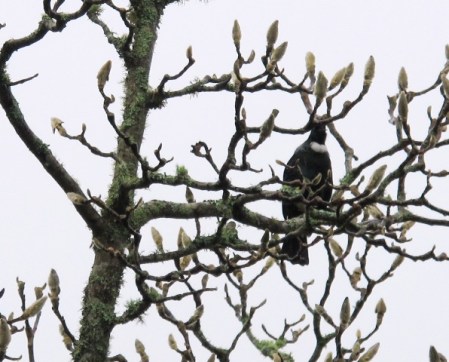
The tui are back

The tui are back

Latest posts: Friday July 6, 2012

1) Fragrant rhododendrons – the final feature article I have written for the Weekend Gardener. So you only want scented plants in the garden? There are fragrant rhododendrons to choose from.

2) The understated elegance of Helleborus orientalis in Plant Collector this week.

3) Reviewing the role of container plants. Do they add anything to the garden other than work?

4) Grow it yourself – celery. We don’t because Mark won’t, so I buy it but you can if you wish. The word from Mark is that it is not that easy to grow well and the one year he got it absolutely right, we only hate about two complete heads of celery and the rest went to waste.

5) In the Garden this fortnight. The final in this series I wrote for Weekend Gardener. It’s on gloriosas this week.

6) Outdoor Classroom revisited – sharpening garden tools. Everybody says do it but nobody says how.

Tikorangi Notes: Friday July 6, 2012

As you may gather from above, I have resigned as a contributor to the Weekend Gardener so the pieces first published there will cease after today. But do not let that stop you – please take the time to fill out their survey and let them know what you think of the changes they have made with their new management.

The three new posts a week from the Waikato Times will continue uninterrupted. Though if anyone has any ideas for replacing Grow Your Own, I would appreciate hearing. There are a finite number of vegetables and I am nearing the end of all available options, even allowing for extensions into some herbs and soft fruits.

In the meantime, great winter weather has seen plenty of sun, mild days (15 degrees yesterday) and very little wind. The mountain has a good covering of snow and is looking its most spectacular. More camellias are opening flowers and the tui and kereru are here in good numbers. It won’t be long before the magnolia season starts.
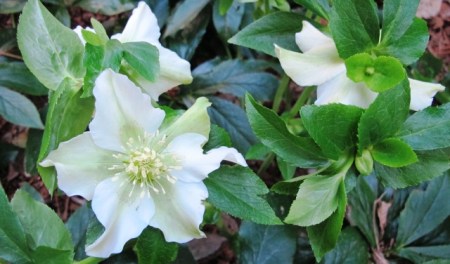
Plant Collector – Helleborus orientalis

Helleborus orientalis - quiet and undemanding stars of winter

Helleborus orientalis – quiet and undemanding stars of winter

Hellebores are quiet heroes in the winter garden. I have never seen a strident one. By far the most common hellebore is H. orientalis – though it is not from the Orient, being native to northern Turkey and Greece. It is a perennial which keeps its leaves all year round but in our experience it is not one that appreciates being dug and divided. Plants subjected to this routine can sulk for a long time afterwards. You are better to salvage some of the many seedlings you get around plants if you want more.

Given their origins, it is not surprising that these plants are happy to lead their quiet existence in fairly tough conditions, coping with root competition and shallow soils. This makes them ideal for semi shaded, dry areas beneath trees where it is not always easy to find suitable plants. However, they won’t appreciate dense shade. Lift the canopy of overhanging trees and shrubs to get more light.

Most hellebores come in shades of dusky pinks, reds, greens and white – or sometimes in blends of these colours and they often change colour with age. There are some highly desirable deep red and slate colours – the latter bringing blue-purple tones. However the performance of these appears to be temperature related. The colder your conditions (and these are cold hardy plants), the better colour you will get. The best ones we have seen were in Taupo and the UK where winters are considerably chillier.

If you have prized cultivars, keep them separate if you are hoping to raise seedlings. They are promiscuous plants and will cross readily. That said, to my mind, hellebores look best in big patches or drifts. Interplant with winter and early spring bulbs (bluebells, snowdrops, smaller growing daffodils are our preferences) to add interest.

First published in the Waikato Times and reprinted here with their permission.

Grow it youself: celery

If you are harvesting celery now, you will be congratulating yourself because it is a very useful vegetable to have on hand. However, it is not a foolproof crop and if you do succeed in getting it to maturity without being stringy, slimy, disease ridden or slug infested, you often have the problem of excessive amounts of celery ready all at once. You can raise celery from seed but the need to stagger harvest means that most people will buy a few baby plants at a time from the garden centre. Seed is not such a great option when you only want 3 or 4 plants maturing at once. That said, I read one advisory that 16 to 20 plants per sowing (so we are talking successional planting) is sufficient for the average family. All I can say is that the author must have eaten vast amounts of celery.

Celery is a cool climate, very hungry crop. It needs good soil, preferably enriched with compost and rotted manure and you must keep it well watered in dry periods. Lack of water leads to stringiness and a bitter flavour. It is also a slow grower and can take up to four months to mature so you have to keep the food and water up to it for quite some time. In cold climates it is a spring crop, but in mild areas it can be sown or planted in early autumn as well. If you want to get a jump start on spring, you could sow seed soon into small pots and grow them under cover for planting out as soon as the soils start to warm up in September. Space at about 20cm apart and stay on top of the weeds which will compete with the celery’s root system and rob the nutrients.

First published in the Waikato Times and reprinted here with their permission.

Outdoor Classroom – how to sharpen garden tools

1) Every winter, the advice comes to sharpen and clean tools, but it rarely includes instructions on how sharpening should be done. There is no doubt that good tools with sharp cutting edges make gardening much easier. If you try it, you will believe it. Better quality tools hold a sharp edge longer.

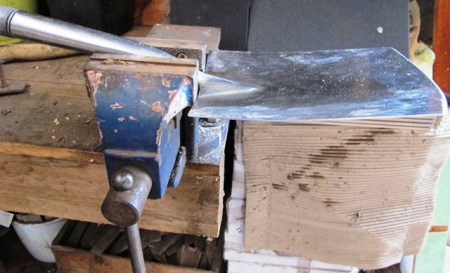
2) It helps to be able to hold larger tools firmly while sharpening and we prefer to do this in a simple workbench vice.

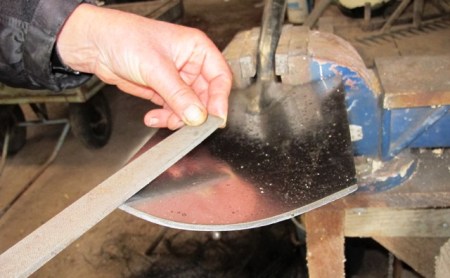
3) Only ever sharpen one side of a spade or push hoe – the side that faces upwards. With a push hoe, this keeps the blade flat to the ground with the cutting angle on the upper side. Spades cut better with one flat side and the upward or outward side bevelled and sharpened. We use a file to sharpen the blade. Home handypeople may go so far as to use an angle grinder but be careful not to overheat the garden tool or you will lose the temper (hardness) of the blade.

4) An oil stone is the best implement we know for sharpening secateurs and can be bought from a hardware store. Most secateurs are held together with a central bolt and nut. You have to unscrew this to take the blades completely apart. Some CRC or oil may help to loosen it. Do not lose the spring in the process.

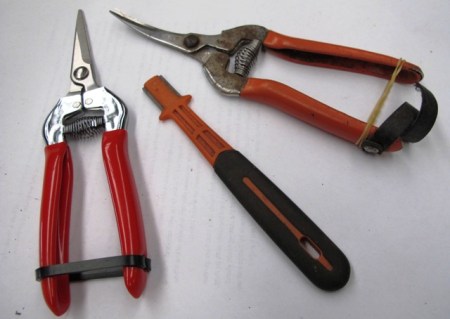
5) Wetting the stone with oil, use a gentle circular motion to sharpen one side of the blade. Never sharpen both sides of the blade or you will find it no longer cuts (it is the same with scissors). Cutting relies on a sharp bevelled edge meeting a completely flat surface so always sharpen the side of the blade that is already bevelled. Where you have secateurs like these with one blade incurved, this second blade shown on the table will need to sharpened on a round stone or with a round file because it will not sit flat to this type of stone.

6) A quick-fix sharpen for secateurs and scissors can be achieved with this handy little tool from garden retail outlets. It is also the only way we know of sharpening cheap secateurs held together by rivet, or the grape snips with upward curving blades. Run it along the angled edge of the cutting blade about six times. Remember to sharpen only the bevelled side of each blade. This tool is made by Bahco though there are other brands on the market.

A little bit of Tikorangi at Clarence House

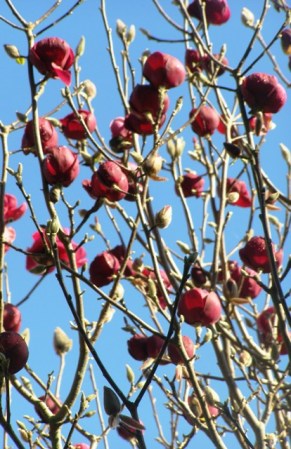
The promise of big fat buds on the magnolias just yesterday morning

The promise of big fat buds on the magnolias just yesterday morning

Latest posts: Friday 29 June, 2012

1) Snowdrop season has started!
2) Not perhaps for everybody. The exotica of a bilbergia in Plant Collector this week. (Hint: it is a bromeliad).
3) Grow it yourself – whacking great Oriental radishes.

It may take a little while for the Black Tulip at Clarence House to reach this scale of display

It may take a little while for the Black Tulip at Clarence House to reach this scale of display

Tikorangi Notes: Friday June 22, 2012
Without a doubt, the highlight of the week was when it was pointed out to us that the magnolia planted by Aung San Suu Kyi at Clarence House, the London home of the Prince of Wales and Duchess of Cornwall, was in fact none other than our very own Black Tulip. The story came via The Telegraph complete with short video of the Nobel peace laureate and Burmese Opposition leader scooping three spade loads of dirt around the tree. Black Tulip is adjacent to another magnolia planted by the Dalai Lama in 2008.

Magnolia Black Tulip was bred here at Tikorangi by Mark. Last year, the Queen herself was given a presentation of Black Tulip, though it looks as if the Clarence House specimen may be slightly larger.

We are honoured by this international recognition, though Mark would have preferred them to have planted his Magnolia Felix instead. It appears to be performing very well in the UK and the Royals’ gardens are large enough to take large flowered magnolias.