Tag Archives: New Zealand Christmas tree

“O Christmas tree O Christmas tree you stand in splendid beauty!” Or maybe not quite so splendid.

The need for a Christmas tree became pressing. I admit that when none of the children get home for Christmas, I tend to skip that festive accoutrement. Our three all live overseas these days. But with two of them making it back this year, one with partner and daughter who was a baby last time I saw her in May but is now very much a small child, there was clearly a need for a decorated tree.

Family tradition decrees that said Christmas tree can not be a) purchased or b) a fake tinsel affair. It must be harvested or repurposed from home. This has led to considerable variation in size and type down the years.

We know it as a pohutukawa – the New Zealand Christmas tree but really only in the landscape

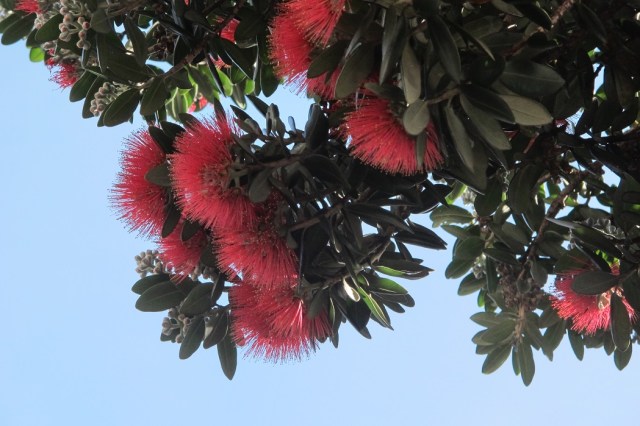
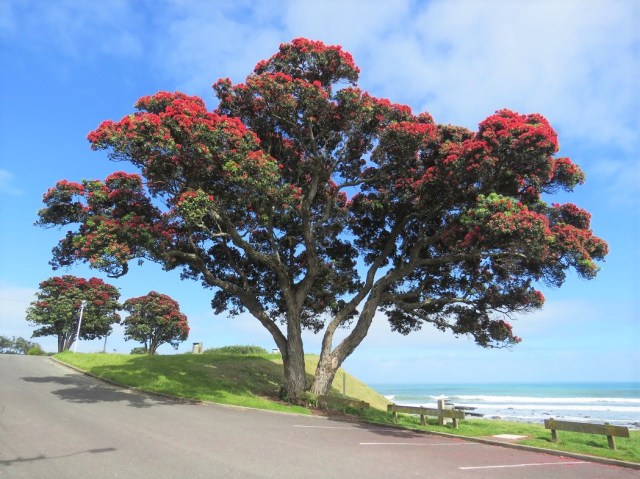
In the warmer parts of Aotearoa New Zealand, the pohutukawa (Metrosideros excelsa) is firmly established as the iconic ‘New Zealand Christmas tree’ but it does not lend itself to cutting to bring indoors. It is an outdoor tree. Being one of the few trees that will grow right on the coast, even on crumbling, eroding land, tolerating both wind and salt spray, it is widely grown as a street tree, on golf courses, as shelter belts and generally all round the place. Its flowering season may be short but it always comes in the lead-up to Christmas.

Pinus radiata is the main choice for Christmas trees here – quick-growing, expendable, suitable foliage and the Christmas pine scent. Christmas tree farms supply them as dense, clipped pyramids but wild collected specimens or just branches are generally more sparse. Mark has been known to wire in extra pieces to fill out bare spaces. It used to be a time-honoured tradition that families would head out to the country to harvest a tree or branch from the roadside but I am not sure that still goes on since tree farms made better specimens easily available, albeit at a price. That practice of wild collection had the potential to go wrong, of course.

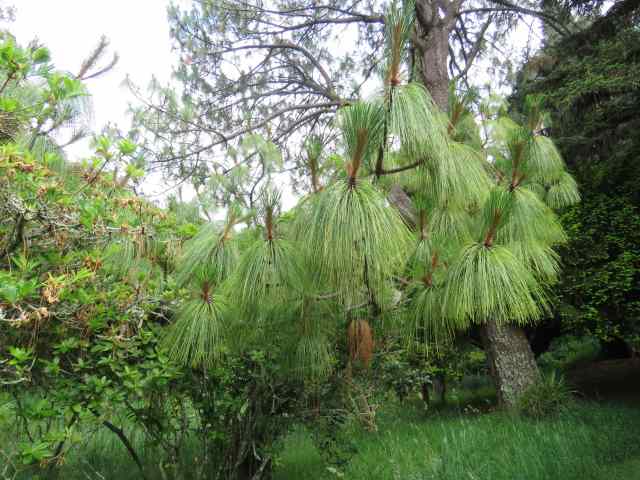
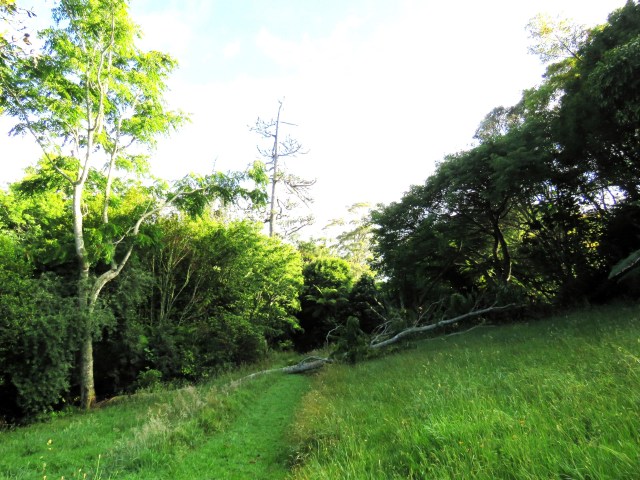
The falling branch of the rather large Pinus montezumae

We lacked even a wilding pine to harvest this year. What could we use? The first plan was to retrieve some of the huge branch of Pinus montezumae which has split but not yet fully snapped off the tree in our park. I could see it would be messy and we would have to be creative in wiring in extra pieces because it is sparse when viewed close-up. But I felt sure a collective effort would see us equal to the task.

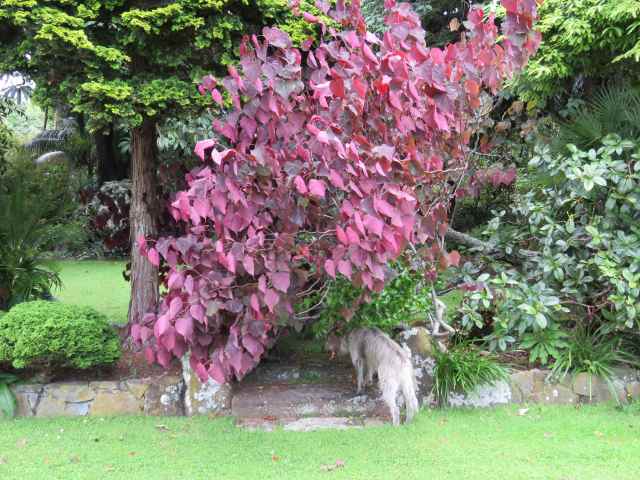
Ralph accompanied me on an inspection of the fallen Cercis ‘Forest Pansy’

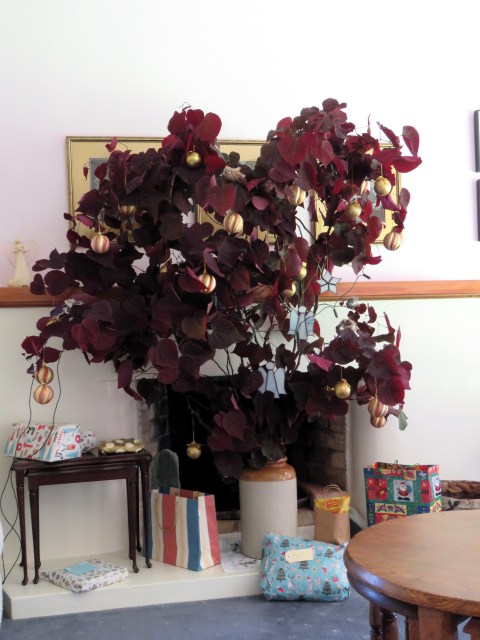
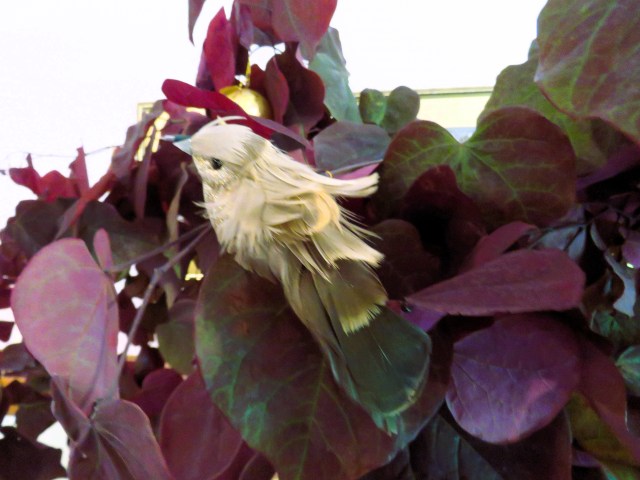
Then the Cercis ‘Forest Pansy’ fell over. It seems to have root problems and it hadn’t even been windy when we noticed it down. It seemed more manageable than the Montezuma Pine although Mark doubted its capacity to take up enough water to keep it alive when cut off. So far, so good. It only has to last another three days so I think it will make it. It is nicely colour-toned to our pink sitting room; it cost nothing either in dollar terms or in environmental impact. It is just not your traditional Christmas tree. I had to bypass all the small decorations because of the big foliage so the decorative aspects are… restrained, shall I say? Golden balls, feather birds and my glass decorations I made back in the days when I was a moderately competent leadlighter and copper foiler and the remaining Christmas lights.

It matches the colour scheme of the sitting room – or, as daughter described it, the marshmallow lounge. On account of it being pink and white, you understand.
The long term prognosis of the propped up cercis is unknown

Lloyd and Zach took 90% of the foliage and branches off the remaining cercis and propped it back up. Only time will tell if it can recover.

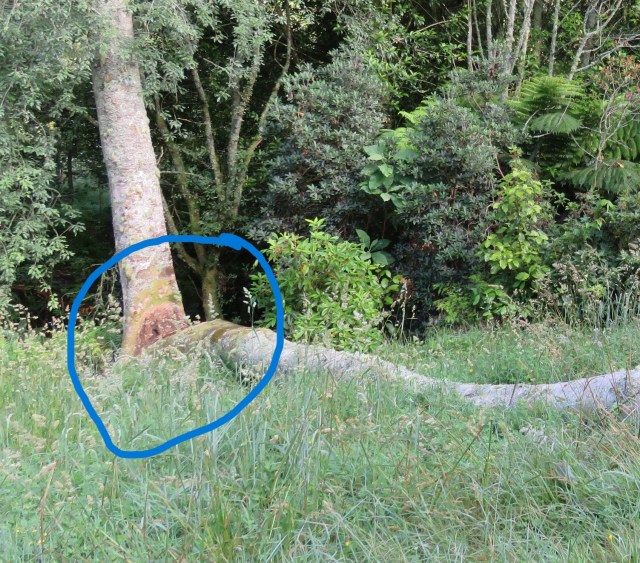
Poor management, allowing the ailanthus to have two leaders at the start

Despite the fact that we have had settled, calm weather recently, we have had more than the cercis and the Montezuma branch fall. I include the tree of heaven (Ailanthus altissima) which lost a trunk last weekend. It is a quick growing tree and something of a weed so it is no loss. But you can see how a trunk split out at the base and it is a good example of why trees should be kept to a single leader from the very start.

That is quite a long straight trunk whn seen lying on the ground, but low grade wood

The wood is too soft and light to be of any use. Lloyd has cut it into manageable lengths and at some stage soon, Zach will create one of his natural compositions in a wooded areas where they can stand as random uprights and start the process of rotting down to return to the soil.

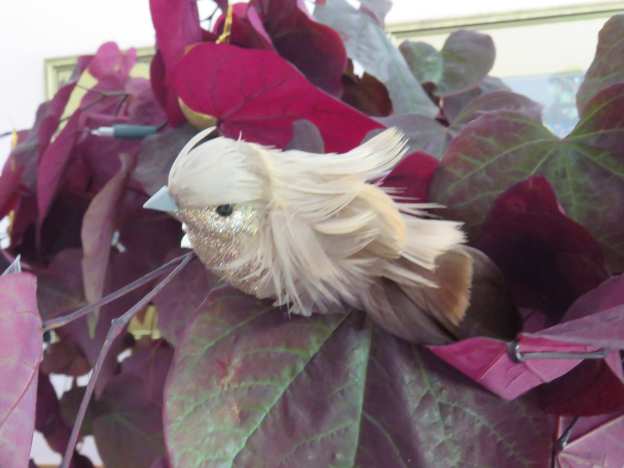
This bird looks as though it may have come off second best in an encounter with a cat but we do not have a cat. Maybe it just had a hard life in the box of Christmas decorations.

May you and those close to you find happiness and congeniality in the festive season. Here, in Aotearoa with our summer Christmas, the country has already started the big shut down when some people at least can breathe out, indulge too much, relax and take time out as much of the country closes down for the next few weeks.

The colours of a New Zealand Christmas

Nature provides us with seasonal decorations – all around the area where we live. Pōhutukawa

My social media is flooded with Christmas photos, mostly from cold, northern climates. But I thought, as I drove through my local town, the colours of a New Zealand Christmas are red, blue and yellow. Bright red, blue and yellow because of the clear light that characterises this country.

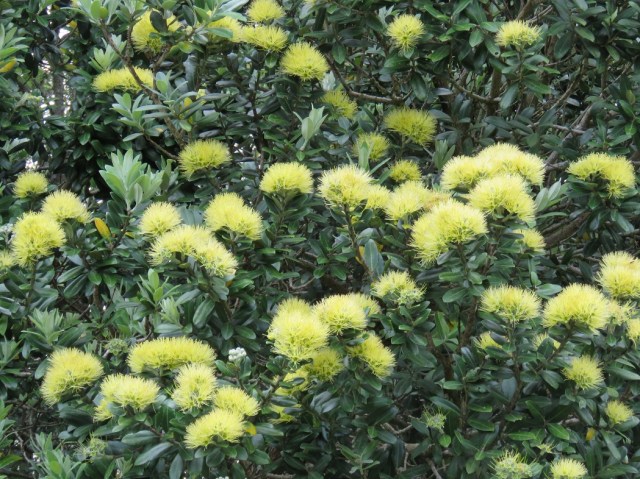
Pōhutukawa come in every shade of red. The yellow is much less common and not as spectacular in the landscape but has a charm of its own.

The pōhutukawa (Metrosideros excelsa) are commonly referred to as the New Zealand Christmas tree though their climatic range does not extend the full length of the country. This is the time they all come into flower for a brief but impressive few weeks.

Lovingly crafted and gifted from our daughter

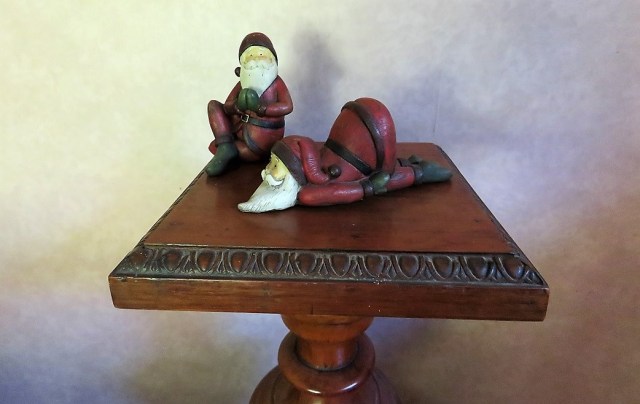
I am not great at Christmas decorations (and Mark’s efforts are limited to the Christmas table flowers). There doesn’t seem a great need for them when we live surrounded by flowers and foliage just outside every window. With no little ones in our life at this time, and indeed no big ones this year with no international travel possible, the box of decorations will likely stay in the Harry Potter cupboard beneath the stairs. In the interests of festive spirit, however, I have brought out the exquisite three kings in crochet that Elder Daughter made for me. And planking Santa and yoga Santa are making their annual appearance.

Planking Santa and yoga Santa – pretty much family heirlooms now.

Spare a thought for Melania, though. There are words I never thought I would say.

After the black and silver gothic horror of her first efforts decorating the White House, followed by her bizarre attempts at designer red – quickly transformed on social media to figures from ‘The Handmaid’s Tale’, this year she went with a more traditional theme. I might not have taken much notice of this were it not the headline I saw from Mashable: “Melania Trump unveils her final White House Christmas decorations and they’re fine.

Talk about being damned with faint praise, tinged with relief!

Lightly decorated though our house will be and few in number sitting down to Christmas treats (few? What am I talking about? Just two) ours at least will be a Christmas of colour, light and flowers.  I may have to dig out the CD we have of reggae Christmas carols as the background soundtrack to Christmas zoom calls with the children, just to make them groan and remember the days of childhood Christmases.

The New Zealand Christmas Tree (but not all are equal)

The story of a New Zealand Christmas is inextricably bound up with the annual blooming of our native pohutukawa trees – Metrosideros excelsa. Truth be told, they only occur naturally as far south as northern Taranaki where we live and Gisborne across the island, (but not in the middle where it is too cold for them). Fortunately, most of the country is happy to go with descriptor of the New Zealand Christmas tree.

The Legacy of the the Lazy Nurseryman. The flowers are more brown than red.

But not all pohutukawa are born equal. No sirree. As we drove to town a few days ago, Mark looked at the trees planted by a local farmer along the roadside and dubbed them the legacy of a lazy nurseryman. They were planted well and are growing well and the farmer has taken care of them, fencing them off from grazing stock and keeping them an attractive shape. The pity is that he (or she) was supplied with plants that flower more brown than red so they will never mature to the glory that could have been. The problem, Mark explains, is that some nurserymen are just too careless about where they gather seed and fail to select the best performing plants with the showiest colour.

Some flower abundantly but without great colour and some just don’t flower at all

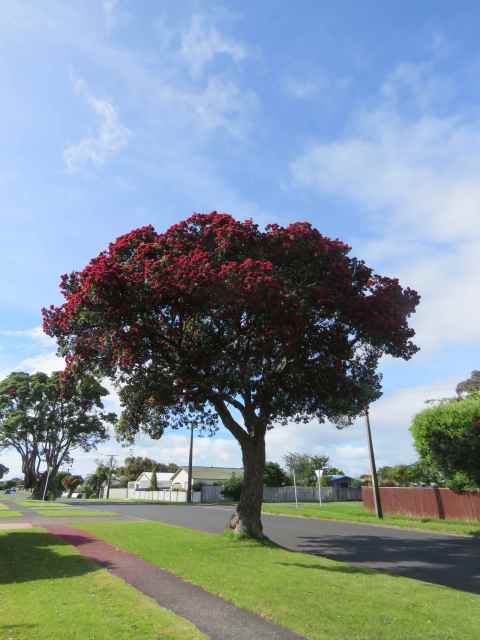
Our local town of Waitara is like Pohutukawa Central – there are many (many, many) trees planted, at least in part because there aren’t a lot of options for trees that will grow in windy, exposed coastal conditions and be fairly bullet-proof (vandal-proof, really) as unprotected street trees. But not all those trees flower well. Some don’t flower at all, really, and some that do are patchy with undistinguished colours. It is called seedling variation. When you come across a tree that is covered in bloom and a clear red in colour, it just leaps out at you, visually speaking.
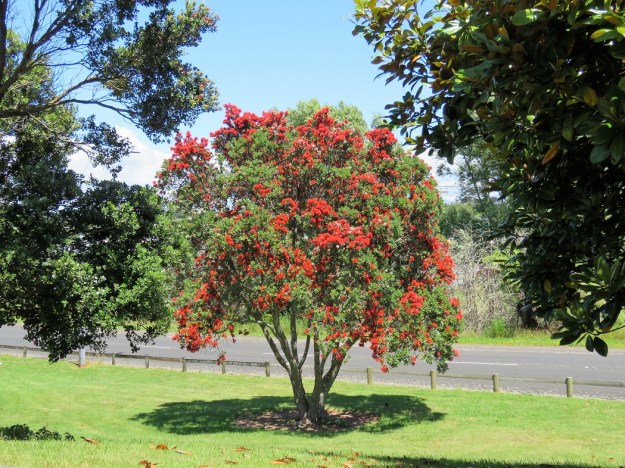
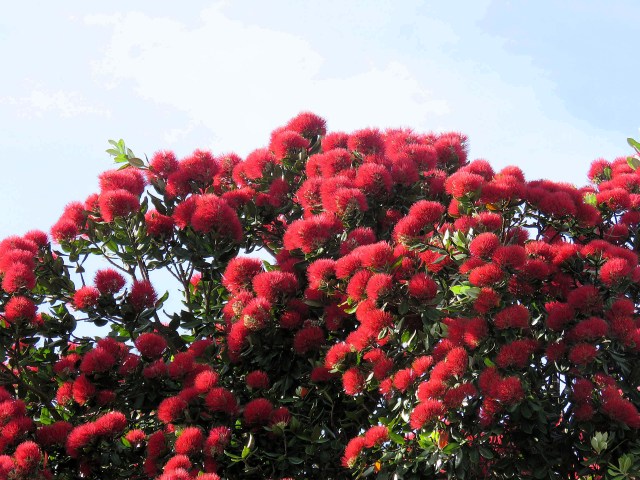
The vibrant tones of this specimen stood out from a considerable distance away

I felt I was channelling my late parents-in-law as I drove around Waitara yesterday, looking at different trees. Back in the late 1970s and early 1980s, they systematically evaluated many of the trees around the river bank and surrounding streets, noting which were the best bloomers year after year and the best colours. At least three went on to be introduced commercially by Duncan and Davies Nursery. Somewhere in the family archives, I have some of Mark’s mother’s diary notes of those observations. They read something along the lines of: “Good bright red to the left of Mrs Markham’s house, 18 xxxxx Street”.  I am not sure if they also measured the length of the flowering season though they did record which ones flowered well every year, rather than every second or random years.  There are so many handsome trees in the wider area here that it had not really occurred to me until very recently that the flowering season is but short – probably only ten days at peak. Ephemeral, I saw it described as recently. It is just that those ten days are in the lead-up to Christmas and a good tree is a show-stopper for that time. Not unlike the Japanese cherries, when you think about it. They too have a very brief peak season but an entire festival celebration has evolved around those days.
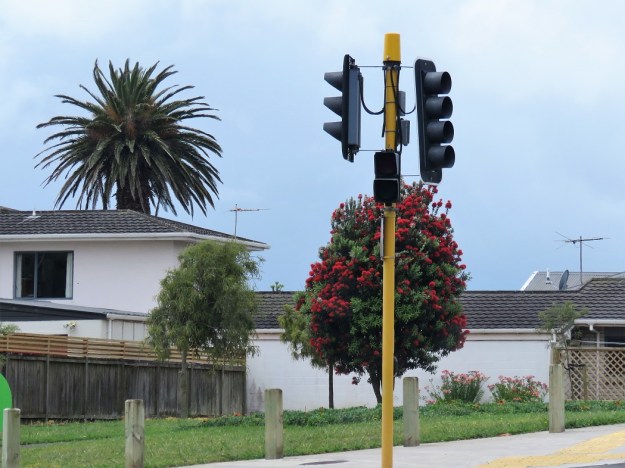
I took this photo out of the car window (Mark was driving) as we went through a busy intersection in New Plymouth. It is clearly a named selection and superior from the start

The lesson to all this is that if you are only going to buy one or a few pohutukawa, buy named varieties which will have been produced by cuttings so they will be identical to the parent. If you are going to buy quite a few, at least select a reputable nursery who can tell you what the seed source was. If they can’t tell you that, forget it. If you are going to raise your own from seed, start with the best flowering specimens. Pohutukawa don’t grow true from seed so you will get seedling variation in the offspring but if you start with the best parent, the proportion of good offspring you raise will be much higher.

If you are wondering about raising your own plants from cuttings, it isn’t at all easy to get them to root unless you start with juvenile material (from a young tree or one that has been kept pruned hard, not big old established specimens with lots of woody growth). If you are going to go down the route of raising your own material, get out and record now which trees have flowered all over the plant and in a good, clear red shade. It takes a commitment of time and effort to raise your own plants and it just seems a waste if you end up with murky, brownish flowers or worse, one that doesn’t flower at all.

Personally, we are not convinced by the Kermadec pohutukawa (Metrosideros kermadecensis). It is a different species and rather smaller growing and often sold as more desirable because of that compact habit and its extended flowering season. Yes, you will get flowers over months, but you only get a few flowers at any one time and the whole thing about the pohutukawa is that beautiful mass of bloom around Christmas. Ditto the yellow forms of M. excelsa. Yes, they are really pretty and they have an interesting botanical history of their own but they won’t give you the wham-bang mass display of the New Zealand Christmas tree.

Just choose good ones if you plan to plant any.