Justicea carnea and Kalmia latifilia ‘Ostbo’s Red’
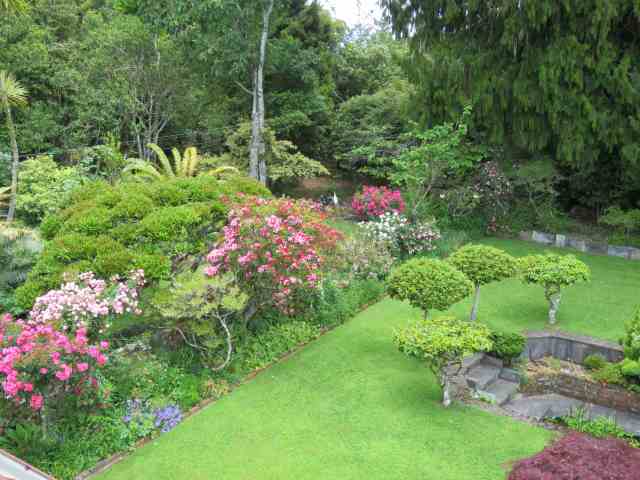
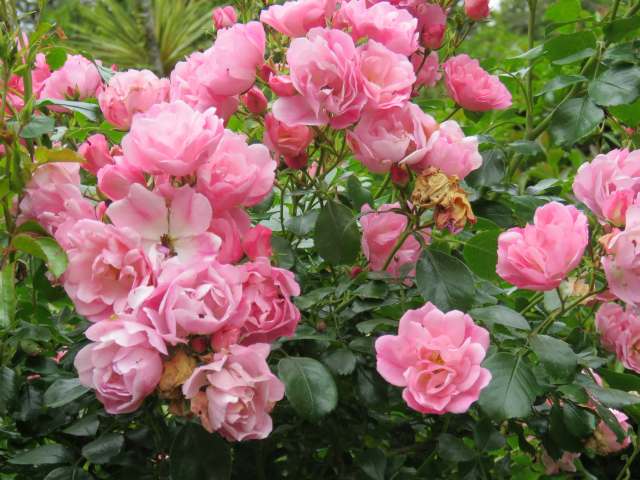
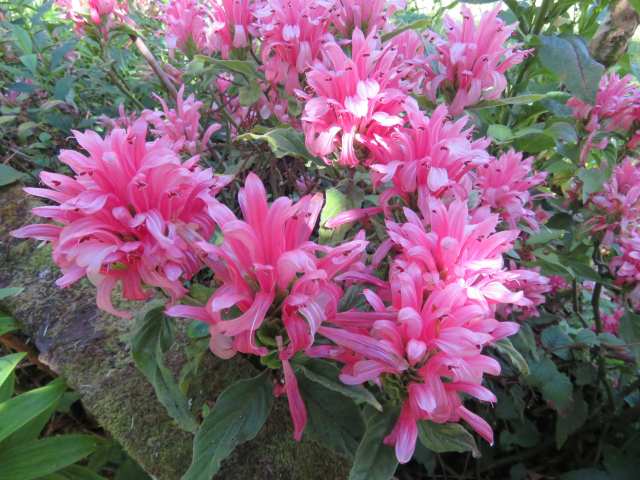
It is satisfying when a plan comes together and this particular border has been giving me pleasure this week. It is very pink and not necessarily a shade of pink that I love but the combination of the piped icing-like kalmia, Flower Carpet roses and pink candlewick flowers of the Justicia carnea works.
The view from an upstairs window this week
From decades ago – Mark’s mother’s rose garden
When Mark’s parents built the house in 1950, they set about creating picture views from every window. Over the years, we have had to work hard on this particular view, despite the solid structure of the sunken garden being the central feature. It was once a froth of old roses. Mark’s mother loved old roses but in the time since the area was first planted, the huge rimu trees (Dacrydium cupressinum) along the back have doubled in size, their roots have reached out a similar distance and other trees have grown, meaning the area is no longer open and sunny.
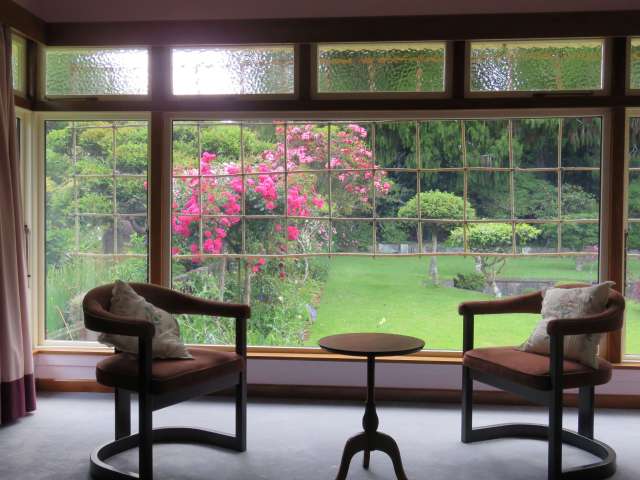
And the view from downstairs. The bamboo screen on the outside of the window is to stop birds flying into the windows and killing or injuring themselves, which used to be a frequent occurrence.
Over the last 30 years, we have made many changes, including removing all the struggling borders bar one and removing all the old roses, bar one. I have wondered about removing this last side border because I don’t enjoy maintaining it and that is usually an indication that something is wrong with it. But it is the view from our sitting room (more like a ‘front parlour’ of old except it is not at the front but it is a room we use when we have guests, rather than every day). And, from upstairs, it is the view from our second daughter’s bedroom (no matter that she left home more than two decades ago – our children still have their own rooms here). As I go in each fine morning to open windows and again late afternoon to close them, I look out the windows. This week, I decided it could definitely stay because every time I looked, the combinations delighted me.
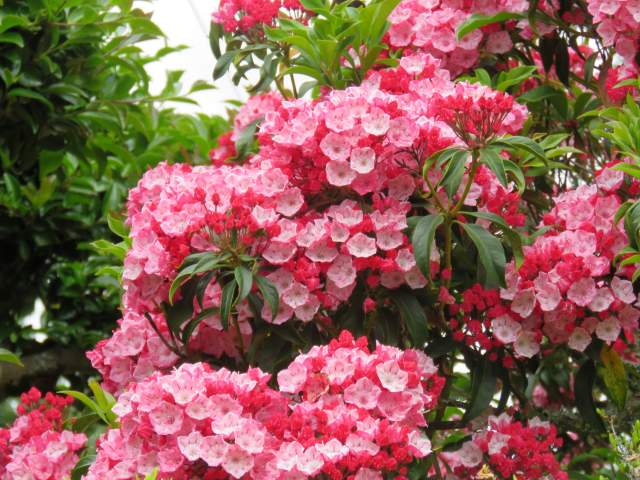
Like piped icing – the resilient flowers of Kalmia latifolia ‘Ostbo’s Red’
We only have a couple of kalmias in the garden and every year, their blooms are a fresh surprise. They look remarkably like skilled cake decorations from piped icing.
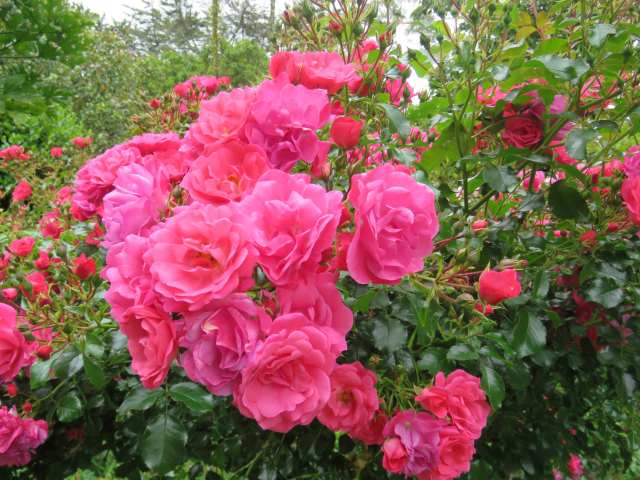
Rose Flower Carpet Pink
Rose Flower Carpet Appleblossom
When it comes to roses, I tried hard to find roses that would grow in our climate without spraying. Our high humidity and sheltered conditions are difficult when it comes to roses and I expect more from a plant than just beautiful blooms. We have tucked a few into the Iolanthe Garden where the froth and volume of perennials masks their diseased foliage and defoliated branches. But in this border, I want better performance and trial and error narrowed them down to Flower Carpet Roses – Pink, Appleblossom and White, mostly grafted as standards which gives elevation and more air movement. They keep much better foliage and mass flower, even if they are perhaps more utilitarian than romantic. The bright pink and white forms repeat flower for us, on and off for months, the softer pink Appleblossom less so and it can ball in the wet but it is the prettiest of them so I forgive that. At least its foliage stays healthy.
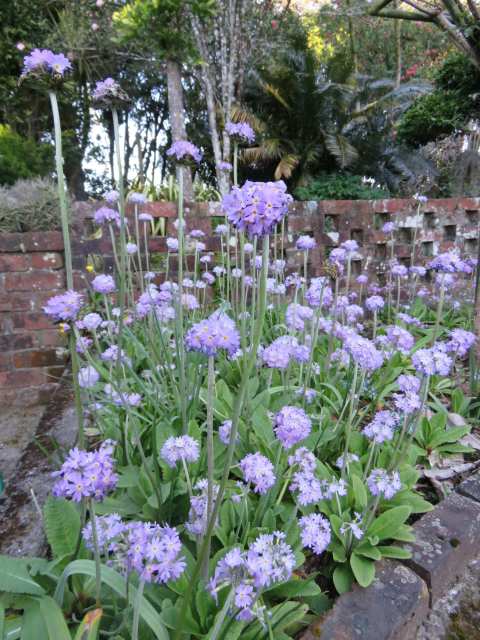
Primula denticulata in early spring
It is not the shrubs in this border that trouble me so much as the under plantings. Conditions range from heavy and wet at one end – perfect for the thriving Primula denticulata in September but there is not much else that flowers for the other eleven months of the year – through various degrees of shade to sun but with considerable root competition from trees and shrubs, to bone dry, impoverished conditions at the far end nearest the rimu trees. I need to come up with better ground cover combinations than we have but 30 years of trying hasn’t yet solved that to my satisfaction. Maybe I am just being too picky, after all.
Memories of candlewick bedspreads which were very common in the 1960s and starting to become threadbare and motheaten in the 1970s – Justicia carnea
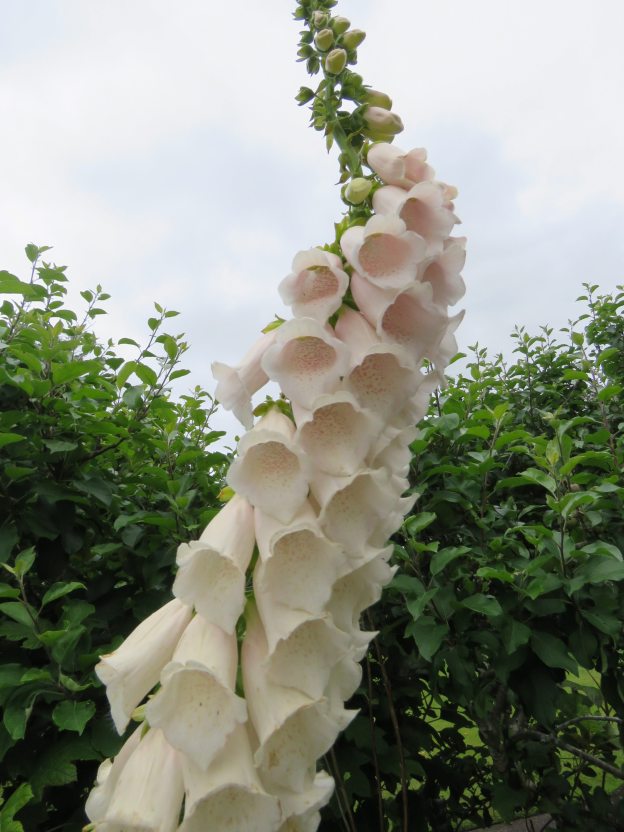
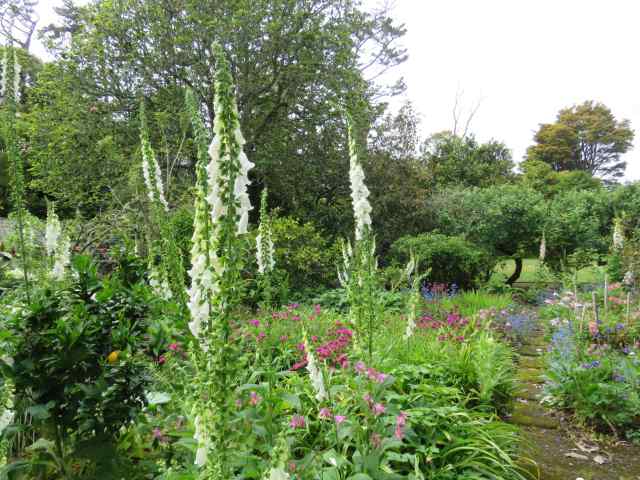
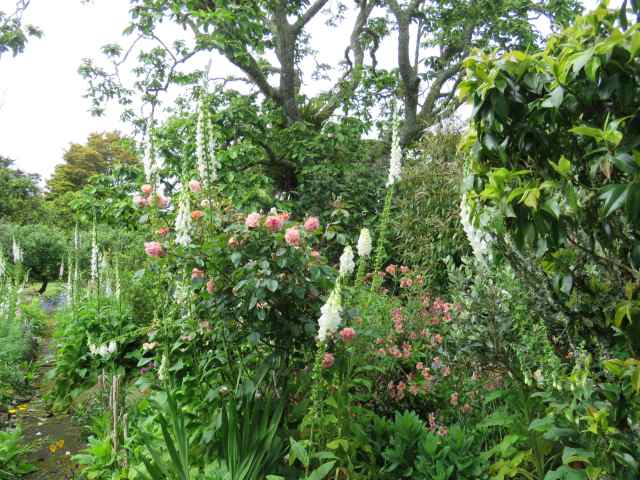
I am fine with the foxgloves in the Iolanthe Garden but there are no common pink ones
We no longer open for the springtime garden festival here but it is still a time of year when out-of-town friends come to see the garden. One such friend is an Auckland garden designer. I never ask for advice because I think seeking free advice is not much different to asking a medical professional for personal advice at a social event. Some lines should not be crossed. On the flip side, both Mark and I have a policy of not offering unsolicited advice in somebody else’s garden, no matter how tempting at the time, so this may all be a bit self-defeating. Our designer friend has a similar approach but he asked one simple question. We were looking at the Court Garden and he said three words, “Why the foxgloves’?
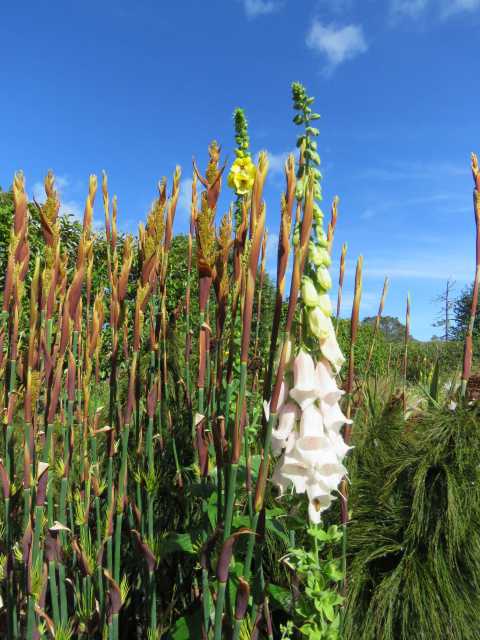
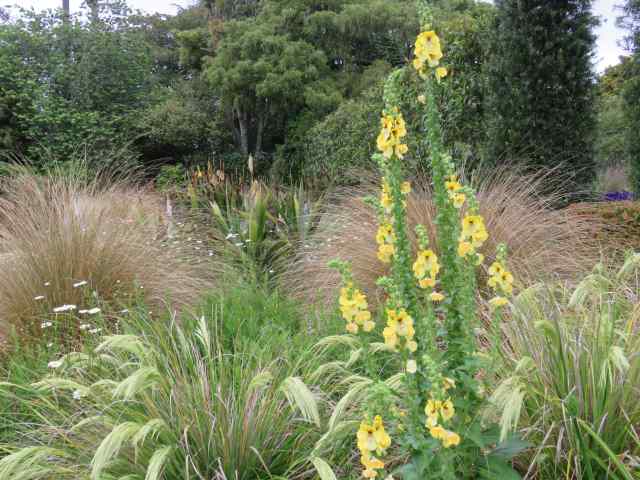
The large flowered yellow Verbascum creticum is fine but the foxgloves were just wrong in that situation
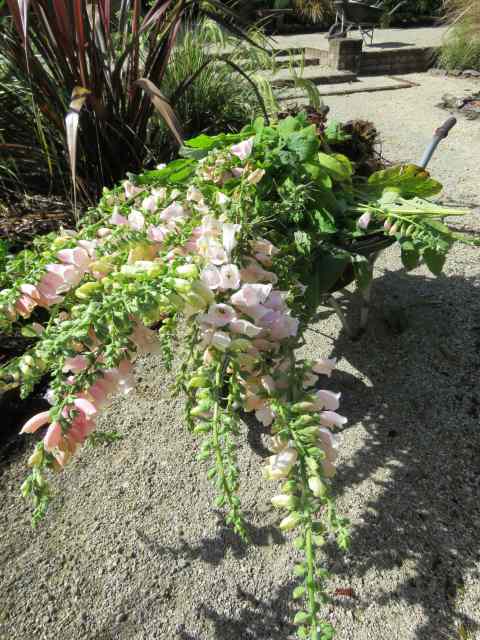
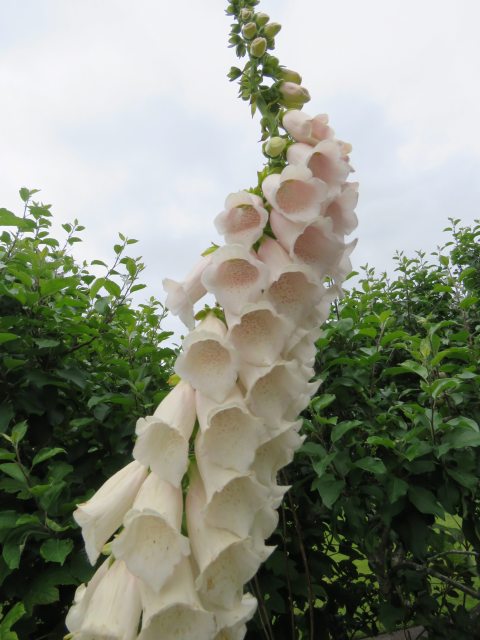
I suddenly looked through his eyes and indeed it was a good question to ask. I went to some trouble when I planted the garden back in 2019 to add palest, pastel coloured foxgloves to add some height and flowers in spring and I have let them gently seed down. Well, at the time they were meant to be pure white ones but they turned out pastel. I had not questioned their presence since but when I looked with different eyes, it occurred to me that they are, in fact, insipid in that situation. I looked at them for the next two days and on the third day, I pulled the lot out. When I sent a text to my friend to say they were gone, he just replied with the single word “Good”.
Flowering or not, once the decision was made, they had to go
Besides, we were running the danger of TMF – Too Many Foxgloves. For years, I have been so focused on pulling out every common pink one and even paler pink versions of it (because foxglove seed will naturally revert to the unattractive pink form) that I hadn’t looked at the overall picture. While I am particularly fond of the pure white form, especially in the Iolanthe garden which is more perennial meadow than anything else and down in the park, we don’t want them everywhere. It is time to review all locations where we have allowed them to grow and time to limit their range.
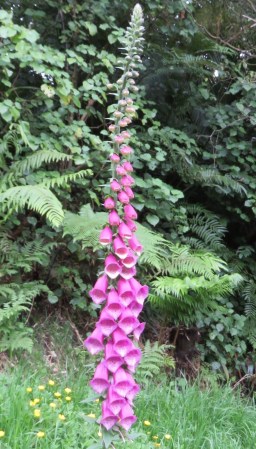
It is not even an attractive pink and it doesn’t combine well with other colours. I regard it as a weed.
I went to see a garden during the recent festival which I hadn’t seen for many years and now has new owners. It was a very nice garden and well maintained but as I walked around, I thought to myself that if they asked me for advice, it would be to pull out 90% of their dark pink foxgloves (Digitalis purpurea) , if not the lot of them, leaving just the white ones. They have let them seed everywhere and, to my eyes, it was a definite case of TMF. They didn’t ask, so I didn’t comment. But it made me more aware of letting them grow here in our garden.
No matter how good a plant is, it is still a mistake to have too much of it. I refer not just to foxgloves but also forget-me-nots, mondo grass, common verbascums, Verbena bonariensis, pansies, aquilegias and a host of other plants that self seed around the garden. In our garden, I would also add tree ferns, nikau palms (Rhopalostylis sapida) and kawakawa (Macropiper excelsum) to that list.
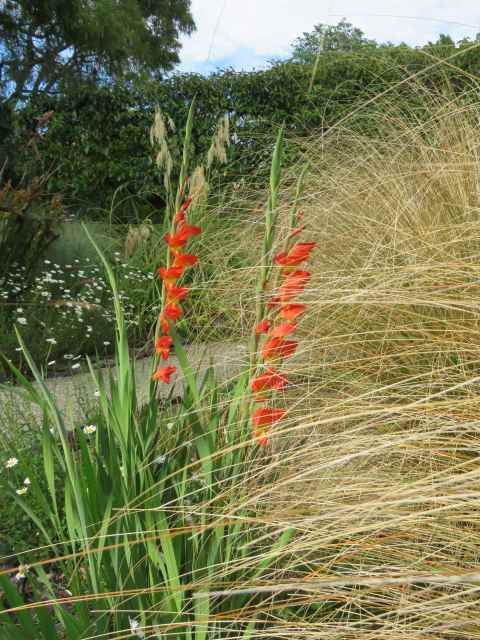
It wasn’t the gladious that was the problem; it was the foxgloves
Interestingly, as soon as I removed the pastel foxgloves from the Court Garden, having decided they were the wrong plant and too pallid, the anything-but-insipid Gladiolus dalenii syn natalensis no longer looked out of place at all; it changed from looking somewhat garish to vibrant instead. It can stay after all. It has only just dawned on me that the reason the foxgloves looked insipid in that location is the background. In the Court Garden, they were surrounded by plants that were either pale green hues or silver or many shades of brown. They look more charming in situations surrounded by masses of darker or brighter shades of green. I should have noticed this earlier.
A garden is never finished and even with an established garden, fine tuning it is what keeps it interesting. Sometimes, seeing it through somebody else’s eyes can be very helpful and small changes can make a big difference. I might ask for more advice from people whose opinions I value. Maybe it is not the same as asking my dentist about toothache over social cocktails after all.
The Court Garden with Verbascum creticum but no foxgloves any longer
Echinacea with contrasting foliage of fine grass and the foliage of Iris sibirica
It is not new year resolutions that have had me thinking in the last few days. In a world that has spun beyond our control, resolutions seem a little… irrelevant. No. Since my post about the graveyard, I have been thinking about plant combinations.
I have a photo file of images loosely categorised under ‘plant combinations’. There are lessons to be learned from some of them.
Ephemeral delights 1: lilac and a deciduous azalea. A very ephemeral delight, this one.
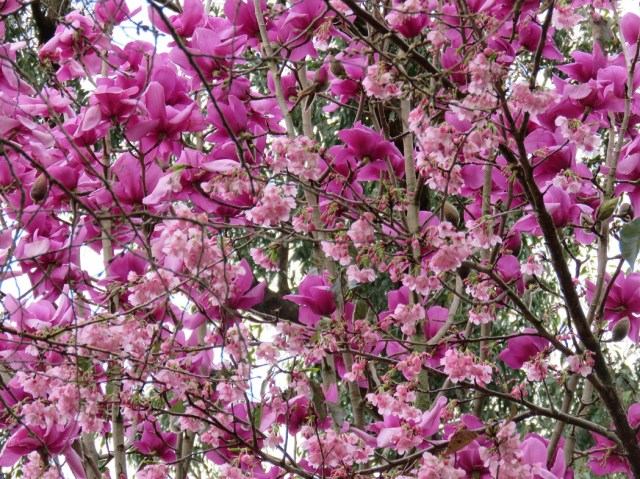
Ephemeral delights 2: A magnolia and Prunus Te Mara
Spot the problem with these two. These are pretty scenes based entirely on flower and colour combinations that we like. But, and it is a very big but, the flowering only lasts for a week to ten days every year. Many trees and shrubs have a very short peak time in bloom if you time them. We have plenty of such pretty scenes around our garden but we have a very big garden. In a smaller garden with limited space, most people want their plants to work harder over a longer period of time.
Hydrangeas are exceptions to the short blooming season rule and there are others but if you are setting out to plan for good combinations that are dependent on flowers, it is wise to check how long it is reasonable to expect the plants to actually bloom.
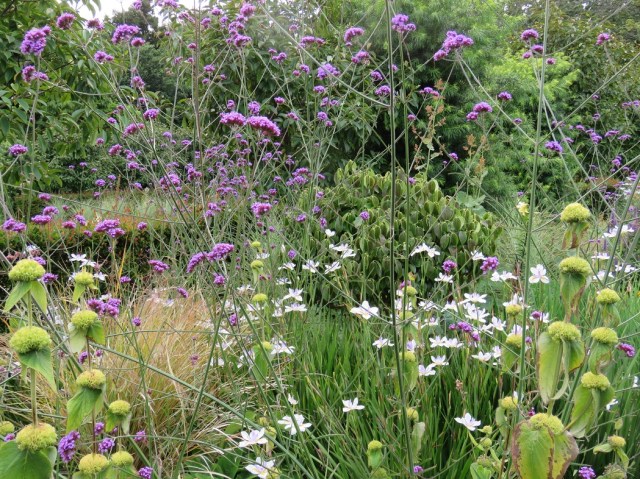
You can get longer in bloom from perennials than trees and shrubs. In practice, perennial gardening is heavily dependent on combinations. This pretty scene of Phlomis russeliana, Dietes grandiflora and Verbena bonariensis will last for a long time. And when the flowering is finished, the foliage combination will carry it through. That is the larger, flattish leaves of the phlomis contrasting with the grassy growth of the dietes, helped by how long the spent, candelabra flower stems of the phlomis hold on with their sculptural form.
Stipa tenuissima and a burgundy ligularia pack a visual punch amongst the graves
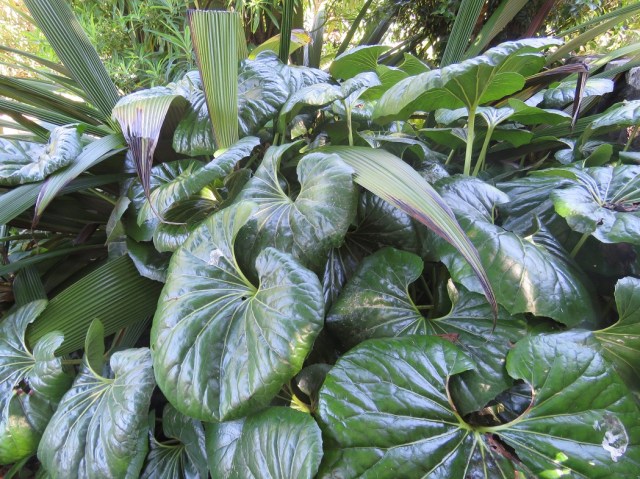
So too do Ligularia reniformis and Curculigo recurvata on our swimming pool garden
Foliage matters. A lot. The graveyard photo of Stipa tenuissima and the burgundy ligularia is entirely dependent on foliage. So too is this scene of Curculigo recurvata and Ligularia reniformis. Foliage contrasts and combinations are what will carry the scene through the year. But, to be honest, foliage alone rarely lifts my spirits and makes me smile in the way flowers do.
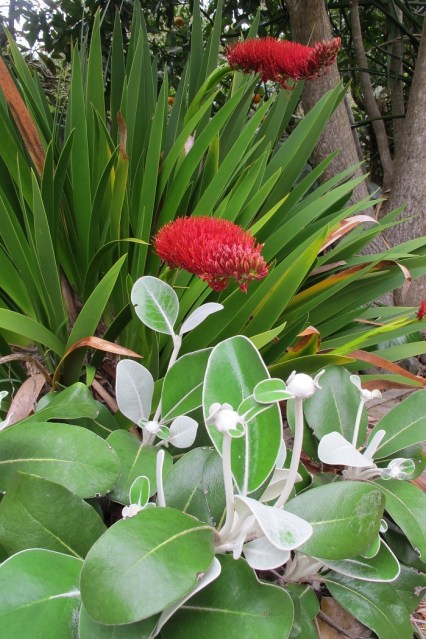
Flowers and foliage work better. This combination of natives – Xeronema callistemon (the Poor Knight’s lily) and Pachystegia insignis (Marlborough rock daisy) looks interesting all year round but is particularly pleasing when the red xeronema or white daisy are in bloom, even though they flower in succession, not at the same time.
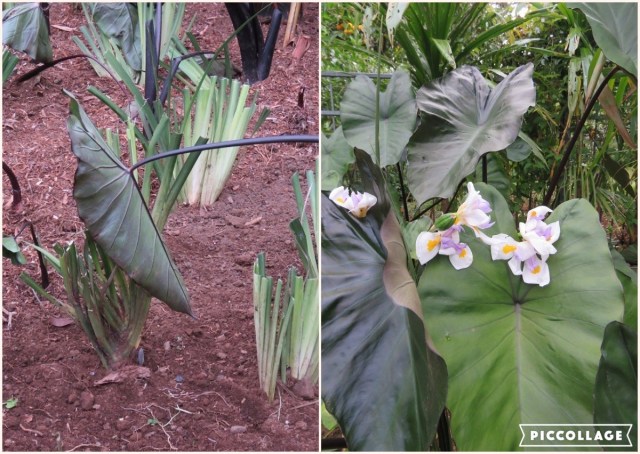
Freshly planted on the left, what it was meant to look like – but with the addition of the dietes grassy foliage – on the right. Alas, the dietes never managed to get above the colocasio so languished, flower-less, beneath the overpowering foliage.
There are plenty of resources that will recommend good plant combinations but I never use them. It is much more fun to put your own together, even if you don’t always get it right first time. I thought my combination of a dark-leafed ornamental taro (black colocasia) and Dietes grandiflora in a low-maintenance planting for summer impact by our swimming pool would be brilliant. It wasn’t. The colocasia was so vigorous, thuggish in fact, that even the dietes didn’t stand a chance. I ended up removing all the colocasia because it was spreading at an alarming rate.
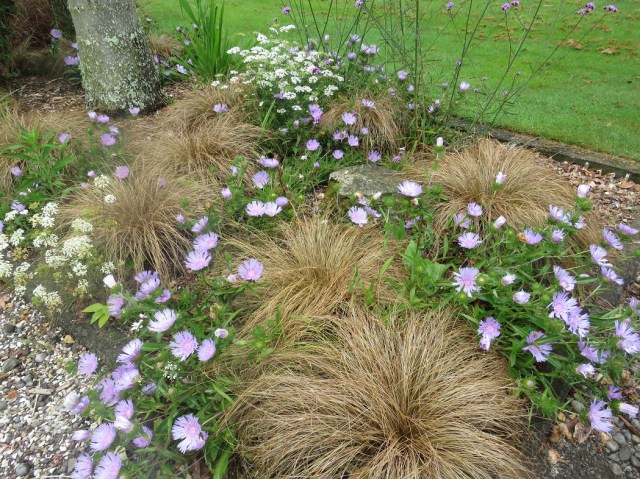
But sometimes it does work. A year ago I replanted this previously unsuccessful bed by our entranceway and I am pretty pleased with it. The dominant groundcovers are the two brown carex – upright Carex buchananii and the spreading Carex comans with a blue stokesia that blooms almost all year round. Autumn interest comes with a plum red nerine of Mark’s raising and towering self-sown Amaranthus caudatus, in late winter snowdrops and dwarf narcissi pop through, rhodohypoxis bloom in spring and I let the Orlaya grandiflora gently seed through. But it is the buff-brown carex and blue stokesia that carries it through all twelve months.
In a colder, semi-shaded area with heavy soil – hostas in blue and yellow hues, Chatham Island forget-me-not (Myosotidium hortensia), Ranunculus cortusifolius and even a blue meconopsis
Putting plants together with both skill and flair comes with experience. Novices may line out plants in the garden centre, often based on flowers alone, and think ‘oh that looks nice. That’ll do.’ Experienced gardeners factor in a whole lot more variants. These variants will include the following:
Plants need compatible growth habits. A vigorous thug will soon out-power a plant that is slower to establish or destined always to be of a more delicate nature. Plants with a spreading habit create shade and those with spreading root systems may swallow up their neighbours.
Plants grow. It helps to consider how quickly and how large they will grow at the time of planning. Also, what their mature form will be.
Plants need to like similar conditions – whether that be full sun or semi shade, sharp drainage or soils that never dry out or any of the other variants that contribute to a favourable growing situation.
If you select plants for floral display, you have to accept that the beautiful combination so carefully crafted may be for a very brief time.
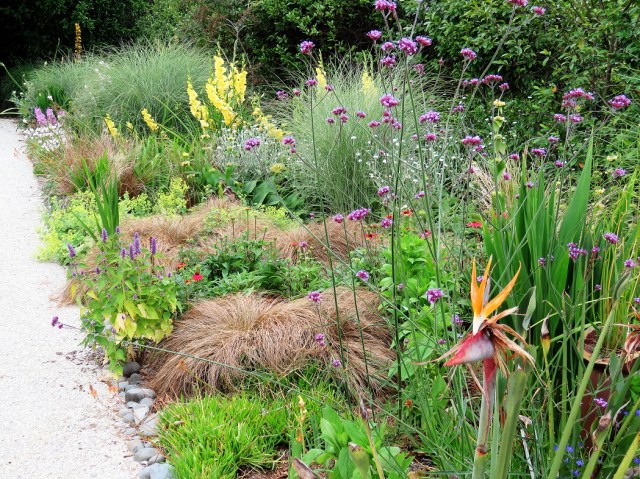
Foliage contrasts give interest most of the year round. The most obvious contrast is spear-shaped foliage beside rounded, lush leaves or bold foliage with something light and fine but it can be more subtle. Variegated foliage is always best teamed with contrasting foliage that is a single colour. One lesson I have learned from our new Court Garden is that contrasts can be more subtle and still effective. All the foundation plants in that garden are selected for their ‘grassy style’ foliage and it is the other, more subtle variations that make the combinations effective – colour, movement, layering, and shape rather than foliar contrast.
A combination of both flowers and foliage will cover more bases in terms of complementary plantings and longer term visual interest.
Plant combinations can be quite simple but effective. It is the combinations that stops a large planting from looking like a Council traffic island or a utility supermarket carpark. Mark’s mantra bears repeating: “The world is full of too many interesting plants to want to mass plant a single variety.
The good news is that with time and experience, deciding on combinations becomes instinctive rather than an intellectual exercise in planning and is, for many of us, one of the best parts of gardening.
It took several attempts to get this stretch of lower growing plants in the summer borders to the point that pleased me visually but I looked at it two weeks ago and thought “Yes! I am happy with that.”
In a city far, far away. Well. four hours’ drive away, to be precise
“The horror! The horror!”
Kurtz’s final words in Heart of Darkness, by Joseph Conrad.
I use these words flippantly and facetiously. I studied the works of Joseph Conrad back – way, way back – when I did Honours in English Literature and the topic of my dissertation was three of his works, including Heart of Darkness. But I found myself muttering ‘the horror! The horror!’ when I beheld this exercise in section maintenance this week.
I only share it with readers because I took these photos in a city four hours drive from here and do not think the people responsible will ever read my gardening pages on line. I would not want to hurt their feelings because they have at least tried. Occasionally, a sight such as this reminds me of just how much I have learned about gardens and design in my life.
Starting with the public frontage (or maybe sideage), we have the sight of weed mat. I am sure I have railed against weed mat in domestic situations before. It is a commercial product for a commercial application – plant nurseries – and it has zero aesthetic appeal. All that can be said for it is that it is marginally better than the earlier habit of laying heavy duty black plastic which soured the soil over time. Weed mat is permeable so it allows moisture through. The soil beneath will compact over time, but it won’t become dead soil, bereft of all microbial and insect activity. It possibly has some application to use as a weed barrier that is then covered (entirely, please, entirely so that none is in view) with some pebble or lime chip but that means it can only be used on a flat surface. What could they have done? It was a rough slope so unsuitable for grass. I would be wanting to stain the fence dark and maybe plant the area solidly in something like mondo grass, perhaps with some marguerite daisies to bring pleasure to passers-by.
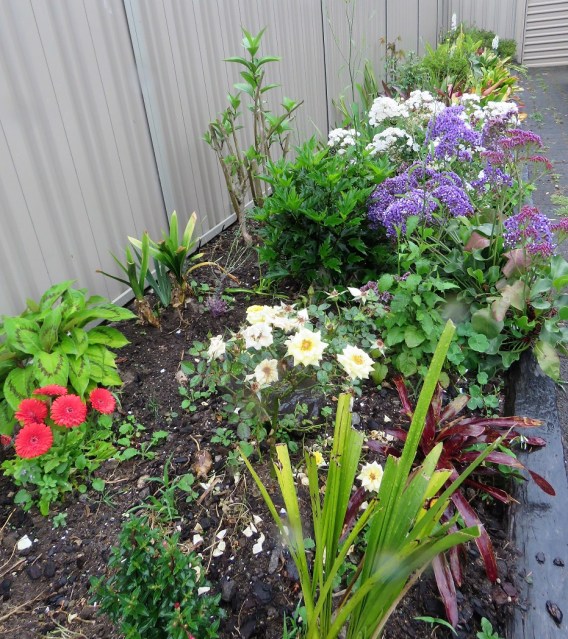
It was the borders inside that made me smile. They were recently planted and into heavy soil. One of this and one of that, randomly distributed. A lavender, a gerbera, a bromeliad, a patio rose, a cineraria, a kale, a paper daisy, a polyanthus and much, much more. In singles, bar the five clivias. I immediately conjured up the mental vision of this couple heading to the garden centre, determined to plant up the beds. They must have wheeled at least two trolleys around, loading up with one of everything which had flowers on it on the day. There were a lot of plants and I don’t imagine it was cheap at all. A garden centre owner’s delight. This is, by the way, a rental property and let me at least give credit that the enthusiastic landlords were attempting to make the outdoors attractive.
If I still had a paid gig writing for the print media, I would be heading out with my camera to find some of the best examples of low maintenance, outdoor planting and design for non-gardeners that I could find. But I don’t, so that idea was short-lived.
At least the bees and butterflies will enjoy these garden beds for the short time that they will bloom, before they become a mess. And it would be worse if the beds were all covered in visible weed mat.
A simple but very pleasing combination of Helleborus niger for winter flowers, Calanthe arisarnensis for spring, some random dwarf narcissi – and interesting foliage all summer
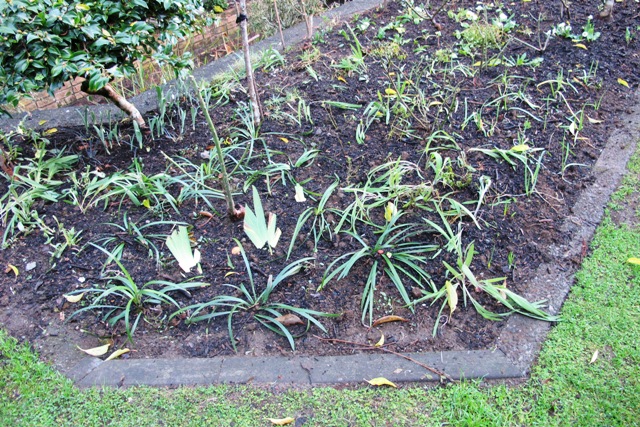
Last week, I wrote about the major makeover in the rose garden and mentioned the fun I was having with the perennials. While the rains have interrupted progress (it is difficult to dig and divide in waterlogged conditions), we have spent a great deal of time discussing perennials and their use here. Indeed, we even dedicated a gardening trip to the UK to look at techniques.
Traditionally, English perennial gardening has been dominated by the herbaceous border organised on what I had been calling the mix and match approach but which I have just seen described as tapestry gardening. And that seems appropriate – it is like building up an entire picture but from a multitude of different plants instead of coloured threads. At its best, it is magnificent but it is also very labour intensive and takes a lot of skill to put together well. Too often both the ongoing labour and the skill levels are lacking and it just looks a mess.
In the nineties when we saw the gardening scene hijacked by the landscape fraternity in this country, that sort of detailed gardening was thrown out. “The Look” became the dominant feature. Gone was tapestry gardening and any value placed on plantsmanship or plant detail. Now perennial gardening became “underplanting” and just as patterned carpets have been shunned in favour of the same plain carpet throughout the entire house, so too was underplanting to be a utility carpet, usually comprising only one plant variety. So rose gardens were carpeted with nepeta (catmint), or maybe stachys (lamb’s ear). Liriope was fine as long as it was en masse, or any other utility perennial that could form a reliable carpet. It is an approach to gardening that we have shunned as deathly dull.
Piet Oudolf’s rivers of perennials at Wisley were a revelation to us. Here was a contemporary take on perennial planting on a large scale. Each river or stripe is composed of three or four different plants, often repeated in other combinations elsewhere in the border. Tom Stuart-Smith’s plantings in the same RHS garden were a reinterpretation of the type of block planting first espoused by Gertrude Jekyll, especially with her later work when her eyesight was failing and she needed more defined form. When I use the word “blocky”, we are talking more freeform shapes than geometric, more Braque than Mondrian.
The upshot of this thinking was that when Neil Ross suggested I look to reorganising the perennial plantings in our rose garden to more contemporary blocky plantings with simple combinations, I had a mental framework to fit it into. While the area is hard landscaped into a formal design, I didn’t want formal geometric plantings. We strive for a spring and summer froth of pretties – roses and perennials – with touches of plant interest to extend the seasons into autumn and winter. So my blocks are random but nothing less than a square metre and nothing more than three square metres. And each block has three, sometimes four different plants in it. The fun has been in deciding the combinations block by block. It is a bit like creating a multitude of mini gardens and linking them together.
I have bought no new plants. All I have done is to lift, divide and recompose what I had in the garden. So they are just arranged differently. In each block, I have tried to combine plants which I think will be compatible in close company with each other – in other words nothing that is going to overwhelm its companions above ground by smothering them or underground by over-competing. I have considered the time of the season that each plant peaks to try and cover a good span of the year and also to get interesting combinations of foliage and flowers within each block.
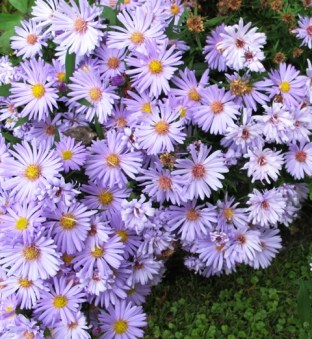
A carpet of blue asters in late summer and autumn
Nothing is more boring than endless plant lists so I will just give a couple of examples. One block is the common liriope (grassy foliage and blue flowers in summer) with a taller, pure white Siberian iris (for spring flowers) and one of the strong growing, mat-forming Kippenberg asters with lovely blue daisy flowers in autumn. Elsewhere, I have another block which repeats the white iris but this time combining it with a compact bright blue campanula and a little pure white scuttelaria which flowers most of the time.
If one block doesn’t work, then it will be easy to address the problems in that section. Some will need lifting and dividing more often than others. The whole area has been dug over thoroughly so the plants are in friable and fluffy soil which most perennials appreciate and I have laid a mulch of compost on top. These are optimal conditions and, while the area is very new right now, I have planted divisions and plants close together so I expect rapid results as soil temperatures rise in spring. If it doesn’t close up and fill the beds with a riotous froth in time for our peak garden visitor season, I may have to be in there with emergency plugging of gaps but I hope that is not going to be required. I am also expecting that the self seeded annuals will also come away quickly and fill gaps. The pretty nigella (love in a mist), linaria pink and lilac, blue poelmonium (Jacob’s Ladder) and common old blue pansies are all welcome to stage a return wherever they wish, to soften the divisions between the blocks.
Now it is just a question of waiting to see the results.
First published in the Waikato Times and reprinted here with their permission.
Planted – patience is now required as I wait for soil temperatures to rise








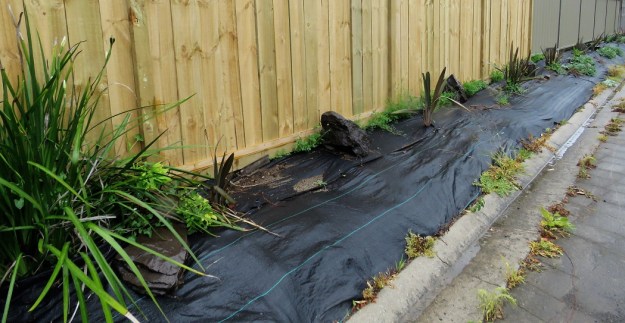 Starting with the public frontage (or maybe sideage), we have the sight of weed mat. I am sure I have railed against weed mat in domestic situations before. It is a commercial product for a commercial application – plant nurseries – and it has zero aesthetic appeal. All that can be said for it is that it is marginally better than the earlier habit of laying heavy duty black plastic which soured the soil over time. Weed mat is permeable so it allows moisture through. The soil beneath will compact over time, but it won’t become dead soil, bereft of all microbial and insect activity. It possibly has some application to use as a weed barrier that is then covered (entirely, please, entirely so that none is in view) with some pebble or lime chip but that means it can only be used on a flat surface. What could they have done? It was a rough slope so unsuitable for grass. I would be wanting to stain the fence dark and maybe plant the area solidly in something like mondo grass, perhaps with some marguerite daisies to bring pleasure to passers-by.
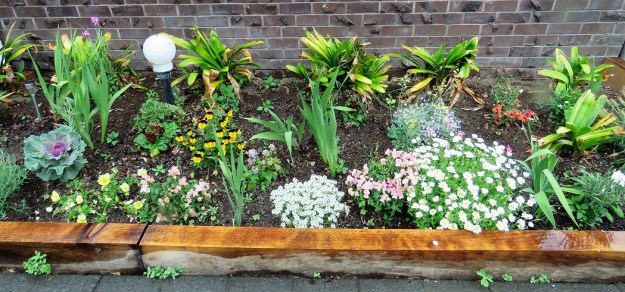 It was the borders inside that made me smile. They were recently planted and into heavy soil. One of this and one of that, randomly distributed. A lavender, a gerbera, a bromeliad, a patio rose, a cineraria, a kale, a paper daisy, a polyanthus and much, much more. In singles, bar the five clivias. I immediately conjured up the mental vision of this couple heading to the garden centre, determined to plant up the beds. They must have wheeled at least two trolleys around, loading up with one of everything which had flowers on it on the day. There were a lot of plants and I don’t imagine it was cheap at all. A garden centre owner’s delight. This is, by the way, a rental property and let me at least give credit that the enthusiastic landlords were attempting to make the outdoors attractive.
 If I still had a paid gig writing for the print media, I would be heading out with my camera to find some of the best examples of low maintenance, outdoor planting and design for non-gardeners that I could find. But I don’t, so that idea was short-lived.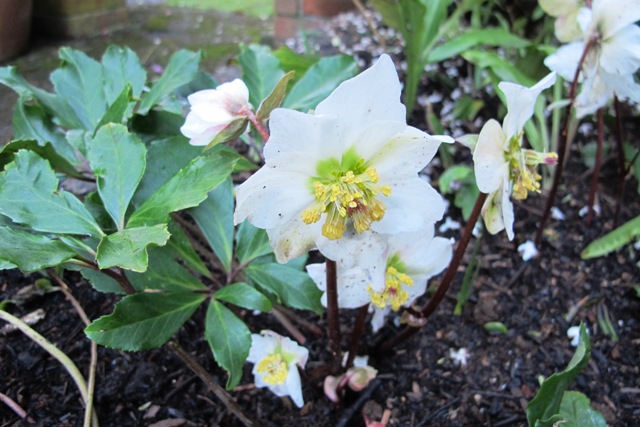
 Tikorangi The Jury Garden