Tag Archives: rockery plants

Autumn delight

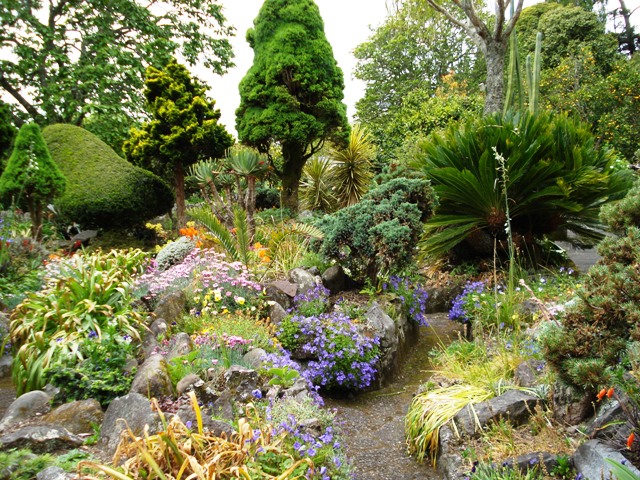
The rockery plantings are complex and varied but that is what makes it all the more interesting to us

I am not quite gone yet; on Wednesday I start the long haul over to Barcelona and then the south of France.  In the meantime, the rockery has been bringing me much pleasure. If I ever have to downsize both house and garden, I might be tempted to turn any new, smaller garden into rockery.  Rockeries lend themselves to highly detailed, high-interest level gardening and I can see I could be quite happy pottering in a rockery – as indeed was Mark’s dad, Felix, in his later years. It is a particularly absorbing area to garden, even if there are times I regard it as the gardening equivalent of micro-surgery.

There was quite a bit of excavation and construction that went into our rockery, especially given it was a blank canvas and largely flat to start with.

Ours is a raised rockery with different levels so it has detail in its design, not just in its plantings. Mark’s mother always used the plural ‘we’ when she talked about building the rockery, but we think it more likely that she designed it and then supervised Felix in its construction, which included some excavation to achieve different levels. Every original garden structure here was done by hand or, on occasion maybe, using horse power. Felix did not have a tractor or access to any of the machinery we can call on these days.
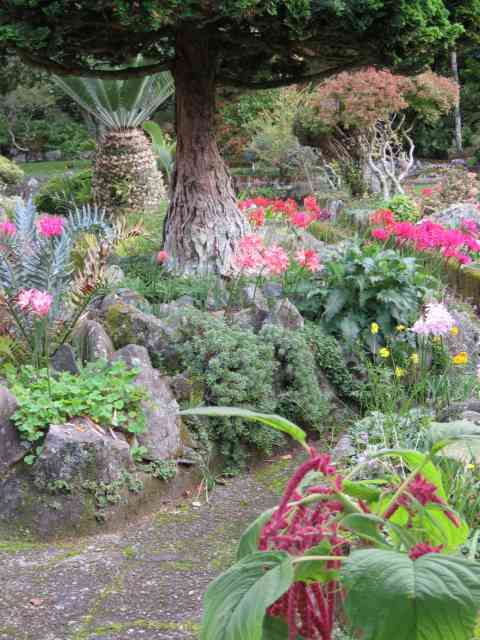
As our rockery measures some 20 metres by 10 metres, it is not small and it is certainly not low maintenance. Because it is largely raised beds and pockets of soil for separate plantings, it dries out and heats up in summer. Our frequent heavy rains drain quickly but that also leaches a lot of the nutrients out of the soil in the process. Bulbs generally need excellent drainage and many thrive in poor soil so they are quite happy in this environment. We try to get around with a thin layer of compost every spring and when I excavate a pocket to sort out its contents, I will add compost when I replant. But the soil overall is pretty impoverished and generally lifeless in the summer heat. There are almost no earthworms in summer but they seem to return as temperatures cool.

Rockeries are traditionally a re-creation of rocky mountain slopes to grow alpines. We can’t grow alpines here where our conditions and climate are anything but alpine. Our rockery basically consists of elderly dwarf conifers of considerable character and a few cycads giving all year round structure, offering some shadier areas beneath for bulbs of many descriptions. Smaller bulbs and many species rather than bigger hybrids which look out of scale, with one notable exception.

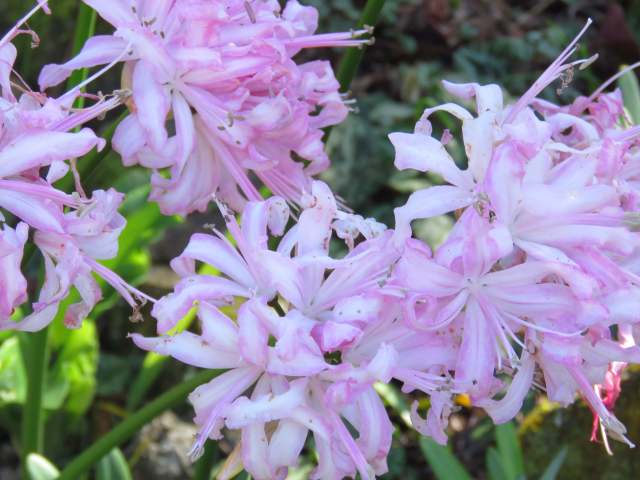
Nerine sarniensis hybrids

That exception is the Nerine sarniensis hybrids, most of which were bred and selected here although we have a few of the early Exbury ones and some of the species nerines. They are sensational at this time of the year. Along with Cyclamen hederafolium and the ornamental oxalis, they keep the autumn rockery full of blooms and colour.

Not all oxalis are equal. Some are much more floriferous and better behaved than others. This is O, luteola and it makes an excellent garden plant,

Last year, Zach reassembled the oxalis collection. Years ago, I planted them all out because I didn’t want to be repotting them every year and he set about retrieving some of each. We had only lost one or two inbetween times and he now has over 30 varieties in pots – most from the garden and a few extras he has picked up from local markets.
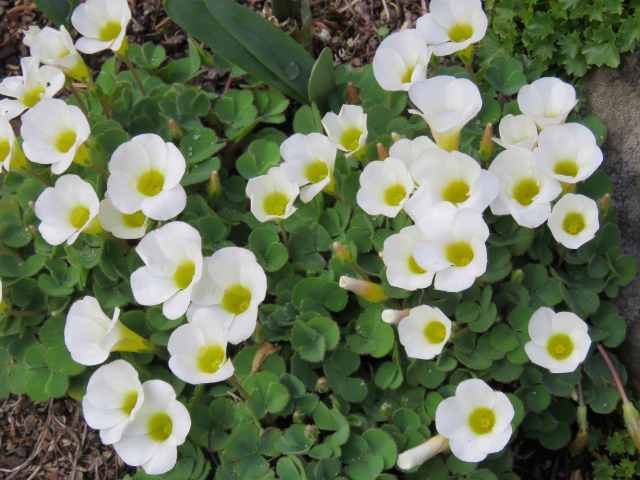
It is hard to fault Oxalis purpurea alba with its long flowering season, mass blooming and non-invasive ways.

A much maligned genus, the oxalis shine at this time of the year. We are only a few months off the short snowdrop season and the start of the dwarf narcissi and lachenalias. There is always something of interest going on in the rockery and it is constantly changing as different bulbs and plants take their time to shine. Always, Mark and I remember Christopher Lloyd saying in conversation on a TV programme, “I think you will find high maintenance is a great deal more interesting.” We could not agree more.
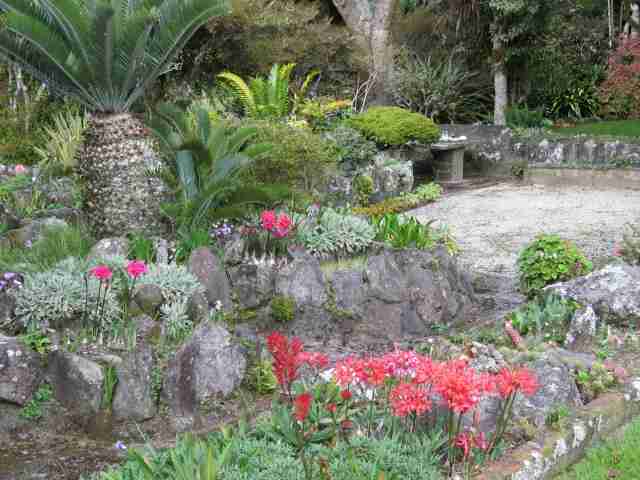
From big picture gardening to small picture detail

Ours is not a rockery for growing alpines

Ours is not a rockery for growing alpines

My mission to weed our stream and ponds, about which I wrote last week, has been subsumed. That is to say it has largely been taken over by the menfolk in my life and turned into something much larger but I am not complaining. I was trying to clear the water weed. They are now building an additional weir, flushing the stream and hiring a sludge pump to clear the ponds. I know my limits. I have moved up from the park and into the rockery.

Moving from the open areas to the intimacy of the rockery is going from one extreme to another. The former is big picture gardening and much concerned with giving large trees space to grow and anchoring the whole picture well into the surrounding environs. This used to be called borrowed views and vistas before those terms became so pretentious they fell into naffdom. The rockery is all about little pictures, highly detailed gardening. I wouldn’t be without either, but I really enjoy the attention the rockery requires.

Traditionally, rockeries were about creating an environment that resembled scree slopes of mountains in order to grow alpines. We cannot grow alpines. We’ve tried but it doesn’t work. Our high humidity, high rainfall and mild year-round temperatures conspire against alpines. For us the rockery has become the place to keep track of treasures and to confine dangerous but attractive bulbs. Most gardeners know how easy it is to lose bulbs in garden borders. Some get swamped out by neighbouring plants, some are so anonymous when dormant that they get pulled out with other plants, some just seem to go, we know not where. If they have their own pocket in the rockery, it is possible to label their location and restrict competition.

Rockery conditions are surprisingly harsh. All that stone and other hard material heats up in summer so the soil dries out quickly. The gentle, steady rain we had last week didn’t penetrate very far. This means you have to be pretty selective about small shrubs, perennials and other plants but the bulbs don’t usually mind. In the wild, most are used to marginal conditions.

Too much of a good thing - Cyclamen hederafolium with black mondo grass

Too much of a good thing - Cyclamen hederafolium with black mondo grass

Two summers ago, I took the rockery apart pocket by pocket. At the time, I estimated there were about 500 separate compartments and it took me a full month’s work. At least I got to know it and all its inhabitants. This time I am only concentrating on the messy bits and the areas where plants responded a little too enthusiastically to the earlier renovation. The combination of black mondo grass and pink Cyclamen hederafolium is very pretty, especially as snowdrops come through the marbled foliage of the cyclamen in the depths of winter. But you can have too much of a good thing and all three inhabitants were trying to outcompete each other. I am thinning them drastically.

To garden in this style, you have to be willing to tolerate the messy season bulbs have, when their foliage is looking past its best. Most bulbs use the time after flowering to build strength below ground so they can flower again next year. When they have done that, their foliage dies down naturally. With some, this is a quick turnaround. Others, like nerines and colchicums, take many months. We just try and ensure that other areas of the rockery have more attractive displays to distract the viewer and leave the plants to their natural cycle.

I used to think that every pocket of the rockery should have something of interest in it all the time. This is actually a lot harder than it sounds because you then need to use a succession of maybe four different plants which can co-exist quite happily – and each compartment should have different combinations. In other words, for me this would be getting on for 500 miniature gardens. Rockeries are no place for mass planting. I flagged that idea – too hard and not necessary. Some compartments will have periods of the year when they appear empty and that is fine as long as there are no weeds. There is no place for any weeds at all in this intensive style of gardening.

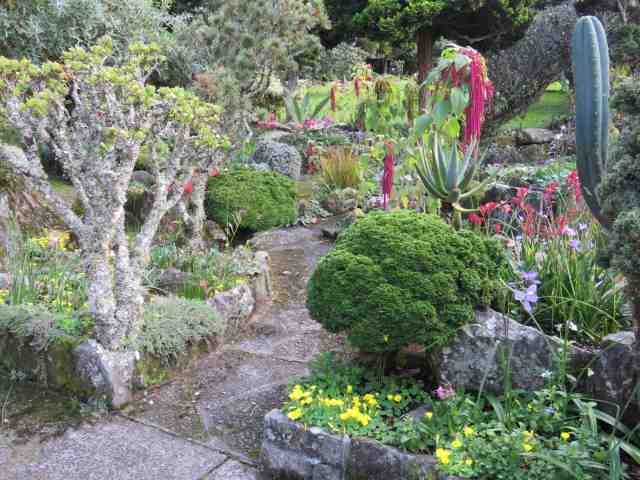
Ours is an aged example – sixty years to be precise. We have some fine, gnarly, old, characterful dwarf conifers to give year round structure along with some smaller growing cycads (though somebody forgot to tell the handsome Cycas revoluta to stop growing). We have a few easy care, small perennials to soften the edges. A compact little blue campanula is one of the best of these along with a well behaved little scutellaria. We like the tall punctuation marks of some plants drifted through the rockery. The upright orange-toned orchid, Satyrium coriifolium, is the choicest one. The large flowered yellow Verbascum creticum seeds down gently to give the statement in late spring and the amaranthus (Love Lies Bleeding), similarly self seeded, is growing before our very eyes to fill the vertical accent role in autumn. These plants just provide a framework for the real stars – a succession of any and all interesting bulbs we can grow.

It means there is always something of interest to look at. I enjoy that sort of detailed gardening.


First published in the Waikato Times and reproduced here with their permission.