Tag Archives: Tikorangi: The Jury garden

Not Exactly Italy. Despatches from Heroic Garden Festival 2.

“Against the uniform sheet of snow and the greyish winter sky the Italian villa loomed up rather grimly; even in summer it kept its distance, and the boldest coleus bed had never ventured nearer than thirty feet from its awful front.”
Edith Wharton The Age of Innocence (1920)

Coleus, I regret to inform you, appear to be staging a comeback if what I saw in Auckland at the weekend is any guide

Coleus, I regret to inform you, appear to be staging a comeback if what I saw in Auckland at the weekend is any guide


I have done two trips to Italy. The first was a major garden tour in the north, in most elevated international company so it was the full immersion experience where we got to meet head gardeners and, in some cases, garden owners. Why, we even had a reception with the Principe and Principessa Borromeo on Isola Bella. For those not in the know, the Borromeo family have an aristocratic pedigree, wealth, power and influence even today which is beyond the average New Zealander’s comprehension.

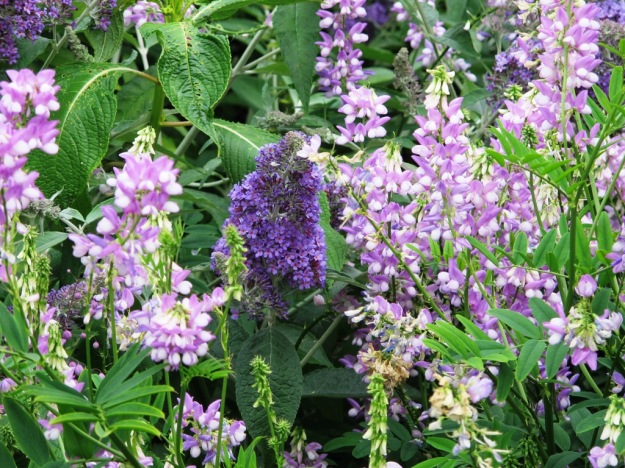
Villa del Balbianello on Lake Como

Villa del Balbianello on Lake Como

On my second Italian trip, we were in the south travelling from Sicily to Rome with some incidental garden visiting along the way. The Italian gardening that most of us see is historical and traces its origins to times of much greater personal wealth and power. Yes it is hugely impressive but not, generally, because of the actual plants and gardening. It is the magnificence of the stone structures, the grandness of the villas – which can be very austere – with imposing formality in garden design. Most of it rests on the confident use of space and proportion, delineated in stone. Literally. There is not a hint of tanalised pine to be seen anywhere. The quality of light is also very different to our hard, bright light in this country.

Yes, there tends to be a very restrained plant palette and the same plants are seen in most gardens. I remember writing at one point about the ten plants that show up in every garden. Many of the historic gardens are clipped and groomed to within an inch of their lives and plant health isn’t always great.

Talking to the head gardeners and garden managers, the restricted plant palette is largely climatic. It is not an easy gardening climate, being cold and dry in the north in winter and hot and dry in summer. Further south, it tends to be just dry and dusty. If they could, they would grow a much wider range and that is evident in some fine gardens like Isola Madre and Villa Taranto.

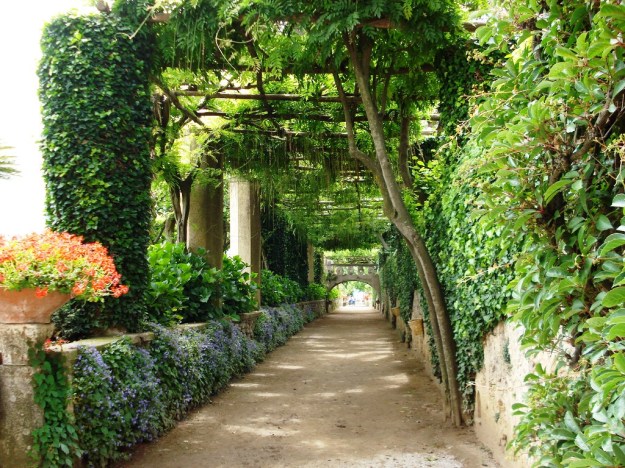
Villa Cimbrone  in Ravello on the Amalfi Coast

Villa Cimbrone in Ravello on the Amalfi Coast

The recently-retired head gardener of Ticino Botanical Park on the Islands of Brissago in Lake Maggiore sought out Mark at the time of our visit. He then stunned us a couple of years later by pedalling in here, unannounced, at Tikorangi. He was biking the country. We really liked Ticino. It was a small island with a villa that seemed more domestic in scale and it had a fine stand of Taxodium distichum growing on the lake edge. His comment to Mark, when he visited here, was: “You must have been very disappointed in Ticino.” He was looking at the range of what we grow compared to the conditions he knew.

So it is a mystery to me as to why New Zealanders, in their quest for “Italian styled” gardens would want to take that restricted plant palette as a mandatory, defining characteristic. This is a country where we can grow almost anything.

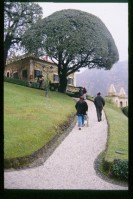
The grand historic reality

The grand historic reality

The modern domestic reinterpretation on the other side of the world

The modern domestic reinterpretation on the other side of the world


And can you achieve a domestic version of the grand, historic Italian gardens In New Zealand without the pivotal grand villa and the grace and proportions of a major estate let alone without the historic stonework? I mean, Villa Serbelloni on Lake Como has a genuine Ancient Roman fort in remarkably good condition at the top of the garden. Difficult to top that as a garden feature. And the grand gardens often have landscape vistas of astonishing beauty.

I don’t know anything about contemporary Italian garden design but neither, I suspect, do most New Zealanders. I can say that my limited experience of current domestic gardening in Italy showed a certain leaning towards what they saw as the “romantic English style” – less formal, more frothy and trying the broaden the plant palette.

Not only do New Zealanders on the quest for an Italian-style garden go for a limited range of plants, with the historically questionable exclusion of colour and bloom, they take a simplistic interpretation of hard-edged formal design without acknowledging that this is the garden design of the super powerful and super wealthy Italians in centuries past.

I could suggest that the Italianate gardening that I have seen in this country is to Italian gardening as a dinette is to a dining room, a kitchenette to a kitchen or as marblette is to marble.

All this is because I visited a garden during the Heroic Garden Festival that billed itself as “transport yourself to Italy…”. I don’t think so. It was a beautifully presented, immaculate garden, very hard edged and clipped with “a controlled palette of plants”. The fact that it is not to my personal taste is completely irrelevant. I can respect the determination and focus that goes into creating and maintaining that sort of garden and it was done to a high standard. I am sure the owners are very proud of it.

But Italian, it is not. I think what we bill as Italianate in this country is more Miami hotel-style reinterpretation of Italy. The Italian inspiration is distant at best.

The real deal in Italy

The real deal in Italy

More Miami than Italy in Auckland

More Miami than Italy in Auckland

Tikorangi Notes: Thursday 12 February, 2015 Wildflowers or weeds?

Pretty by the road to town. The convolvulus IS a problem and agapanthus come in for a lot of criticism in NZ.

Pretty by the road to town. The convolvulus IS a problem and agapanthus come in for a lot of criticism in NZ.

Feeling the need to head my site with something more pleasing than the industrialisation of our beloved Tikorangi in my previous post, I flag wildflowers and roadsides. We have been talking about this a great deal over summer and clarifying our thinking. In New Zealand, these are often – in fact usually – seen as weeds for we are still a pastoral countryside where unrelenting green fields are deemed to be the desirable state. And of course our roadside flowers are almost all introduced plants, a few of which run amok.

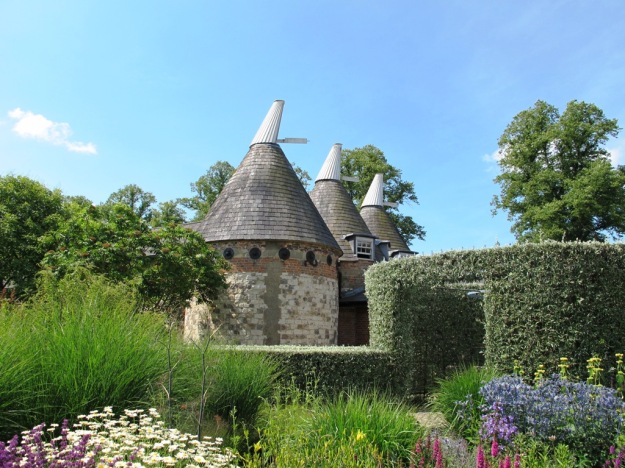
Who wouldn't covet the oast houses at Bury Court?

Who wouldn’t covet the oast houses at Bury Court?

It was interesting watching BBC Gardeners’ World a few days ago. We seem to run about two years behind here so any UK readers may not remember the episode where Carol Klein visited Bury Court and the owner spoke about how he wanted his garden to echo the nature. The nature to which he referred was the hedgerows, meadows and road verges.

We visited Bury Court late last June. Naturally we coveted the lovely oast houses but the garden was also a delight and we learned a great deal from it. We could see the echoes of the English countryside repeated in a managed fashion.

To New Zealanders, nature is more likely to evoke images of our verdant and dense native forests and bush. It is a different perception of the environment altogether and it is taking some thinking to move preconceptions away from weeds to valued wildflowers that contribute to the eco system. Of course the pasture grass that we value so highly for our grass-fed stock is no more native than the wildflowers that grace our verges but the latter still get a bad rap here. I will return to this topic.

More Bury Court. Is this not lovely? I think so.

More Bury Court. Is this not lovely? I think so.

Tikorangi Notes, Feb 8, 2015: In search of a missing tennis ball

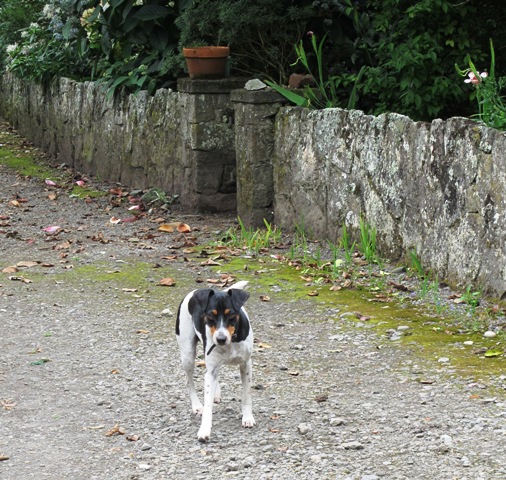
New dog Dudley lacked application when it came to searching for his missing tennis ball in the shrubbery

New dog Dudley lacked application when it came to searching for his missing tennis ball in the shrubbery

When we first plant a garden, we all experience impatience – waiting for the plants to settle in, to grow and to fill the space. At some point, often without us even noticing, the garden morphs over to the point where it is all about trimming back, shaping and letting in light. This thought came as I spent my weekend on an entirely different task to that I had planned. The shrubbery beside the driveway had indeed reached the point where it would benefit from some serious attention.

Our new dog Dudley was the unwitting catalyst. Dudley, or Dudders to give him his cricketing nickname, is a four year old fox terrier – a re-home from the SPCA (as opposed to a rescue dog). He was clearly a much loved dog but a townie dog and it has been a steep learning curve of liberation for him to move to the country and space. In his nine short days with us, he has won a place in our affections already and settled in better than any of us ever anticipated. Dudley plays and therein lies the connection. Yours truly was never a sporty gal at school and my ball skills were always a little lacking. Out entertaining Dudders on the lawn with a tennis ball, I hurled it into the shrubbery in error. He quickly gave up the search.

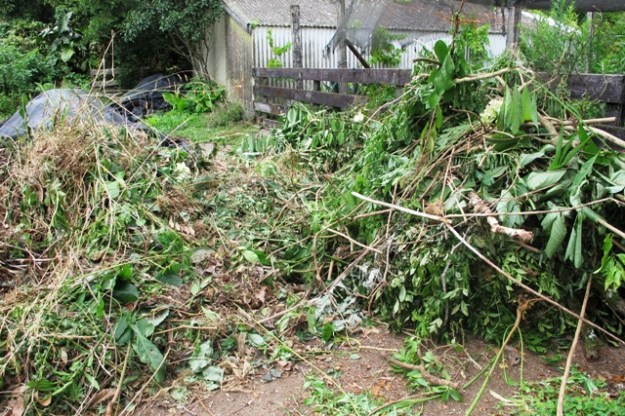
I have removed a prodigious amount of material - to the left for compost, to the right to be chipped and then composted

I have removed a prodigious amount of material – to the left for compost, to the right to be chipped and then composted

I, on the other hand, have spent two full days cutting back and clearing out a prodigious amount of plant material. Yet the tennis ball remains missing. Each time Mark passes, he asks whether I have found it yet. He has suggested I may not know my own strength and maybe launched it further than I realised. That seems unlikely but its whereabouts remains a mystery. The shrubbery, however, is now open to the light and there are gaps to be filled when the autumn rains arrive. I expect it to look well furnished and handsome again by spring and I am keeping it largely true to my original theme of blue and white flowered shrubs only.

I have long thought that shrubberies are one of the lowest maintenance forms of gardening and they probably are but even they need a major clean out once every five years.
???????????????????????????????In the garden it is still all about lilies. Big, blowsy, over the top auratum lilies. I am not picking the ones in the garden but in a small area of Mark’s new vegetable garden is a congested block of his seedling auratums, raised in anticipation of our new summer garden. There I can pick by the armful and oh, how I love these extravagant blooms. Auratums are a strong argument for the vigilant border control we have in this country. We do not, repeat NOT, need the lily beetle here. It is a nasty critter that takes up residence on auratum lilies and covers itself in its own excrement. We have seen it in the UK where it is an unwelcome arrival which has all but destroyed the auratum display in some areas.
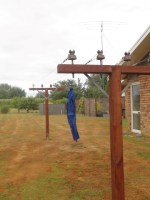
DSC01258 (Small)DSC01260 (Small)2013_0105carol0023 (Small)Following my final photo feature for the Waikato Times on the topic of washing lines, Times reader Carol Lodge sent me a lovely email of appreciation and sent me photos of her new washing line which struck me as genuinely creative and resourceful. She says: “The insulators and stays for the washing line came from a trade with the power board gang who were replacing poles down our road- morning tea in return for the insulators…. My husband is a radio ham and apparently , and not by coincidence my clothesline is tuned to the 80 metre band.”

It is a bit like the final word on washing lines, isn’t it? But I am off garden visiting with friends in Auckland this weekend at the Heroic Garden Festival. It appears to have lost many of its heroic origins now – become “straightified” a gay friend observed – but I may well find additional examples of washing lines and other ideas to share from these smaller urban gardens.

I have ALL the lilies

I have ALL the lilies

Plant Collector: Z is for habranthus

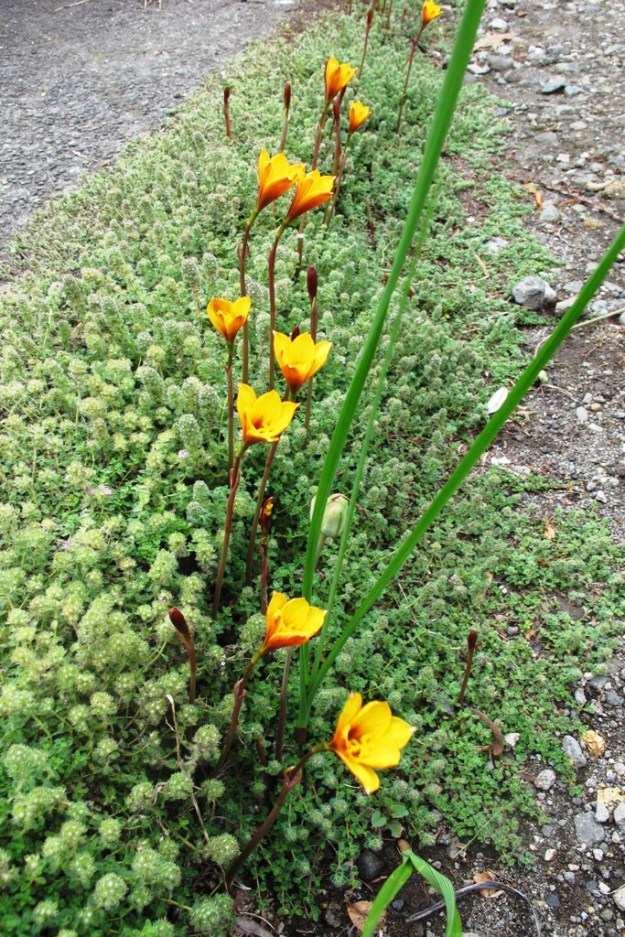
Habranthus. Not zephyranthes any longer. Apparently.

Habranthus. Not zephyranthes any longer. Apparently.

We have always called this a zephyranthes. It probably came to us as a zephyranthes and in the past it has been referred to as one of that family but it appears it is now an habranthus – H. andersonii from the description. Or rain lilies, to use the common name, for the flowering is triggered by summer rainfall. Lilies are a bit of a stretch because these habranthus belong to the Amaryllidaceae family not the Liliaceae one. Besides, they look more like summer crocus, really.

They gently seed down and are established here amongst the prostrate thyme that edges our driveway, popping up also in the cracks in the concrete. The many flowers spring up very quickly throughout summer and set seed which matures equally quickly. This is usually an indication of weed potential but we have not found them to be invasive over many years. From time to time, I thin out the seedlings and I pull off some of the seed heads as I pass. Foliage follows after flowering and is the thin, grassy persuasion.

Habranthus andersonii is native to Uruguay and Argentina and indeed all the habranthus and zephyranthes seem to originate from that area of Central America, north into Texas and the warm areas of South America. The difference between the classification of the two plants may, it appears, come down to the angle at which they hold their stamens. That is a little esoteric, even for us.

No longer first published in the Waikato Times and I do not need their permission to publish here. Replaced, I have been, by a page that tells you how to grow savory, how to go about hanging wallpaper and to go and buy your swan plants from the garden centre now. It is too late for the last suggestion. You need your swan plants well established and sizeable already if you want to get through the late summer rush of monarch caterpillars.

The utilitarian washing line in the garden

Washing lines! These continue to be seen as essential for most New Zealanders, although they are apparently banned in a number of urban areas in the USA as inappropriate for public view. As urban apartment dwellers are limited to clothes driers or folding clothes racks, those of us with sufficient outdoor space for line drying should perhaps count our blessings.
???????????????????????????????1) This is my own washing line, dating back, I assume, to when the house was built in 1950. I like the giant bamboo prop we use to hold it up. I think it is what Kevin McLeod of Grand Designs would call “honest” or maybe “unpretentious”. Old fashioned, certainly, it offers excellent drying but you do need space and you have to walk up and down it rather than standing in one spot to peg and unpeg.
???????????????????????????????2) The rotary clothesline, often referred to as the Hill’s Hoist, is an Australasian phenomenon which features heavily in suburban backyards of both Australia and New Zealand. There is no doubt it is practical but it also lacks any aesthetic at all. Is there a sadder sight than a barren backyard with nowt but a weed infested area of broken concrete and a Hill’s Hoist washing line?
???????????????????????????????3) Presumably in an attempt to hide the heavy visual presence of the Hill’s Hoist, there seems to be strong interest in wall-mounted lines which can often folded down discreetly when not in use. I would guess this one was advertised as having 20 metres of line space (10 wires by 2 metres each) but it isn’t really 20 metres of usable space and it won’t hold large sheets without folding them in on themselves. It lacks the air circulation of the first two options so will not offer such efficient drying but the wide eaves give some protection from rain.
???????????????????????????????4) For property-proud people, the service areas needed for a household may be screened. Here the washing lines join the Sky dish, heat pump units, and probably the wheelie bins and recycling bins. The trade off is the reduction in sunshine hours on the shaded side of the house as well as reducing the air movement which dries washing more quickly. I have seen this done in a small garden but the screening was much closer to the washing line which created more shade and reduced air movement even further. Keep some distance if you can.
???????????????????????????????5) As a D.I.Y. compromise, I photographed this fixed line which is free standing in full sun but softened by the frames at either end which are wreathed in a flowering climber – one of the solanum family but I am not sure which one. Paving beneath gives reflected heat and keeps fallen items cleaner. This is the best example I found for a town section where the owner wanted a more discreet but still efficient washing line. It also took the award for the prettiest clothes line I found.
???????????????????????????????6) I spotted this line on a large country property where winters can be a little cold and bleak. It is under cover but the roof is high. It incorporates screening from view without sacrificing air movement. It is on a property with accommodation units and the owner told me there was sufficient line space to hang all the washing from the four units. She loved her washing line and, where space allows, it struck me as remarkably practical.

First published in the Waikato Times and reprinted here with their permission.