

This is the first spring in twenty seven years that our garden has not been open to the public. It has been something of a revelation. We have so many friends and colleagues who open their private gardens for at least some of the year that it had become normal – an integral part of our lives and how we gardened. We wanted a break but the main driver for the decision to close has been the high impact of the petrochemical industry. From being a sleepy little rural enclave, in a few short years Tikorangi has become Petrochemical Central and this has sent scarily large amounts of heavy and often hazardous transport past our gate. It is not a good fit with an open garden. We take the long view here. Our garden is built around trees originally planted by Mark’s great grandfather from 1870 onwards. The house gardens have been intensively worked since they were first put in by Mark’s parents in 1950. It seems likely that the garden will still be here when the gas has been pumped out from the ground below us and the petrochemical companies have moved on from fossil fuels – to renewables, we hope. In the interim, I don my iPod because I would rather listen to music in the garden than heavy industry. Now we garden for our own pleasure and without having to titivate to open garden standards – or garden grooming we call it.

Cymbeline, on of the David Austen roses
November is peak rose season for us. I have a love-hate affair with roses. I am forever debating with myself whether the beauty of the blooms outweighs the foliage and form which are often disappointing – even more so as the poor defoliated things battle through summer and autumn. But is a large, comprehensive garden ever complete without roses? The problem is that we don’t spray our roses. Ever. I never spray anything and Mark point blank refuses to do roses. If they don’t perform without spraying, rip them out and replace them is his view. We do a bit of that and we are trialling some almost thornless pillar roses for a new pergola we have planned.

Mme Plantier, I understand
Mme Plantier, I understand [/caption]Personally, I am not a fan of hybrid teas. They don’t even rank amongst desirable cut flowers for me. I much prefer the informal floribunda types. We have a wonderful white shrub rose which was finally identified for us as Mme Plantier. It keeps excellent foliage without intervention, flowers in abundance and is sweetly scented. But it is only once-flowering and so many gardeners now refuse to grow any rose that doesn’t repeat-flower through the season. We don’t expect other shrubs to flower continually but poor roses are now judged by a different standard. Is six weeks not enough?

Rose Flower Carpet Appleblossom
While the Rose Flower Carpet series never attract descriptors such as delicious or exquisite, as high health backbone plants, we have yet to find anything to rival them. Year in and year out, they flourish despite our high humidity and high summer rainfall. The somewhat vibrant pink form that was the first to be released and the white have particularly long flowering seasons. In fact the white is rarely without blooms. The bright pink looks great when surrounded by large amounts of background green. It took me a few attempts to find the right locations. I prefer the paler apple blossom pink but it doesn’t repeat as well and blooms can ball in heavy rain. While we don’t spray, I am old fashioned and prune by the manual, even though there is research which says that a pass over with hedge clippers is just as effective. We keep roses in open, sunny positions with good air movement. As a point of principle, we do not routinely add fertilisers to our ornamental gardens but we mulch often with homemade compost. That is their feed. If any roses can’t perform well enough with the same regime of care that the rest of the garden gets, then I am afraid they are not for us. But those that do well here are a November delight.
First published in the November issue of NZ Gardener and reprinted here with their permission.
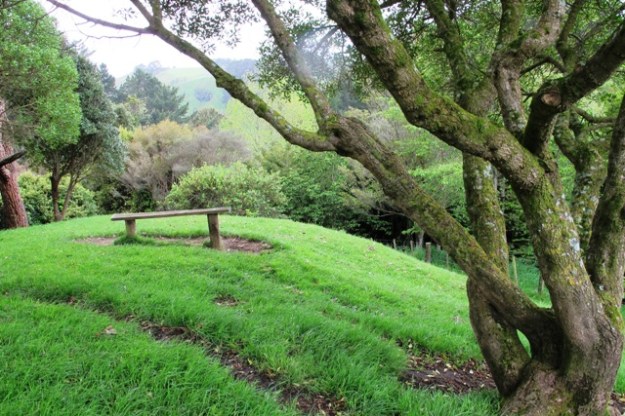 1. Sometimes it is the setting, not the seating which is the important feature. A simple bench is all that is needed to draw attention to the beautiful long vista, inviting you to take the time to sit and look. You need tanalised timber of course and farm posts are the most practical option. Make the bench long enough to hold two people and their coffee mugs without having to be too close, but not so long that it sags if somebody sits in the middle. This lovely scene is at Puketarata Garden near Hawera.
 2. How could I not include this example from Wairere Garden in Gordonton? Obviously there are a few practical issues when it comes to sitting on this hand crafted bench which looks as if it has been made from old fence battens. With that length it would only be suitable for a single person or two young lovers. I really liked the sense of enclosure with it being placed inside a curved hedge and the contrast between the lichen-encrusted, rough simplicity and the clipped formality behind.
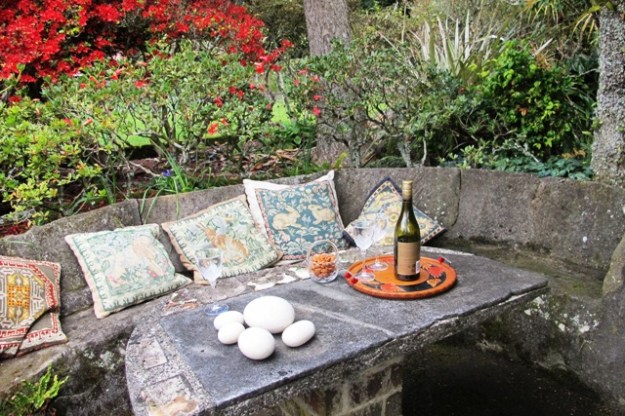 3. This is one of our own favoured seating areas, especially in summer when there is dappled light through the trees above. It is comfortable enough even without the tapestry cushions made by my late mother. The curved bench seat is stone, the table concrete on a brick plinth. I am guessing it was Mark’s mother who inset the vintage tiles around the edge of the table to add detail although few remain now. It does not always come equipped with the bottle of wine.
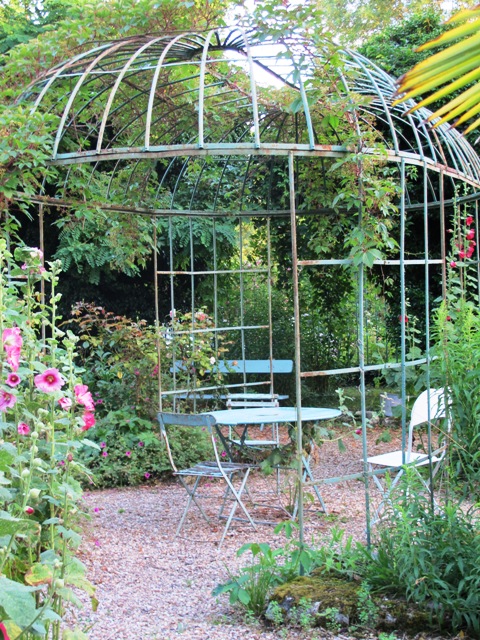 4. From home to away – the garden out the back of Restaurant Baudy in Giverny (where Monet himself used to dine with friends and you can repeat the experience to this day) applied casual French deshabille style to the outdoors. You would not want to be of large stature and trust to this outdoor setting, but the hollyhocks and gently rusting iron are the epitome of what is sometimes styled shabby chic in modern parlance.
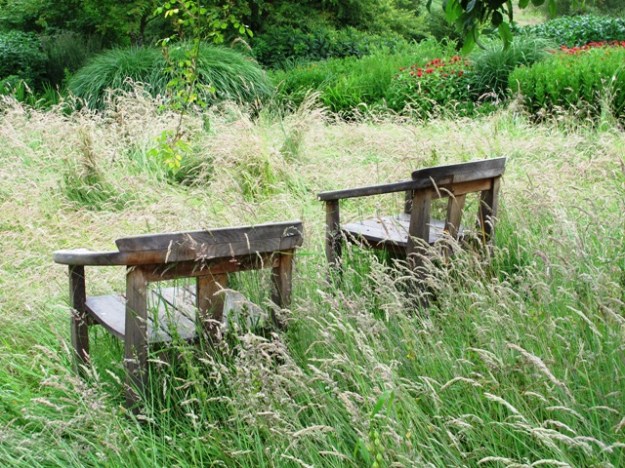 5. Let’s be honest, you would not be wanting to sit on these chairs when the grass is wet, but then if it has been raining, outdoor seating will be wet too. The absence of worn track marks to the chairs suggested that they were not in great use when we visited this garden near Stratford on Avon. But that long grass, meadow look is very charming. And at least if the seats are sited in the long grass, the legs will not be making holes in the lawn and you don’t have to move the furniture to mow.
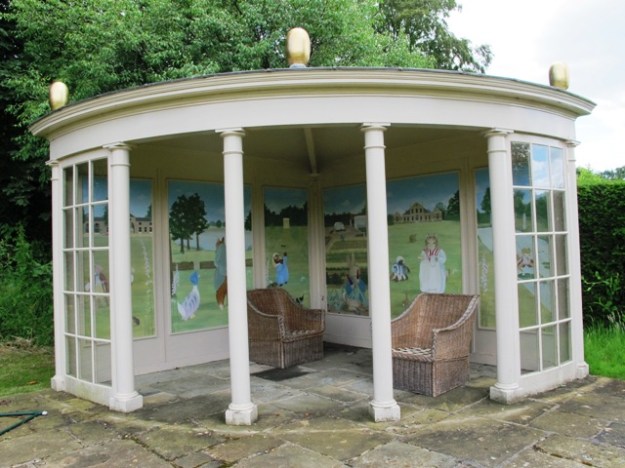 6. This is in a private Yorkshire garden and is, believe it or not, the children’s pavilion though I doubt that the comfortable cane chairs are there for the children to sit upon – far more likely for adults. Traditional cane needs to be under cover. It is only the all weather modern synthetics that can be left out in all weathers but modern or old, I have yet to meet outdoor seating that is more comfortable than cane. Personally I covet a little semi-enclosed pavilion like this one – with or without the Beatrix Potter wall paintings. In a climate which is never quite as warm as I would like, this type of outdoor room seems eminently practical.
