Tag Archives: Tikorangi: The Jury garden

Mostly Villas d’Este and Adriana – Postcards of Italy 2.

This Italy actually exists

Cliched though this scene may appear, it is not contrived. I just came across the view as we walked from Villa Adriana to the nearest coffee shop five minutes up the road. We wanted our morning caffeine hit before we tramped the ruins. Not only were there red poppies growing wild in the barley crop, the blue chicory and white convolvulus (field bindweed) were flowering alongside the stone wall that edged the road. I probably laughed out loud in delight.

Villa d’Este in Tivoli is known worldwide as one of the great Italian gardens. Built by The Man Who Would be Pope to compensate his thwarted ambition, it dates back to 1560. It was grand then. It is still grand today and water features throughout. His land excavations to achieve this garden would have put Capability Brown into the shade.

Formal but not strictly symmetrical at Villa d’Este

We have looked at some of the great Italian gardens on previous visits and had come to the conclusion that it is the settings, the hard landscaping – particularly the stonework – the history, the handling of space and proportions and the symmetry that makes these gardens endure as monuments to wealth, power and sometimes grace down the centuries. It is not so much to do with the plants or the maintenance. In a moment of profundity, as we walked through Villa d’Este, I noted that the symmetry is achieved through repetition, not through slavish measurement. It is that repetition and symmetry on a large scale that makes them so pleasing to the eye.

Attention to detail is not a strong point in Italian garden maintenance. Plants are not required to be immaculate. Irrigation hoses are often visible. It is okay to have plastic pots visible inside the terracotta pots. Water quality can leave a lot to be desired. Lawns are impossible in their climate. Some coarse grass kept green by watering is the best that one can hope for. The big picture is what matters. But, should you have grand visions of creating an “Italian-style” garden at home in New Zealand, maybe be aware that there is not one skerrick of tanalised timber – be they posts or plywood edgings or pergola beams – in any of these originals. Personally, I do not think that you can be Italianate or even Italianesque and use undisguised tanalised timber as a substitute for stone and terracotta. Ditto modern ‘dragonstone’ urns. And imposing suburban New Zealand values of pristine maintenance and velvet lawns takes such gardens even further away from the originals.

The straw broom brought a smile to our faces. Regular readers may remember me posting about the making of these in China.  Sometimes there is a charm to old ways. Besides, as Mark points out, these brooms work very well. Our first ever visit to Italy was back in the early 2000s when we went on an IDS tour of northern Italian gardens. It was there we first saw the widespread use of leaf blowers and came home and bought one. These days, Mark is using ours less and less. He is a bit of a purist, our Mark, and has become concerned at how dependent we have become on the internal combustion engine to maintain the garden.  If somebody would just make him a few straw brooms, he would be a happy man.

I am sure it takes a great deal of work to look like a modern-day princess, even more so when the temperature is over 30 Celsius and the location requires walking down and then up hundreds of steps. Mark noted that she was also behaving like a princess – the one with the pea under the mattress. I couldn’t possibly comment. Even when I was considerably younger, I do not think I ever managed the princess look.

Real life nymphs at Villa d’Este

I preferred the real-life nymphs. It transpired they were American art students doing an art history semester in Italy. Mark discreetly walked past them as they sketched and reported that they were extremely competent at drawing.

Villa Adriana – just one small view of a huge complex

Villa Adriana surprised us by its scale. It is the Emperor Hadrian’s retreat dating back to 200AD. The word villa encompasses a range of building styles and scale in Italy. The one at Villa d’Este is more akin to a palace. Villa Adriana is an entire small city of largely unrestored ruins encompassing about 250 acres. What is more, you can walk amongst them. I found a Roman toilet and an ancient olive grove that was simply astonishing. More on the olive grove another time. This was the Roman empire but it had an air of abandoned desolation even today, as though the tourist plans and archaeological aspirations of even a few years ago had fallen on hard times.

There was a fair amount of statuary of the armless, legless and formerly white variety but I think most of it was more recent reproduction already in decay. Much of the surviving, original statuary and marble had been raided 500 years ago by Cardinal Ippolito ll d’Este and relocated to his nearby pad but we did not know this when we went around Villa d’Este.

The wildflowers in the ruins of Adriana had a simple charm. In those drought-like conditions, the spring rains must bring a short-lived surge of germination and growth. The plants shoot straight into flower but conditions prevent them becoming invasive problems.

Finally, fields of sunflowers on the road to Ninfa. All facing the wrong way for the picture book image with the house and hills behind. Viewed from the other side, we lost the landscape context.

The light is so different in Italy

Quaker Mason, the magnolia and our maunga


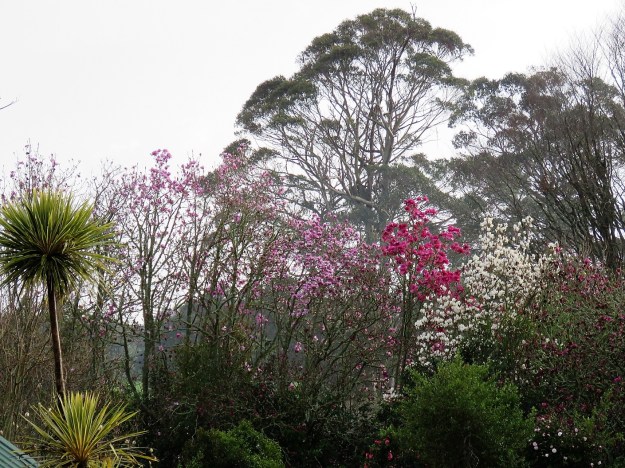
The magnolia and the maunga from our garden in Tikorangi

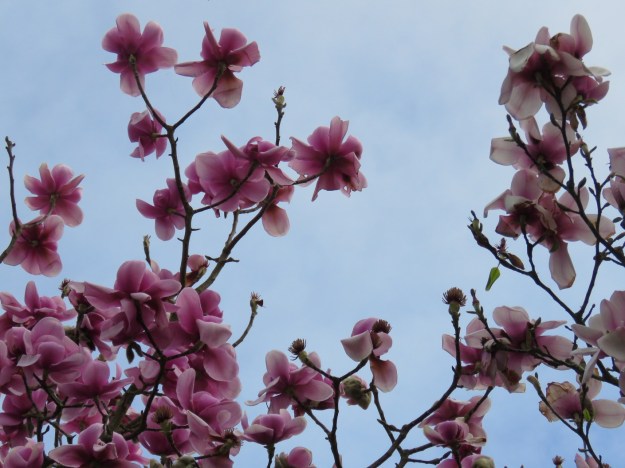
In the heart of wintry July, M. campbellii is the first magnolia to open and promises the delight of a new spring. At least, that is when our tree blooms. All the tarseal and concrete in the central city of New Plymouth lifts the temperature and the cluster of trees in the Huatoki Reserve by Powderham Street open their first flowers in June, before they have even shed all their autumn foliage.

For the past two Julys, I have spent more time than I should have taking photos of our tree against the snow-capped peak of Mount Taranaki. The magnolia and the maunga, I call the series. There is a distance of maybe 40 km or so between the two so this is right at the limits of both the zoom on my camera and my technical skills but I keep trying for the perfect image without having to resort to cheating with filters and the computer.

M. campbellii in the grounds of the Church of St John Baptist in Waitara

When I look at my photo file on campbellii, I have a series of trees framed against backgrounds – one in our local town of Waitara against the spire of the Church of St John the Baptist, a specimen at Tupare garden with the backdrop of the rushing Waiwhakaiho River, the aforementioned Powderham Street specimens against a carpark building, even one on Mount Baotai, framed by Chinese roof lines. I think what drives me is the effort to capture the spirit of over the top, gorgeous flowers appearing in a winter landscape.

Quaker Mason form

Magnolia campbellii is one of the oldest varieties in New Zealand. It dates back to the second half of the nineteenth century and was sold commercially by Duncan and Davies as early as 1915. Before you rush out to buy one, you need to be aware that this species can take many years before it sets flower buds and ultimately grows into a very large tree. Its early season blooming also makes it vulnerable to frost damage in cooler parts of the country. If you are only going to plant one magnolia, maybe look to one of the more recent hybrids, although M. campbellii itself belongs in any collection. Our specimen here was one of the first trees planted in our park by Mark’s father, Felix, in the early 1950s.

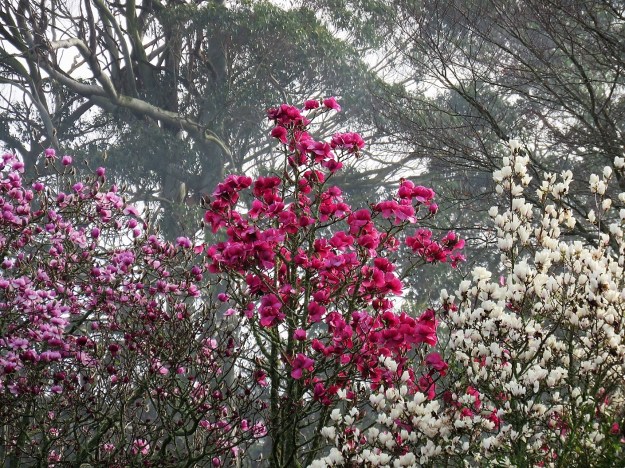
The pink campbellii is the most common in Taranaki where the majority are the particularly good ‘Quaker-Mason form’. It is traced back to Thomas Mason (commonly referred to as Quaker Mason, on account of him being a Quaker), a prominent Wellington horticulturist who arrived as a new settler in 1841 and had a huge influence through until the end the century. But the pink that we take as the norm here, is in fact not at all common in the wild where most campbelliis are white. Apparently our pink originated in Darjeeling – an area better known for its tea in India’s north east.

M. campbellii on Mount Baotai in south west China, with Chinese powerlines

Overall, M. campbellii has a wide natural distribution. It grows from eastern Nepal, across Sikkim and Assam into south western China and down to northern Burma. We were thrilled to see a plant on Mount Baotai in China last year, even though its pale pink blooms showed it to be a pretty average form of the species. We couldn’t tell if it was naturally occurring or had been moved into its current position, as the modern Chinese are wont to do.

The white form at Tupare

We don’t have a white M. campbellii in our garden so I had to head to Tupare Garden in New Plymouth to photograph their mature specimen that dates back to the late 1940s or early 50s. The blooms have a curious green flush at the juvenile stage but the tree is not a strong growing, distinctive form. It is not a patch on all the pink Quaker-Mason specimens around but there will be other white forms available in New Zealand.

These are all Magnolia campbellii var. campbellii. The other popular form of the same species, known as Magnolia campbellii var. mollicomata, originates from areas further to the east and flowers several weeks later. Our fine specimen of purple ‘Lanarth’ (or Magnolia campbellii var. mollicomata ‘Lanarth’, to be pedantic) will not flower until halfway into August.

First published in the July issue of New Zealand Gardener and reprinted here with their permission. 


The pink campbellii at Tupare with the rushing river beyond

Two footnotes:

The word maunga means mountain in the Maori language. In Taranaki, where the presence of our beautiful maunga (Mount Taranaki) is a defining element for all who live here, the word maunga is often used in preference to the English word.

The blue skies are indeed genuine. We have a clarity and intensity of light here all year round, even in mid winter. Though it must be said that not every day in winter has blue skies!

Postcards of Italy

The reflecting pool at La Torrecchia

While the visit to Ninfa was the reason that took us to the area around Latina, south of Rome, we were also fortunate to get to the nearby garden of La Torrecchia. It, too, is created around the ruins of a medieval village, though a smaller one than Ninfa. It is a much more recent garden, dating back to 1991, and it remains gardening on a private, domestic scale. Much of the design can be attributed to the English landscaper, Dan Pearson, whose style interests us a great deal. While this is early Pearson (dating back almost 25 years now), the reflecting pool above is his work. Surrounded by a riot of self-sown seedlings, it was a delight.

The cork oak, Quercus suber

In New Zealand, it is rare to see a wine bottle with a cork these days and most of those will be plastic. This is the land of the stelvin screw top closure. But I give you the curious cork oak, Quercus suber. This fine specimen is in the garden of La Torrecchia. The switch to screw tops has done much to relieve the pressure on these trees which had, apparently resulted in too many inferior corks. It is a curious fact that many restaurants here still pour a mouthful of wine to be sampled by the patron when, as I understand it, this tradition came about because of wine being tainted by the original cork.

The cork dog kennel stood by the gardener’s cottage at La Torrecchia. Whether a resident dog lives in it remains a mystery but I can tell you that we saw a big as, bigly even, huge hornet fly into the cork. We don’t have hornets at home, let alone these scary specimens. If I was a dog, I would be refusing to share my quarters with a hornet like that.

It is always a slightly strange feeling to encounter one of our plants across the world so I made Mark pose by the specimen of Magnolia Atlas in La Torrecchia. This one was bred by his father, Felix, and it felt very personal that there was a little bit of Tikorangi even in an Italian garden.

Mark beside Atlas at La Torrecchia

Kiwi fruit (actinidia) may have originated in China but we pretty much claim them as our own in NZ. And the commercial product now bears little resemblance to the wild species in their native habitat. It is one of our horticultural stars and a linchpin of our economy. So we were more than a little surprised to see the extent of kiwifruit plantings in Italy. Apparently it is now greater than in this country and a fair acreage of it was in the area around Cisterna di Latina. It is all irrigated which may prove interesting in the future if water becomes an issue.

Vast kiwi fruit plantations in Italy

At the local supermarket in Tivoli, we saw fruit being sold. So I can tell you that the green kiwifruit imported from Chile retailed at 2.99 euros a kilo (Haywards variety). The Zespri Green variety grown in Italy retailed at 4.99 euros a kilo while Zespri Gold sourced from New Zealand was 5.99 euros a kilo (which is a little over $9NZ a kilo). We did not buy any, preferring the big beautiful cherries we could buy at the morning market in Tivoli for a little less than that price.


Gardening in the old town of Tivoli

We used Air BnB on line to book most of our accommodation and this proved a huge success for us. In Tivoli, we had a charming one bedroomed, full self-contained apartment with a large garden, right in the heart of the old town.  All this for just over $70 a night which seemed astonishingly good value to us. Just down the road from us was this apartment which clearly lacked any outdoor space so the owner could only garden around her door. I always find the urge to grow plants in the most constrained circumstances affirming. At the same time, I felt a twinge of shame and sadness that I doubt such a publicly exposed private garden would even survive in the country I call home. It is more likely that the pots would be smashed and the plants vandalised within days. Or stolen. Sometimes I wonder how civilised we really are.

I give you the inquisitive man to whom I am married. He does like to look closely. In this case, he was interested in the construction of the bamboo door to the tool shed that he spotted at Ninfa. The bamboo will have been harvested from their own plantations in the garden and are a creative solution to crafting a door to fit a non-standard entry which likely dates back to the Middle Ages when the buildings of this town were largely constructed. I hasten to add, the door was left open. Mark may inspect but does not usually pry.

The bamboo grove at Ninfa, not unlike our own one.

Looking back at the entrance way to La Torrecchia, also built around the ruins of a small medieval village

The old and the new. Roof tiles in Italy.

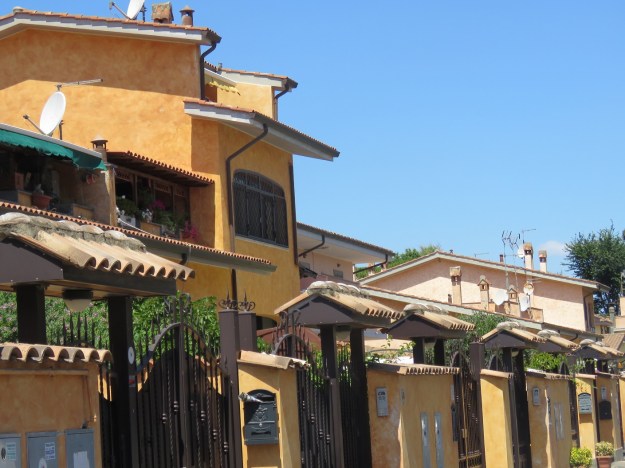
We have moved on from Italy and are now hanging out in Camembert in Normandy – and yes, Camembert is the original home of the cheese that bears its name. But that is another story still to come. Back in Italy, looking out over the mellow tones of the tiled roofs is part of the landscape.

I can understand that not everybody is as interested in roof tiles as we are. This is because we live with a fragile concrete tile roof that needs Mark’s constant monitoring. Italian fired terracotta tiles seem altogether more romantic, especially with the tonal variations. These are laid in the classic over and under construction – alternating face up and face down.

I will admit I had not really thought about the shape and the laying pattern of this classic terracotta tile until I can across this little bundle of replacement tiles on our hotel “balcony” in Sermonetta (where the roof top views were also photographed).

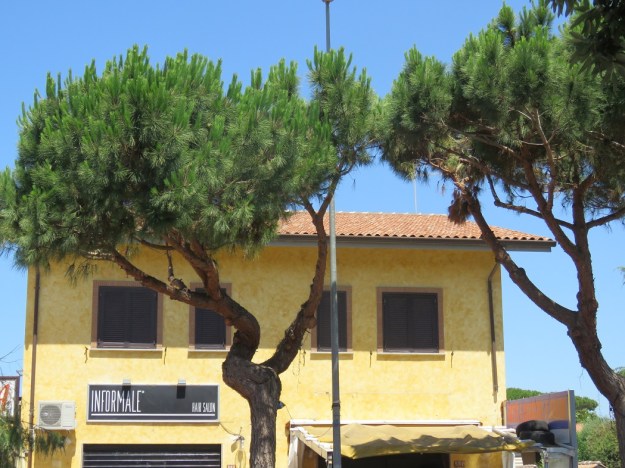
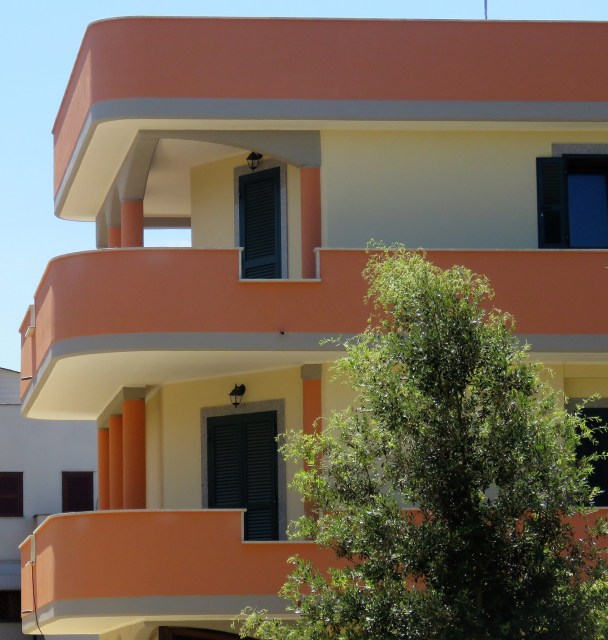
Alas, there is nothing like modern suburbia to cause a rethink. And modern suburbia in Fiumicino gave a different view. These tiles have the gully between the tiles attached.

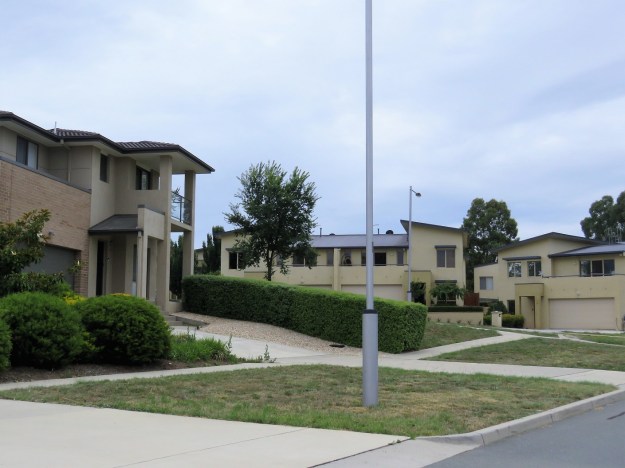
Coming from a climate where torrential rain in combination with high wind is not uncommon, we were unconvinced that the overlap of these modern Italian roof tiles would be sufficient to stop the water getting blown over the ridge in our conditions. Besides, where is the romance, La Bella Italia? But then, where in the world is there environmental romance in modern suburbia? It is just an interesting aspect of travel to see beyond the picture postcard scenes, sometimes.

Shady broms

Neoregelia

Bilbergia

We are not big on low maintenance gardening here, though I know that many others are. It has always seemed like an oxymoron to me. But as I looked at the bromeliads flowering beneath our stand of rimu trees, it occurred to me that here was a genuinely low maintenance area of the garden. As long as you don’t mind the prickly nature of many of the bromeliads, they are extremely undemanding plants.

About twice a year, I don gloves and home-made lower arm puttees (to stop my skin being shredded) to go through removing fallen debris and dead leaves or dying rosettes from the plants. That is about all the maintenance they need which is pretty astonishing for such an exotic planting.

We are not quite frost-free so we grow most of our bromeliads in the high shade cast by huge trees. Some varieties, particularly the ones with red foliage, lose the colour intensity in shaded conditions. Some just turn green, in fact, but at least they never get frosted. Because we are detailed, mix and match gardeners, we don’t only plant bromeliads. They combine very well with ferns, dendrobium orchids, clivias, begonias, hippeastrums and a host of other choice, shade-loving plants.

Aechmea

Mark’s father planted the first stretch of this sub-tropical woodland area back in the 1950s, when the use of bromeliads as shade plants would not have been common. He was working with very few different types but over the years, as a wider range has become available, we have added variety. Most of what we grow are epiphytic so they don’t have much at all in the way of root systems and they gather all the sustenance they need from the air and rain. The majority of them increase steadily by putting up two new rosettes at a time to replace the main one which, having bloomed, will slowly die. In the right conditions, these are truly self-sustaining plants to grow.

Vriesea

I have to make an admission. Neither Mark nor I have any botanical expertise in bromeliads – though we can claim to have gardening experience with them. Neither of us have ever felt drawn to unravel more of their botany. It is a big and complicated family – close to 3500 different species and goodness only knows how many hybrids from crossing the species. The best known member of the family is the pineapple while at the other end of the spectrum, tillandsias (commonly called Spanish moss) are also bromeliads which seems pretty surprising. In the middle are the ones most of know and grow – the alcantareas, bilbergias, neoregelias, vrieseas and the like. A lot of what we have in the garden will be named hybrids though the names have long gone.

If you are more dedicated to the botany of this family than we are, track down the books written by Andrew Steens which are even more useful in that all his experience is based in this country, not overseas.

Aechmea

A fair number of bromeliads come into flower in winter and their exotica is unmatched by any other plants at this somewhat gloomy time of year. Not only can the colour be startling, so too is the huge range of flower form and texture. Some, like vriesea, can resemble flat two dimensional wax creations and these blooms can last months. Others, like the bilbergias, are more abundant but over much more quickly.

If you are willing to tolerate the prickly foliage, the only other downside to my mind is that many hold water in their centres and that can breed mosquitoes in summer.

That opinion was not shared by a cantankerous garden visitor. Notwithstanding that she had managed to get into the garden without paying, she stood in the middle of the Rimu Avenue, looked around and rudely declared, “I hate bromeliads. They look so fake and artificial.” I just left her to it.

First published in the June issue of New Zealand Gardener and reproduced here with their permission.