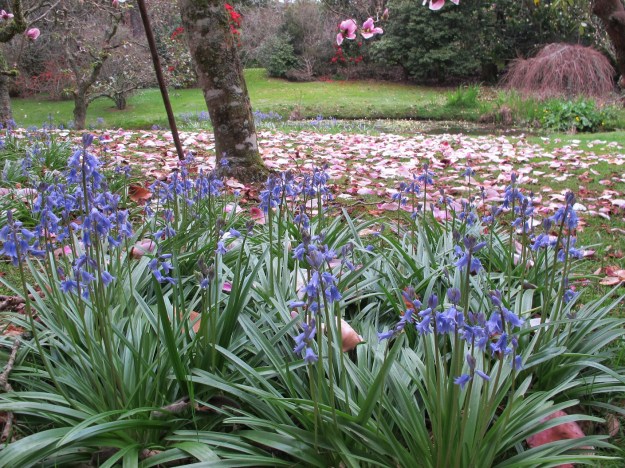
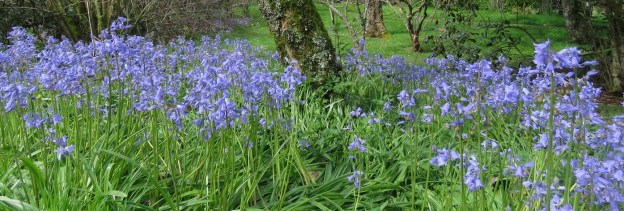
 There is something wildly romantic about a proper bluebell wood. I have never forgotten being entranced by the haze of blue through woodlands near Castle Douglas in Scotland and that was more than two decades ago. Those particular bluebells and woodland trees are native to the area but this does not stop many of us trying to replicate the effect at home.
Bluebells are best suited to the meadow look, in our experience. They grow too vigorously to tuck tidily into garden borders but their charms become obvious in a less constricted, wilder setting. The whole woodland style is dependent on having deciduous trees fairly widely spaced because the bulbs need light to bloom. In this country, we tend to have a mix of deciduous and evergreen in our gardens and lean more to “bush” or even “forest” than open “woodland”. On top of that, the time at which the bluebells are in growth, coincides with the spring flush of grass so mowing becomes problematic. As with most bulbs, it is best to let them die down naturally because that leafy stage is replenishing the strength of the bulb for next season’s flowering.
We solved this problem by planting bluebells in our wilder areas that we do not mow and on the margins of plantings in the park where we used to mow the wider area regularly. That way, we had defined swathes of blue in bloom and then swathes of long foliage until they went dormant. Now that we have stopped the regular mowing, it will be interesting to see if they spread naturally to give us expansive carpets rather than swathes. They set seed so freely that we try and remove at least some of the spent flower spikes.
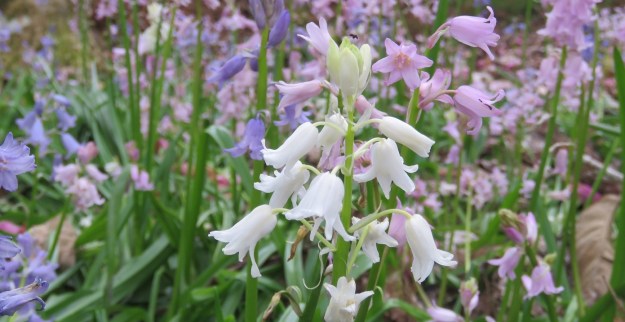
 It took UK writer Ken Thompson to demystify bluebell differences for me. The English Hyacinthoides non-scripta has sweetly scented, deep blue flowers on a droopy spike which means most hang to one side. Individual flowers are narrow tubes with reflexed tips. The Spanish H. hispanica is much stronger growing with an upright spike and flowers radiating all round. There is a greater range of colour from pale to dark blues and lilacs along with the pinks and whites. Individual flowers are bell-shaped and while the tips of the blooms flare out, they don’t reflex. They have little scent.
But to add to the mix, there are the natural hybrids. The English and Spanish forms cross freely and the hybrids fall somewhat in the middle with characteristics from both parents. I had previously tried to unravel the species and headed out looking for the cream anthers that define the English one as compared to the blue anthers of the Spanish form, ending up totally confused. Of course I did. I wasn’t factoring in hybrids. If Ken Thompson is right in his interesting book ‘The Sceptical Gardener’ – and I am willing to accept that he is correct given that he is an academic plant ecologist – and the majority of bluebells growing in UK gardens now are either the Spanish version or hybrids, then it seems likely that almost all of what we see in this country will be the same.
I stopped down the road to examine some bluebell patches on the site of one of the first settler houses built in Tikorangi. If we had any proper English bluebells around here, Mark hypothesized, that seemed a likely site. No, they were either Spanish or hybrids. Ditto with the bluebells here which date back to his great grandmother’s days and have now mixed with all the others we have. I can’t see any point in nursing ideals of species purity when it comes to bluebells in New Zealand.
 A word about white or pink bluebells. While the English bluebell can occasionally throw a white mutant, given the rarity of H. non-scripta in this country, it seems likely that all colour variants we have are either Spanish or hybrids. The whites and pinks are charming mixed with the predominant blues, making a pretty scene. Isolate them out by colour on their own, and they become a novelty plant. Bluebells, by definition, should be mostly blue. A display of only pink bells would look awfully contrived for this simple flower while a mass of white bells might as well be onion weed, really. That is my opinion.
First published in the September issue of New Zealand Gardener and reprinted here with their permission.

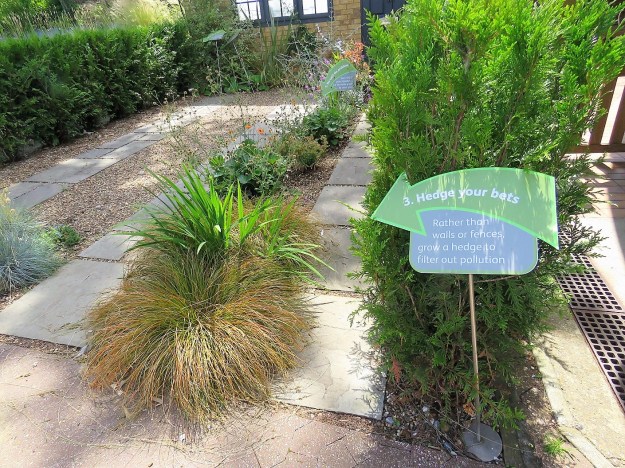
 The environmental benefits of growing plants are perhaps a harder concept to sell to people who don’t see anything wrong with living in concrete jungles. But we ignore the evidence of declining insect populations and the loss of biodiversity at our peril. Our planet is hitting crisis point, fuelled by human ignorance.
 It is not that the RHS are the only body leading public education in this area, but they are an influential one and all power to that.




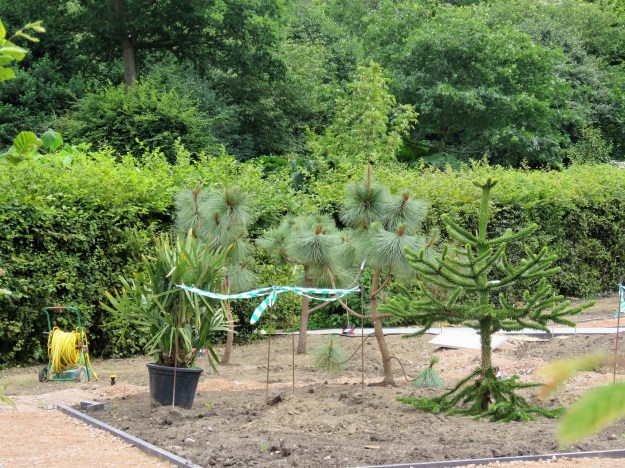 These friends had recently been to Great Dixter and expressed surprise at Christopher Lloyd’s dramatic ‘subtropical’ garden being taken out and seeing conifers going back in instead. It became a little clearer when we came across the Wisley project along similar lines. The conifers are being used as a framework for subtropical plantings. This is not a combination that would ever occur to a New Zealander but we will reserve all judgement until we see the finished product. Sometimes it is good to be surprised. Conifers are long overdue a revival and who knows? Maybe a new combination will launch a new fashion. Or maybe not.

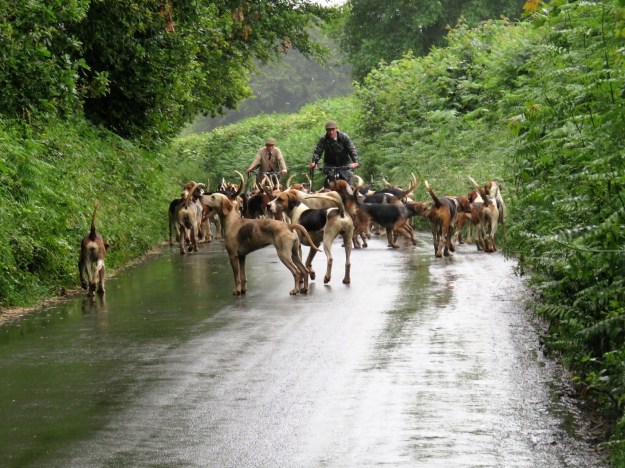 The hunt dogs! Or hounds, I have just been informed (see reader comments below). Indubitably hounds. Out for a morning run on a Devon lane with their keepers on bicycles. Beautiful hounds, so very well trained and an interesting scene but still incomprehensible to me. English garden media personality and writer of steamy romantic novels, Alan Titchmarsh, may defend foxhunting on the grounds that it is, apparently, a traditional part of country life – country life, that is, as experienced by the toffs who cry ‘tally-ho’, not so much a traditional pursuit for the peasantry. But tradition alone is not a justification for anything, really.
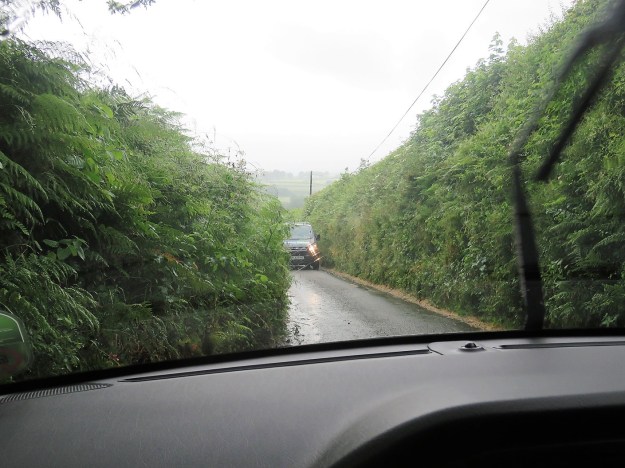 The Devon roads can be notoriously narrow, though they are by no means alone in that. These roads can carry more traffic than the upgraded, single carriageway that passes by our place at home but there does not appear to be an uproar with loud demands that they be widened, straightened and allegedly made ‘safer’ for cars and trucks. It means drivers must be fully alert, dropping speed to meet the conditions, courteous and capable of backing up to the passing bays that are dotted along these roads. It is a very different ethos to the aggressive driving on New Zealand roads. If we were more defensive, tolerant and patient drivers, maybe our corner of the world would be a better place?
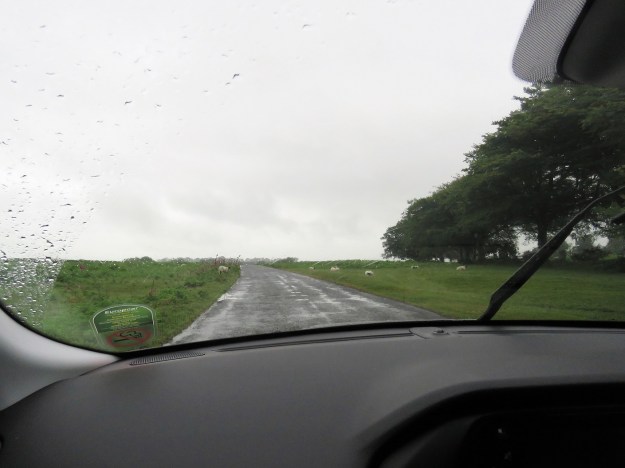 We went to south Devon to have another look at one of our all time favourite gardens – Wildside. More on this garden in a future post, but it is on the edges of Dartmoor. It rained on our day there, though fortunately it was not cold. There is a certain evocative gloom to the open moorland on a grey day with low light levels. Because I have always done my reading from across the world in New Zealand, the geographic location of different moors is hazy at best (though I think I have the heaths and heathers of Scottish moorland separated in my mind). I kept thinking of the likes of Daphne du Maurier but I see she set ‘Jamaica Inn’ on Bodmin Moor which is the next one down and Dartmoor belongs to ‘Hound of the Baskervilles’. But one can imagine this landscape with the bleak winds of winter blowing across it and it certainly has its own identity, including the roaming stock and lack of fencing.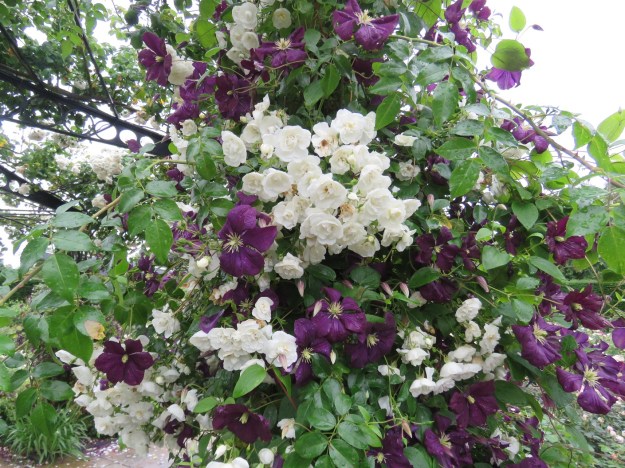
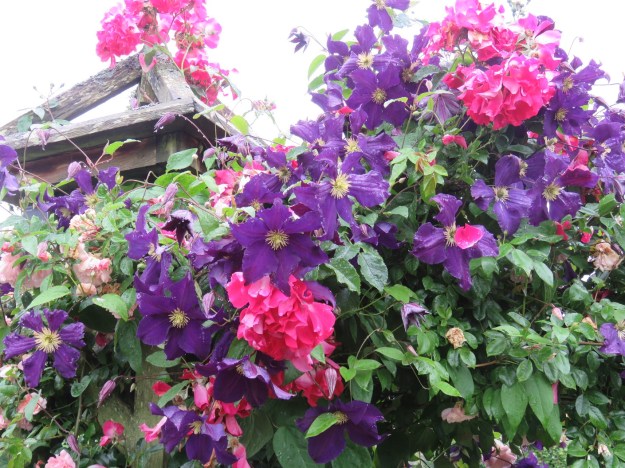 While in the area, we headed over to see the RHS garden, Rosemoor. The original garden and accompanying land was gifted to the RHS by Lady Anne Berry, now a long-time resident of Gisborne. Lady Anne had been particularly kind to us in our earlier years so we were pleased to finally get to see Rosemoor. While the traditional rose garden left me unmoved, the rose and clematis combinations in the adjacent garden enclosure were a delight.
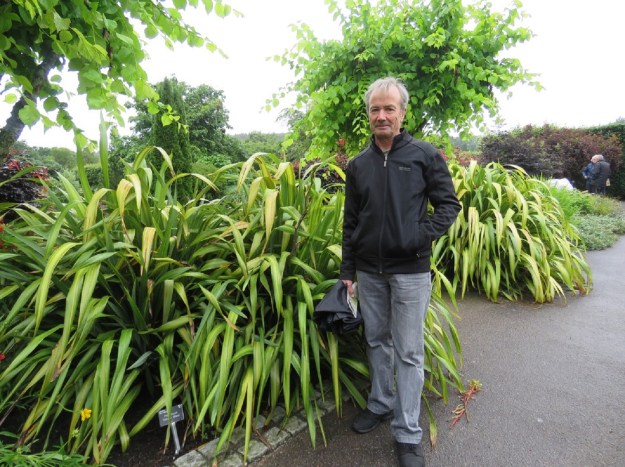 I make Mark pose for vanity photos beside what we call ‘Jury Plants’ as we come across them around the world. Part gentle boasting, part family record. In this case it is Phormium ‘Yellow Wave’, bred by his father Felix and one of the first generation of variegated flaxes for home gardens. He never received a cent for it (or a penny, as it would have been back then) and is rarely credited with it. It is not easy to keep good foliage on phormiums in New Zealand so Felix moved on to astelias and then clumping cordylines in his attempts to get an extended colour range into plants with this habit of growth and foliage. Eventually, this led to our Cordyline ‘Red Fountain’ but Phormium ‘Yellow Wave’ continues to hold some ground internationally.
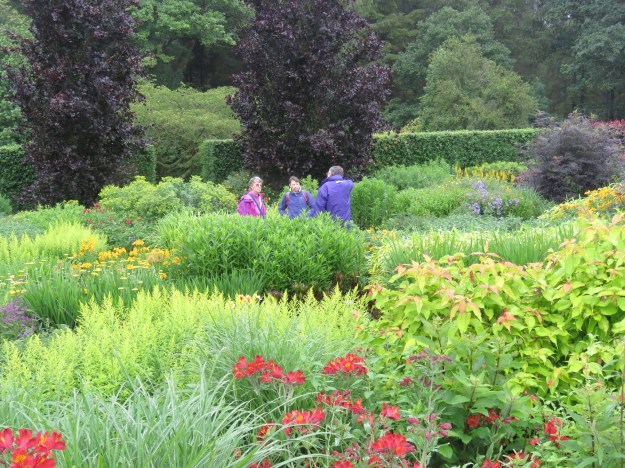 Still at Rosemoor, the herbaceous plantings are terrific. If you are looking for a middle road between the traditional herbaceous border and the grassy new wave look of Oudolf, Stuart-Smith and New Perennials proponents, you probably end up with something closer to these Rosemoor beds and borders. Lots of vibrant colour and care with combinations, often quite tight colour toning but also lighter on plant options that need continual maintenance to keep them flowering and looking good. However, these are herbaceous plantings for large, public spaces, not so much for downscaling to the home garden. You can see more in the