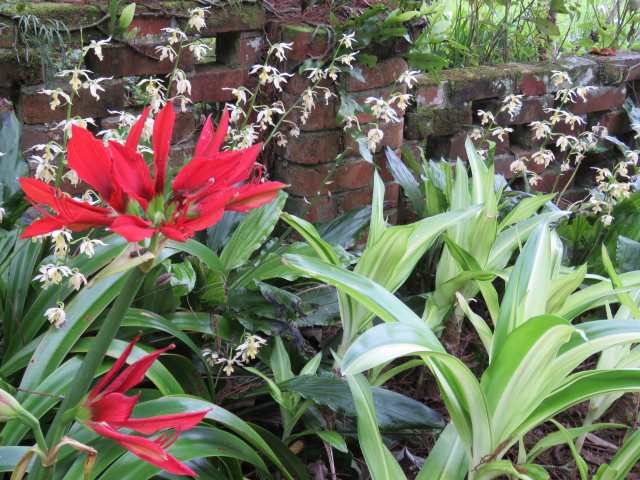
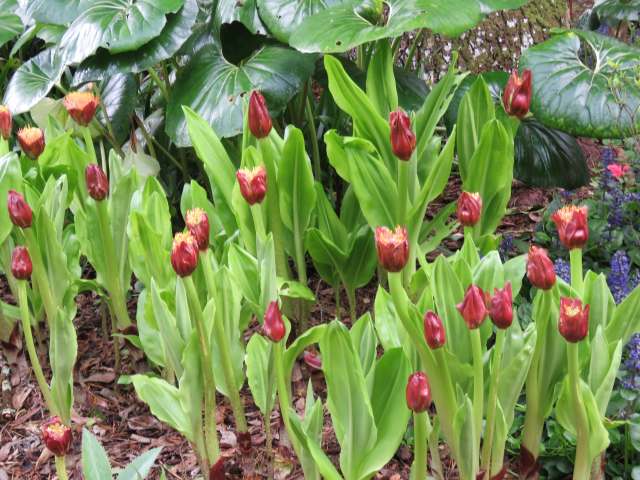
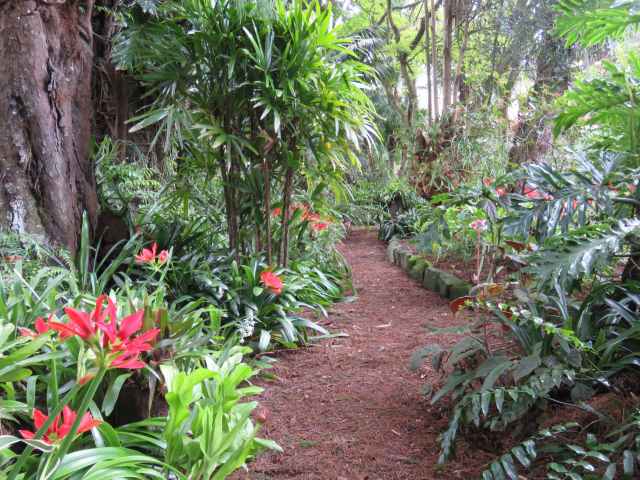
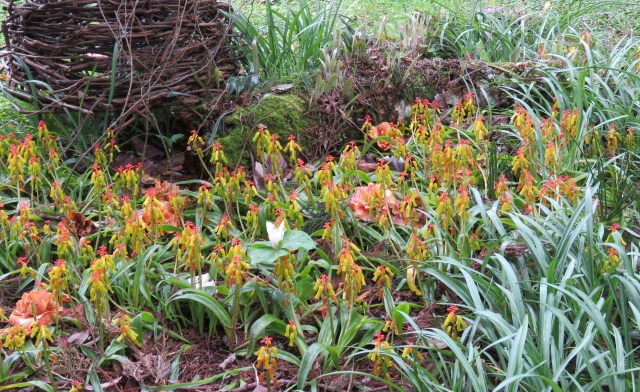
Red Hippeastrum aulicum, pale yellow calanthe orchids and Crinum moorei varegata are all mainstays of our woodland plantings
It has been a difficult week, so all I have to entertain readers with this week is scenes from the spring woodland. We like highly detailed woodland.
High shade is the key – here in the Avenue Garden
The key to woodland gardening here is to manage light levels. The charming scenes we see of European and British woodlands – the expanse of white birches underplanted with snowdrops and crocuses and that sort of thing – are beneath deciduous trees which let light in during winter and shoulder seasons.
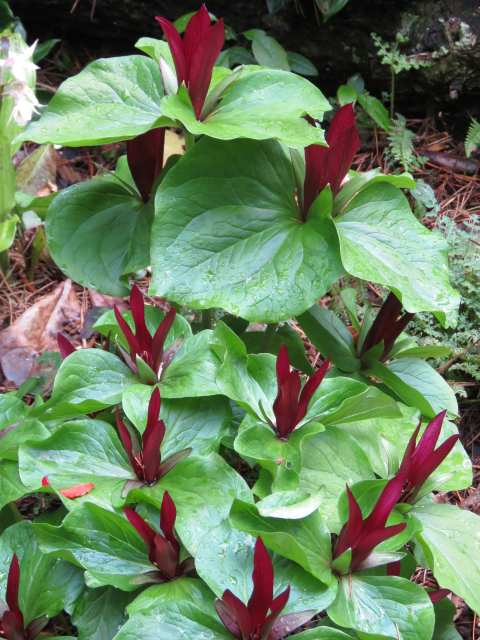
Trilliums are a bit marginal in our climate so it is always a thrill to see their understated charm
Scadoxus, however, are so happy here that they have pretty much naturalised themselves. This is S. puniceus which flowers in spring. S. katherinae will feature in summer.
In Aotearoa, somewhere over 99% of our native flora is evergreen and most people tend to garden with exotic evergreens as a preference. In our years of retail, I encountered many gardeners who would reject anything deciduous. As a result, we don’t get the seasonal light coming into shaded areas. Also, with our rapid growth rates, trees tend to grow much larger. As UK author and horticulturist, John Hillier inscribed in our copy of Hiller Manual of Trees and Shrubs, ‘double heights and halve the time for New Zealand’. Dare I say it, UK woodlands often look quite spindly to my eyes.
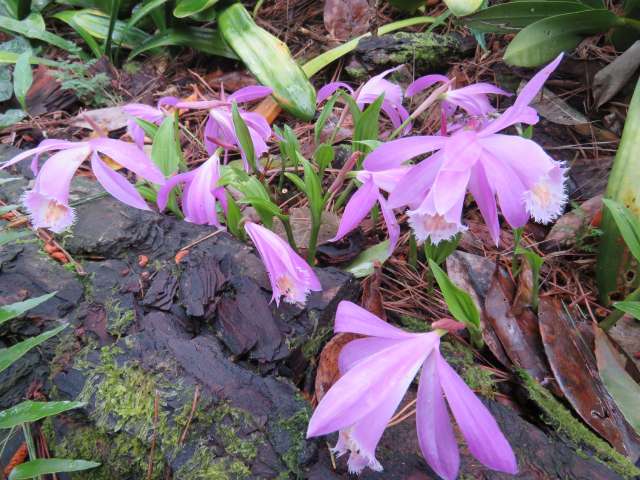
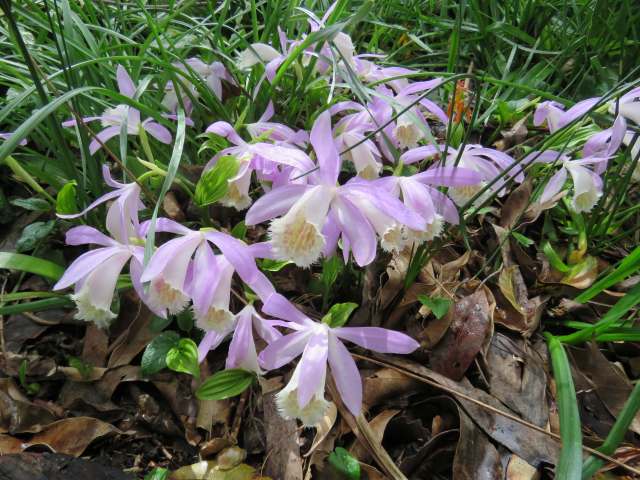
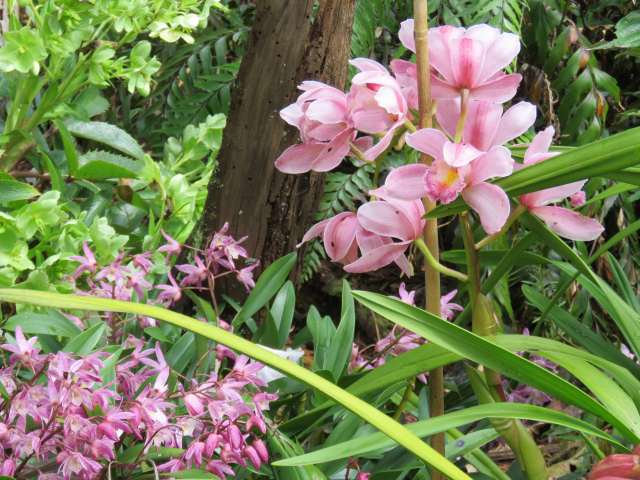
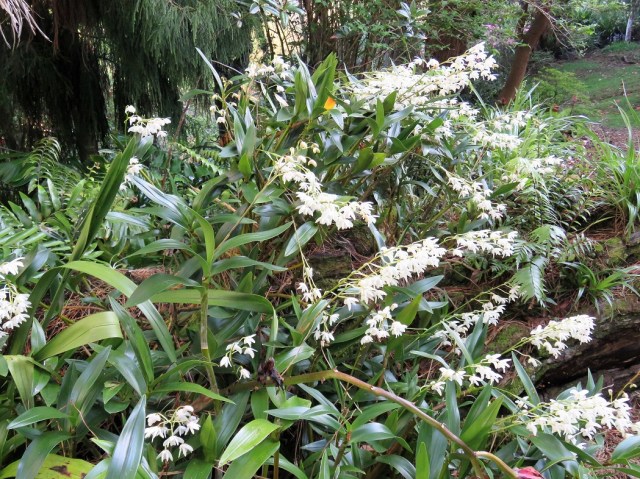
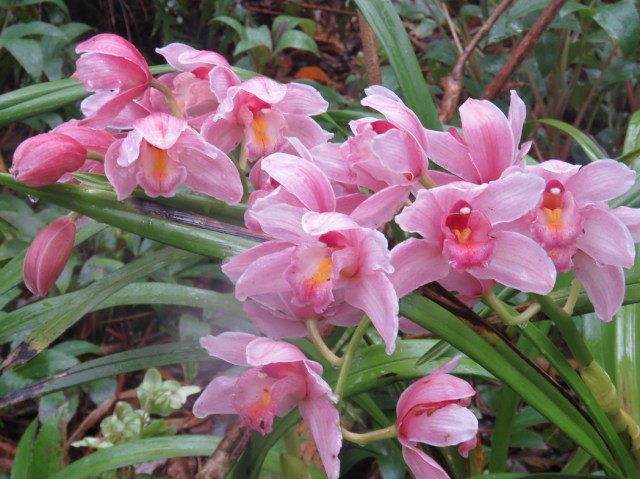
Orchids, we have a few. These are pleiones. We lost all the yellow ones that need more of a winter chill but the purple, lilac and white varieties thrive under laissez faire management in the woodland garden. More orchids – dendrobium to the left and cymbidium to the right
Woodland gardening means dappled light and some shade, but not deep shade. There aren’t many flowering plants that will perform in deep shade. Lifting, limbing and thinning are needed to create high shade and to allow reasonable light levels below.
The Rimu Avenue has such a dense network of roots from trees that are now over 150 years old that we have had to rebuild soil below to allow underplanting
There are also times when the soils below will need some extra texture, volume and replenishment in order to get small plants established. Small plants at ground level won’t thrive if they are bedded in amongst dense tree roots which have dried out the surface.
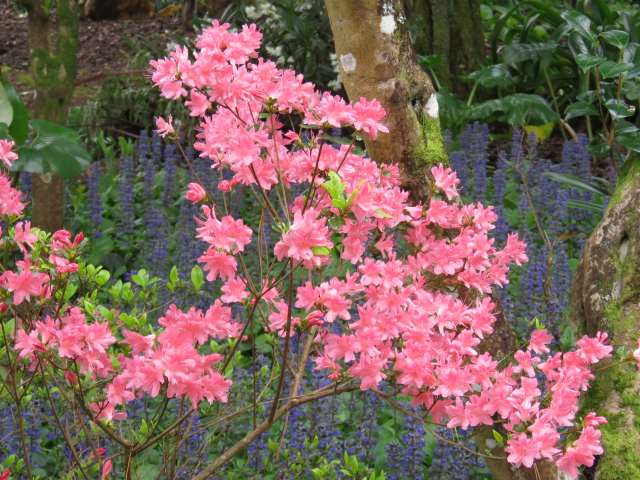
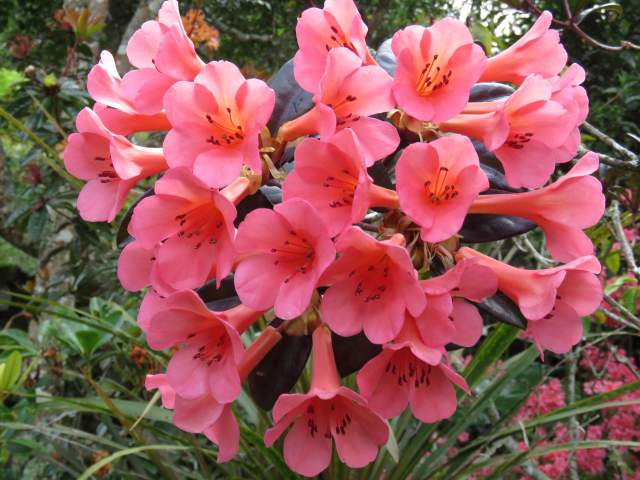
It is not all bulbs in our woodlands. Azaleas, vireya rhododendrons, camellias, hydrangeas and other shrubs add mid-level detail and height.
On the upside, even high shade and dappled light is enough to hugely reduce weed growth and the visual delight lies both in the detail below and the play of light. It is much lower maintenance than gardening in full sun.
Why a difficult week, you may wonder. We nearly lost our beloved dog Ralph to poison – not our poison and not deliberate but traumatic, nonetheless. We thought he was going to die on Tuesday night. He is still recovering and we are now confident he will survive, although there is a possibility of long-term organ damage.
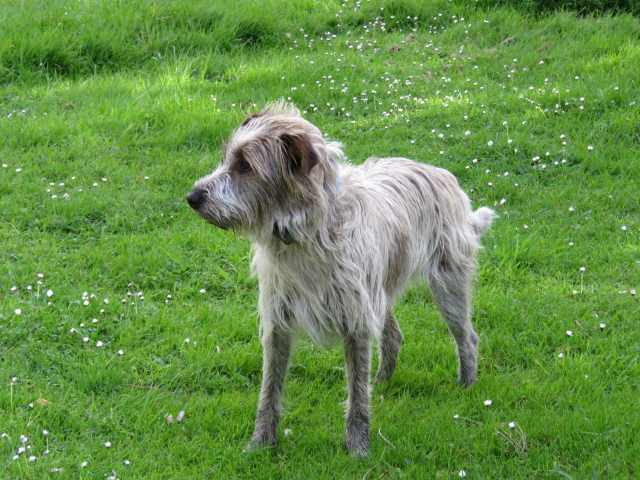
Ralph in happier times
It is perhaps little understood in this country that our predator-free goals are only achievable with the extremely widespread use of slow-acting poisons, one of which has no antidote. There is a pretty gung-ho attitude and light regulation when it comes to the use of poison. We choose not to use it and will trap and shoot instead. Ralph’s ordeal this week is a reminder to us of why we made that decision. Our lives would have been so much poorer had he died so needlessly and in distress.
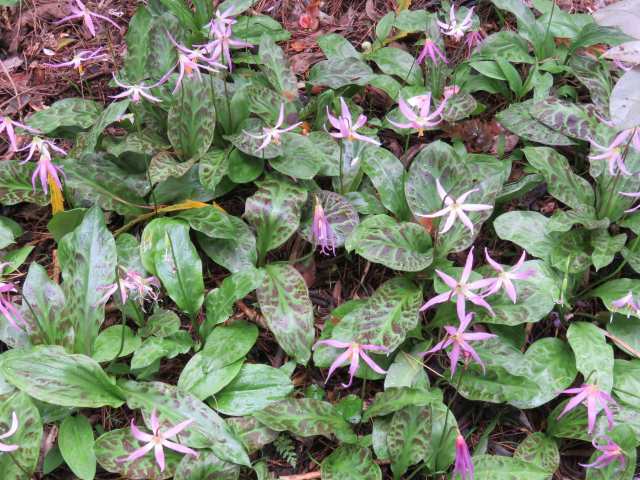
Charming erythroniums or dogs tooth violets – best left undisturbed as much as possible because their long, thin bulbs sit vertically in the soil and are fearfully easy to snap when digging. Lachenalia aloides tricolor on the margins of woodland where light levels are higher. With a white trillium popping up through them and snowdrop foliage to the right.
We had our arborist in again this week and there is nothing like getting some tree work done to refresh an area.
The leaning tower of gum and rātā which was rather larger than it appears in this photo
The catalyst was this leaning gum tree which carried the weight of a rātā vine. The host tree was in poor condition and the lean was certainly getting more pronounced. We worried that the weight of the rātā at the top of the tree would bring it all down, potentially bringing down other trees with it and, in the worst case scenario, cutting the power lines to the house. With increasingly frequent extreme weather events these days, we err on the side of anticipating risk and trying to avoid damage.
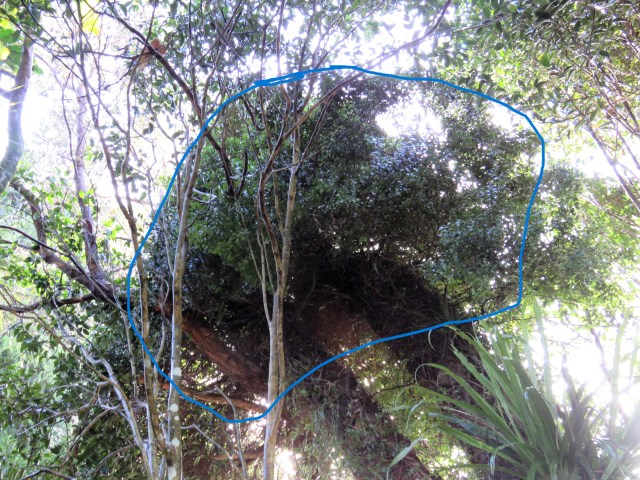
Circled in blue is the foliage of the rātā vine weighing down the twin trunks of the old gum tree. it looked to be a case of when, not if, it would fall.
Rātā vines climbing the old gum tree trunk
I just looked up rātā, which are a native plant. The Department of Conservation site tells me we have 11 species – 3 are trees, 1 shrub and 6 climbing vines. It is probable that ours was Metrosideros fulgens. It did bloom for us but was never as showy as its cousin, the pohutukawa and the flowers were always right at the top of the canopy so only visible from a distance.
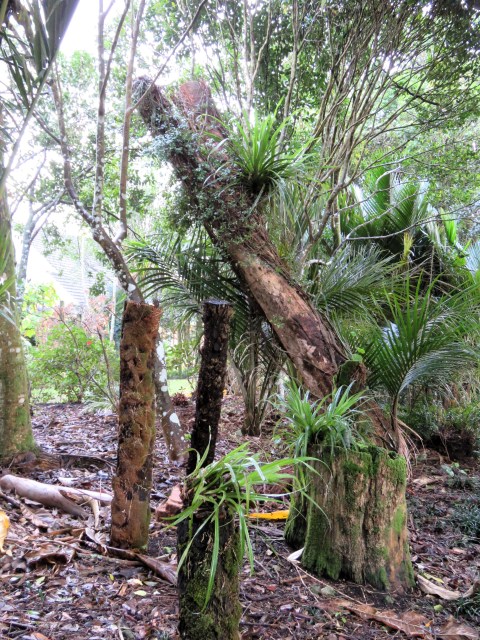
We chose to keep some of the trunk to keep the rātā. It may still fall but it won’t cause much damage if it does.
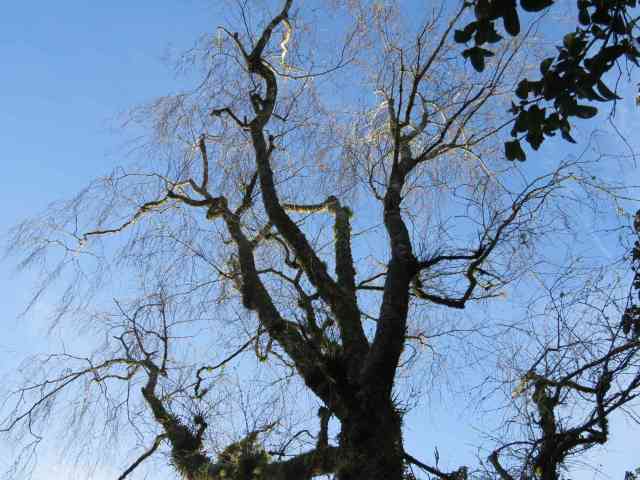
We chose not to fell the gum completely but left about 3 metres of it to keep the rātā. While here, we asked the arborist to drop the last remaining silver birch tree nearby which was not in good health. Once it was down, we could see from the stump that it was completely rotted out in the middle of the trunk with a hollow centre. Silver birches are not good in our climate and their only redeeming feature, in my eyes, is that beautiful tracery of the bare branches against the winter sky. And we dropped a third small tree that had died. It was one Felix had brought back from New Guinea in the late 1950s but it was never as interesting as the lovely Schefflera septulosa, Ficus antiarus and Rhododendron macgregoriae that we still have from that intrepid plant hunting trip.
The silver birch set against the blue winter sky, just before it was felled
Dropping trees lets light in again and opens up areas that then need a touch of renovation. In mature gardens, getting light back in to shaded areas is a constant issue and often requires some quite major work on large trees. Not many plants are happy to grow in deep shade, and few of those are desirable ornamentals.
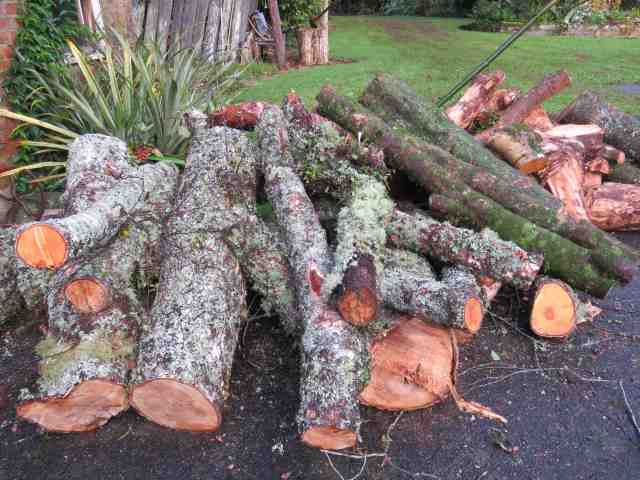
A mix of birch and gum for firewood and waste wood from the unnamed New Guinea tree
Our arborist is very good at cleaning up after himself so he left that day leaving clear space. Empty, but clear. Lloyd, bless him, removed the lengths of firewood to our enormous woodshed the next day and Zach moved in to replant. It was all done and dusted in a couple of days but, with more light, Zach and I are now turning our attention to somewhat messy areas beyond that immediate zone. Which brings me to Zach’s orchid structure.
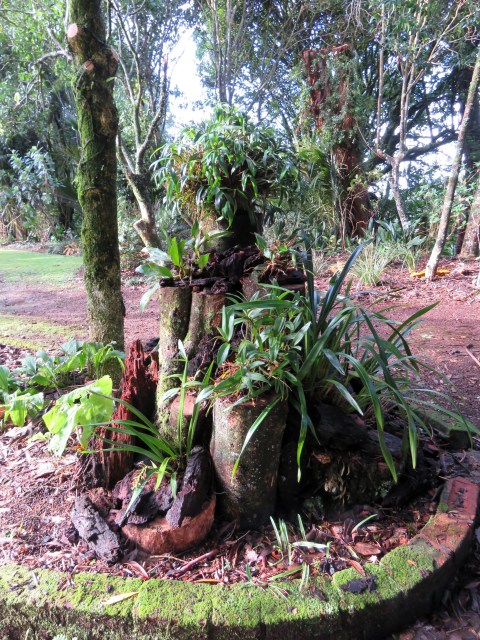
An installation of orchids that looks right at home from the start and adds a point of interest in an otherwise unremarkable spot
The wood from the felled New Guinea tree was too light to use for firewood. It needed to be stowed elsewhere to break down naturally and I suggested to Zach that he use it to make a base for some orchids as a punctuation point at the uninteresting end of an adjacent garden bed. Zach is a keen orchid man. A couple of hours later, I came back to find his construction which exceeded all my expectations. That is all waste wood, already filled with cymbidiums and dendrobiums which are divisions from other plants around the garden. What was a dull space is now a feature which will look charming as the orchids come into flower over the next months and already looks as though it has always been there.
Dropping trees is not a cheap activity but it opens up new possibilities.
A postscript, for those of you for whom chainsaws are a part of life. Our arborist used an electric chainsaw and he declares them to be an absolute gamechanger in every way – safer, quiet, much cheaper to run and a massive improvement in environmental terms. We are still using petrol chainsaws here but Mark was saying that next time we need to buy one, we will buy electric. I have heard others praise them but to have a professional give such a glowing reference convinced me they are the way to go.
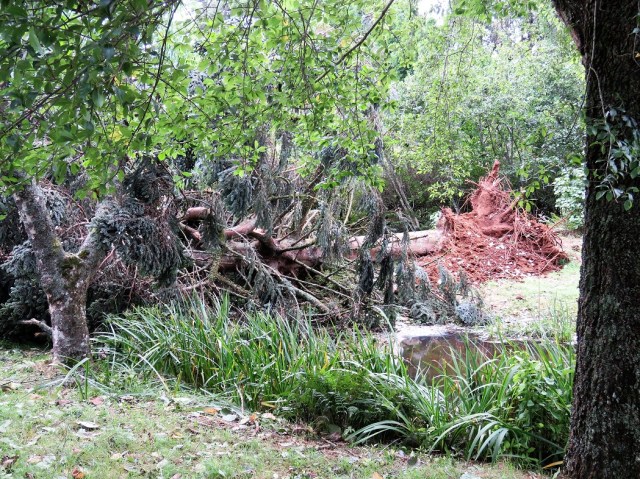
The remaining stump doesn’t look very large in the photo but the poor abies was between 60 and 70 years old.
I think we all breathed a sigh of relief when the last of the Cyclone Dovi major damage was cleared and repaired. The abies that fell over the high bridge in the park has been cleared; Lloyd has reinstated the stopbank which had been ripped apart by the tree roots and the he has repaired the bridge.
The bridge was beneath the tree
The challenge with the abies was what to do with it. Mark had no interest in the timber for firewood. We have plenty already and abies is a lighter wood that does burns quickly so was not desirable. Had it been somewhere with vehicle access, we would have given it away but it was too much of a challenge to try and get it back up the hill when the only access was by our baby tractor or Lloyd’s quad bike and trailer.
Installations, maybe.
The job of cutting it up fell to Zach. Given it had fallen right across the stream, we are lucky that we have had a dry late summer and autumn with low water flow because he spent a few days working around the water with gumboots that are no longer waterproof. He burned the foliage on site as he went. The wood was cut to manageable lengths. A few were used nearby as ‘installations’, we might say. Most of it, he carted halfway back up the hill to build what we have come to call The Barricades.
The Barricades
For readers not into musicals, this is a reference to ‘Les Miserables’. Of course it is. Zach is a fan of musicals and we have been been a Les Mis household ever since our second daughter played Little Cosette in the stage show at the tender age of 10.
That is a Bardo Rose dendrobium freshly planted in the wood
Meet our barricades. Essentially, they are a way of dealing with surplus wood while giving some structure and height in a casual woodland area. Over the years, they will rot down but, in the meantime, they give all sorts of cavities in which to grow plants as well as being not so much a trendy hotel for insects, as an entire insect resort. Or condominium. Zach started with planting a few orchids in it and we will continue to add more plants as suitable candidates become available.
Early March after the initial clean up in the Avenue Gardens
Meanwhile, the rate of recovery in the Avenue Gardens has been rewarding. When Dovi hit, this area was completely covered by fallen pine and the lower canopy of jacaranda, camellia and cordyline. After it had been cleared, it was a bare wasteland with everything tramped into the ground by heavy boots dragging out the debris. We covered it in the woodchip mulch – of which we had small mountains heaped around the area and this was how it looked on March 5.
Early May. The poor jacaranda is unlikely to rally again but the rest is recovering.
Two months on, in autumn, it has already recovered to this point. We are still missing the middle canopy layer, but it looks as if the perennial groundcover will return afresh.
Further along the damage zone, the plants are already softening the length of trunk we decided to leave where it fell. In a few years’ time, Cyclone Dovi will just be a memory.
I wrote about Mark’s hippeastrum hybrids back in 2019. Another one has opened and is positively glowing in the Rimu Avenue. Everyone that has bloomed so far is red. It would have been nice to have had more variety, given that one parent is H. papilio. But what is more interesting is their random blooming. H. aulicum flowers like clockwork for us in September, H. papilio in October. These hybrids are popping up the odd flower any time of the year. It will take a few more years to see if they settle down to a predictable seasonal pattern but, in the meantime, it is quite delightful to come across unexpected, over the top blooms glowing in the woodland gardens.
That is an old stone mill wheel from the ninteenth century, repurposed these days as a bird bath
It has been a difficult week in New Zealand. I recall commenting here to an Irish reader (*waving to Paddy*) that if anybody can get rid of Delta, we will. This week brought us the distressing realisation that we almost certainly can’t. Gone is the dream of the return to level one this summer – level one being no restrictions on day-to-day living bar those pesky border controls. Like many others, we were plunged into a state of deep anxiety. All due to just one case entering the country and now spiralling ever larger, creating the whack-a-mole situation we are now in.
I have to grit my teeth with those who declare ‘we just have to learn to live with it’. I don’t think learning to live with Covid looks like they think it does. It does not mean a return to life as it was with some people getting a bit sick and a few dying – but, presumably, nobody known to those advocating this course of action. Learning to live with Covid means living with ongoing anxiety, wearing masks, using sanitiser, scanning, restrictions on movements and gatherings and playing whack-a-mole all the time. Learning to live with Covid means an indefinite extension of the current status quo.
Scadoxus puniceus
The only path out of this is very high vaccination rate. Please, if you haven’t been vaccinated yet, get it done now. Ignore that small group of very loud, insistent anti-vaxxers. Surveys show that there aren’t that many of them, statistically speaking (somewhere between 4 and 7%?) but too many of them seem pretty determined to keep their ‘freedom of choice’ by attempting to abuse and verbally bludgeon everybody else out of exercising their freedom of choice.
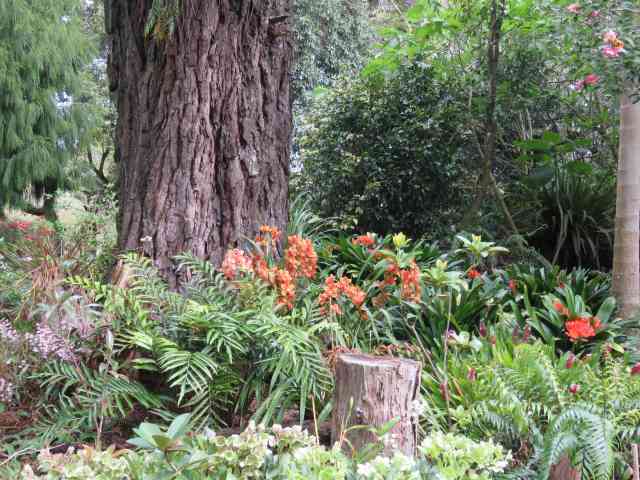
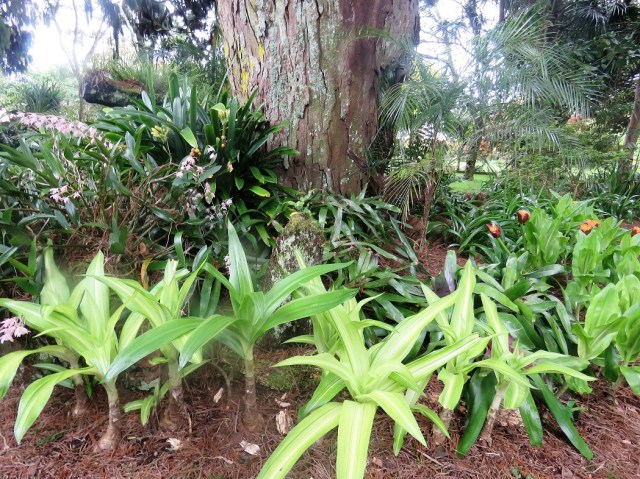
Crinum moorei at the front, which will flower white later in the season, dendrobium orchid, clivias, bromeliads, Scadoxus puniceus and the wedding palm – Lytocaryum weddellianum – in a tiered woodland planting beneath giant rimu trees
What does this mean for our garden festival, scheduled to start on October 29? Goodness only knows; we certainly don’t. We were headed for one of the largest attendances ever with coach tours and ticket sales setting new records. That seems unlikely now.
I see three possibilities. The first is the best-case scenario where travel restrictions are lifted to the north of us and we plough ahead but with masks, sanitiser and physical distancing. This is also the least likely scenario.
The second scenario is the border remains in place on our main northern access to Taranaki and numbers are hugely reduced as a result. In which case it will all be much quieter and lower key.
The third is that Covid reaches Taranaki in the next few weeks and all events are cancelled but I figure we cross that bridge if we come to it.
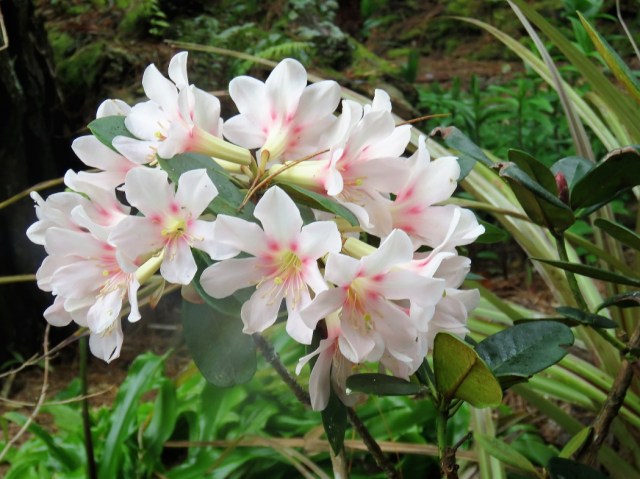
Seedling vireya, very scented, which seems to be predominantly R. konorii growing beneath pine trees Pleione orchids have a shorter season in bloom but are so pretty
It all makes planning very difficult here. When we know we are opening the garden, there is a lot of extra garden grooming that gets done – titivating, one might call it. It takes a lot of time to titivate a garden the size of ours and we don’t do that final flourish if it is just for our own pleasure.
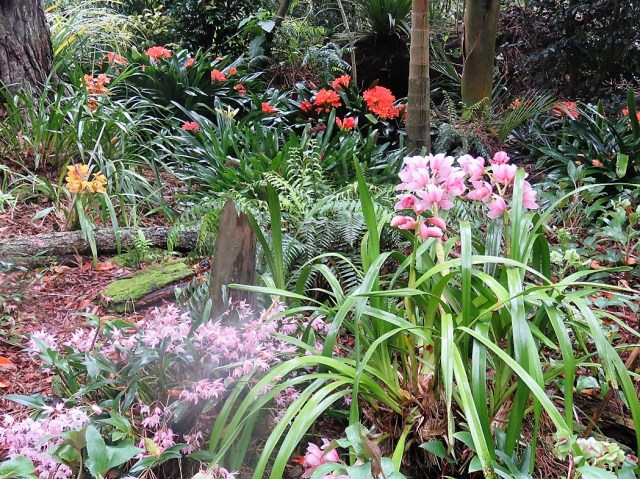
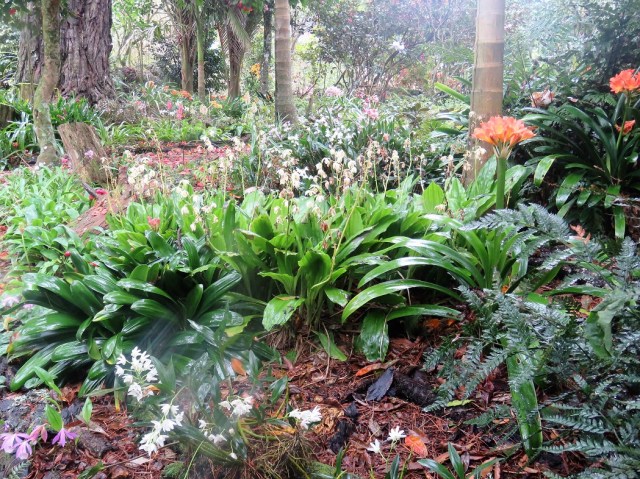
Colourful woodland on rainy morning this week to lift the spirits
But if it all turns to custard, there are many (many, many) worse places to be than here. The colourful woodland this week soothes my soul and relieves my own anxieties. Woodland gardening does not generally conjure up colourful visions bar maybe a sea of snowdrops beneath bare trees if you are British, or perhaps large drifts of bluebells or hellebores.
Finally getting Mark’s neglected orchids out of his Nova house and into the garden in lengths of tree trunk with the centre rotted out We are big fans of the dainty dendrobium orchids from the Bardo-Rose group
We like highly detailed woodland and it certainly is looking very pretty this week. We achieve this by lifting the canopy of our tall trees to let filtered light in below. Over the years, low branches have been removed to keep the lower trunks clear for maybe the bottom four metres or so. These days we do more thinning at ground level than planting and we use various strategies to ensure that plants can grow despite the massive root systems on the trees. Zach has been planting out some of Mark’s neglected orchids – mostly dendrobiums in the Bardo-Rose group – in hollowed out tree rings this week. These stump lengths are from the silver birch we dropped a few weeks ago. The rotten heart of the tree tells us we were right to fell it.
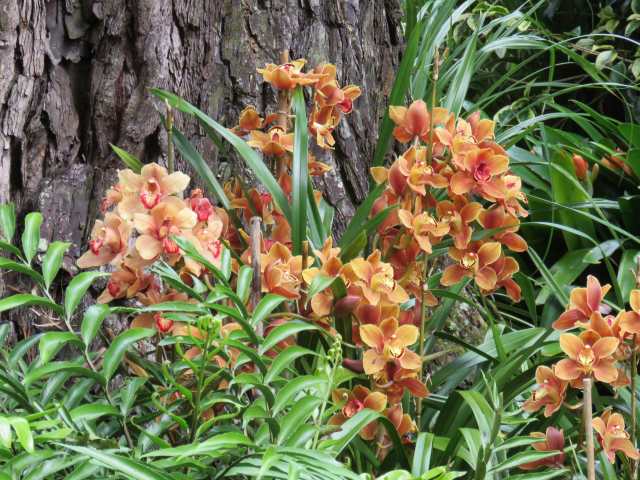
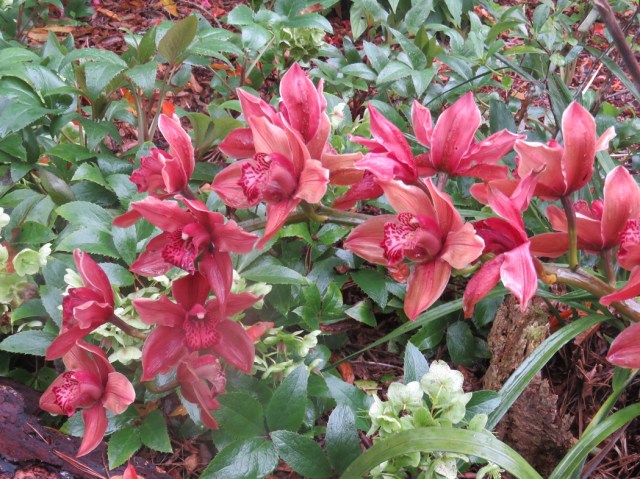
We do not get florist-quality blooms outdoors but the cymbidiums last a long time in the garden and add glamour Cymbidium with Helleborus sternii. I would like more cymbidiums but need plants with smaller flowers. Those bred for cut flowers tend to be larger and can look out of scale in the garden.
Our interest in orchids is basically on plants we can grow outdoors in the garden so mostly pleiones, cymbidiums, calanthes and dendrobiums in practice. I like the little dendrobiums the best but the cymbidiums add a touch of glamour.
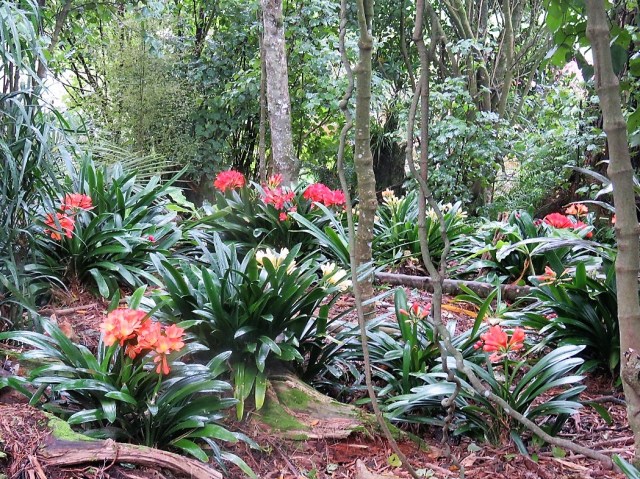
Clivias in orange, red and yellow, we have in abundance
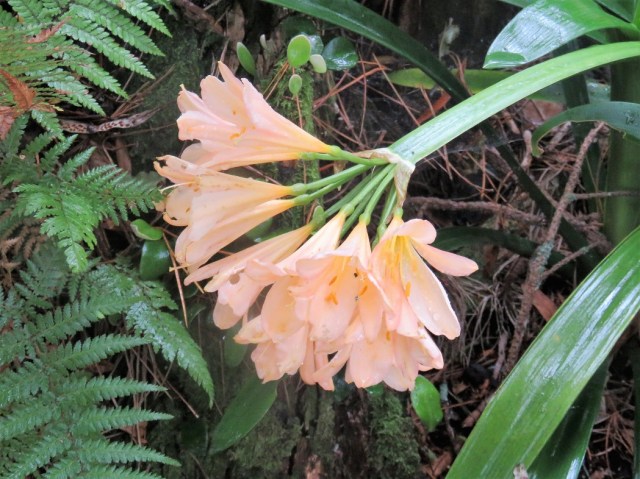
Mark’s peach hybrids add variety but this one seems reluctant to hold its flower spikes upwards
Quite a few years ago, Mark did some hybridising with clivias to try and get some peach coloured ones. He rather lost interest but I planted out the best and they are coming in to their own. I wish this one held its flower up better but it is a pretty, pastel variation on the many oranges, reds and yellows we have. Last time I looked, there were quite a few international breeders working on peach tones and then on white and green flowers but I have no idea if these are commercially available here yet.
Wherever you are, stay sane as well as staying safe. These are trying times we are living through. I will be hiding in the garden somewhere, maybe taking photos to share.
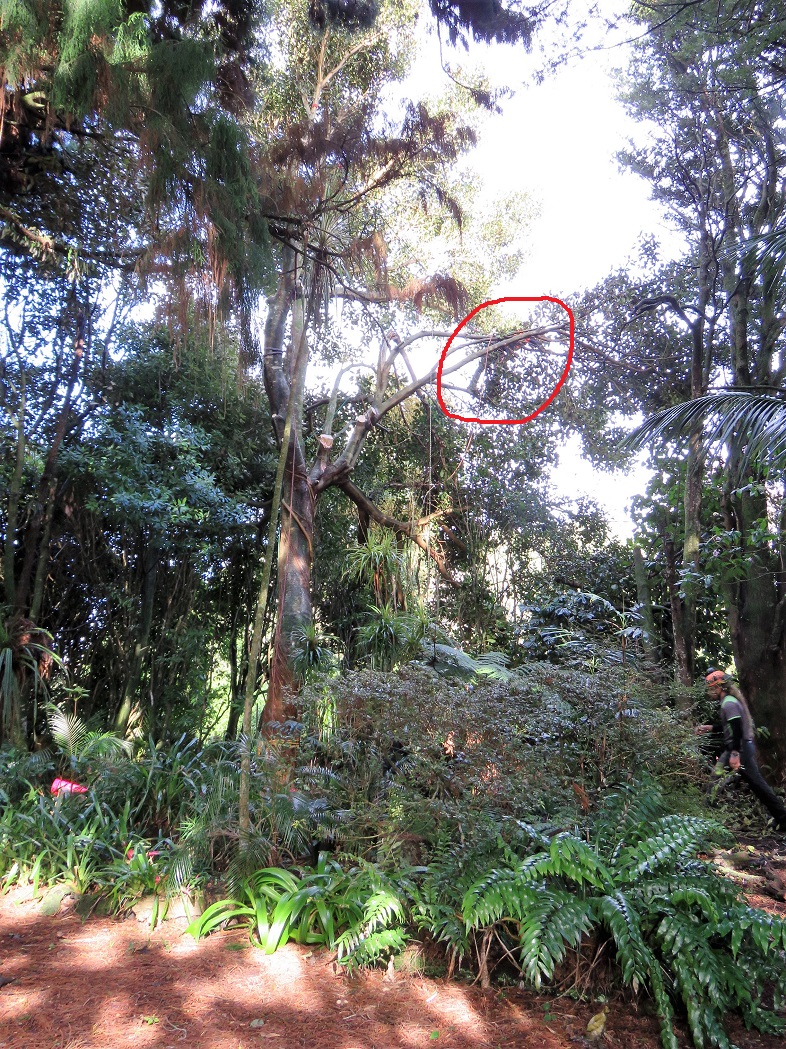
I circled the man in the tree. I don’t think I would stand on that branch but these trained arborists know what they are doing.
We had the arborist back in last week. Two of them, in fact because our usual arborist has teamed up with another so there were two skilled people on the job. This is just as well because we only call them in to do major jobs. On this occasion, it involved three trees but the one I photographed because I thought it was most interesting was a fairly large ficus – a fig tree but not a fruiting one. Mark estimates it was about thirty years old and growing at a great rate. Not only was it in the wrong position but it was of neither interest nor merit. When it dropped a large branch recently, we realised it was also brittle.
Dropping it was a skilled job because it had to be dismantled, not felled in one go. With the road on one side and a densely planted garden on three sides, how the pieces came down was of considerable importance to us. It took the arborists about six hours to fell the tree and clear up.
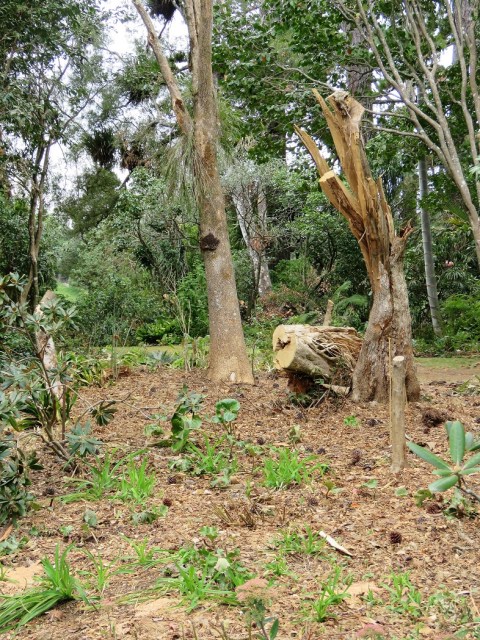
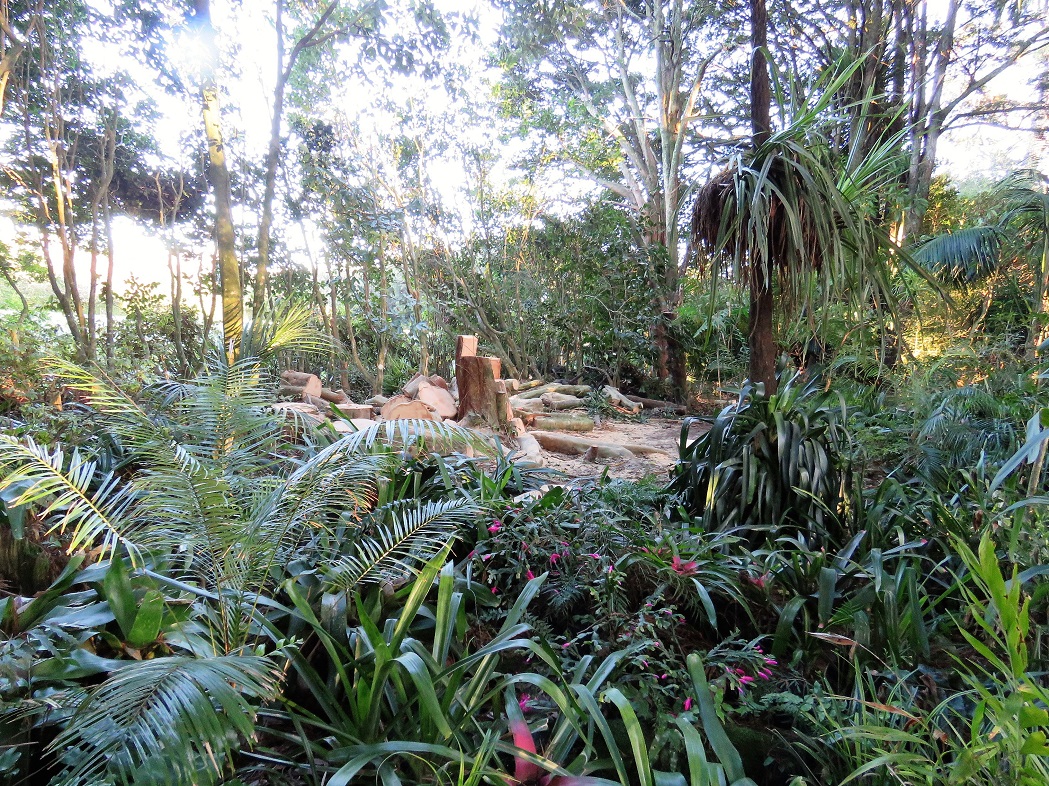
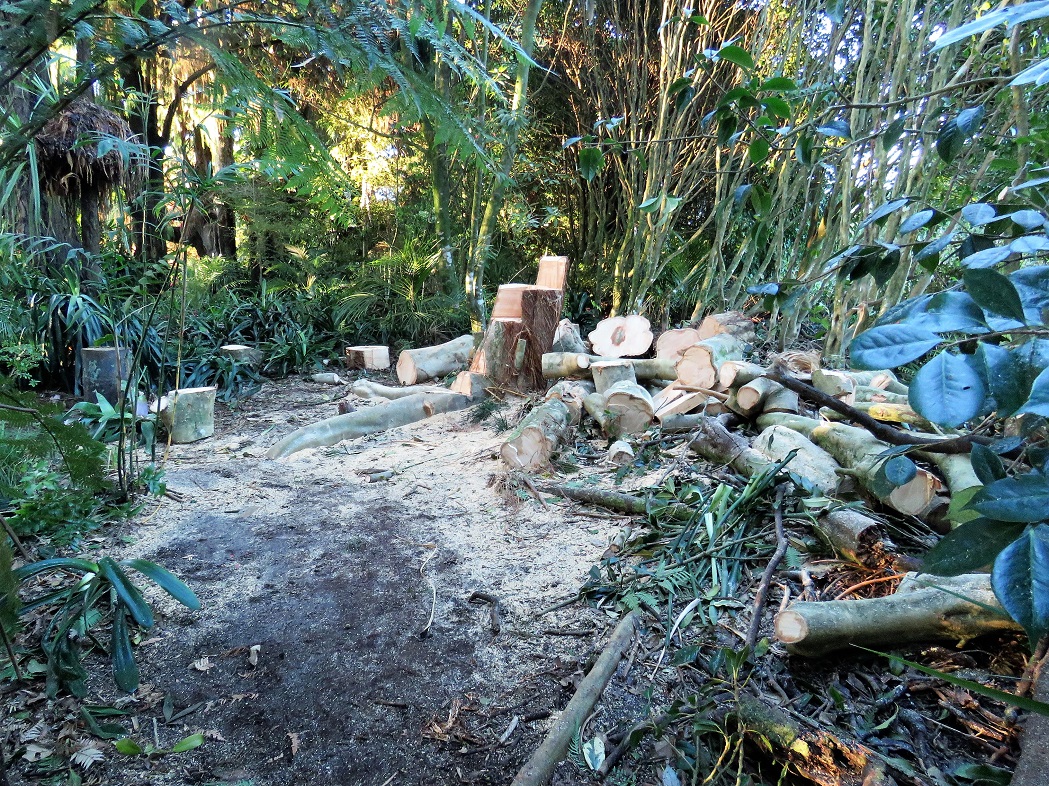
The amount of tramped, bare space was a bit daunting at first glance
This was how the scene looked at the end of the arborists’ work. They mulch all the leafy material and remove it and cut the bigger lengths up. Fortunately, they had dug out most of the plants that were in the area – mostly clivias and bromeliads – and the only damage was to a dracophyllum which is now somewhat smaller than it was. In a moment of whimsy, one of them shaped the remaining trunk into a throne, though only designed for those with small derrières and the gluey sap oozing from it was a problem, as Mark found when he tried. Mark described the area as looking somewhat like a state highway, given the amount of bare, tramped space.
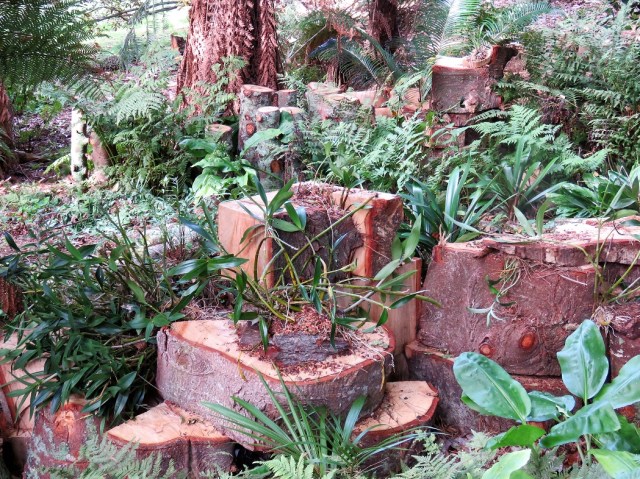
Not so much a trendy insect hotel, Mark quipped, as an entire insect resort
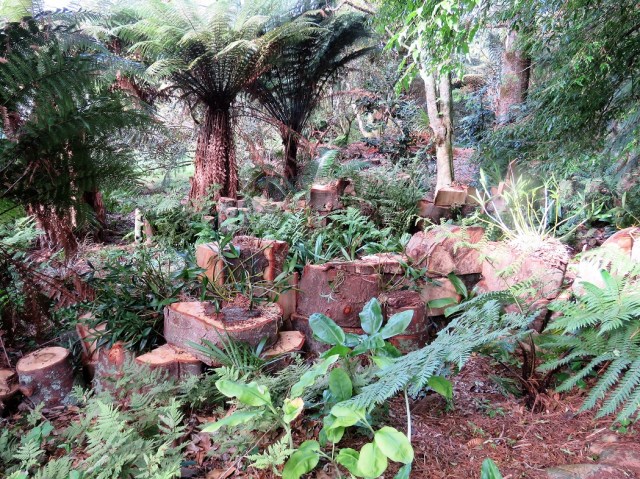
Because the timber was very soft and sappy, it had no use for firewood or garden edging, or anything else. It seemed best to let it break down at its own speed in situ. I asked Lloyd to stand up the longer lengths and rounds and to stow the small material out of sight at the back. He also removed the throne shaping. Not our style and we didn’t want to encourage any garden visitors to tramp across the garden to try it out.
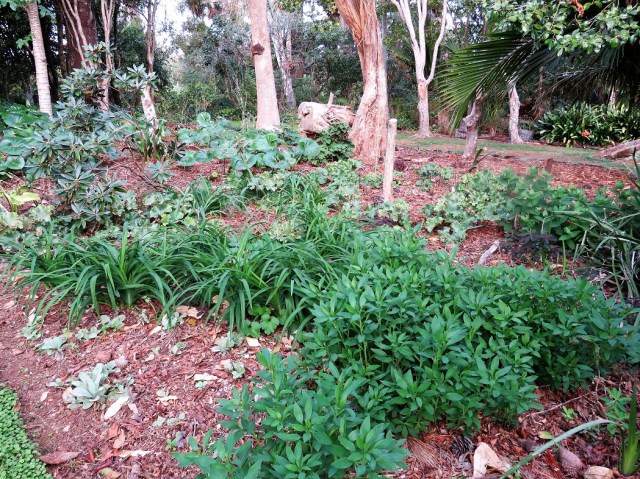
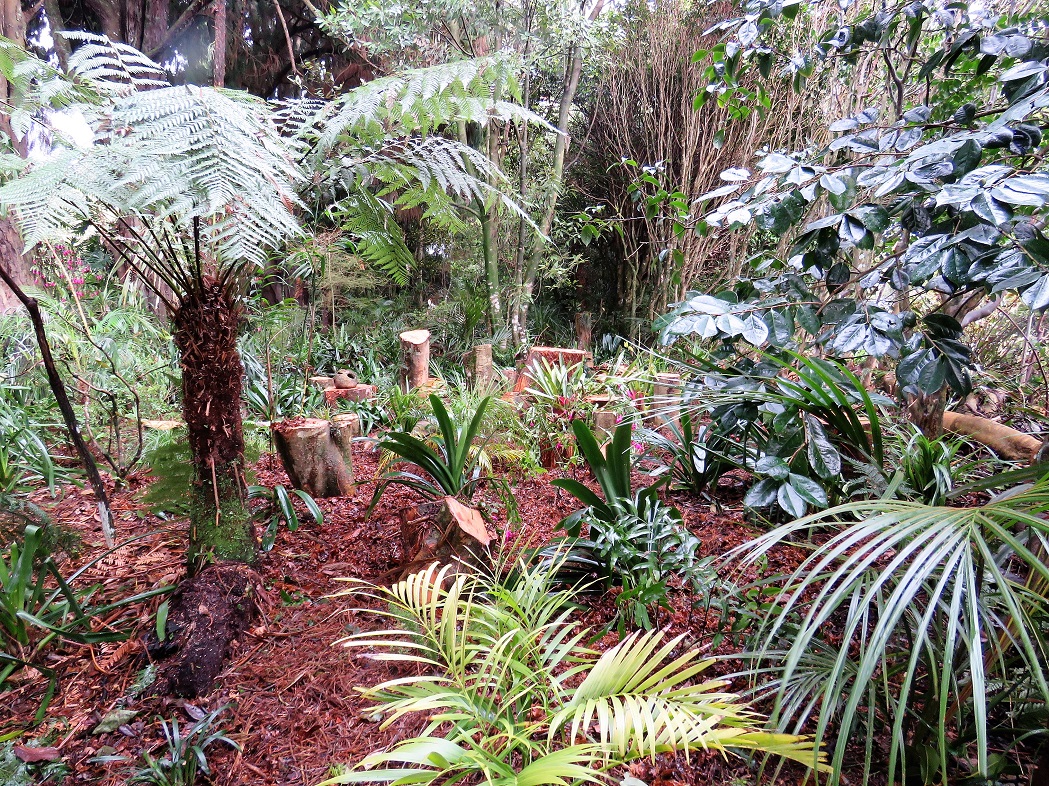
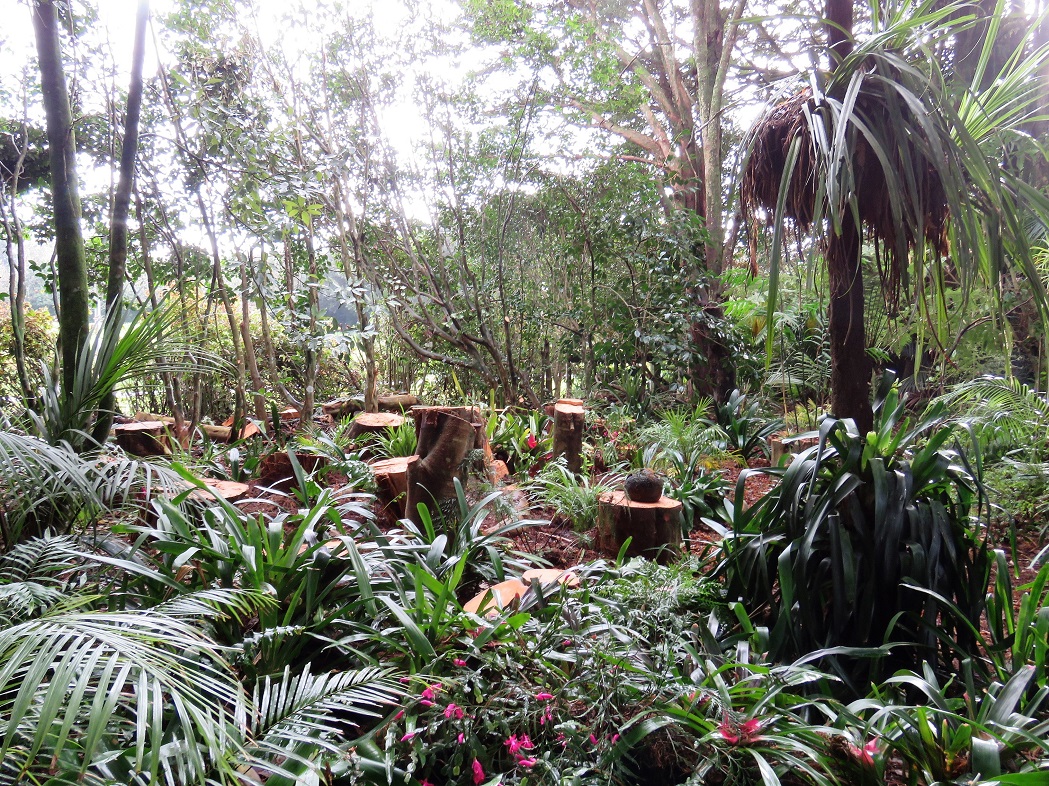
Then I moved in, replanting what had been dug out and rustling up other suitable material to fill it all up. Ferns, clivias, chain cactus, bromeliads, three small growing palms from the collection Mark still has ‘out the back’, some liriope and I can not recall what else. This area is mixed and informal and is one of the best examples of a stable matrix planting we have. By matrix planting, I mean one where the selected plants co-exist happily over time (measured in decades, not months or a year or two), requiring remarkably little maintenance or intervention. It is also bio-diverse because of the range of plant material used, the depth of natural leaf litter and because most of the spent material is kept on location, not removed.
To finish off the reinstatement of the area, I moved in large amounts of leaf litter as mulch. With high overhead trees, the whole area has considerable depth of mature leaf litter and I was able to skim it off from adjacent spaces to get what I wanted. There is no bare earth left visible.
The cut edges on the trunks need to mellow. The plants need to bed down and put on fresh growth. It does not look as densely planted as the surrounding areas. But it doesn’t look raw and new and I am pleased. The two factors that made the biggest difference to the appearance are the natural mulch and using plants that were a variety of different sizes and maturity. If you buy plants from a garden centre, they are a uniform grade. Freshly planted, they will look like plants you bought from a garden centre. If you can cast around and rustle up plants to hand, the look is far more natural and that is the effect we want.
The whole exercise took about four days from the arborists arriving to reach this final point. The pile of woodchip mulch has grown further. It is clearly generating some heat on this frosty morning. It represents a handy resource, even if we don’t want to use fresh woodchip mulch everywhere in the garden.











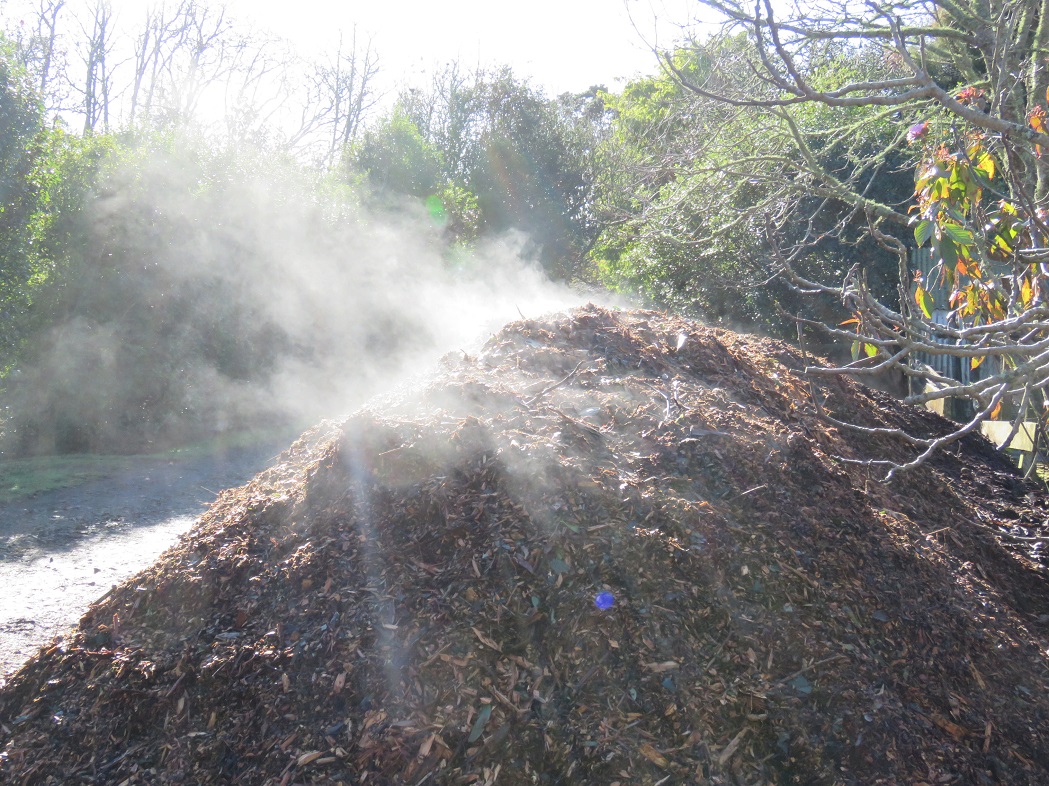 The pile of woodchip mulch has grown further. It is clearly generating some heat on this frosty morning. It represents a handy resource, even if we don’t want to use fresh woodchip mulch everywhere in the garden.
 Tikorangi The Jury Garden