Author Archives: Abbie Jury

Unknown's avatar

About Abbie Jury

jury.co.nz Tikorangi The Jury Garden Taranaki NZ

Just as well we don't need yew wood for longbows here

Taxus baccata fastigiata - no longer fastigiate in our rockery

Taxus baccata fastigiata - no longer fastigiate in our rockery

A little piece on yew trees in our local newspaper garden pages started us talking about them. They are a most interesting plant. It is just a shame they are not generally happy in Taranaki conditions and there are reasons why they have never featured large in New Zealand gardens and plantings.

We have one feature yew tree still surviving here, a venerable specimen of what is probably widely known as the Irish Yew – Taxus baccata fastigiata. At some point it keeled over at an angle and decided to stay there so we clip it tightly once a year and it resembles a kiwi body (minus any head) as a feature in our rockery. I say venerable, but that is venerable by New Zealand standards – as in probably 60 years old – not venerable by British and European standards where yew trees can survive for a very long time. Many hundreds of years is common and the oldest known tree at Fortingall in Scotland is thought to be somewhere between two and five thousand years old. Astonishing. We used to have many other yew trees here. Mark’s parents were as heavily influenced by English gardening traditions as others of their era and yews are an integral part of that. But over the years, many have, as we say, whiffed off which is our way of describing plants that die from root problems. If you look at where yew trees thrive, it is generally in colder, drier climates and their natural habitats in Britain are on chalk soils. We occupy the cheese side of the chalk and cheese equation – nothing even remotely resembling chalk soils here, thank goodness. We would not try planting more yews here – there are other plants we can grow better in our conditions.

Added to that, another reason why yew trees have never been a big hit in New Zealand is that we still have very strong rural roots and yews are deadly to stock. We know. The remains of our golden yew killed four of our beefies when they got into the paddock with the fire heap in it. This is not at all a suitable tree for country folk to plant here.
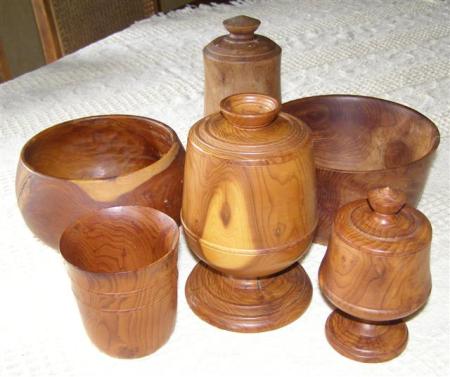
Mark's little collection of treen turned from yew

Mark's little collection of treen turned from yew

The fact we can’t grow them well does not stop them from being an interesting plant. They are pretty sacrosanct these days in Britain but if you ever come across anyone cutting down an old yew, get down on the timber. Mark pretty much destroyed a chainsaw cutting into one many years ago (it wasn’t the yew that was the problem – it was the metal stake that somebody had driven in to support the plant and left there to be hidden as the tree grew). But when he came to turn the timber on his lathe it was not only one of the very best woods he ever used – he described it as being like turning hard butter – it also had one of the richest and most varied grains and markings you will ever see. We still have an assortment of treen turned from that one tree. Unusually for timber, the pale sap wood is also durable.

While there are other yew species from Japan, Canada, China and North America, it is the European form of baccata, also known as the English yew, that is the most widely used. It belongs to the family of conifers and its leaves are needle-like. These days it is highly rated in its homelands as a garden plant for specimen, hedging or clipping because it grows slowly, doesn’t ever get too large, it sprouts from bare wood and so lends itself to long-lived topiary and formal hedges where its fine, dark green appearance acts as a splendid punctuation mark in the garden. It is one of the main topiary candidates in English gardens. It is most commonly found with a spreading habit, not upright. In fact the vertical yews which make such splendid pillar shapes, are a far more recent addition dating back just two hundred years to a mere two trees selected in Ireland. No doubt other forms have been discovered since, but the so-called Irish Yew is identified as fastigiata (fastigiate just means tall and narrow) and is traced to those two specimens.

In its natural state, the yew is dark green but it can sport to a yellow variegation and in a country with a long winter, British gardeners continue to value yellow foliaged plants for a spot of colour whereas we tend to shun them in this country. Our most recent yew to kick the bucket (and not greatly mourned) was a specimen of the Golden Irish Yew. I don’t care if yew trees are all class, I still don’t go for yellow variegated conifers.

It may be as garden plants that the yew family are valued nowadays but that was not always the case. They have a history steeped in warfare. For it was the development of the longbow that made Britain a military force and yew wood made the best longbows. As far back as the thirteenth century, England was importing yew wood from Europe and the local supplies were under huge pressure. Within a hundred years there was a serious shortage and in 1350, Henry 1V basically nationalised all the yew trees in Britain so they could be harvested to meet the needs of the royal bowmen. Not only that, but trade with Europe was dominated by the supply of yew timber and within the next couple of hundred years, Bavaria and Austria were stripped of all their native yews to supply bows for the King of England’s archers. The move to firearms at the end of the sixteenth century had more to do with a lack of adequate supplies of yew wood left anywhere in Europe, rather than technological advances. Given the warmongering tendencies of the Middle Ages, it is a bit of a miracle that any yew trees survived in the wild anywhere in Britain and Europe.

Many, if not most of Britain’s significant yew trees survive in churchyards and there are many theories abounding as to why they are such a common tree there. It may just be that a respect for the church meant these specimens could not be plundered for the making of longbows.

There was considerable angst amongst conservationists and historians when researchers first found that Taxus baccata had natural compounds which could be used in the manufacture of a new drug to treat cancer. It seemed that the future of the remaining yews could be under threat because it takes a vast amount of raw material to yield a small amount of the compound. The loyal British gardeners rose to the occasion. When the call went out for them to gather up their yew clippings to contribute to research, apparently they did so in droves. It was sufficient to progress the research to the point where the compound could be manufactured synthetically in a laboratory.

The future of the yew tree seems secure.
In the garden this week: September 24, 2010

  • Cut the spent flowers off your hellebores to stop the likely infestation of aphids, which find them a pleasant home, and to prevent them self seeding.
  • You still have time to start your own summer veg from seed but don’t delay with tomatoes, cucumbers, melons, aubergines, capsicums and the like. These are all started off sown in trays or pots for planting out in the garden later next month. If you only want one or two plants, it is probably just as cheap to buy the plants as packets of seed but sowing seed gives you the chance to be generous and share plants with friends and family.
  • Mark will be starting his corn in baby pots here. It is too early to plant out in the open yet but this being his most favourite vegetable of all, he likes to maximize the season and to get an early start with established plants.
  • Cloches come into their own at this time of the year. They will warm the soil more quickly, so allowing earlier planting out. They will also protect young crops and keep rain splash off micro greens.
  • In the ornamental garden, dahlias can be lifted and divided.
  • Feed roses if you have yet to do so. They are in full growth now so will have maximum uptake of fertiliser. If you are laying mulch around your roses, keep it well clear of the rose crown near the ground.
  • Kumara can be chitted, like potatoes. Place them on damp sawdust, straw or even crumpled newspaper in a warm, dark spot to encourage them to start sprouting. Kumara are another crop that needs maximum growing time, so the timing of planting out is important.
  • Get a copper spray onto deciduous fruit trees as they break dormancy. This is a key application to prevent problems later and is the single most important spray of the season.

Plant Collector: Edgeworthia gardneri

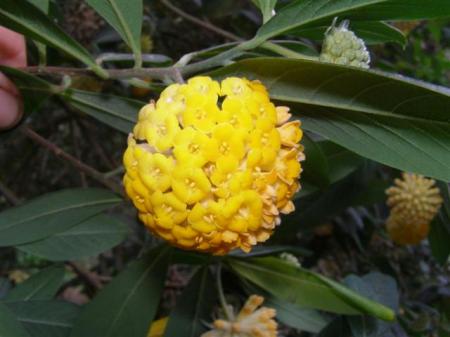
The scented golden orb of Edgeworthia gardneri

The scented golden orb of Edgeworthia gardneri

This plant has a very curious flower head – fully rounded golden pompoms of tightly packed, almost waxy flowers. Sweetly scented too, which is not surprising because it is a close relative of the daphnes, but because it does not mass flower, it lacks the fragrant oomph of its cousins. Each flower head is only about 3cm across, not much larger than an old fashioned gobstopper. Gardneri is still newly introduced to the west – it comes from Nepal – not easy to propagate from cutting and rare. I tell you this because several years ago we did manage to get some plants successfully growing and offered them on the mailorder list we used to put out. At the same time a gardening magazine showed a photograph of the flower but gave no idea of the size. Somebody in Palmerston North tracked us down and ordered the plant. We shipped her down a splendid specimen but she was not happy. She was expecting a flower more akin, I suspect, to the size of a cricket ball rather than a pingpong ball. She sent back this rare and choice shrub. It cost her more in freight than the plant was worth, but clearly it was a matter of principle because she felt short-changed by the size of the flower.

There are only two, maybe three, species of edgeworthia. The more common Chinese form, papyrifera or chyrsantha, is deciduous but gardneri is fully evergreen and makes an open, airy bush with a graceful appeal. It is not particularly hardy and won’t thrive in areas with cold winters. It has good nectar for the tuis and we are planning to add another plant in full sun to feed our butterflies.

In the garden this week: September 17, 2010

  • Give top priority to getting woody trees and shrubs planted which includes fruit trees. The soils are warming up and you want these plants to get established and make fresh root growth before summer. As a general rule, fruit trees do best in full sun.
  • It is time to wage war on wandering jew (tradescantia) and onion weed. These are not easy weeds to eliminate. If you are hand pulling them, don’t pile them in a heap and hope they will rot down – they will merely grow. You need to kill them, usually best done with heat – black rubbish sacks on concrete under a hot sun will work but does take effort. If you are willing to spray, Shortcut or Amitrol appear to be best options for home gardeners but you also need to add a surfactant to make the spray stick. Grazon or Tordon Gold will work if you are a farmer with these in the cupboard. Glyphosate won’t work at all. With wandering jew, if you roll up the top layer (and dispose of it elsewhere because every piece will grow again if it gets the chance), you will get a better kill with spray because you are killing the layers closest to the ground. Be prepared to spray on repeated occasions for eradication.
  • Don’t rush to plant tender summer crops such as tomatoes, cucumbers, aubergines or melons in the garden yet. You won’t gain anything and it really is still too cold. You can, however, be giving them a head start in containers in a sheltered position such as a porch or a glasshouse. If you have been tempted to buy baby plants from the garden centre, pot them on to a larger pot and cosset them until the great Labour Weekend plant out. It is really important that small plants not be checked in their growth by poor conditions (too dry, too cold, too wet or root bound in pots which are too small for them). They rarely recover from early encounters with adverse conditions.
  • Pinch off the first flowers on your freshly planted strawberries. This allows the plant to get larger and stronger and produce more fruit in the long run. It takes a lot of energy for a plant to produce fruit and you don’t want to exhaust the poor wee juvenile plants. You can still plant strawberries but don’t delay if you want fruit for Christmas. I see the handy advice is to put in five plants per family member. If you have a large family and you are buying plants, it would be cheaper to wait until next year and to plant runners much earlier in the season.
  • Keep the fertilising round going this month. Cheap and cheerful fertilisers are fine for the garden – keep the expensive, slow release fertilisers for container plants. Compost will also nourish and has the advantage of improving the texture and health of the soils. We recommend laying the compost on top as a mulch to suppress weeds. Nature and the worms will do the rest to mix it in with the dirt below.

Countdown to Festival: September 17, 2010

  • Southwards in Hawera at Puketarata, Jennifer Horner has been looking on the positive side and enjoying those spring days which have been lovely (as opposed to sodden). While the early daffodils and Magnolia Vulcan are looking a little weather beaten, (though Jen says Vulcan has been spectacular this year), Rhododendron Bibiani is in full flower and has escaped damage and the pretty Prunus Awanuis are just opening. The lawns have responded most gratifyingly to an application of potash and Jennifer is feeling that she is on top of the pruning, fertilizing and mulching but the vegetable garden is calling.
  • Also down in Hawera, one of Festival’s most experienced openers, Mary Dixon is dashing out in between the showers trying to get jobs done – weeding, moving plants, deadheading and getting rid of the winter moss buildup. She is still worried about the possibility of late frosts, so is cautious about rushing to fill the gaps left by earlier frost damage. However the delight of the early spring display of magnolias, flowering cherries, daffodils, violas and pansies, different hellebores and primulas more than compensates. Mary gardens for twelve months of the year but likes to have her garden peaking to perfection for Festival at the end of October.
  • Moving northwards, June Lees of Cairnhill Garden, Stratford has been waging war on liverwort, the bane of all our lives in our climate. She is hoping it will be invisible by the time Festival opens. June is also having fun with her new playhouse, as she calls her tunnel house. It may seem an extravagant home for her hanging baskets, but it has made life much easier for both June and said baskets. In the past she has had to house them in her glasshouse where she kept bumping into them so leading her to move them out too early to the patio. So at this stage, her new tunnel house gives room for a glorious line of hanging baskets and no doubt, over time, June will find a whole host of other uses for her tunnel house and she will wonder how she ever managed without it.
  • Joyce Young has been in Festival for a very long time indeed but more recently has moved to a small garden in town – a mere 480 square metres, she says. This is an interesting opportunity for Joyce to manage a sustainable gardening model from scratch. She has installed a rain water tank with gravity fed soak hoses to water her vegetable garden – the gentle soaking is far kinder and does not lead to as many mildew problems as overhead watering. Her worm farm has been in operation for a full two years and while her three bin compost system is a commercial structure, it is an efficient and simple option for a retired person for whom the manual labour of a more traditional compost system is a challenge. Joyce is well known for her pottery (particularly pukekos) but of late she has been really enjoying getting to grips with painting with pastels and has just moved on to flower subjects – magnolias, this week.
  • Also in New Plymouth, David Clarkson and Valda Poletti at Te Kainga Marire are despairing at the damage being wrought on the black mamaku (ponga) tree ferns, they say by the dreaded Indian mynah birds. Apparently they eat the unfurling leaf buds and the neighbours’ pongas have already succumbed to sustained attack. David and Valda are fighting off the mynahs to try and save their 30 year old pongas, moving Valda to express the wish that people would stop encouraging these pest birds by feeding them household scraps.
  • Here at Tikorangi, the mynah birds are a minor issue and the pongas are perhaps too plentiful but we could have done without the ginormous Lombardy poplar that crashed to the ground without warning in our park. At about 80 years old and 80 feet tall, it was perhaps fortunate that it fell inwards to our property and not outwards to the road. It is such a shame that poplar wood of no value either for firewood or timber but in its descent to ground level, it clipped the Magnolia campbellii which is now about half of its former size and magnolia is a good timber. Our rhododendron Loderi King George also bit the dust but considering the size of the tree, the damage was not too bad overall. Now that it is all cleaned up, we are looking at an unexpected new area to plant up.