Author Archives: Abbie Jury

Unknown's avatar

About Abbie Jury

jury.co.nz Tikorangi The Jury Garden Taranaki NZ

Learning from the Old Country – the appeal of traditional English crafts

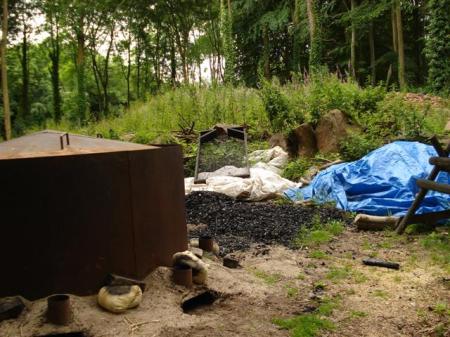
Reality didn't quite match the romantic mental image - charcoal making at Hestercomb

Reality didn't quite match the romantic mental image - charcoal making at Hestercomb

Prime Television appears more willing to deliver gardening programmes to us than TV1. Clearly the head of programming on the state owned channels is no gardener – maybe we just don’t fit the target demographic? It seems a long time since we have had any garden programme, good or otherwise, on state-owned television but Prime are currently running a doco series on the famed Sissinghurst Garden on Friday evenings.

For those of you not in the know, Sissinghurst Castle Garden in Kent is one of England’s most famed. Created in the first half of the twentieth century by a flamboyant and eccentric couple, Harold Nicholson and Vita Sackville-West, it was cutting edge in that very pretty, flowery style the English do so well, confined within tight, formal design. It certainly helps to have huge walls and castle remnants including a splendid tower. Alas it fell prey to England’s savage inheritance taxes so the Nicholson and Sackville-West progeny could not afford to keep it in private ownership in the 1960s and it was given to the National Trust with the proviso that the family be allowed to occupy the house for up to three generations. The current occupant is the grandson, Adam Nicholson and his wife Sarah. It does appear that Adam sees himself as the guardian of their dream though it is the National Trust which provides the money and the labour force to maintain the dream. The rather drawn-out series is worth dipping in to even if you don’t find it sufficiently compelling to last the full hour each week.

You need Sky and the Living Channel to tap into some of the other back to nature lifestyle programmes coming out of Britain these days. I think it was a Grand Designs episode (also screened on TV3) that finally spurred Mark in to some serious attempts to get to grips with sustainable woodlots. We watched one man hand building his house primarily from green chestnut, harvested from his sustainably managed woodland. In New Zealand we are so used to the notion of kiln drying or air drying timber to season it, that there is little knowledge about which timbers can be used freshly cut and still wet. That is what the term green oak and green chestnut refer to, though to use fresh-cut timbers you must also understand the way each different wood will react as it dries out. We are not talking pinus radiata here.

I don’t think Mark is intending to go into building, but he is certainly interested in sustainable woodlots at a lifestyle block level. We get through a lot of wood here (most of it burned for heating) and while we are currently self sufficient in firewood, we can take that principle further.

Then there is the series on Saturday evenings on the Living Channel where selected candidates learn traditional English crafts. It is hosted by Britain’s very own Expert on Many Things, Monty Don. The first programme was fine – it had the participants learning traditional methods of making furniture using green woods (naturally from a sustainably managed woodlot). The chairs they made were delightful and I would be more than happy for Mark to get back into working with wood. He used to do a lot of it in the days before we had expensive children to maintain and he had more leisure. In fact he became an accomplished wood turner and we still have his lathe in the back shed though it has lathered there in pieces for thirty years under the delusion that he will get back to it. He bought it when we lived in Dunedin and it was entirely rebuilt for him at no cost other than a couple of turned lamp stands by someone who knew someone who worked in the Hillside Railway Workshops. Back then they called such freebie jobs “foreigners”. We still recall those railway workshops most kindly though Richard Prebble’s analysis of how New Zealand Railways operated was probably closer to the mark than many people knew.

The third programme in the series was safe enough – blacksmithery or forging. Mark watched with deep fascination and commented that they made it look really straightforward but I don’t think he is going to get diverted into ironwork. Nor to weaving or leadlighting which have also been explored.

From this (1950's concrete roof tiles)....

From this (1950's concrete roof tiles)....

No, it was the second programme that is causing me some angst – thatching for beginners. Everybody knows that traditional English thatched cottages are unbelievably cute, genuine chocolate box cute. It is just so much more aesthetically pleasing and indeed environmentally sustainable than our long-run roofing iron. And the life expectancy of each layer of thatch is about the same as roofing iron – forty years or so – though finding a skilled thatching team to repair your roof is harder than finding a team of modern roofers. It should be said that apparently you don’t replace your thatch, generally you just add another layer to waterproof the roof. The principle is that the thatch is packed so tightly that it directs the water downwards and sheds it quickly.

... to this, maybe (thatched cottages at Hidcote)

... to this, maybe (thatched cottages at Hidcote)

You don’t want a house fire. I have seen a burned out shell. Once the thatched roof catches, it is impossible to quench. Beneath the more recent layers, there may be dried straw or reeds which are 500 years old. Personally I am a bit worried about spiders and mice too. And maybe other livestock. I feel that the dry and warm under-layers of thatch may be altogether too appealing for them and they might set up home en masse.

So I began to get a little worried by the level of interest Mark shows in thatching, more than a little worried when he commented that he felt our house would look a great deal more appealing with a thatched roof. He has even tried making one of the packed bundles which are the foundation of thatching. With a gleam in his eye, he announced that he could now see a use for his buckwheat straw. It was with some relief that I saw the straw recycled as mulch for the strawberries and he observed that maybe he would be better to start with a smaller project than the house, perhaps a thatched dovecote.

We have yet to get an episode on making charcoal but I am sure it will come. The British are big on charcoal and, in the near absence of the gas-fired barbecue, charcoal is still popular (though these days it is more likely to be cheap charcoal imported from defoliating third world countries). We realised that charcoal-making is undergoing a renaissance when we visited Hestercomb near Taunton last year. The garden map showed a site for the making of charcoal. We were inspired. We even bought a book on the topic – this could be the novel activity to attract additional visitors to the garden. Or so we thought, until we came to Hestercomb’s charcoal campsite. The only aesthetically acceptable aspect was the repro charcoal maker’s hut which may have been cold and drafty and minus a resident charcoal maker but it was at least quaint. No, we figured we would leave the making of charcoal to the Taranaki Regional Council. It seems a suitable activity for the folksy rebranding of their garden at Kaponga. I wonder if I should offer to loan them our book on the topic?
In the Garden: August 27, 2010

  • The Living Art bonsai fraternity will be at Cedar Lodge Nursery on Egmont Road this Sunday from 10am to 4pm and are keen to share their knowledge and enthusiasm with anybody interested in learning more. Some might style this hobby as occupying the bondage and discipline sector of the gardening world and there is no doubt that the skills are highly specialized so it helps to learn from people who know what they are doing.
  • You are running out of time for moving large plants. They need time to settle in and make some fresh root growth before the heat of summer starts. Take as large a root ball as you can manage and prune back the top to reduce the stress on the plant. Make sure you dig a deep enough hole to replant, ensuring that the level of the plant remains the same but no deeper than it was.
  • September is nearly here and that is the big time for planting the summer vegetable garden. If you haven’t yet dug your green crops in, do it this very weekend so the process of breaking down in the soil can be well underway before you want to plant.
  • Learning to grow vegetables from seed can save you a great deal of money as well as extending the range of different varieties you can grow. Some seeds, such as carrots, peas, onions, beet and lettuce can be sown directly into the position where they are to grow. Others, particularly tomatoes, melons, cucumbers, aubergines and pretty much anything exotic or needing a long growing season are started in seed trays or small pots for planting out later in the season. Egg cartons can be a useful quick turnover seed tray and, like the cardboard core of toilet rolls or even newspaper folded into tubes mean that when the seed has germinated and put on some growth, you can plant out the whole item without disturbing the roots. The temporary pot will decompose very quickly in the soil but keep this technique for germinating quick turn over crops such as lettuce, cabbage or bok choy.
  • If you haven’t got a copper spray onto your deciduous fruit trees yet, do not delay. You want it done before bud break and that is imminent.
  • Further to the article on growing apple trees at home by Glyn Church in the Taranaki Daily News last week, I have been looking at control of codling moth, the single most troublesome pest we have for apples. The short answer is that there is too much information to summarise in brief. If you are organic, Hort Research have been doing a lot of work on organic controls which you can find easily on the internet. There are no one-step answers – the pheromone traps need to be used in conjunction with other measures. The collar of corrugated cardboard around the main stems is not a stand-alone technique. If you had a problem last year and didn’t do anything, it will get worse this year. This is why we will be resorting to spraying this year, to try and break the cycle after a decade of total neglect which has allowed numbers to build up. Springtime is when you need to start the fight against codling moth.

Countdown to Festival August 27, 2010

  • In Stratford at Merleswood, Erica Jago has been enjoying her drifts of little English snowdrops beneath the deciduous trees. Their flowering season is now pretty well over for the year but the winter display of the cornus is more lasting. Cornus alba has bright red stems while Cornus stolonifera “Flaviramea” has lovely yellow stems. Erica has them planted in her pond garden and the cooler climate of Central Taranaki accentuates the colour. Cornus are otherwise known as dogwoods and the reference to stolonifera just means that plant suckers along below ground.
  • Just down the road at Te Popo, Lorri Ellis has been waging war on surplus tree ferns. Lorri has come to the conclusion that tree ferns sneak in under the radar and manage to grow before she even realises they are there, though she is willing to admit that this may in part be her failure to differentiate them from more desirable ferns in the early stages. If you want to shock English and northern European visitors, tell them how we cut down ponga ferns willy nilly – they pay mega bucks for them at home and value them greatly, taking great care to over-winter them though the closely related Tasmanian tree fern is more commonly available than our NZ species. Lorri and Bruce have also been reconstructing their low wall of sawn timber logs which edges an area near their pond. But as the mondo grass (ophiopogon) which softens the hard lines has spread (it, too, is stoloniferous), to get it out has involved digging out all the irises, tulips and daylilies as well to disentangle them. The day lilies and irises will appreciate this lifting and replanting exercise and should romp away with renewed vigour.
  • Around the coast past Okato, Chris Goodin is feeling pretty relaxed about this year’s festival, now that she knows what they are in for after being first-time openers last year. Chris has finished making her quota of wedding and opera dresses for the time being and is now into gardening mode. She is particularly thrilled to have just had it confirmed that Auckland artist Karl Maughan will be exhibiting some of his paintings, particularly of rhododendrons, at the Goodins during festival. There is an added incentive to visit. Chris tells me that in the latest Next magazine (the one with Petra on the cover), on page 59 there is a photograph of a fancy woman standing in front of one of Karl’s paintings. Just remember page 59 for the next time you are waiting in line at the supermarket checkout and you are not looking at the fancy woman but at the picture on the wall behind her.
  • In town, Mary Vinnicomb was relieved to have finished pruning the climbing roses – she says her knees don’t really appreciate climbing up and down the ladder repeatedly. Many other gardeners will have knees which would go out in sympathy with that sentiment. Her Magnolia Lanarth has done its flowering dash for the year but Mary is grateful that it is still alive after its near terminal encounter with spray drift from somebody else’s property last year. Magnolia Burgundy Star is opening its flowers and Camellia Our Melissa has been an absolute picture along the front fence. Mary says it is quite fun to be working out of sight in the garden and to hear people admiring Our Mel as they walk past. She is worried, however, that her early narcissi (jonquils and daffodils) seem to be reducing in number, not increasing, and she wonders if it is due to the nasty narcissi fly which lays it eggs in the crown of the bulb so the larvae wriggle down to feed.
  • At Havenview Vegetable Garden, Maree Rowe is frequently accompanied by her son’s characterful dog, Smoke. She is willing to overlook Smoke’s inclination to snooze on freshly dug beds because this dog has developed a taste for grass grub. She is in fact so keen on them that she will actually dig up the lawn looking for them and Maree says it is like having a chook at her feet whenever she is digs – the dog is waiting and looking for delectable grubs. I am sure this is not natural behavior, but at least they are organic grass grubs in this garden.

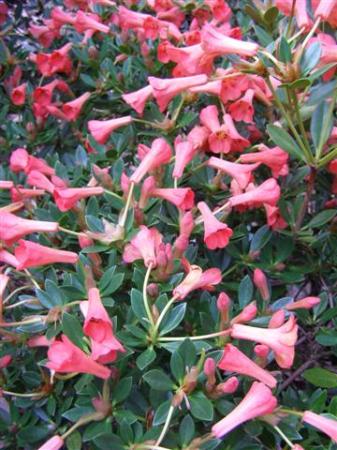
Tried and True: vireya rhododendrons Jiminy Cricket, Saxon Glow and Saxon Blush

Jiminy Cricket - the hardiest of any vireya we know

Jiminy Cricket - the hardiest of any vireya we know

  • The hardiest of the vireya family.
  • Tidy, compact growth around 75cm high.
  • Widely available.
  • Flower freely over a long period of time.

Siblings, these three cultivars. The breeder, Os Blumhardt, gave us seed of the cross and one plant grew so well we put it into production with his agreement. We called it Jiminy Cricket because the flowers are held upright and as singles, reminding one of the original Jiminy Cricket’s eyes swivelling on stalks. The remaining plants with Os also grew well and in due course another nursery took two and named them Saxon Glow and Saxon Blush. Glow is a little redder, Blush is a little paler pink while Jiminy is more coral orange coloured but they all have similar habits of growth. They are funny dense little plants with stiff, upwardly pointed leaves. And hardiness in colder, wetter conditions where most vireyas would promptly curl up and die – that is their biggest attraction of all. This is not to say that they will take bog, repeated heavy frosts or snow. They are just hardier than any other vireya we know so are a good choice for very marginal conditions. They make a corker little hedge – we have a semi circle planted beneath a mandarin tree and after close to a decade, they are still bushy and only about 60cm high. Vireyas are easy to strike from cutting so patient gardeners may just buy one plant and build up the numbers for a hedge.

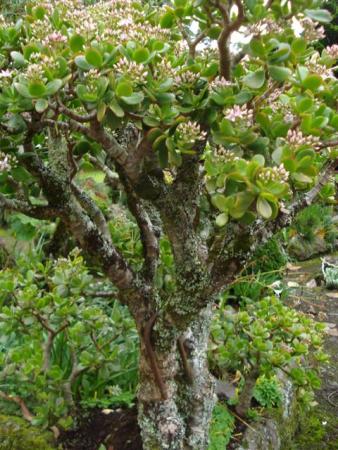
Tried and True: Crassula ovata or the Jade Plant

The Jade Plant or Crassula ovata

The Jade Plant or Crassula ovata

  • Grows like a natural bonsai.
  • Flowers in late autumn and winter.
  • Widely available and dead easy to increase at home.
  • Optimistically called the Money Plant sometimes.
  • Apparently good for feng shui.

This crassula comes from a very large family and has undergone a number of name changes – the current choice seems to Crassula ovata. But it is commonly known as the Jade Plant. In near frost free areas, it is fine as a garden plant but inland, it will need some protection. The dry border under the eaves of the house may be an option, or a container brought under some cover in winter. Frosts will destroy the flowers and can burn the fleshy leaves, even kill the whole plant in bad cases. Being succulent, it doesn’t want wet feet, either. In return, the crassula will reward you by being genuinely easy care and undemanding and putting on a very pretty floral display in the gloom of early winter. I have never seen it more than 90cm high but it develops into a naturally characterful, gnarly looking plant with relative speed. To get more plants, just cut a branch off. Let it dry for a few days and then stick it in some potting mix or good garden soil. Bingo, it will grow roots, just as long as you don’t let it get too wet in the meantime or it may rot. This is a good plant for children to try growing – get them to put in cuttings now and the plants should be well established as Christmas presents for grandparents. Be generous and put in larger cuttings, whole branches even, for more impressive results.