
- The real heat of summer has not yet arrived (and there is no guarantee that it will this year) so the usual summer maintenance of watering has not been necessary but vigilance against weeds is critical at the moment. In many cases it is better to remove the hoed weeds than to rely on the heat of the sun to cook them. Continue reading
Author Archives: Abbie Jury

Music to watch gardens by
We have been pondering entertainment and music in open gardens. This came about because our local Waitara garden trail was held last weekend. A true community venture, run on the goodwill and hard work of the organisers and the garden openers, this not-for-profit event brings out several hundred people to enjoy themselves over the two day period and entertainment is sometimes part of the package.
I must admit we only got to visit one garden ourselves but music played a large part. Being somewhat purist in our approach, we have steered well clear of the entertainment factor in our own garden. Mark is of the view that he would much rather visitors came to enjoy the garden than to treat it more as a venue for entertainment. But we were really interested in the impact of music in the garden we visited. The owners were playing carefully chosen, contemporary instrumental music which was loud enough to create an ambience on arrival but not so intrusive as to dominate. In the spirit of a fun afternoon, it certainly added to the atmosphere and gave a sense of being where something was happening. Continue reading
This week 26 January 2007
- While grey rainy days may be dreary in mid summer, it has been a steady gentle rain, where we live at least, and absorbed well into the ground with little runoff. This makes for ideal conditions for planting again. Not perhaps large trees and shrubs (best held until autumn) but certainly annuals and perennials for late summer and autumn colour.
- Alas the warmth and the rain will also result in speedy germination of weed seeds so expect to see an explosion of fresh weeds over the next two weeks and get on to them early.
- If you have hybrid clematis suffering from mildew or which have finished flowering, cut them back hard now, give them a feed and start counting. In six weeks time, they should be flowering again on fresh growth. This won’t work on early spring flowering Clematis montana (the pretty but rampant pink or white one which is great for covering disused buildings or ugly banks) because it only flowers once each season, but most of the clematis will repeat flower with encouragement.
- It is still a free for all in the seed sowing department of the vegetable garden but for us it is the last week for sowing corn. Mark makes this last sowing a large one because they will hold much longer in the cold of early winter. Carrots and even parsnips can still be sown although they won’t get to full size.
- Plant brassicas for winter. It is getting too late for brussels sprouts unless you have good plants. Start successional sowings of winter spinach. There are two types of spinach. Winter spinach, or prickly seeded spinach prefers the cooler months of autumn to develop. Smooth seed spinach can still be sown but it won’t hold the same. It is generally sown in the spring.
- Garlic has been harvested here and Mark can confirm that it is a waste of time growing Chinese garlic from the supermarket. The elephant garlic is hugely more productive and the certified garlic did much better. The problems with the Chinese garlic are probably to do with them having switched hemispheres and their growing season being dislocated.
- As soon as you have harvested stone fruit such as plums, it is time to start the main prune on the trees, opening the plant up and thinning two thirds of the new growth. Summer pruning is done to avoid silver blight.
- Grapes need another trim to remove laterals and to set the final length of the fruit bearing canes. Spray with Bravo or similar to prevent mildew and watch for mealie bugs.
- Citrus trees need their summer spray of copper now.
This week 19 January 2007
- The flush of spring growth is over now so you have missed the boat for heavy pruning of plants such as rhododendrons, camellias and conifers which only put on one or two flushes. Other plants which grow all summer can still be pruned and shaped and cleaned up because they will continue to put on new growth after pruning. This includes vireya rhododendrons (which keep flushing repeatedly pretty well all year) , roses, clematis, luculias and michelias.
- Do not forget to prune cherry trees this month. We admit we have yet to do ours.
- With the sun finally generating some summer heat, weeds pulled out of the soil and left on the garden will shrivel away to nothing in a matter of hours. However, remove any weeds with seed heads, even if they are not fully ripe. The sun can ripen these quickly and if you leave seeding weeds on the surface, they will just sow themselves into perpetuity. It pays to carry a bucket with you while you are weeding or to tuck seeding weeds under a paver or stone where they can’t grow again. The key to weeding is to hoe them out while freshly germinated. Summer weeds such as portulaca and summer grass, if allowed to get some size, can survive hoeing and even survive being turned upside down with roots facing the sun. These need to be removed altogether.
- The next two weeks are your last opportunity for planting corn with a good chance of getting a harvest. Planted this late, corn can ripen and hold into the winter through to June.
- It is getting close to the cut off point for planting winter vegetables such as carrot and parsnip from seed so do not delay. If you are using plants, you have longer.
- Keep tomatoes sprayed with copper.
- If you have caterpillar infestations in broccoli or cauliflower, talk to your local garden centre about what pyrethrum based treatments are available. Pyrethrum is the active ingredient in flyspray and was originally extracted from a daisy. These days it is more likely to be synthetic but it remains a pretty safe and acceptable control. Alternatively, if you don’t like added protein to your cooked vegetables (while Mark does not mind the odd cooked caterpillar, the rest of the family find it very offputting), you can sprinkle lots of salt over the florets as you prepare them, then cover them with cold water for a few minutes while the caterpillars die. Rinse them thoroughly, inspect closely and cook with no added salt.
Of pohutukawa and pineapples
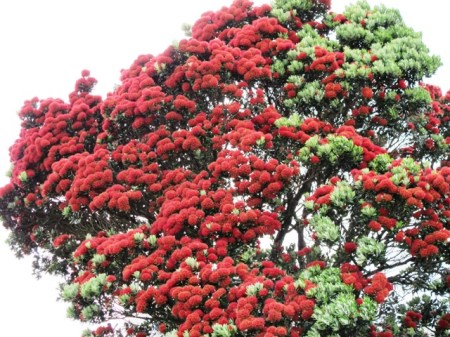
The pohutukawa - often called the NZ Christmas tree
Mark and I drove around looking at the pohuts (as we tend to call them) in Waitara which are well worth a visit at the moment. Waitara would be a bleak little town without these splendid trees. We felt a bit like Mark’s parents reincarnated. For years, Felix and Mimosa would make forays around the pohutukawa plantings and keep records on particularly heavy flowering specimens and good coloured ones. Mark could still recall certain trees – number six along such and such an avenue, or the one outside Mrs So and So’s place. Felix and Mimosa knew them all.
We were not so meticulous, but certainly three aspects made a big impression. The first was what a splendid tree they are for coastal areas and what a joy to behold in flower. The second aspect was a bouquet to the District Council who finally got around to limbing up and cleaning up underneath the trees which line the river. They look hugely better for it.
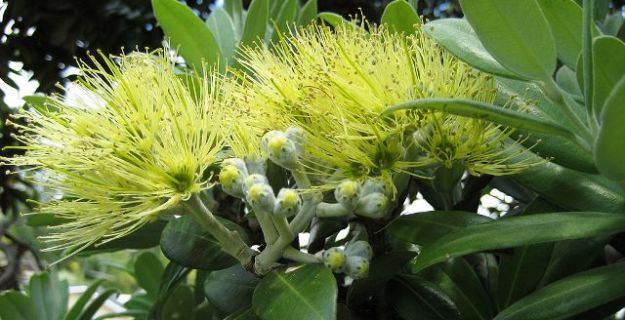
The Waitara riverbanks are also home to the oldest yellow pohutakawa on the mainland
The third aspect was the variation in colour. As landscape trees, not all pohutukawa are born equal. Their flowers may look lovely en masse, close up. But from a distance, rather a lot of them are distinctly brown in tonings. The stand out trees were those with rich red flowers, or those which had an orange tone to them. The orange lifts the colour considerably when viewed from further away. Funnily enough, the dark flowered forms tend to be later flowering.
The moral of this particular story is that if you are going to buy pohutukawa plants, it is worthwhile seeking out either named clones or plants from an identified seed source of good colour. One might as well start with better selections. If you plan on gathering your own seed, identify a good specimen now and return around mid May to collect the seed. Growing selected seed increases your chances of keeping good colour, although there will be variation. Partly as a result of Felix and Mimosa’s study of the Waitara pohutukawa, Duncan and Davies put out a good range of named selections. “Rata Maid” and “Scarlet Pimpernel” are still growing in Waitara. Up north, Graham Platt also selected good forms along with Jack Hobbs, including one called “Brilliance”.
Pohutukawa are tough trees and while they can get wide, they don’t get particularly tall. They can withstand most assaults except for frost when young and vicious attacks with injected weedkiller. If you cut a tree back hard to ground level, it will sprout again. And they will take heavy pruning. Cutting away all the growth from the base exposes their interesting trunk and branch structure and allows views through the tree. They don’t have to be dense, impenetrable visual barriers. They can be a flowering canopy with an interesting structure beneath. And the prunings are brilliant firewood.
We happened to be in Patea over the weekend and their pohutakuwa were also a real feature in the town. Many of them appeared to be of about the same age and are therefore likely to be from the same seed batch so they are not quite as varied as the Waitara plantings. Alas both these small towns suffer from the same problem of overhead power lines. If these were underground, the trees could grow without the heavy mutilation of top pruning some get subjected to on frequent occasions. That pruning does not do much for the appearance of the trees. Bottom pruning is good. Top pruning can be butchery.
On another topic, we had an amusing discussion with London daughter home for a holiday. In her travels around this country visiting friends, she had got into a conversation with somebody about an exciting new red pineapple which is being widely marketed. She just about fell off her chair when we told her that it was none other than the pineapple which grows beside our garage and which has been growing there for about 40 years or more since her grandfather imported it. Or so we understand. A northern nurseryman had visited and bought a plant from us. Sure that he had uncovered treasure which we didn’t appreciate, he put it into tissue culture to multiply it quickly and has been marketing it nationally as an exciting new release which is “cold tolerant, extremely hardy and easy to grow.”
Have we got news for him. It might be easy in Northland (and pineapples are just bromeliads so they are pretty easy in the right conditions) but hardy it ain’t (unless compared with the tropical pineapple) and it sure won’t be that rewarding in less than ideal conditions. I imagine he will get many letters from areas south of the Bombay Hills querying his claims. I can’t think that it will be a great success growing in Christchurch or Invercargill, for example, or indeed anywhere inland. In our books, cold tolerant and extremely hardy means it will grow in Tekapo and Turangi. If you have bought one of these pineapples, it will need the hottest position you can find in full sun. We find its fruit producing capacity is pretty hit and miss and it is an ornamental curiosity rather than the taste treat of the decade.
Pineapples are gross feeders. Our elderly plant is a pretty large clump. It needs thinning, which, because it is spiky and intimidating, does not happen often. You need leather gloves to handle it. The season that Mark thinned the clump and fed it well, it responded beautifully by putting on a splendid crop of fruit which are decidedly ornamental, but in our conditions they tend to rot before ripening properly. As Mark is big fresh pineapple fan, we still buy them from the supermarket.

