
Hostas planted with Ranunculus cortusifolius, Chatham Island forget-me-not and meconopsis
November sees hostas looking their very best. We used to grow hostas when we were still running the nursery. From memory, it was in the vicinity of four or five thousand every year, year in and year out, across maybe 35 different varieties. There is not much we don’t know about propagating and growing this plant family in containers. We always sold plants raised by division – not from tissue culture – and earned a reputation for a large and luscious grade.
Growing plants in a garden is different and now that we are gardening full time, we have taken a great deal more interest in their long term performance. Not all hostas are equal. Nor are they quite the low maintenance plant that is often claimed. Once the ground around them starts to compact, it is not uncommon to suddenly realise that a well-established clump has reached the point where it is getting smaller not larger. Smaller clumps which are not thriving may disappear altogether, even though they are in the recommended humus-rich shade. They like cultivated soil and will do better if given better conditions, especially the touchier varieties.

One of Mark’s reliable blue seedling hostas
The one exception has been a run of big blue hostas that Mark raised from seed. These are still handsome, large and fine after maybe two decades with absolutely no attention at all. The same cannot be said of all varieties. Alas, a number of the fancy newer ones are better in pots than the garden.
There is no doubt that hostas are a highly desirable dish on the smorgasbord of slug and snail food. I have seen plants eaten away to almost nothing, particularly in UK gardens where they seem to have a much worse problem than here, though I have been told Auckland snails may rival them. Should I therefore whisper that we don’t seem to have a big problem here? We so rarely use snail bait that neither of us can ever remember where the packet may be. Instead, we have reached an accord with the birds and they carry out constant pest patrols to keep the critters at bay. But if you are resorting to baits, remember that they are a poison, not a fertiliser. You only need two or three pellets per plant and more is not better. If you are not a slug bait fan, I did try the technique of baker’s bran and found that worked. Circle the plant generously with bran. I don’t think it actually kills the slugs and snails but they find it so irresistible they can’t stop eating it. Once in the gut, it swells and they lie around in a bloated fashion til the morning when the birds find them. Think of it as adding protein and fibre to the ornithological diet rather than subjecting them to toxins.
Softer leaves are more vulnerable to critter damage, so if you have an issue, go for the varieties with tough, almost leathery leaves.
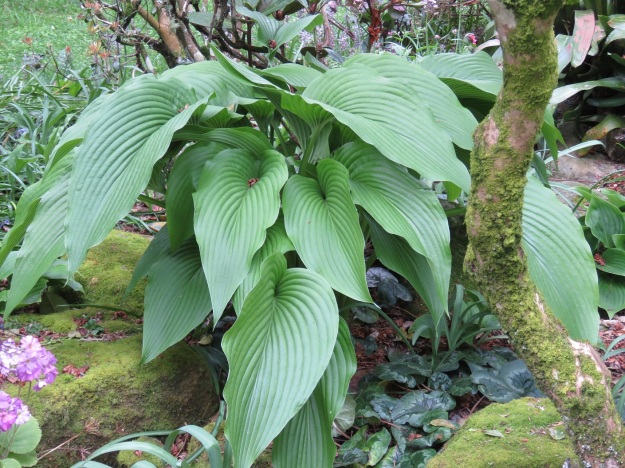
Hosta Jade Cascade
When it comes to locating them in the garden, it will be no surprise that we go for mix and match. Hostas love similar conditions to clivias, ferns, some of the primulas, meconopsis, Chatham Island forget-me-not and other plants which we use in damper, cooler situations of semi shade. They are not so keen on deep shade and will turn all green if they don’t get sufficient light. Gardeners in colder climates have more leeway in terms of sunnier positions but the yellows and pale variegations burn in the summer sun here.
 Many gardeners seem to prefer to group their hostas together in a hosta bed. It is not compulsory to plant them this way but if you prefer this look, I will repeat my advice given often to customers back in the days. Don’t be wooed into buying only the showy, variegated ones and bunging them all in together. It is the plainer hostas in single colours, and the variety in leaf form, shape and size that set off the fancy ones and avoid a mishmash. One fancy one to at least three plainer ones is my rule of thumb. These days, our preference lies with the solid coloured ones rather than variegated varieties.
Hands-on gardeners know that big clumps of hostas can be dug and divided in the same way as any other perennial plant. In terms of timing, it is best to do this in winter or early spring in our climate.
Running a mailorder business taught me never to take anything for granted. Hostas are deciduous, a fact that eluded one customer. “I am not happy with my order,” she wrote. “It looks as if there has been a rabbit in the box, eating the foliage. Or if they are deciduous, I don’t want them.”
It is the fresh foliage in spring that is the highlight for this plant family and some varieties will follow up with a showy floral display in shades of white, blue or, most commonly, lilac-purple shades in summer.

Hosta Regal Splendour (front) and Fragrant Blue
First published in the November issue of New Zealand Gardener and reprinted here with their permission.



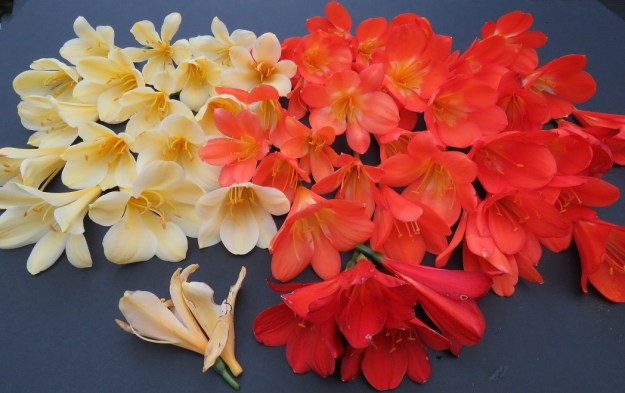 Mid spring brings us vibrant clivias in bloom. The ”contemporary” or “landscaped” look is to block plant in a single colour so you may have a swathe of orange clivias with the yellow ones segregated in a different area. This is not our style, in a garden where we strive for far more of a naturalistic, woodland look – “enhanced nature” seems to be the latest descriptor for this style though it is not a term you are likely to see me using often. We like to blend our plantings and combine the clivias with ferns, astelias, bromeliads and any and all of the other plants we use as the understorey in our shady areas.
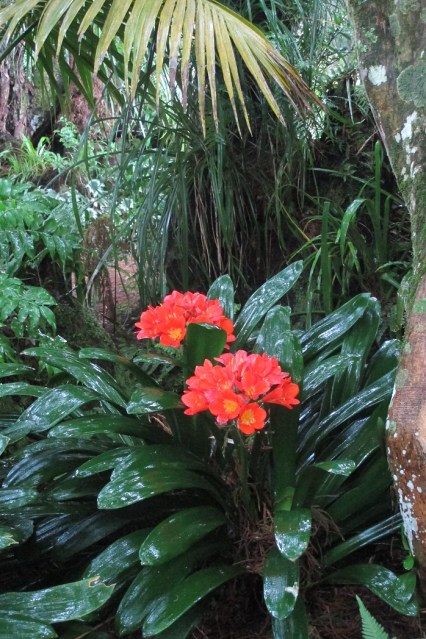 This completely confused a self-described Auckland landscaper I once took around the garden. This must have been back in the 1990s when ambitious but unqualified young people who, in a previous generation would likely have done an apprenticeship, discovered they could earn more money by dispensing advice and services to the growing wealthy of our largest city. He patronised me all the way around the garden – landscapers, you understand, rated themselves further up the social scale than mere gardeners – and at the end pronounced his surprise that we didn’t grow any clivias. I may have a been a little tart when I pointed out he just hadn’t noticed them, for they are there in abundance.
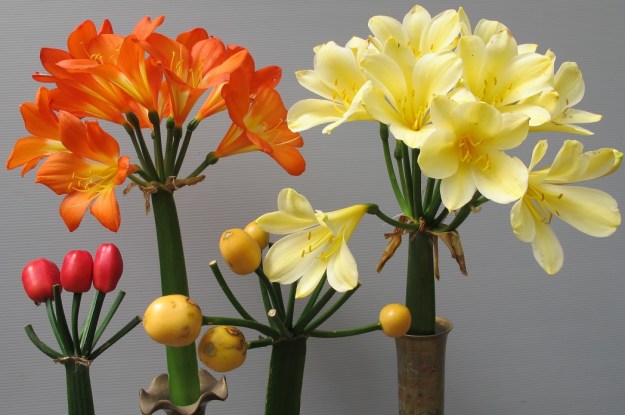
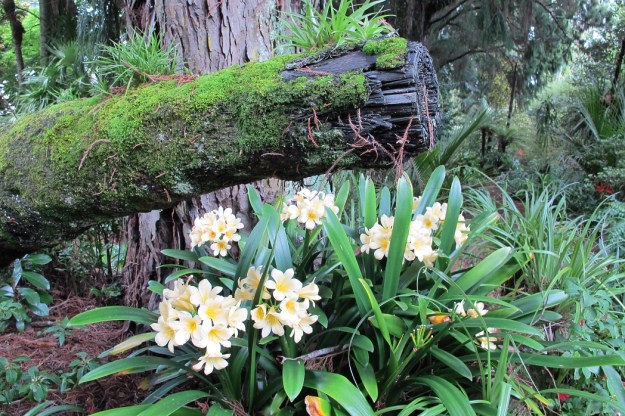 The soft yellows are still a recent introduction but already widely grown, readily available and making a huge contribution in gardens. Extending the colours into peach tones is well underway and of late the combination of white and green in clivias represents another development. One can, when all is said and done, have too much orange in the garden (NABOC syndrome – Not Another Bloody Orange Clivia) whereas the option of other, softer shades can bring welcome variety and interest. If you covet red clivias, you need to be aware that they open orange and age to red. Do not be like the gardener I heard of who bought a swag of large red clivia plants at considerable expense. When the first ones opened orange, she dug them all out.
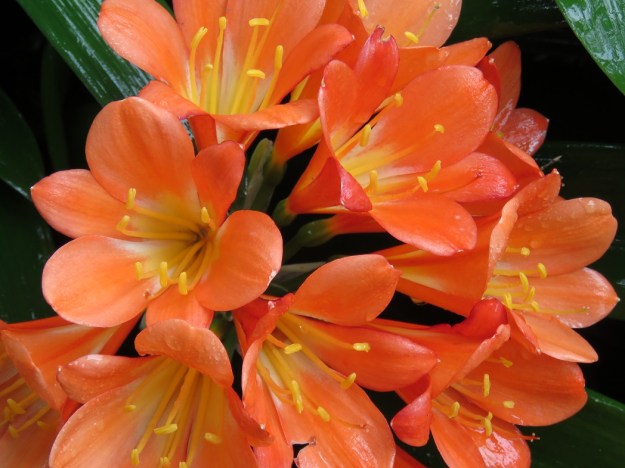 Considering the easy care nature of clivias, you may wonder why they are often relatively expensive to buy. It is all to do with time because they are slow to get established and to reach flowering size. In these days of instant gratification, most gardeners want plants that will perform and be showy in the garden from day one. In the case of clivias, be prepared to pay because it costs nurseries money to hold slow growing plants much longer to reach saleable size.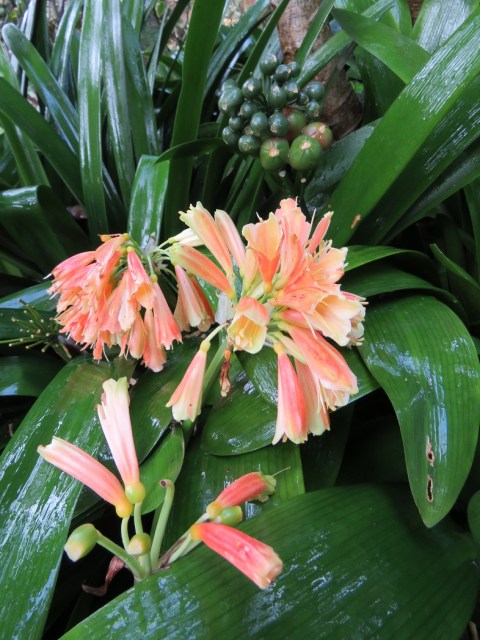

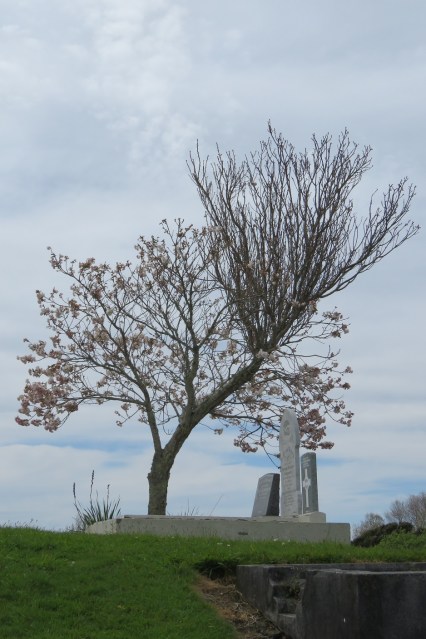
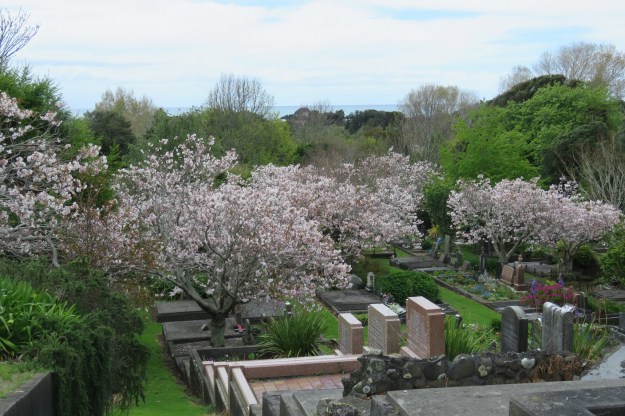
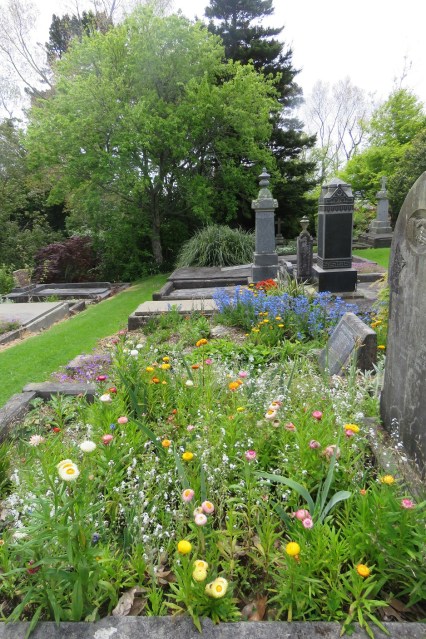
 Somebody, or probably several living bodies, must have lavished a lot of love and care on this section of the graveyard over many years. It was so well done and individualised that it did not have the look of institutional management. Nor indeed of relying on family or descendant management of individual graves – though there were some examples of these.
 It was the wide range of plants used, the attention to detail and the many delightful little pictures that were created as a result, the careful colour toning in some areas and the soft-edged maintenance that made me think it was not chance that created these scenes. Many are created as individual small gardens for a specific grave. I could not help but notice that the space of an individual grave back when the 1800s turned into the 1900s was considerably larger than a modern grave; family plots were larger again.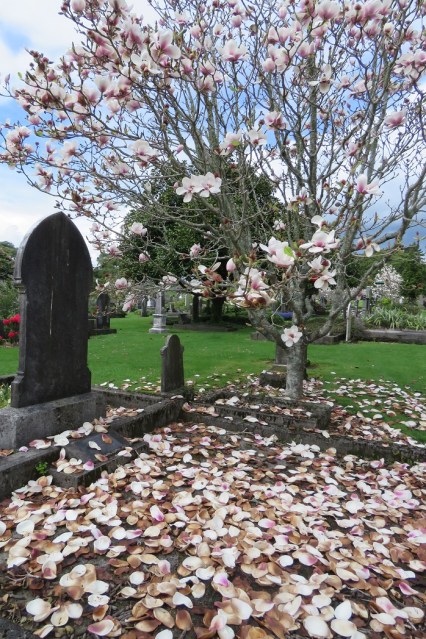

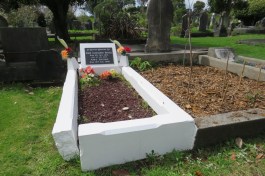
 For spring scenes, the cemetery was unsurpassed. I must go again in summer and see if the secret hands have wrought similar magic into the next season.
 If you are on Facebook, I have posted an album of additional photos to our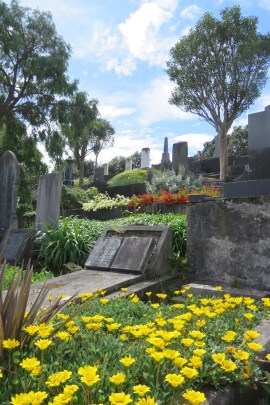

 Tikorangi The Jury Garden