
A few weeks ago, I looked at a selection of somewhat subtle garden ornamentation, understated even. Returning to the topic today, it is some more colourful statements that have caught my attention.
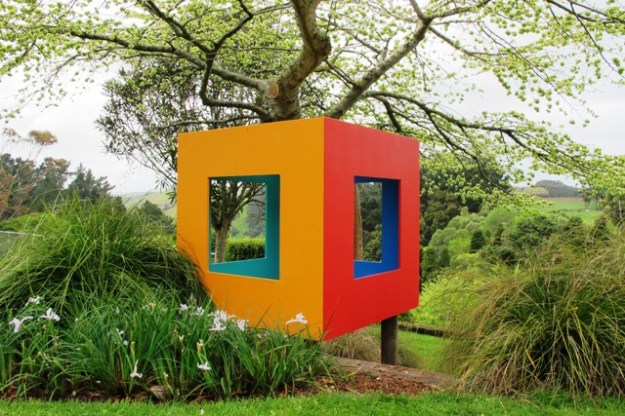 1) The box with its flat planes of colour is by Coromandel-resident artist Michael Smither and has found its permanent home at Puketarata Garden near Hawera. It has echoes of a child’s play house but the simplicity is deceptive. So too is the placement. It becomes the absolute centre of attention in the middle ground but is also successful in drawing the eye to the large landscape beyond.
 2) In a similar vein, the whimsical pavilion created by garden owner, Clive Higgie at Paloma Garden near Whanganui makes an undeniable statement as a focal point in an otherwise natural environment. The reflection is an integral part of the picture. As with the Smither box, it is the combination of a vibrant creation with thoughtful placement which makes this a successful installation. What appears to be a blue ceramic ball topping the roof is arguably the best use I have seen of one of these mass produced decorative items.
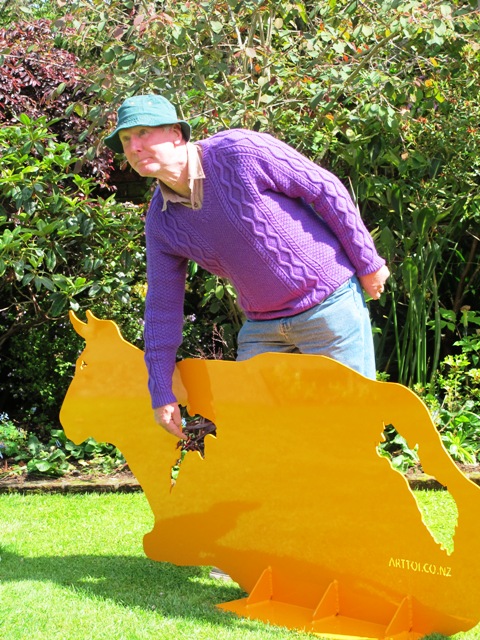 3) The freestanding, two dimensional yellow cow was on temporary display in our garden, the work of Joep from Arttoi (www.arttoi.co.nz) so we won’t mention the placement. The gentleman in the very purple jersey posed so willingly, adding a certain ambience, I felt. The cow may or may not be to your personal taste (I would have preferred it without the map of New Zealand). The purple jersey, the man’s wife told me, had been found in a skip and became an instant favourite for the wearer. Each to their own.
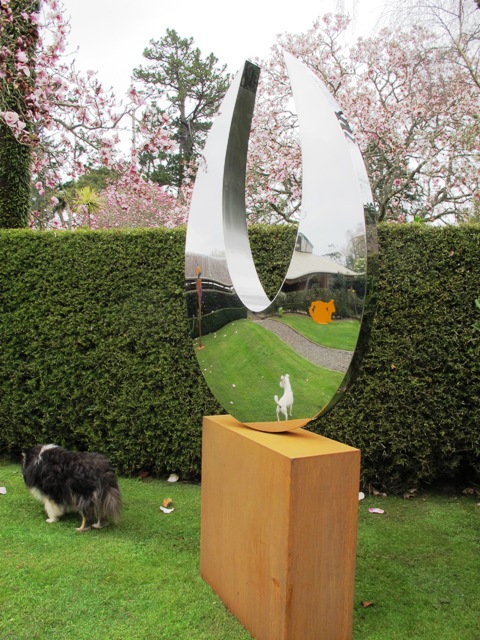 4) At the same temporary installation of Joep’s work, the stainless steel sculptures were beautifully executed and caught my fancy. The reflective qualities of the highly polished stainless steel were a great deal more subtle than a garden mirror. While there is a tendency to put this type of work in a hard-edged, minimalist, modern garden, I admit I was surprised by how well they fitted in to our own setting which is anything but that. We placed them in positions with relatively plain backgrounds where they could star and the reflections made it a two way interaction with their surroundings.
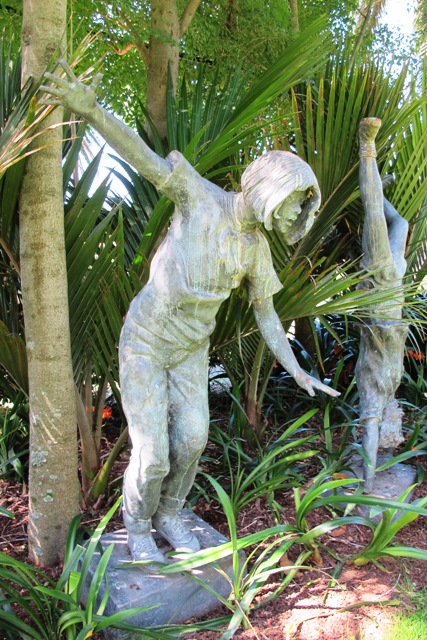 5) While not keen on reproduction classical statuary in a New Zealand garden context, these modern interpretations made me smile. In a very family-oriented garden, they fitted thematically. The frozen moment in time captured with the balance of their poses gave the contrast of tension with the subtle placement against the nikau palms. I could see these ageing gracefully down the decades.
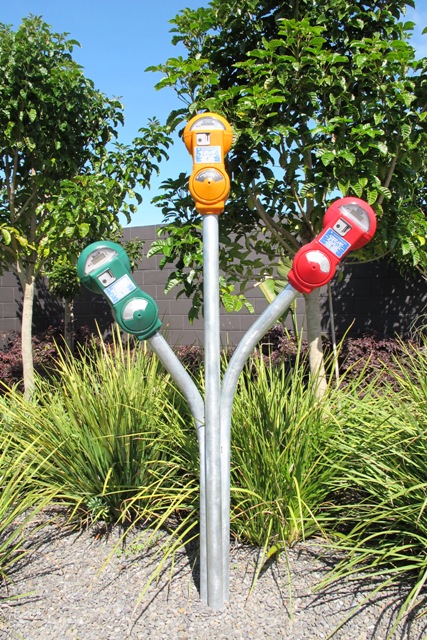
 6) When out and about garden visiting in spring and I could not help but notice a plethora of parking meters as garden ornaments. I am sure this was a result of the market being flooded with old meters in this particular area, which had moved to an electronic sensor parking system. The customised triple meter installation was perhaps more witty and striking than those single ones which had simply been placed as a relic of the past decade.
First printed in the Waikato Times and reprinted here with their permission.



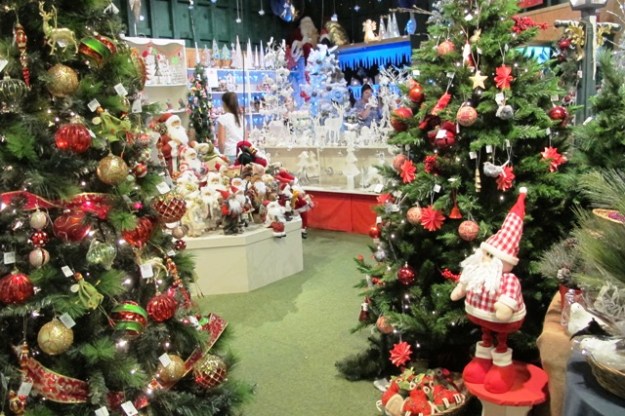 1) I have not made a great study of artificial Christmas trees but from what I can see, there is a vast range and both quality and price are equally variable. They are not as easy to customise as a living tree (or a dying tree, to be precise, if you have one without roots). There is a certain danger of ending up with one that looks similar to a shopping centre tree, especially if you opt for decorations that are restrained and unified as is favoured by many designers. For many, much of the charm of the traditional tree lies in the mishmash of family decorations passed down the decades.
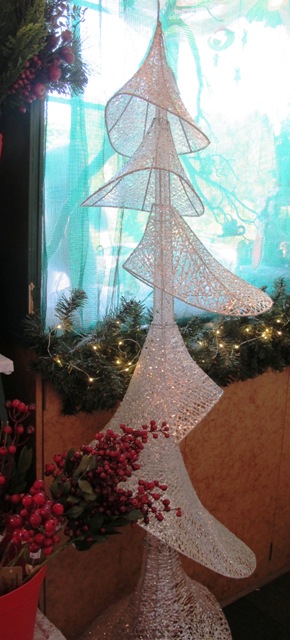
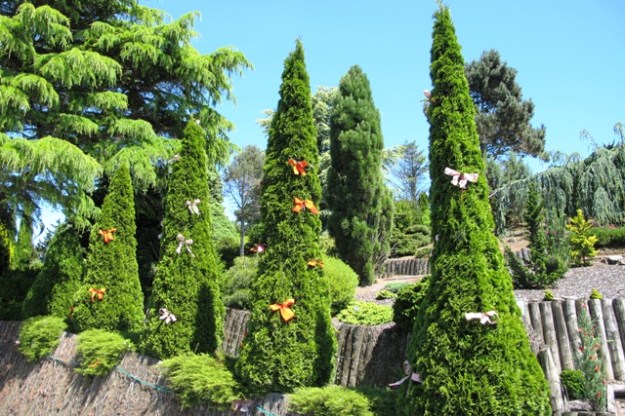
 3) If you have a suitable tree outdoors, decorating it with expendable decorations can be a festive greeting to be shared with passers-by. These are thujas. Norfolk Island pines look magnificent with a star on the top if you can work out how to reach their elevated heights. I have seen it done, though I am not sure how one would manage without a cherry picker or a tree-climbing monkey in the family. But folk are sufficiently enterprising to festoon their houses in Christmas lights (and pay the power bill) so no doubt there are some quite capable of decorating trees outside.
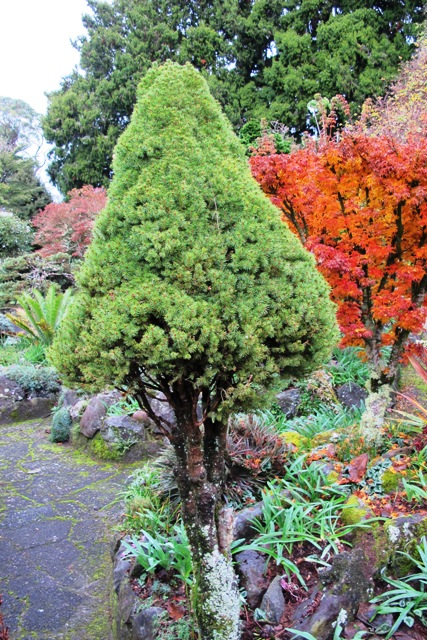 4) Our cute little Picea albertiana conica died. I have wondered about shaking all the dead foliage out of it and recycling it for the next few years as a skeleton Christmas tree. It is the perfect size and shape and could be stored in a shed. However, I recall one year using a large yet shapely dead branch which I spray-painted white. The children were young at the time but they were distinctly underwhelmed by their mother’s creativity and just wanted a proper Christmas tree such as other families had.
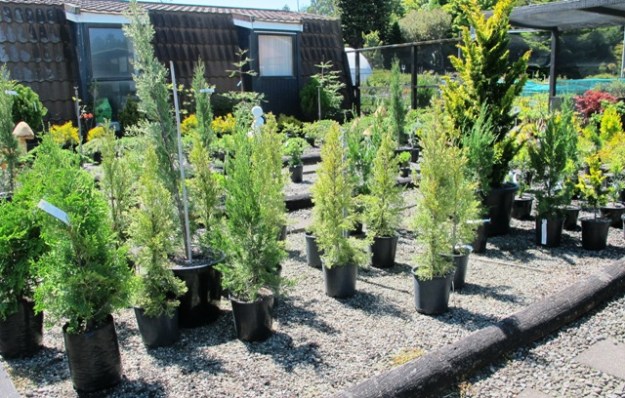 5) If you want a living tree, you need to set your sights small and choose a dwarf if you are intending to keep it alive for several years. Conifers have relatively large root systems and will not thrive on benign neglect when kept in a pot long term. However the very small growing varieties can be kept for many years with just the usual care that container plants require. They get more characterful with age, though not necessarily a whole lot larger.
 6) At the risk of repeating myself from previous years, I offer up our two variations. Both use a handy, permanent, metal frame I was given.
 This is what our corner of Otaraoa and Tikorangi Roads used to look like in the mid 1990s. The havoc on the left hand side is the result of major work Mark carried out to reduce flooding through our park and to return some of the stream to its original bed. His tidy grandfather had straightened up the stream to run along the boundary back around the early 1900s.
 A year or two later and our children are getting off the school bus on what was a quiet country road. Note the trees on the right hand side.
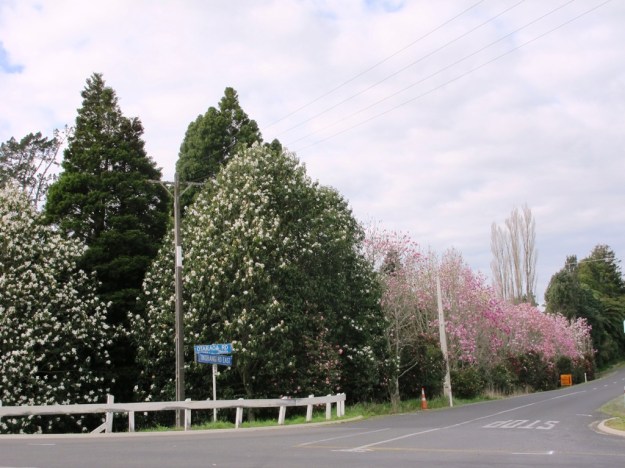 This is what our side of the road looks like now. The trees have grown up and many people tell us how much they enjoy the flowering.
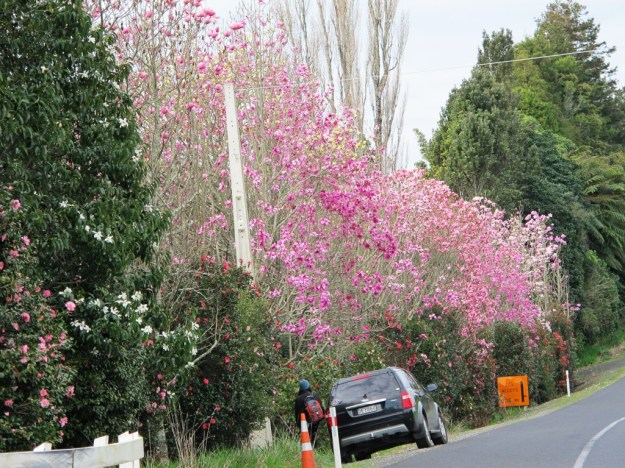 But we now have the petrochemical industry all round us and down this formerly quiet little country lane is the huge Mangahewa C site with its eight gas wells, single men’s camp and much additional activity. The road has been strengthened and widened for their heavy transport, all done in such a way as it is now impossible to walk along the verge. It is sometimes referred to as “loss of rural amenity”. Children can no longer walk safely to and from school bus stops, cycling is not safe, forget horse riding. It is pretty difficult to find a safe position to stand clear when the heavy transport thunders by. Meantime, across the intersection, the other side of Tikorangi Road – largely unused by the petrochemical industry – has remained unchanged over the past 20 years. It is a stark contrast.
 And on the right hand side of the road where there used to be trees, there is now a green wasteland dominated by the designated high tension power lines that Todd Energy, a petrochemical company, deemed necessary for their operations. Sadly, petrochemical development is now given precedence over rural amenity, local residents or the preservation of the environment. This is our world of 2014. During the day we listen to the heavy transport. At night, our formerly pitch black sky is often lit by gas flares in one or more quadrants. On an otherwise quiet Sunday morning today, I could hear the distant noise from Mangahewa E site. Every night we go to sleep to a low drone from one of the plants and we are not even sure which one it is any longer because there are four possible sources for the noise. But under the Resource Management Act, we are told by our councils that “effects are less than minor” and we are not, therefore, an affected party.
 Tikorangi The Jury Garden