While late winter and spring are the peak seasons for the many of the bulbs, the lesser known autumn flowering varieties offer fresh seasonal delight at a time when many flowering plants have finished or are passing over. The triggers for these bulbs are a drop in temperature, declining day length and summer rain. They are neither easily available nor widely grown but that may be a chicken or egg situation because many of them are not difficult or touchy.

Moraea polystachya – the autumn flowering peacock iris
The bulb that gives us the longest flowering season of all at this time of the year is the lovely lilac- blue, autumn Moraea polystachya from South Africa. Each flower is a dainty iris and while individual blooms are brief, new ones open down the stem for many weeks on end, stretching into months. The foliage is fine and light and the wiry flower stems can reach about 50 cm high. It grows from corms and will gently seed down without becoming an undesirable weed. It is particularly attractive popping up in cracks between pavers or on the edges of paths. The problem will be sourcing corms to buy. If you see one growing in somebody else’s garden, ask for seed which is easily raised and should flower in its third year.

Haemanthus coccineus
Haemanthus coccineus is most valued for its striking winter foliage – enormous, fleshy leaves which lie flat to the ground, giving the plant its common name of elephant ears. But in early autumn, up pop bristly red flowers looking somewhat like a dish brush head. In fact they are a large cluster of red stamens, each tipped with a generous amount of golden pollen and all encased in six petals that almost resemble a plastic cup. Flowering is triggered by rain and comes just before the new foliage starts to emerge. Plants need excellent drainage and some protection from heavy frosts but will thrive in semi shade.
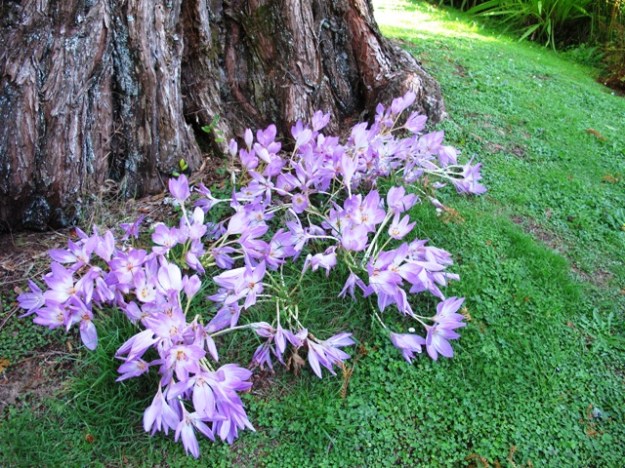
Colchicum autumnale
Colchicums are often referred to as autumn crocus, but they are only distant relatives at best and are generally much larger flowered toughies that are easy to grow. Most are so vigorous that they can be established in grass for the meadow look, but keep them away from mown areas because the foliage hangs on right through to spring. Each flower is a cup with six petals and while not long lived, a bulb can put up a succession of blooms. It flowers well before the foliage appears. Most colchicums hail from Europe and are in lilac pink to purple shades. For those who prefer all their flowers in white, there is a white form available but purists may prefer to stay with the dominant colours of the European meadows. The major drawback to the colchicums is that the foliage takes such a long time to die off that it can have a protracted scruffy period but it does at least have lush foliage in the bare winter months.

Nerines sarniensis hybrids
Despite their common name of the “Guernsey lily”, nerines hail from South Africa. While there are over 30 different species, the ones most widely available include N. fothergillii (scarlet flowers often referred to as the ‘spider lily’), N. bowdenii (late season flowering, sugar pink with long stems) and N. sarniensis hybrids. It is the hybrids that bring the larger flowers in desirable colours which can range from smoky hues, purple, salmon apricot and across the whole spectrum of shades associated with pink and red. There are white cultivars though I would have to say that we have never found a good pure white form which performs well. All make excellent cut flowers and have a long record of use in floristry.
Nerines have large bulbs which like to sit half in the soil and half baking in the sun. They will struggle in very cold, wet conditions and won’t flower in the shade.

Cyclamen hederafolium
Cyclamen hederafolium is one of the star performers for us, opening its first flowers as early as January and continuing through late summer to peak in autumn. Once the flowering is finished, the lovely heart shaped dark green leaves which are lightly marbled in silver remain a feature through winter. Flowers vary in colour from pure white, pale pink to dark pink, though not on the same tuber. As long as the tuber does not rot out, it can get very large over time – at least as big as a bread and butter plate. It is best nestled into the soil, as opposed to buried beneath. In C. hederafolium, the roots, flower stems and leaves all sprout afresh each year from the top of the tuber so you need to plant it the right way up. It will grow in full sun through semi shade to woodland conditions of high shade and, when happy, it will seed down over time and naturalise – as long as you don’t garden around it with weed spray. Good drainage is the key.
The species cyclamen have a delicate charm which has long gone from the pot hybrids sold as indoor plants. C. hederafolium is the easiest and most reliable of the species. There is nothing rare about it, except I failed to find anybody selling it this season. It is easy to raise from seed if you know of somebody with a plant. Harvest the seed in late spring and sow it in a pot or tray immediately. It can reach flowering size in as little as 18 months.
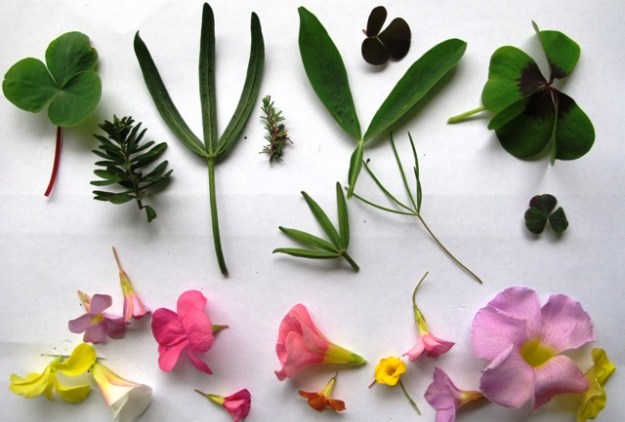
Ornamental oxalis
Oxalis. Spare a thought for the poor, maligned oxalis family which gets dismissed out of hand because of a few bad eggs. Call them by their romantic common name of wood sorrel if it makes you feel better. There are over 800 members of the family and by no means are they all invasive weeds. Neither are they all worthwhile garden plants either, but some of them are autumn stars for us. All oxalis need full sun because they only open their flowers in the bright light. If you remain nervous about them, plant them in wide, shallow pots and place them on sunny steps to give you a seasonal display. When you repot them after a year, you can see clearly which ones show invasive potential because they will have formed multitudes of babies. These ones are best kept in pots forever but others are perfectly garden safe.
Over the years, we gathered up maybe 30 different oxalis species and you can often find dry bulbs of different ones offered for sale on Trade Me. Some have very short flowering seasons and I am not sure it is worth my time to repot them each year. Others are exceptionally good. The best of all is O. purpurea alba. It has an abundance of very large, glistening pure white flowers with a golden centre and it flowers over a very long period. The foliage is a flat mat of green, slightly hairy, clover-like leaves. We have had it in the garden here for decades and it has never been badly behaved or shown invasive tendencies. There are other forms of O. purpurea with pink flowers and with burgundy red foliage (O. purpurea ‘Nigrescens’). While these are also very showy, they can be a bit too rampant and are best kept in pots.
Other personal favourites are O. massoniana (feathery foliage and masses of pretty flowers in apricot with a yellow eye), O. hirta lavender and the sunny yellow O.luteola. There are no blue or green flowered oxalis, as far as I know, but they come in pretty much every other colour.
Other autumn flowering bulbs which we value, but which will be even harder to source are Lycoris aurea (which looks like a golden nerine), Rhodophiala bifida and some of the autumnal tricyrtus, particularly T. macrantha.

The Guernsey Lily
Guernsey’s only claim to nerines is cut flower production. The exact method of arrival to the Channel Islands is unknown but there are records of N. sarniensis growing, and presumably flowering, in Paris as early as 1630. By the 1800s, Guernsey already had a flower export trade in full swing and was sending nerines to England. The local folklore version, laying claim to the nerine, has charm.
The Guernsey lily folk tale from the Visit Guernsey website:
Legend holds that a handsome fairy prince met and fell madly in love with Michelle de Garis, a beautiful Guernsey girl. Michelle left her cottage early one morning to see to her cows. As she entered the meadow, she was surprised to find a young man asleep on the grass. He had a particularly small stature, was finely proportioned, and remarkably handsome.
Michelle stood and admired the small man dressed in green and with bow and arrow. When he awoke he told Michelle that he was a fairy prince from England and asked for her hand in marriage, as they had both instantly fallen in love. She agreed but as they headed to Fairyland she asked that she leave a token to reassure her family. The prince gave her a bulb, which she planted.
Michelle’s mother later discovered a beautiful flower above Vazon bay, on the west coast of Guernsey. It was the colour of Michelle’s shawl and sprinkled with elfin gold – the Guernsey lily.
Sometime later on, many fairy men came from Fairyland, entranced by Michelle’s beauty and looking for a Guernsey girl of their own. They asked that Guernseymen gave up their wives and daughters, which ended in many battles between the fairies and Guernseymen. The Rouge Rue (Red Road) is said to have been named after a particularly fierce battle.
First published in the May issue of NZ Gardener and reprinted here with their permission.

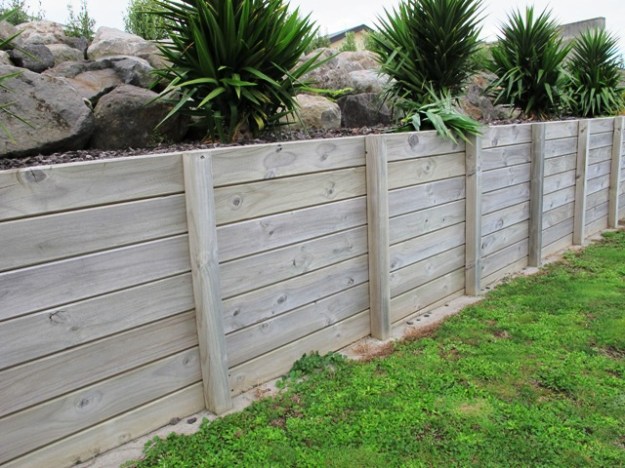 1) Timber remains the most common choice, probably based on price and the DIY ethos. It is holding back a considerable weight of soil that will be wet and exerting outward pressure, so strong construction is critical. Walk around established suburbs and you are sure to find older timber retaining walls bulging outwards. You need to get the supports right, both horizontally and vertically, to keep it all in place. Milled timber must be tanalised to ground retention grade or it will rot quickly.
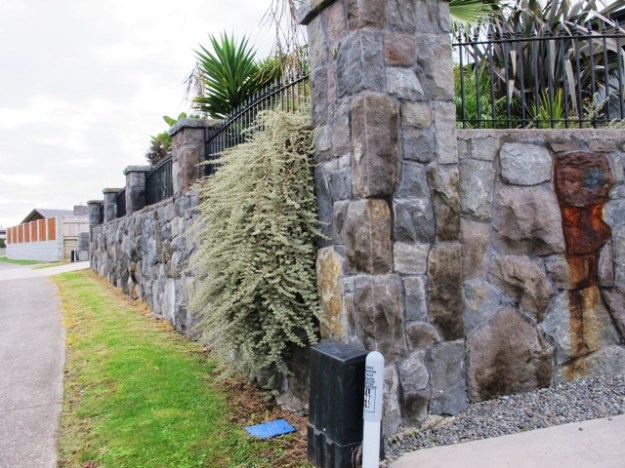 2) A cut stone wall is permanent, aesthetically pleasing and probably the most expensive option. The part-time stonemason here critiques my photos of modern stonework, pointing out that the stones should be keyed in to each other (as brickwork is). You should not be able to pick out vertical lines running down the wall because these are a point of weakness which indicate that it is the mortar holding the stones together. I mention this in case you decide to commission a stone wall of your own.
 3) Immediately next door to the attractive stone wall is the DIY option – although probably involving some lifting machinery to get the rocks in place. These have cement laid between them, which is unlikely to be structural but merely to keep out weed growth. Keen gardeners might prefer to plant between the rocks. Interestingly, some gradient has been left here rather than the vertical cut seen on the adjacent stone wall. Allowing a gradient reduces the outward pressure the retained ground will exert.
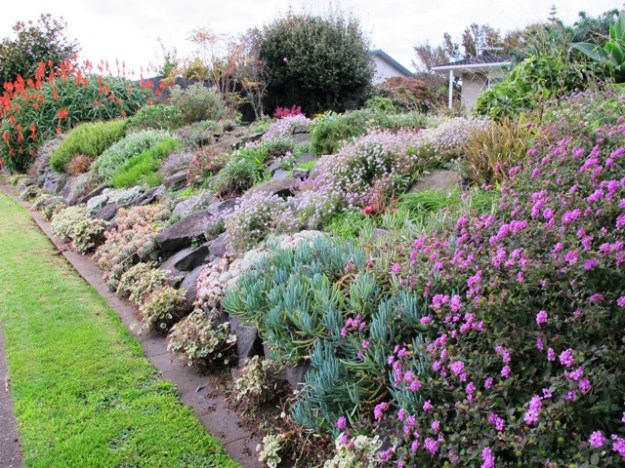 4) Further down the same street, I found the true DIY option. Smaller stones, able to be lifted by one or two people, have been placed and the area has been turned into a rockery on a sloped gradient again. Once established, plant roots will hold a certain amount of soil in place. The owner of this frontage is clearly a keen gardener.
 5) Ugly functionalism at its worst – and I can say that because this is on a property we bought. Concrete blocks have been used to retain the straight sections, poured concrete on the curves. It does the job. That is all there is to say. If I still lived in that house, I would be contemplating plastering and painting the retaining walls to try and make them a little less brutal.
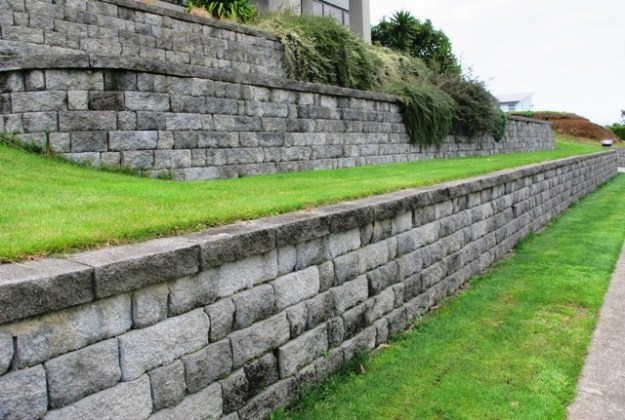 6) Faced with a similar situation to the preceding photo, this example shows what a little more thought, imagination and money can achieve. These are blocks – though whether a soft stone or aggregate, I am not sure – but a much superior look in aesthetic terms with the softer edges and random sizes. What also makes a big difference here is the flat capping on the top of the retained sections. It is a stylish finishing touch.
 7) The same bottom layer of retaining wall has been used throughout this modern subdivision. This house shows a mix of materials used in the quest for privacy, ground retention and street appeal. It was so well executed that I suspect a professional was employed to achieve this effect. The usual advice is not to mix materials but you can see the use of cobblestone bricks, timber, hedging and a relatively wide palette of plants. Prostrate plants are being used to retain the sloping bank.

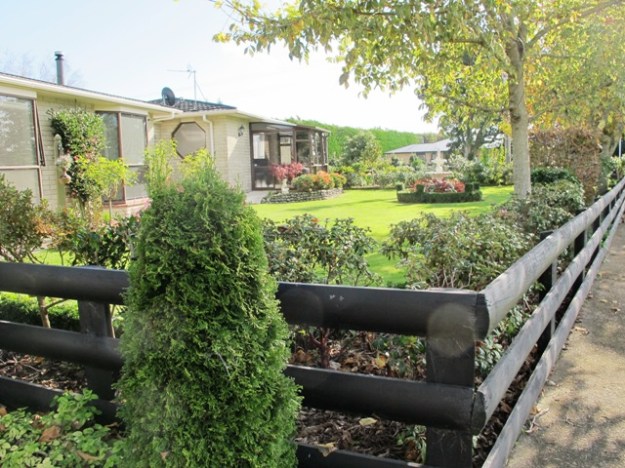 1) In times gone by, this was the norm – a low boundary fence which allows views in while marking the territory. The owner of this house tells me her husband likes to be able to see out too. Some folk enjoy being able to chat to passers-by and like having their front garden visible to people. It is a different mind-set altogether to those who want their space to be completely enclosed. In that case privacy is sometimes only a step away from voluntary imprisonment.
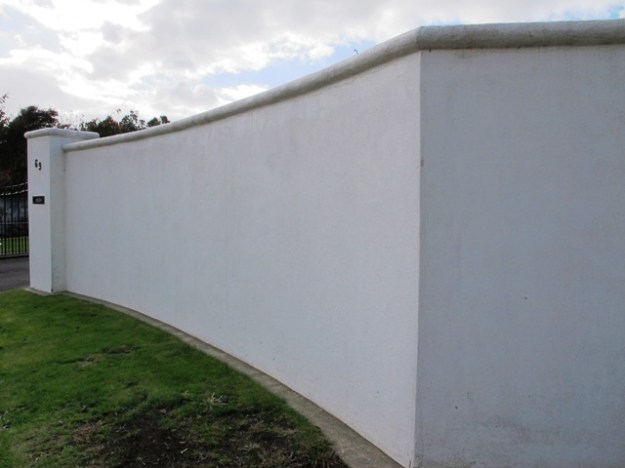 2) The plastered expanse of wall has become increasingly popular with its clean modern lines and the luxury Mediterranean look. It is usually smooth plaster applied to a concrete block construction so is not a cheap option. This one is at the end of a cul de sac where it may be safe. If you construct a wall like this in a more public position, it is like an invitation to taggers, offering a perfect blank canvas.
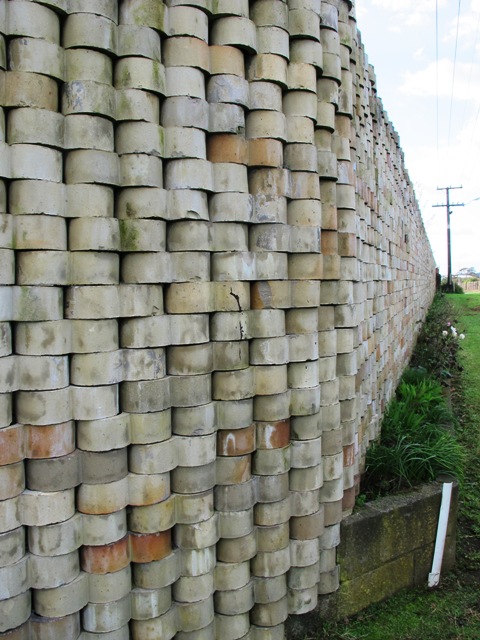 3) We have admired this fence for many years, even though closer inspection shows its construction is pretty rough and ready. It is made out of by-product from some commercial kiln-firing enterprise. The rounds are in joined pairs and we wonder if they were stands for field tiles or similar. There are a lot of them, for this is a large wall. The variation in both colour and texture appeals and it is a creative use of waste material, though probably a one-off.
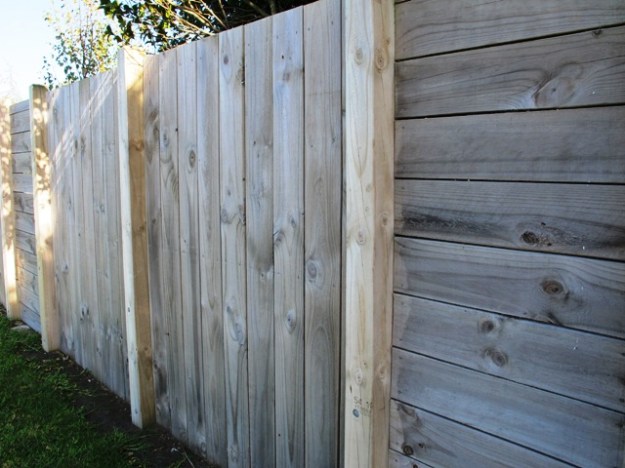 4) I mentioned in
 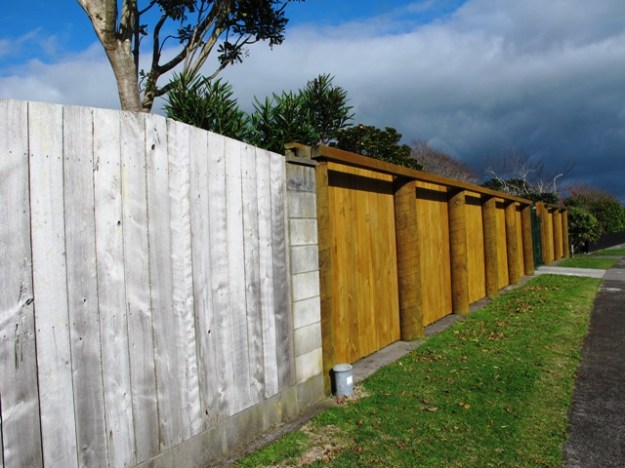 5) These substantial walls also show variations on the timber fence theme. The closer fence has tried for some detail with the use of concrete block pillars and footings and the shaped top to each panel. The second fence is brave although I find the colour a little garish. Maybe it will fade. The use of over-sized round posts and the top railing add emphatic detail which lifts it above cheap utility.
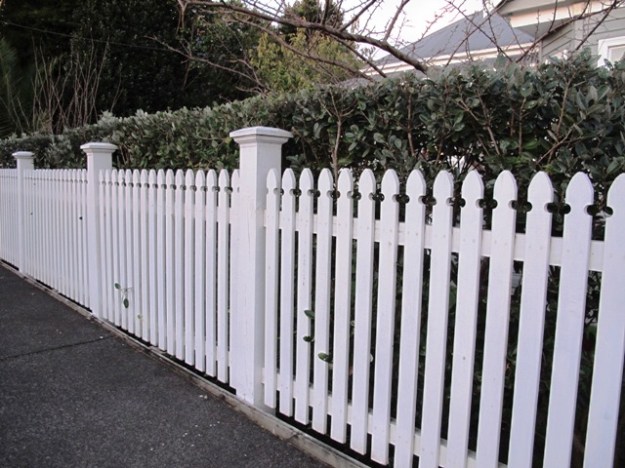 6) I photographed this in Auckland’s Mount Eden where I felt the traditional picket fence sat far more comfortably with the equally traditional villas than the newer options of solid walls closing in the properties. Here the owners have planted an inner hedge which they keep clipped. It gives additional height and privacy without the “in your face” unfriendliness of a solid wall. It is often a fallacy that major walls act as security. Once breached, they can equally give burglars free reign out of sight from passers-by.



 Tikorangi The Jury Garden