Category Archives: Abbie’s column

Abbie’s newspaper columns

Perennials for late summer colour

Annuals are plants that are done and dusted in the same year. Biennials flower in their second year, set seed and die. Perennials simply last more than two years. It is some herbaceous perennials that give us most colour in the late summer garden, at a time when many gardens can be looking a little jaded, dull and green.
Kniphofia - worth a second look

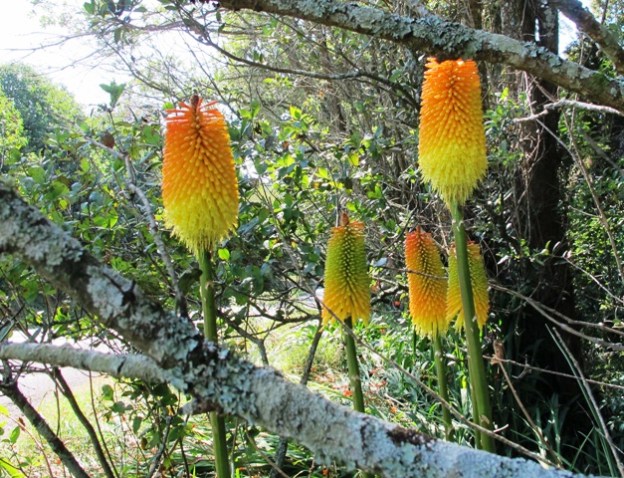
Kniphofia – worth a second look

Kniphofia might have had a better lot in the life of NZ gardens if we called them by some of their other common names. Knofflers sound so much more whimsical, torch lilies more exotic but alas we usually refer to them as the less attractive red hot pokers and treat them as low grade roadside plants. Not all kniphofia are the same – there are tall ones, short ones, yellows, bicolours, deciduous, evergreen and finer foliaged options. Don’t overlook them for late summer colour.

Sedums - good bee and butterfly food

Sedums – good bee and butterfly food

Sedums are not the world’s most exciting plant, in my humble opinion, but they put on a great late summer display and feed the bees. You can delay the flowering by snipping off the early growths – called the Chelsea chop. It forces the plant to set new growing and flowering stems which tend to be a little more compact, avoiding that tendency to fall apart. I see sedums have technically been reclassified now as hylotelephium but my chances of remembering that are not great. The white one shown here is S. (or H.) spectabile ‘Stardust’ while the pink one ‘Meteor’. These die back to ground level in late autumn and benefit from digging and dividing every few years.
Coreopsis 'Moonbeam' flowers for a long time through summer without needing deadheading

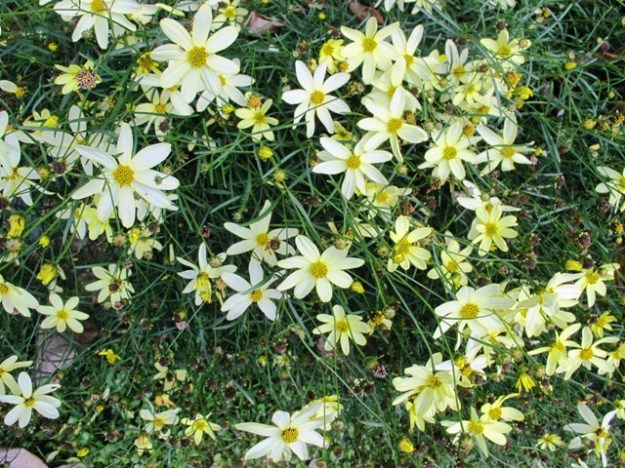
Coreopsis ‘Moonbeam’ flowers for a long time through summer without needing deadheading

There is a delightful simplicity to daisy flowers and Coreopsis ‘Moonbeam’ is no exception. From a flat mat of tiny leaves hugging ground level, it then grows to form a loose mound covered in the prettiest of soft yellow flowers over many weeks at this time. It is perfect for full sun, especially where you want a plant at the front to gently festoon over the edge. There are a host of different coreopsis, originating from North American wild flowers. Some are more perennial than others which are often treated as annuals. ‘Moonbeam’ is fully perennial and easy to increase by division.
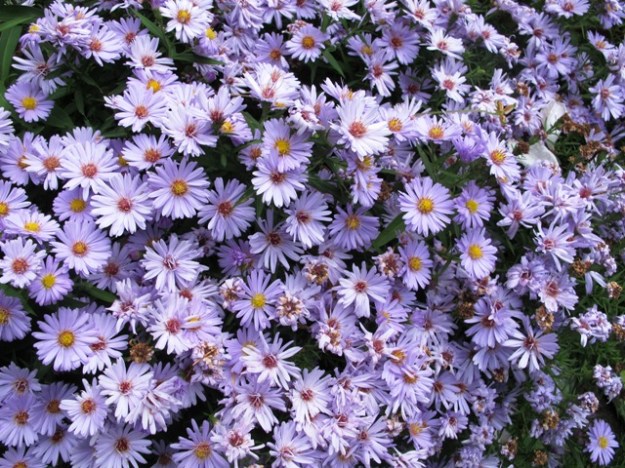
This aster is a lovely colour but it needs lifting and dividing every year or two

This aster is a lovely colour but it needs lifting and dividing every year or two

I have a love affair with blue and lilac flowers so this aster never fails to please me. Despite its hugely cumbersome name of Aster novi-belgii ‘Professor Anton Kippenberg’, it too has its roots in the North American wild flowers. If you trace both the coreopsis and the aster back, they are in same family of asteraceae. It is easy to grow, so vigorous in fact that I find it best if it is lifted and divided every two years. It responds with renewed enthusiasm and gives even more flowers than when left congested. In winter, it dies down to a flat mat of foliage.

Dahlia 'Bishop of Llandaff'

Dahlia ‘Bishop of Llandaff’

Dahlias. I wrote about raising dahlias from seed last week and there is little doubt that our late summer gardens would be poorer for their absence. This is an oldie but a goodie – the Bish, or Dahlia ‘Bishop of Llandaff’ with pure red flowers and attractive dark foliage. NZ plant breeder Keith Hammett has done a lot of work with dahlias and we are lucky in this country to have a wide range of new varieties to choose from as well.

Showy not subtle, the cannas

Showy not subtle, the cannas

I admit cannas, often referred to as canna lilies, are not my favourite plant. I find their flowers a bit scruffy and the showy foliage a bit over the top but there is no doubt they make a splendid display where something big and bold is desired. Should famine strike, you can apparently eat the rhizome or harvest the young growth. In winter, it all dies away to absolutely nothing visible, to return again the following summer.

First published in the Waikato Times and reprinted here with their permission.
The folly of the quest for garden perfection

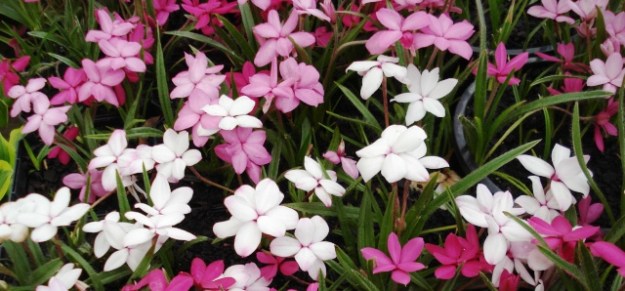
Rhodohypoxis are to be in drifts, not clumps, thank you.

Rhodohypoxis are to be in drifts, not clumps, thank you.

I commented to a photographer once about the immaculate interiors featured in glossy magazines and how our home could never look like that. She laughed and said she once went back to get some extra photos for a feature and the place did not look the same at all. Oh, so this is how they usually live, she thought.

It is an illusion made possible by the fact that photographs capture a single moment in time and it applies equally to gardens as to house interiors. I do it when I take photos. I look at the first image and then I will rearrange or remove something to get a clearer, more pleasing shot. The folly is when we think we can achieve and maintain that in real life. It is a trap to which many of us fall victim.

This train of thought came about recently as I spent a day redoing a garden bed. In my mind, I know exactly what I want and yet again, I am on a quest to make it happen. In this case, it is a bed with five clipped and shaped small camellias in it, backed by a clipped hedge. How much can you do with about 12 square metres of garden? A lot, it turns out.

This bed, in full sun, started as a cottage garden themed on red and yellow, full of roses, perennials and annuals. It looked lovely for 3 weeks of the year and messy for the remaining 49 weeks. It then went formal(ish) and I wrestled with finding the perfect ground cover. Rubus pentalobus (‘the orangeberry plant’) was too invasive. Violets were too vigorous. Cyclamen hederafolium were lovely for about 8 months of the year but were dying off during our peak visitor season. We changed the hedge last year from clipped buxus to clipped Camellia transnokoensis (tiny white flowers and small leaves). I reduced the number topiaried camellias which give the structure. I started inter-planting the cyclamen with rhodohypoxis for spring colour and a little ground hugging perennial called scutellaria with white flowers for summer cover.

How ironic that I still went searching for a photograph to show the garden bed looking good - but had to settle for Spike the dog creating a dust bath in the reworked ground covers. This is a long way from the mental image I have of what it is to look like.

How ironic that I still went searching for a photograph to show the garden bed looking good – but had to settle for Spike the dog creating a dust bath in the reworked ground covers. This is a long way from the mental image I have of what it is to look like.

My most recent effort was because the rhodohypoxis were looking too clumpy and I wanted them drifty, not clumpy so I spread them out, while trying to make sure that the cyclamen were sufficient in number to make an uninterrupted winter carpet. It is still looking dry and dusty at the moment but will it work?

Yes and no. It will, I hope, closely match my mental image at some points in the next year or two – but it won’t stay that way. Gardens have plants and plants are not static. The mistake is thinking that we can create constant pictures in our gardens and that when it most closely matches the mental image we have, that we can then keep it that way.

It is possible to achieve something nearing perfection in a garden. For a couple of weeks. For 52 weeks? Without an army of able staff and a stand out area of replacement plants “out the back” somewhere, I doubt it. None of us own Versailles where, reportedly, the entire colour scheme of the extensive parterre gardens could be changed overnight. Even Sissinghurst today has a large nursery out of sight, full of plants to bring in as required to spruce up the displays in the garden.

Does the answer lie in a very formal garden? Not unless you are going to use artificial plants. I have seen formal gardens where the hedges and shapes have lost their sharp edge because the wretched plants will insist on putting out fresh growth. When you lose the sharp edges in a formal garden, there’s not much of interest left.

It would be much better, surely, to rid ourselves of this idea that we can achieve photographic perfection in real life gardens. But that is easier said than done, as evidenced by my repeated efforts in the garden border mentioned above. When all is said and done, I am still worried about the scutellaria which may be better in partial shade than full sun.

Cyclamen hederfolium give pretty flowers from summer through autumn and carpet of attractive foliage until mid spring

Cyclamen hederfolium give pretty flowers from summer through autumn and carpet of attractive foliage until mid spring

First published in the Waikato Times and reprinted here with their permission.

Rather too much winter firewood has arrived

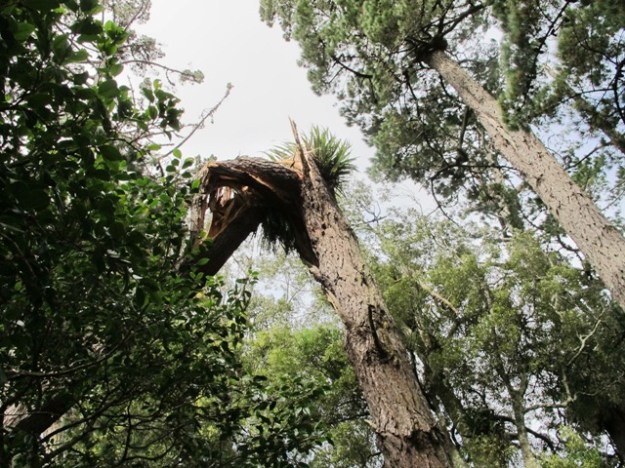
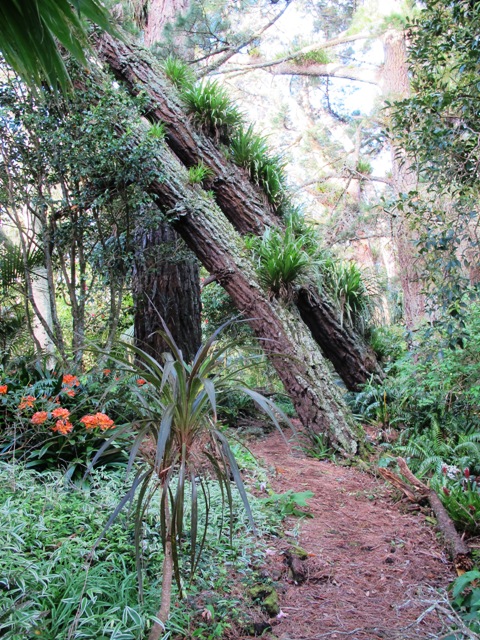
Over the decades, the angle of lean increased past the point of balance. After 80 years, these two pines fell.

Over the decades, the angle of lean increased past the point of balance. After 80 years, these two pines fell.

There I was mentally prepared to write on an entirely different topic this week when yet another tree fell here yesterday. One large old tree falling is bothersome and relatively major. Four in under four months is unprecedented here. While we possibly have more very large trees in our garden than most, thanks to Mark’s forbears, my conversations on the social medium of Twitter last night made me realise that there are a fair number of other people who are worried about large specimens at their places.

First to go here were two 80 year old Pinus radiata last October. They had been on a lean for decades but one Saturday I suggested to Mark that the lean had increased. He scoffed but on the Sunday, he conceded I might be right. On Monday he thought maybe we should be barricading off the area because our garden was still open to the public but they fell by lunchtime. We did the immediate clean up but the large trunks are still blocking one path and need some attention.

At least when the gum tree fell over, it ripped its roots out. A brave clump of clivias is unscathed.

At least when the gum tree fell over, it ripped its roots out. A brave clump of clivias is unscathed.

Ten days ago I heard a crash in the night but no whump at the end (falling trees crack, crash and then whump when they hit the ground) so I thought it must be a large branch. Mark heard nothing and was sure I had imagined it until we found the fallen gum tree the next morning. It had been planted by his great grandfather around the late 1870s so it was quite large but it fell down the hill, mostly out of harm’s way, although another path is now blocked.

Yesterday I heard the ominous sound of cracking and looked up to see one of our largest pines coming down. These are about 50 metres tall and 140 years old. That is a lot of pine. It is a bit more problematic to clean up because it has not uprooted but instead snapped without fully detaching, maybe 6 metres up where Mark’s grandfather had topped the pines back around 1900.

The latest pine to fall, failed to snap off cleanly, maybe 6 metres up.

The latest pine to fall, failed to snap off cleanly, maybe 6 metres up.

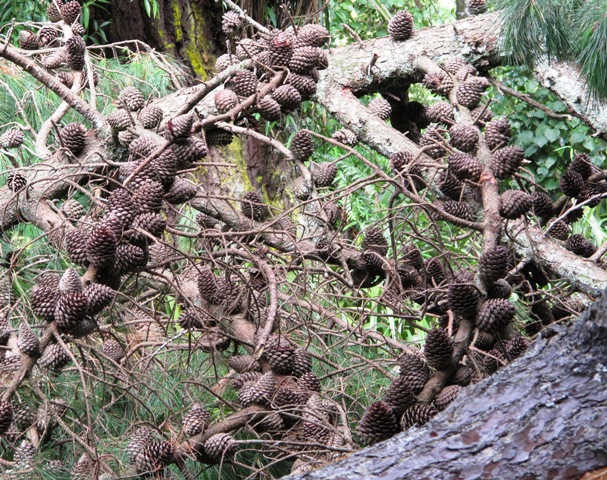
Even I am surprised at the philosophical and matter of fact approach adopted by the two menfolk in my life (the one I am married to and the one we pay wages to). The cleanup has started. We will have sufficient pine cones to last us several winters and there is no fear of running out of firewood here despite the fact we burn prodigious amounts.

 We have pine cones for eternity here. Or at least several years.

We have pine cones for eternity here. Or at least several years.

We have so many big trees, we let them fall in situ. Mind you, we have had discussions as to what to do should one start to go beside us. Run to the trunk, is my as yet unproven theory, and jump left or right at the last minute. I say this because the trunk is the narrowest part. I am hoping we never have to test this theory.

In a smaller garden, the damage from a falling tree will probably be much larger than here and the damage from the clean up may well be greater still. We avoid this by doing a reduced clean up. We do not try and remove the trunks. We remove the side branches and the litter and tidy up any plants damaged in the fall. Paths need to be cleared but, once stripped, the main trunk remains where it fell and we garden around it. It is part of nature’s cycle. Trunkeries, I have decided to call these areas – a variation on the idea of stumperies. They give height to otherwise flat areas of the garden.

It is a different matter entirely when large trees threaten either buildings or power lines. The lines companies would, of course, like all trees over the height of about 3 metres felled immediately. While it can’t be fun being a linesman called out in atrocious conditions to restore power cut by falling trees, I recoil from the thought that overhead power lines be allowed to dominate our landscape. Our lines company will do the first trim at their cost to trees that are threatening their lines but after that it becomes the landowner’s responsibility, even when they don’t have a legal easement to have their lines crossing private property. We know quite a bit about this because we have problematic power lines taking a short cut across our place and have sought legal opinion. I don’t know if this is standard policy with other lines companies.

Sadly, unless you are highly skilled with chainsaws and tree felling, if you are in the position of an at-risk tree endangering your house or power lines, you are going to have to pay someone to deal with it and it is likely to be very expensive. In this case, get some good advice first on the stability and health of the tree and get it from a tree person, not a chainsaw operator. There are truly terrible stories about amateurs with chainsaws so make sure you employ a reputable operator to do potentially dangerous tree work. The consequences of getting it wrong can be extremely expensive or even fatal in worst case scenarios.

For all their problems, we would not be without our big trees. They give shelter and add stature to the landscape. Some are magnificent specimens in their own right. I do not want to live in an environment where nothing is allowed to grow more than 2 or 3 metres high.

First published in the Waikato Times and reprinted here with their permission.

A very public garden

Shimmering grasses in the lightest of breezes.

Shimmering grasses in the lightest of breezes.

Monday this week found me wandering the Auckland Botanic Gardens in Manurewa. It is a few years since I have been there and I was curious to see if they were experimenting with ideas from the New Perennials Movement which I referenced in last week’s column. I felt sure they would be because the staff and management there are pretty innovative and on-trend. They weren’t, as far as this went.

No matter, there is always plenty else to look at. The Auckland Bot Gardens are still young. When you think about it, most botanical gardens go back a long way and have a backbone of very mature trees. I can remember when we first started to notice the new plantings from the motorway and how barren, windswept and inhospitable the site appeared. That was back in the early 1980s. There are easier sites to work with than this one.

Readers who have been to the famed Wisley Gardens south of London, may recall the background hum of noise from the adjacent motorway. That hum reaches a roaring crescendo when one gets to the trial grounds there. When I found the trial grounds (somewhat dominated by penstemons) where the sound track is the nearby Auckland motorway, I realised there are certain parallels between the Auckland Bot Gardens and Wisley.

It is not just the motorway noise, though. It is the very strong educative function that is threaded throughout that interested me.

Always a sucker for the ducks

Always a sucker for the ducks

Public gardening is a very different kettle of fish to private gardening and it has to meet many different needs. We have never forgotten Jack Hobbs, Director at Auckland, telling us that their extensive visitor surveys had just yielded the information that the single biggest reason visitors came was to feed the ducks. These days, lycra-clad exercise fiends may possibly have taken over the top spot but the gardens are there for a range of purposes – recreation, entertainment, education, plant conservation, even inspiration. I have a great deal of respect for those whose job is to keep all those threads together and still present an aesthetically pleasing, well maintained environment.

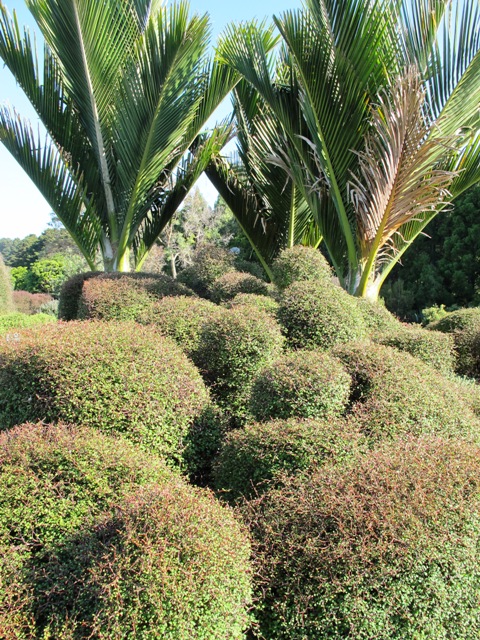
Clipped Muehlenbeckia astonii and nikau palms show native plants are not boring at all

Clipped Muehlenbeckia astonii and nikau palms show native plants are not boring at all

Personally, having found the perennial plantings pleasant but not all I had hoped for in terms of inspiring contemporary styles, it was the native plantings that brought a gleam to my eye. Here were ideas that take the use of native plants beyond the bush or forest context of the wild. The abstract shapes of clipped muhlenbeckia were nothing short of inspirational in terms of domestic gardening, as were some of the plant combinations. And the grasses in the children’s gardens set against nikau palms brought to life all I had read about the charm of movement when the lightest of breezes ripples through the fine foliage of these plants. It is time we shed once and for all those awful clichés about native plants being boring. Any plant can be dull or uninspiring in certain situations. It is how we use them in a garden or landscaping context that makes the difference.

Others may take more from the display area dedicated to trees suited to small urban gardens or maybe the environmentally friendly process of dealing with storm water run-off or the roof garden. There is the large rockery – more hot-climate desert than traditional rockery, rose gardens that I didn’t go too and plenty more. Some may even enjoy the large beds of garish red blooms – begonias, from memory. Gardens like these have to cater for all types and that includes dog walkers.

I politely admired two, elderly, plump chihuahuas (not corgis)

I politely admired two, elderly, plump chihuahuas (not corgis)

I have not mentioned the temporary sculpture trail. While I saw one or two pieces that I quite liked, there were others that I thought tacky (it’s a fine line to tread between whimsy and tack) and others that I felt did not enhance the environment at all. Sticking out like dogs’ balls came to mind but I am more interested in design and plants than ornamentation. Others feel very differently as evidenced by the enormous popularity of outdoor sculpture exhibitions.

Botanic gardens and leading parks are expensive to run without many means of cost recovery. But when you look at how widely used these urban spaces are, how many different roles they fill, at the often passionate attachments local residents have to their gardens, at the huge contribution they make to the quality of urban life, I guess most of us feel the costs are fully justified.

Ratepayers can get up in arms about many issues, but fortunately it is rarely about the cost of running these city gardens. Long may that last.

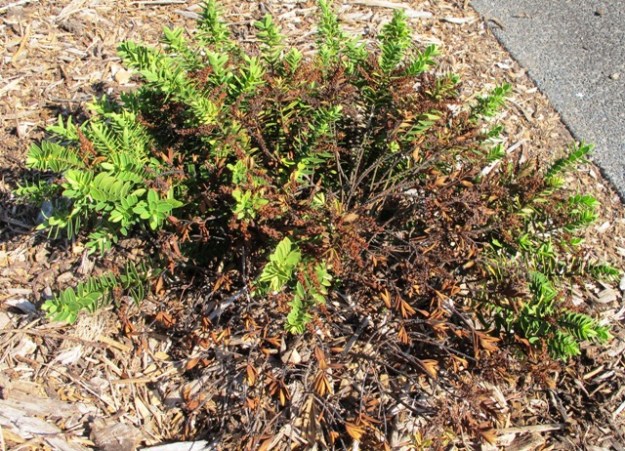
It is impossible to get everything right all of the time. The sign by this sad plant read “Better than box. Little leaves and lots of new growth from the base make Hebe ‘Wiri Mist’ a great little hedge.” I think not.

It is impossible to get everything right all of the time. The sign by this sad plant read “Better than box. Little leaves and lots of new growth from the base make Hebe ‘Wiri Mist’ a great little hedge.” I think not.

First published in the Waikato Times and reprinted here with their permission.
Garden style

Sissinghurst of course - the inspiration for many, many gardens in NZ. Too many.

Sissinghurst of course – the inspiration for many, many gardens in NZ. Too many.

Truly, it is difficult to be original in the garden. Oh, there can be the odd touch of whimsy or indication of flair but generally it has all been done before. Somewhere. The skills lie in how you put the ideas together and manage it all. It is a bit optimistic, grandiose even, to consider that you can come up with some brilliant concept that nobody has thought of before. But that is all right. We are all in the same boat.

We had a small British gardening tour through last week. Not all garden tours are equal by any means and we particularly enjoyed this one. They were both knowledgeable and enthusiastic, giving us as much stimulation as we hope we gave to them. We have a huge debt to British gardening traditions in this country.

I have looked at Italian gardens but they are more about design, space and hard landscaping (and wealth) than gardening as we know it here. The plant interest is minimal. But should an Italian stonemason want to enter your life, do not turn him away. There is a history of magnificent stonework in that culture.

More about wealth, power and lifestyle than plants - the Alhambra in Spain

More about wealth, power and lifestyle than plants – the Alhambra in Spain

Southern Europe has a pretty difficult climate. If it is not hot and dry then it is cold and dry. So the historic gardens of Spain and Portugal that I have seen were also about wealth and power. Their hallmark is magnificent hard landscaping and good design but they too, are light on plants.

Japanese gardening is one that exists in something akin to a bubble all of its own. It is deeply steeped in symbolism, tradition and contemplation. I admit I have not been to Japan so I don’t know much about the modern gardening trends, but from afar it appears that the old traditions remain dominant. They seem to be relatively immune to the eclectic cobbling together of ideas from around the world that most of us do.

We have drawn upon Asia for the tropical gardens, so fashionable at the moment. I wrote about the hotel-style gardening in the middle of last year.

I understand our preoccupation with lawns and the high value placed on the dreaded “kerb appeal”, in real estate speak, have a debt to USA but those are questionable contributions to our gardening heritage here.

In fact, large parts of the world do not garden at a domestic level as we do. In some cases it is lack of physical space – or any outdoor, private space at all in heavily populated areas. In other cases, the conditions are just too hard. If your ground is set like concrete and it is alternately too hot and then too cold to be outside, the motivation must flag.

If you look at Britain, you can see a gardening ethos that is very close to our own. It is probably no accident that while their conditions are nowhere near as easy as ours, nevertheless it is a relatively mild climate. Being islands, the sea has a tempering effect and they lack the extremes of temperature and near absence of rain that many other countries experience. Many of the great and intrepid plant hunters originated from Britain and they have always put a high priority on plants – new plants, varied plants, plant combinations, entire collections of a single plant genus. Gardens are expected to have a high level of plant interest, not just grand design. Even what we would regard as the great gardens of last century (the likes of Great Dixter, Sissinghurst and Hidcote) are still essentially domestic gardens in their origin. These are less a statement of power and wealth and more an example of gardening obsession.

Meadow gardening and a return to a more natural style is evident in UK gardens, less so here.

Meadow gardening and a return to a more natural style is evident in UK gardens, less so here.

So it is curious that we have only adopted a few key garden styles from that country – notably cottage gardening, mixed borders and the Sissinghurst garden rooms’ genre. We have been very slow on the uptake when it comes to what is now called the New Perennials Movement and just as slow on the dialogue they have been having in recent years about a return to a more naturalistic style of gardening. When I say slow on the uptake, I mean I have not seen anything at all in our gardening media and few of the colleagues I have talked to even know what these mean.

Yet I have heard it described by UK garden expert Carol Klein, as “the most influential garden movement in Britain in the last 15 years”. Mind you, the term New Perennials Movement, appears to be of recent usage only and it brings together the apparently disparate threads of naturalistic, meadow, grasses and prairie gardening that we noticed on our last visit there in 2009. Much of it was still seen as pretty avant garde then. Maybe it has bedded in better now.

069 (2)In the meantime, “The New English Garden” by Tim Richardson, published by Frances Lincoln, is more than a coffee table book. The sumptuous photographs and presentation are complemented by an intelligent and discerning text. Perhaps the problem is that we New Zealanders are still visiting only the most famous gardens and the existence of a whole new style has so far bypassed us. We are heading back this June to have a closer look.

First published in the Waikato Times and reprinted here with their permission.