Category Archives: Abbie’s column

Abbie’s newspaper columns

An Easter legend – the Glastonbury thorn

I went looking for the Glastonbury thorn but it was not to be found at St Mary's cathedral after all

I went looking for the Glastonbury thorn but it was not to be found at St Mary’s cathedral after all

The legend of the Glastonbury thorn seems timely as an Easter story. I started by setting out to find the local specimen at St Mary’s Cathedral in New Plymouth that is reputed to be the Glastonbury thorn, only to find it isn’t. We have our own legends too.

Glastonbury is in the Somerset area of the United Kingdom. The abbey site has had a Christian church on it since the seventh century, but legend takes it back further. One version has Joseph of Arimathea bringing his young nephew, Jesus Christ to Glastonbury where they built the first Christian church at that location. But the Glastonbury thorn tree is attributed to the second visit by Joseph of Arimathea soon after the death of Christ. Reportedly landing in a state of exhaustion, he thrust his staff into the ground on the slope now known as Wearyall Hill. The staff took root overnight and grew into the Glastonbury thorn tree, revered as sacred through the ages since.

Interwoven through the Glastonbury thorn legend, is the more powerful myth of the Holy Grail that Joseph was believed to have brought and buried just beneath the Glastonbury Tor. The Holy Grail of course is the cup used by Christ at the Last Supper and subsequently used by Joseph to catch his blood at the crucifixion. And with the Holy Grail come the legends of King Arthur and the Knights of the Round Table. Glastonbury Abbey is reputedly the final resting place of both Arthur and Guinevere. Sadly, after about 1000 years, they got a bit careless with the remains and when the abbey was sacked and largely destroyed in the 1500s, Arthur and Guinevere’s remains were no more.

But the Glastonbury thorn endured. Not the original tree. It had a bit of a rough history and still has as replacement plants either die, are vandalised or maybe attacked in spiritual fervour. But as the plant does not strike from cutting or grow true from seed, it has to be grafted. And it does appear that the plant has remained true and been distributed for many hundreds of years.

It seems a little mean-spirited to disturb such a wonderful legend with botany. But whatever the truth is about the Holy Grail, it is a fact that that the Glastonbury thorn is simply a variation on Crataegus monogyna that is the common hawthorn of the UK – the fragrant Mayflower. It seems unlikely that Joseph of Arimathea’s wooden staff at the time of his alleged arrival in Britain was fashioned from a plant native to that country. What makes C. monogyna “Biflora” different is that it has two flowerings a year. Its main flowering is in spring but it also puts up a minor second blooming in winter. The tradition of sending a spray of Glastonbury thorn to the monarch at Christmas started back in the time of James 1 at the turn of the sixteenth century and apparently continues today.

These days Glastonbury is probably associated as much with the annual music festival which, despite being timed for the end of June, seems to be a particularly muddy affair. Despite its very early Christian history and even earlier pagan history, or maybe as a result of it, modern Glastonbury apparently now resembles something more akin to Diagon Alley from the Harry Potter stories.

I noticed the wry comments on a BBC New Magazine site from 2012. “The former mayor John Coles tends to the remnants of the thorn. In recent years, people have tied ribbons to it bearing messages, prayers and maybe even spells. Coles removes them. “It takes daylight away from the trunk,” he explains. He also prises out the coins that people have jammed into the bark.”This never used to happen even eight or nine years ago,” he says sadly.The apparent takeover of the town by new age believers disturbs him. “There’s nothing wrong with paganism but there is a certain taste of Satanism as well and I have always regarded Glastonbury as a Christian town.”

Many St Mary’s parishioners in New Plymouth were proud of their Glastonbury thorn until it was revealed that it is Crataegus crus-galli from the eastern states of North America. Apparently it was planted back around 1860 by Archdeacon Govett. This makes it one of the oldest known introduced trees in the province but the Glastonbury thorn it ain’t. This is a bit of a shame as the Cathedral of St Mary is the oldest stone church in New Zealand with its foundation stone having been laid in 1845. It would have been a charming connection back to the Glastonbury Abbey history and legend where the lady chapel is still referred to as ‘Our Lady St. Mary of Glastonbury’. Instead they just have a scrubby but venerable North American species.

First published in the Waikato Times and reprinted here with their permission.
Windflower romance

Wind flowers are a personal marker of our wedding anniversary

Wind flowers are a personal marker of our wedding anniversary

On the evening before we married, Mark turned up with an armful of Japanese anemones that he had gathered from the Taihape roadside. Don’t even ask why we got married in Taihape when we neither lived there nor came from there. It’s a complicated story. Wind flowers, he called the anemones and believe me, although back in the mists of time, it was a romantic gesture I have never forgotten.

Every year the wind flowers bloom on our wedding anniversary and he often brings some indoors. Last week he followed the old cut flower wisdom – re-cut the stems and burned the ends and they have lasted a full week in water.

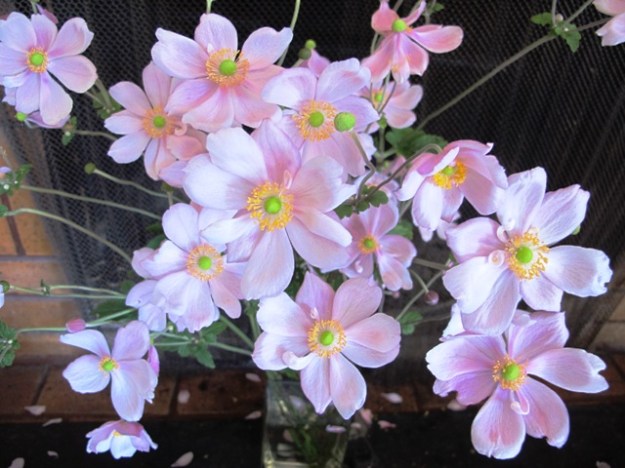
We have three different Japanese anemones, in light pink, white and a semi double dark pink which is more compact in growth. It seems that the first two are the straight species, A. hupehensis. Although known throughout the world as Japanese anemones, they are originally Chinese – from the eastern province of Hupeh, in fact. They have been grown so widely in Japan for so long that common parlance attributes them to that country. It is no surprise that the Japanese, with their cultural penchant for simplicity and natural form, took a liking to them.

Japanese anemones are commonly found in pinks and white although selections are being made to extend the colour range into lilac blues

Japanese anemones are commonly found in pinks and white although selections are being made to extend the colour range into lilac blues

The semi-double darker one will be a hybrid and a named form that was purchased. Mark commented vaguely that he thought it may carry a woman’s name but I see that this plant family is more highly prized overseas than in New Zealand and there are a fair number of named forms, several of them named after women. For the botanically inclined, the Japanese anemones classified as A. hybrida are likely to be mixes of A. hupehenis with A. elegans and A. vitifolia. This is a plant family that crosses readily – though to get a cross you generally need plants that flower around the same time.

Weeds, I hear some readers saying. Weeds. Yes they can be overly vigorous, given the right conditions and become rampant, bordering on invasive because they spread below ground. You probably don’t want to unleash them in areas with plant treasures which they may out-compete. Lovely though they are in flower, you can have too many of them.

That said, I see that there is general agreement that they are not always easy to establish which made me feel better about our meagre showing of white ones in the woodland garden. I had spotted a pretty patch down the road, growing as a roadside wild flower and it is those I photographed. I love the combination of the single, white flowers dancing above the dried grasses.

 The white Japanese anemone down the road looks better than the patch we have in our garden

The white Japanese anemone down the road looks better than the patch we have in our garden

Our pink ones are planted on our roadside and come into flower after the summer colour has largely faded. We have designated our rural road verges no-spray zones with the local council so we carry out our own maintenance. We mow a grassy strip immediately beside the road, get rid of noxious weeds like the dreaded bristle grass and we can do what we like with the rest. And what we like are roadside wild flowers – agapanthus, hydrangeas, robust begonia species, oenothera (evening primrose), belladonnas, crocosmia and the like. It is not just for passing motorists. It is also to feed the bees and to keep some roadside cover in an intensive dairying area which can otherwise resemble a green grass desert.

There are actually somewhere over 120 different anemone species. By far the most common in gardens are A. coronaria. These are the spring flowering corms that you buy as de Caen (the singles, mainly in blue and red but also in pinks and whites) and St Brigid (the doubles). They are very cheerful and cheap to buy. If you get a bulk pack, split it into four and soak one batch at a time overnight before planting. Done at weekly intervals, you can extend the flowering for the first season.

A. blanda is a little Greek species with predominantly blue flowers, more like a carpet if mass planted. A. nemerosa is the European wood anemone. We would like both of these dainty species to naturalise far more widely in our garden than we have achieved so far. They are transient early spring delights.

But in autumn it is time for the wind flowers to star.

First published in the Waikato Times and reprinted here with this permission.

Autumn seed

Autumn can seem a slightly melancholy time of year, the opposite to the bright promise and floral extravagance of spring. It is that sense of ‘passing over’, of annuals dying and other plants retreating in preparation for winter. We tend to focus on the flowering capacity of most plants but some have a subtle, understated beauty on the other side with their seed heads. Not all, of course. Some simply look scruffy, brown and of no interest. But once you get your eye in, there is an astonishing range of different forms and some are well worth admiring in their own right. Where plants are not weedy, leaving the seed heads in place provides a valuable food source for birds.

Fennel - foeniculum vulgare

Fennel – foeniculum vulgare

“Don’t buy any more fennel seed,” he said as these plants crossed over from flowering to seeding. Fennel is one of my favoured cooking herbs. In fact these are the seed heads of Florence fennel or finocchio which never made it as far as the vegetable garden. The common fennel that flowers on many a roadside but never develops that edible bulbous base is the usual one that is harvested for herbal purposes.

Phlomis russeliana

Phlomis russeliana

We find Phlomis russeliana an undemanding, handy little perennial which flowers well even in conditions of high shade. Its flowers are soft yellow, arranged like a tiered cake stand and the stiff seed heads retain that interesting form. I had to pick these to photograph them and you can see the see the seed falling out. Usually the birds – and maybe the mice – will clean up this seed.

Clematis tangutica

Clematis tangutica

While these cute seed heads are from Clematis tangutica, it is a typical clematis seed form, although these are silkier and greener because it is a late season bloomer. That light ethereal form is usually a sign that the seeds are spread by wind, as indeed is thistledown from dandelions. The plant of course has evolved not to please humankind but to ensure its own survival.

Pachystegia rufa

Pachystegia rufa

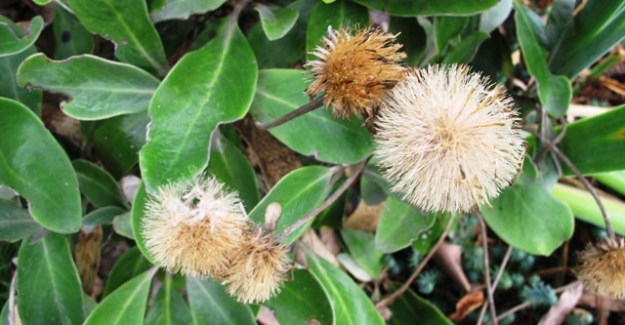
Pachystegia have fluff balls of seed, another wind dispersal candidate. This one is P. rufa, a different form of the Marlborough rock daisy to the highly prized, larger-leafed P. insignis. There is something very tactile about these soft pompoms.

Arisaema seed head, in this case A. tortuosum

Arisaema seed head, in this case A. tortuosum

Arisaemas are bulbs from the Asian subcontinent with hooded flowers somewhat reminiscent of a cobra. Many of the arisaemas, and indeed other aroids like arum lilies and zantedeschia, set attractive seed pods. The birds don’t touch these which is usually an indication that they are poisonous. Small children are not as discriminating as our feathered friends and it pays to check the safety of any plant which sets such attractive seed, as well as teaching your little ones not to put stray seeds and berries in their mouths.

Agapanthus - weed or wildflower?

Agapanthus – weed or wildflower?

Even the humble and often maligned agapanthus has an attractive seed head. These are heavy seed and don’t often fall far from the parent plant but, given the concern about weediness, dead heading seems a wise move, especially if you have them near waterways or reserves. Water is an efficient method of seed dispersal as can be witnessed by downstream and riverbank weeds.

First published in the Waikato Times and reprinted here with their permission.

What price public accountability and garden reviews?

We put the closed sign up late last year

We put the closed sign up late last year

We have been part of the open garden scene in New Zealand for 25 years but at the end of last season we put the closed sign up. We don’t know what the future holds for us yet but we are certainly enjoying taking a year or two out. It is interesting taking a step back.

I have long advocated that it is possible to assess gardens and that not all gardens are equal. Like any other human endeavour, some gardeners are simply better at the task than others. Whether you like a garden is a matter of personal opinion. Whether it is a fine example of gardening is, to my mind, not a matter of opinion but able to be measured by certain criteria. I can think of some very good gardens that are not to my personal taste just as there are gardens that I really enjoy, even though they are not top notch. Mind you, I shy away from the very thought of ranking gardens in a single line hierarchy, as required by competitions. I am only willing to work in broad bands or categories.

I have also advocated strongly for accurate garden descriptions for open gardens. There is a certain folly in letting garden owners write their own descriptions. Some are far too modest and fail to capture the essence of their own place, shying away from anything that might be seen as boastful. Too many, alas, are not.

So it has been interesting this week to debate the issue of garden reviews. This came up on a British gardening website (www.thinkingardens.org.uk) where the editorial policy is of honesty, sometimes brutal honesty. A contributor posted a particularly critical review of the historic garden, Rousham.

Rousham House (photo credit Grahamec via Wikimedia Commons)

Rousham House (photo credit Grahamec via Wikimedia Commons)

I have never been to Rousham which is in Oxfordshire and it is not likely to feature high on our visiting list because we prefer different gardening styles. My English garden guidebook (written by an independent, not the garden owners) describes Rousham as “the most perfect surviving example of William Kent’s landscaping….an Arcadian experience.” It dates back to the early eighteenth century, one of the earliest and best preserved examples of English landscape gardens, drawing on influences from ancient classical times. In other words, it is mostly green and architectural. It is still in private ownership, apparently run with a relatively small budget. According to the reviewer, the owners are not doing a very good job of it.

Does charging an entry fee make a garden fully commercial and therefore fair game for disaffected garden visitors? Most New Zealand open gardens are in a similar position to Rousham (though few are of any historic note). It is a rare garden here that is part of a fully commercialised set-up with cafe, craft shop, plant sales and a full complement of service staff. In fact I can only think of two such privately-owned gardens. Every other private garden I know is a labour of love by individuals where the entry fee, if charged, adds up to a minor contribution to the costs.

Would it help lift open garden standards here if there was a *robust* and public review system? The advent of the internet has made this possible – would the Trip Advisor garden section become an integral part of planning? The neo-liberal, consumer approach says yes. A comment on the aforementioned website by one such on-line reviewer defending himself read: “Being a petty, rude and generally disrespectful smart-arse is the right of those that pay money for a thing.”

We were underwhelmed in every way by this overseas garden so I prefer not to identify it or write about it

We were underwhelmed in every way by this overseas garden so I prefer not to identify it or write about it

I may be a bit old fashioned in these matters, but I think it is a privilege to be able to get into private gardens irrespective of whether an entry fee is paid or not. If I really don’t like a garden after visiting, we analyse the reasons why in private discussion. Would I write a scathing review? No, that just seems discourteous. If I wrote about it, I would try and balance out the negatives with some positives. If there were no positives, I wouldn’t write about it.

On the day we put up the closed sign on our garden, we received our first ever letter of complaint. It was unpleasant, written by an angry woman who accused us of ripping her off. It hurt. Fortunately it is the only one but we have kept it as a reminder. Of course she had paid to come in so she had the right to vent her displeasure. Just as we have the right to decide that we don’t want people like that in our garden. It wouldn’t take too many experiences like that to make us decide never to open again.

So-called honest reviewing and feedback is a fraught path.

First published in the Waikato Times and reprinted here with their permission.

Continuing the quest to get to grips with perennials

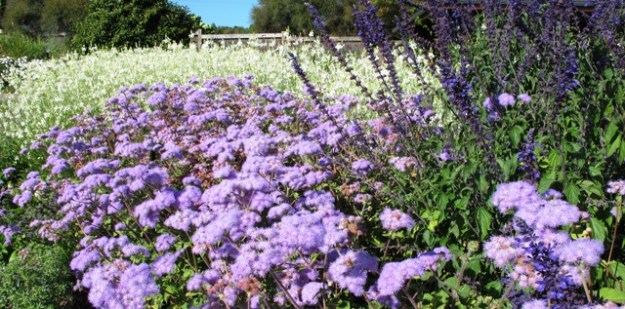
Perennial beds at Auckland Botanic Gardens - white gaura with eupatorium and a salvia.

Perennial beds at Auckland Botanic Gardens – white gaura with eupatorium and a salvia.

The January issue of the NZ Gardener magazine had a two page feature from Auckland garden designer, Xanthe White, on designing perennial borders. It is worth searching out if you are interested, because it is a remarkably succinct piece of writing tailored to in our conditions.

I say “our conditions” because gardening in this country is a year-round activity. In much colder climates, people put their gardens to bed for several months of the year and retreat indoors. I can’t recall any New Zealand garden I have seen which becomes a bare, dormant canvas in winter. Xanthe was suggesting getting a mix of perennial plants to take the garden through the seasons. Her recommended balance was to select 30% of plants that flowered in each of the peak seasons of spring, summer and autumn and 10% in winter. It is good advice, though you may be struggling to find a wide range of winter flowering perennials beyond bulbs and hellebores.

The long border at Great Dixter in England is regarded as a classic example of its type

The long border at Great Dixter in England is regarded as a classic example of its type

The trade-off is that there is never a peak time for bloom. Nobody does herbaceous borders like the English do but it is not just because of their labour intensive property that we have not embraced them in this country. Few New Zealand gardeners would accept a garden which looked absolutely amazing in February, pretty good in January and March, starting to pass over by April, dead as a dodo through the winter months and resolutely green with no colour in spring. But if you want a garden that comes together all at once in peak perfection, that is what you can end up with. To manage blooms and fresh growth for a much greater period of time, requires very high level gardening skills, plant knowledge and willing labour.

The fall back position in New Zealand is to add in trees and shrubs and to encase the border in a neat little evergreen hedge. Buxus suffruticosa was the go-to option for this until the dreaded box blight took hold. This takes it away from a perennial border and turns it into a mixed border. We all do it. It is rare to see a straight perennial border here, outside of public parks and botanic gardens, without woody shrubs, trees and hedges added in to give year round structure and interest.

When it comes to understanding perennials, I would ever so modestly claim that we have a better than average knowledge of bulbs and woodland or shade perennials here. Getting to grips with perennials for sunny positions is a different kettle of fish altogether. Several years in already, I can see that it is likely to take the rest of my active gardening life to get the level of knowledge and skill I want. They are the mainstay of the summer garden and a major contributor to the autumn garden but my goodness it can be complex. I disregard spring because, honestly, we do brilliant spring gardens in this country. I see lots of splendid gardens filled with colour, lush foliage and scent throughout spring time. It is easy here. But I can’t recall seeing drop-dead wonderful summer gardens achieved without irrigation. By autumn, most of us are resigned to a somewhat scruffier appearance altogether. We lift our eyes instead in the hope of autumn colours from deciduous trees and shrubs.

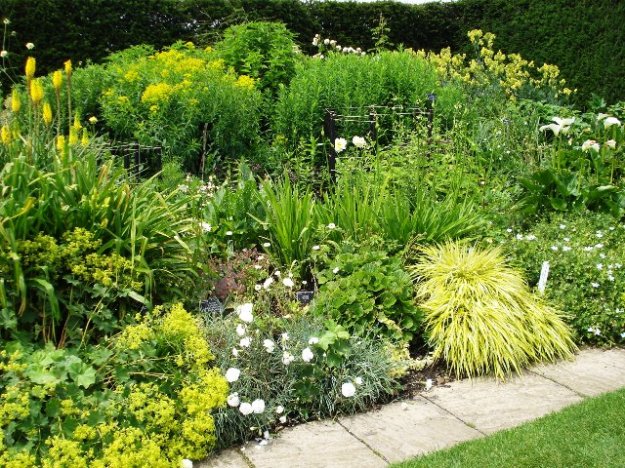
The yellow perennial bay at Hyde Hall, the RHS garden north of London

The yellow perennial bay at Hyde Hall, the RHS garden north of London

Why do I say perennials are complex? There are so many variables. Not only is there below ground – the root systems and how these grow in conjunction or in competition with other plants – but there is such a lot to be factored in about above ground performance. Deciduous or evergreen, colour and shape of both foliage and flowers, peak display time, whether they need staking or dead heading and how often the plant needs lifting and dividing, size, how the plant looks when outside its star performance time, requirements for water, frost protection or winter chill let alone sun and light – and that is not a comprehensive list. These vary for each plant type. It is a lot of knowledge to build up.

The skills lie in avoiding the mishmash or hodgepodge effect. No wonder people go for the easiest option and mass plant a single tried and true ground cover perennial. The aforementioned Xanthe White article gives you a mid-line option if you want something more interesting but still relatively easily managed by the home gardener. I am anticipating spending the next decade at least getting to better grips with perennials before I think I will be happy with the results I can achieve. But that is fine. We have never seen gardening as a path to instant gratification.

First published in the Waikato Times and reprinted here with their permission