Category Archives: Abbie’s column

Abbie’s newspaper columns

A love-hate relationship with roses

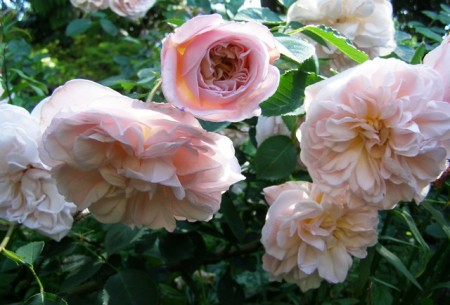
There is something undeniably romantic about Rosa Cymbeline

There is something undeniably romantic about Rosa Cymbeline

I have a bit of an ambivalent attitude to roses. On the one hand, there are only two types of flowers I consistently cut and bring indoors – roses and auratum lilies. There is something wonderfully opulent about a vase full of fragrant roses. Most roses rank pretty high up the scale for flower power. In other words, in reasonable conditions, they give a high number of flowers over a good length of time, given the size of the plant. Roses have an air of romance and promise. Well, most roses do. We will ignore the naff patio standards and freaky types. Just as the complete garden has a productive kitchen garden, so should it have at least some roses – in our opinion at least.

On the other hand… well. Roses are grown for the lovely flowers. Very few bushes are things of beauty. They harbour more pests and diseases than any other plant I know. They are probably second only to lawns in being the cause of home gardeners pouring a whole range of nasties into the environment. I hate their thorns and resent splinters and gouges during pruning. I am always nervous of wounds since being told by a nurse how she had to special a patient who caught a thorn in her elbow and it subsequently turned extremely septic. Disposing of prunings is a problem because they have to be burned or go to landfill. They get black spot and have few leaves after about March. They positively lure aphids. Climbing roses are so rampant that it becomes a major battle to contain them. The year I spent an entire afternoon pruning and tying in one plant of Albertine was its last. I decided that the resulting reward was not worth that amount of effort. The list of negatives is extensive.

The bottom line is that, despite all their disadvantages, roses remain a big seller so clearly the general opinion is that they still justify their place in the garden because of their lovely blooms. And I haven’t taken all mine out and put them on the burning heap because I still love them. I have taken some out, though and another is destined to go soon. It has black spot and yellow leaves already.

The issue here is that we don’t spray our roses. Ever. I don’t spray anything and the husband is adamant that he won’t spray roses and I should just pull out the non performers. Despite having grown up as the Chemical Generation (would that be Gen C?), we have made a conscious decision to try and garden with a greatly reduced spraying regime. There are only a few key plants that get sprayed here. Picea albertiana conica is one – the red spiders will take it out otherwise. For the rest, if they can’t survive and thrive in hospitable conditions, planted well and fed regularly with compost, then they aren’t worth keeping.

In times gone by, the classic rose garden tended to be an area of scorched earth with no build up of leaf litter below which stopped diseases from wintering over. Plants were spaced well apart, usually only one of each variety and predominantly hybrid teas, so there was plenty of air movement which reduces problems with mildew. And it was easy to spray. It is a pretty dated look and really only applicable to a picking garden.

The modern rose garden is more likely to go one of two ways. Either the roses get bedded into what is essentially a cottage garden mixed border, filled with a froth of perennials, annuals and small shrubs. That is what I do, in the hope that as the roses defoliate through the season, the other plants will hide the shortcomings.
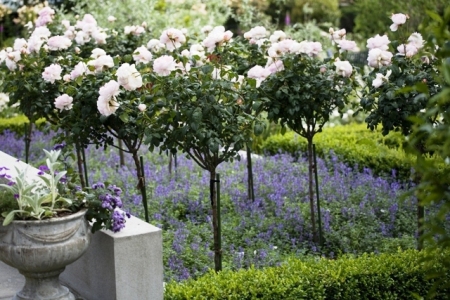
A modern take on the rose garden at La Rosaleda in New Plymouth (photo by Jane Dove Juneau)

A modern take on the rose garden at La Rosaleda in New Plymouth (photo by Jane Dove Juneau)

Alternatively, one can go the formal path, as at Coleen Peri’s garden, La Rosaleda, where she has planted a grid of matched Sharifa Asma standard roses with a solid groundcover of catmint or nepeta beneath. To carry this look off, you have to maintain your roses in the highest health or they will look unloved, uncared for and considerably more of an eyesore than my defoliated specimens in a mixed border.

What annoys me is that it has taken so long for rose breeders and rose nurseries to heed the call for disease resistant varieties. The Flower Carpets led the way and I have to say that while they are not picking roses and they lack some of the romance of old roses, let alone the fragrance, the white and coral variants of Flower Carpet are two of the very best performers in our garden. I am told the new amber variety is particularly good too. But aside from that series, the trialling and selection of roses based on the criterion of being able to grow them in the home garden without spraying appears to have moved at a snail’s pace. Maybe the clamour from the consumer has simply not been loud enough yet? There is a pretty quick turnaround on rose breeding, certainly compared to the slow process that comes with magnolias, camellias and similar woody trees and shrubs.

Two final comments: firstly, if you are not going to spray, you have to be thorough with pruning and feeding to promote health. We feed through regular applications of compost mulch. I do a textbook hard prune in winter and I constantly summer prune lightly to remove spent stems, weak growth and diseased areas. That repeated pruning encourages the rose to keep pushing out fresh leaf buds.

Secondly, we were told by an international rose breeder in Holland that perfume and longevity as a cut flower are incompatible. That is why many florists’ roses lack scent. They are bred for vase life. Nobody has ever confirmed that for us, but we assume he knew what he was talking about, it being his speciality.
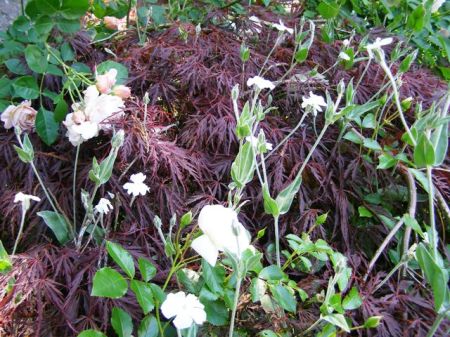
I grow my roses in a mixed border situation - with the hope that the other plants will disguise the defects of the unsprayed rose bushes

I grow my roses in a mixed border situation - with the hope that the other plants will disguise the defects of the unsprayed rose bushes

First published in the Waikato Times and reproduced here with their permission.

Gardening is not exempt from fashion trends

We are hoping the next garden fashion may be the revival of romantic naturalism

We are hoping the next garden fashion may be the revival of romantic naturalism

I was reading an interesting review on line when I came across the following comment: “… New Zealand gardens are getting more conservative with time”. I have not gone back to the original source yet, so will not attribute the comment except to say it is apparently local to Hamilton. It certainly gave us food for discussion here.

Are our gardens getting more conservative and less adventurous? On balance, the unanimous opinion of two was: probably not. We are currently in the meshes of a deeply conservative garden fashion where mini Sissinghursts are all the rage (clipped buxus hedges and balls, white standard roses or bay trees, the odd limbed up hornbeam that claims to be pleached) but it is only a fashion. It too will pass.

What has changed, we suspect, is disposable income, the trickle down of wealth and status to the hoi polloi and the linking of garden to fickle fashion. In other words, the democratisation of gardening. In centuries past, garden fashion was dictated by the rich and powerful across the globe. From the Islamic water gardens, through the classic revival of Italy, the British landscape tradition of Capability Brown, the Arts and Crafts revival in Edwardian times – none of it had anything to do with the common people.

Now we have a whole breed of property owners, some of whom are gardeners, who want an outdoor environment which complements their lifestyle, marks their social position and brings some level of reward in pleasure or productivity. And just like everything else, the cycles have sped up. Clothing fashions change. Colours change in interior design. Why would we expect gardening to be timeless?

The gardening genre of suburban Sissinghurst

The gardening genre of suburban Sissinghurst

Some of us can remember the conifer garden of the seventies – the first instance of a mass fashion in gardening that I can recall. It wasn’t just conifers. It was the meeting of small conifers and the easy-care pebble garden that gave us a certain genre which is widely regarded with horror these days.

We were already in the plant nursery business when flowering trees and shrubs took a dive in the eighties. It was the time of the cottage garden, filled with a froth of annuals, perennials and roses. Anecdotally, we attributed it to the sharemarket crash of the time. Back in those days, you could buy three or four perennials for the price of one good tree or shrub. The price of woody plants has never recovered and these days you can pay about the same for a good perennial as you do for a woody plant which has taken at least five times longer to produce.

But cottage gardens are not low maintenance and in due course they morphed into the short-lived fashion of minimalism – large rocks, ground cover scleranthus and three vertical plants, one of which should be a sanseveria or yucca. That was a fashion driven by a new breed of landscaper who knew about design and space but not plants.

Somewhere along this timeline, natives became the vogue and we saw a fair number of Idealistic Young Things who would only buy a plant if it was a native.

Then we had the tropical garden – lots of palms, clivias, vibrant vireya rhododendrons and that burgundy aeonium with the unpronounceable name (Aeonium “Zwartkop” and I don’t think I ever spelled it correctly in years gone by). The trouble is that most of us do not live in tropical climes and those tropical gardens didn’t take winters too well.

The Auckland bromeliad garden has survived a little longer and is still de rigueur in some circles – for all the world the conifer garden of the new millennium. The overseas trend of prairie or meadow gardens has largely bypassed us in this country. It is damn difficult to do a prairie garden unless you live in prairie conditions with dry, hot summers and dry, cold winters.

Enter the edible garden and the Bright Young Things who would only buy native plants in the past decided they would only buy a plant now if it was edible. Raised beds, nasty mulches of used woollen carpet, no dig gardening, watered down organics – aiming for self sufficiency in food has never been easier, or so it is widely claimed. I know I am not alone when I say many of us have tired of vegetables dominating the gardening media. There are not many aesthetics when it comes to vegetables which are utility things at best.

Gardeners who weren’t into growing vegetables followed a parallel path with their recreations of suburban Sissinghurst, sometimes adorned by a pretty potager if they wanted to adopt both fashions. Even the gals at the New Zealand Gardener appear to think that vegetables have passed their peak and they are onto new branding with Grandma’s flowers – from dahlias to rhododendrons if recent pieces I have read are any guide.

The hope here is for the next fashion trend to be sustainable gardening and to see a revival of romantic naturalism replacing suburban Sissinghurst. Gardens don’t freeze in time any more than their owners do but by definition, few people are trend setters and most people are followers of fashion.

First published in the Waikato Times and reproduced here with their permission.

What is in a name? Quite a bit, sometimes.

I will take Rhododendron nuttallii any time

I will take Rhododendron nuttallii any time

I was looking at a newly released NZ gardening book and happened upon praise for a fruit described as a Chilean guava. For decades, the term Chilean guava, sometimes strawberry guava, has been widely known in this country to refer to a South American fruit called Psidium littorale. It is a biggish, evergreen shrub which produces fruit about the size of a large marble or a gobstopper in red or yellow with rather large pips. It is at least the same genus as the tropical guava – the pink fruit that most of us know in tins from South Africa.

Enter Myrtus ugni (or Ugni molinae to be more correct), usually called the New Zealand cranberry (to which it is entirely unrelated). In Australia, it is known as the Tazzieberry but internationally it is often referred to as the Chilean guava. In recent times there has been a growing tendency in the nursery and retail trade (and now in publishing) to adopt the international common name and to refer to the New Zealand cranberry (aka Myrtus ugni) as the Chilean guava. No matter that there is a pre-exisiting fruiting bush widely known as that. In the aforementioned book, the only reason I knew the author was writing about Myrtus ugni and not Psidium littorale was by the picture. That is because the header was: “Chilean guava” with no botanical name given at all. Sometimes writers and publishers can dumb stuff down so far that they almost guarantee failure.

Two entirely different plants, both commonly called the Chilean guava

Two entirely different plants, both commonly called the Chilean guava

Common names can be helpful in gardening where proper names are often in Latin and hard to remember, but they are only helpful when there is shared understanding about the plant being so labelled. There is no excuse for not putting the proper name in smaller type beneath the common name in books, or indeed for failing to give alternative common names that are in wide usage.

What novice gardeners need is not the complete dumbing down of information to a jazzy but relatively useless level. They need skilled interpretation so that the wealth of information is sorted for them and they are gently encouraged to lift both their knowledge and skills level. Part of that is learning about plant names and plant families.
Why does it matter whether you understand these things? Think of cooking. You can make a perfectly acceptable cheese sauce using any old cheddar but to lift your cooking to a higher level, it is usually necessary to understand the different types of cheeses and just when Parmesan is going to give a better result than Mozzarella or even Pecorino.

You can enjoy your garden and fill it with seeds and cuttings without knowing the names of any of them, let alone where they come from or to which plant family they belong. You may even be perfectly happy growing one Chilean guava while thinking it is the other Chilean guava you have. But it becomes a great deal more interesting when you know more. And the more you know, the more likely your outcomes will be successful and the better your garden will be.

It was an eighteenth century Swedish botanist, Carl Linnaeus, who reorganized the structure of living things, including plants, into the order or sequence (called taxonomy) that we still adhere to today. You can get by quite satisfactorily just understanding the end points of species and genus.

The species is specific to one plant, though there can be some variation within a species – think of brothers and sisters. So if you take the gorgeous Rhododendron nuttallii (and it is so gorgeous, I will take it any time), the nuttallii is the species. There are differences between various forms of nuttalliis but botanically they all very close. The rhododendron part of the name is the genera and there are many different species within that genera – in fact all the different rhododendron, vireya and azalea species. They are like the cousins, second cousins and third cousins plus assorted relatives.

Plant names are in two parts: first the genus and then the species. Hence Rhododendron nuttallii. Even the humble common garden bean has a two part name – Phaesolus vulgaris for most green beans and Phaesolus coccineus for runner beans. Runner beans are a different species to green beans but take it a step up and they are the same genus. The naming of plants in this form is one of Linnaeus’ most enduring legacies. Prior to that, the naming of plants was entirely random and told you nothing at all about the botany of the plant (which is a bit of a problem when it involves medicinal herbs). It was also a source of considerable confusion and duplication.

Linnaeus’s system of classifying plant species through names (called binomial – two names) has stood the test of time over nearly 300 years. But apparently in this country, it is too difficult for us to grasp. If the trends of the past decade are anything to go by, we must return to the pre-Linnaeus era because we are only capable of managing common names, no matter that it can cause confusion. It is apparently asking too much that the botanical name be run alongside the common name.

First published in the Waikato Times and reproduced here with their permission.
So you want to open your garden to the public?

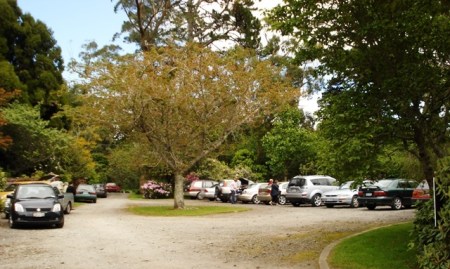
A welcome sight perhaps, carloads of garden visitors, but by no means a certainty

A welcome sight perhaps, carloads of garden visitors, but by no means a certainty

Spring in New Zealand sees the main flurry of garden visiting. If you have been out and about with friends recently and one is starting to make dangerous comments like: “My garden is as good as this one,” or “I have got one like that but mine is better,” maybe: “My standard Icebergs are more advanced than hers,” be proactive. It may be kinder to take your friend to Harvey Norman and persuade him or her to buy a new home appliance instead. Opening your garden to the public is a time consuming, expensive and demanding activity.

Many open garden circuits are of short duration with all proceeds going to charity. Clearly this motivation is entirely above reproach and we will just set it to one side as not being relevant to this discussion.

But too many garden openers are under the misapprehension that they can make money by opening. Experienced openers will tell you that in many cases it actually costs you money because you go to a great deal of time and expense preparing your garden, often buying expensive potted colour to plug gaps which you would otherwise have ignored. The bottom line is that there are too few garden visitors in this country to make it financially viable. To get more than just a few visitors, you need a brilliant location (preferably main road close to a population centre, right on a tourist route and featuring a castle), usually allied to an established reputation which takes years to build and a very good garden. Added attractions are advisable, whether they be a cafe, craft shop, plant sales or major events. If you go in for added attractions (which can certainly contribute a great deal to financial viability), don’t delude yourself into thinking that visitors are all coming to enjoy your garden. In reality your garden simply becomes a pleasant venue and many visitors come for the attractions, not to see your gardening efforts.

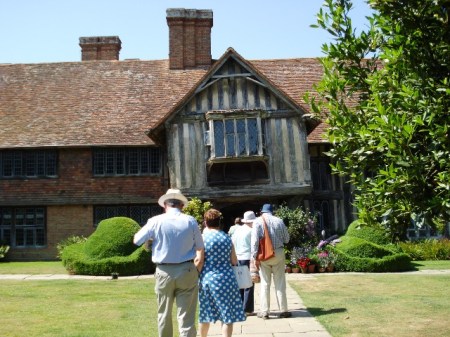
Don't expect the sort of visitor numbers Great Dixter gets

Don't expect the sort of visitor numbers Great Dixter gets

So what are the main reasons for opening besides charity? At its best, positive affirmation of one’s efforts. At its worst, ego. Garden openers’ egos can be a scary force to encounter and the whole exercise can turn a perfectly pleasant Dr Jekyll of a gardener into a Mr Hyde garden opener.

If you are contemplating opening your own garden, the first piece of advice I would offer is to go out and look closely at other people’s gardens – not critically but comparatively. You need to work out where your garden fits in and what you have to offer that is better, more skilled or more interesting than what is already out there.

The second step is to come home and look critically at your own garden, trying to assume the persona of an outsider looking for the first time. Over the years, we have met many gardeners who expect visitors to see their garden through the same eyes as they do. You know your own garden inside out. Often you envisage the potential when plants grow and fill out. The mistake is to think that the first time visitor will also see your dream. They won’t. They will see the reality on the day. You need to take off rose-tinted glasses to see that reality for yourself.

If you have children still at home, they won’t thank you. We always had two flat rules for the kids: no loud music and no loud arguments. But I do recall Second Daughter saying plaintively one busy week: “And you could tell visitors they don’t have to wave to me through the window when I am having breakfast.” That would the 11.30am weekend brunch when she was still in her dressing grown.

If you are determined to open, presentation becomes a key issue. Open gardens are finished and presented to a higher standard than your average home garden. All that lawns, hedges and edges stuff has to be done well and maintained at that standard. Established weeds are a no-no as are unsightly areas of wasteland. Visitor safety can be an issue, especially when the average age of garden visitors usually works out somewhere over 60 (which means a fair proportion will be decidedly elderly). Access to a toilet and safe parking are additional factors, as is the personal touch of meeting and greeting visitors. Opening your garden these days requires a whole lot more than just sticking out an icecream container and collecting the money.

That said, our experience of opening for many years is enormously positive. We can count on the fingers of one hand the attempts at plant theft over the years (the loss of the unripe seed on Mark’s Paris polyphylla was particularly galling). There is the odd person who tries to sneak in without paying but we have become pretty good at dealing with that (it is so embarrassing but it should be embarrassing to the guilty party, not the host). Only once have we ever caught an old biddy going through the house (shameless, she was!). The vast majority of garden visitors regard it as a privilege to be able to come into a private garden and behave accordingly. Though I should add that we are a more expensive garden at $10 for adults. The cheaper you are, the more riffraff you will attract.

In the end, it is enormously affirming to have garden visitors who really enjoy the environment you have created and who are unstinting in their expression of appreciation. In New Zealand, that has to be the main reason for opening. If you are thinking about it for any other reason, you may be better off going to try some retail therapy instead.

First published in the Waikato Times and reproduced here with their permission.
Garden fashion – from designer trend to cliche

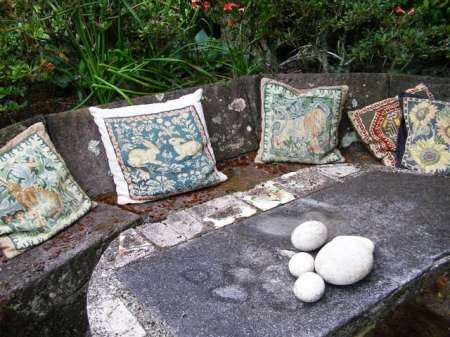
I fear my scatter cushions are more of the shabby chic genre than designer...

I fear my scatter cushions are more of the shabby chic genre than designer...

I attended a really interesting garden lecture on Saturday. Some readers may know Neil Ross from his regular contributions to the NZ Gardener magazine. He spent some years as head gardener at Ayrlies in Auckland but these days is back gardening, designing and writing in the UK. His talk was loosely on gardening trends in Britain and I thought readers might enjoy a summary of what is going out of fashion and what is on the rise, based in part on his analysis of the cutting edge garden installations by leading designers at Britain’s superb garden shows – Chelsea, Tatton Park, Hampton Court and the like.

Passing over (so they will look dated very soon in your garden, should you be contemplating them) are painted walls – usually solid plastered walls installed as a garden feature and painted in a dramatic shade with colour toned plantings. Sorry, passé now, along with gabions, thank goodness. The latter are wire cages, usually filled with rocks but sometimes with au naturelle branches and trunks cut to length or even pine cones. We always thought that gabions looked better when used for their original purpose of slowing erosion. They are a bit too industrial altogether in a garden.

Dribbly water features that look like urinals (Neil’s description, not mine) are looking dated, irrespective of whether that trickle of water is flowing out of a terracotta head, a gargoyle of any description or just a modest pipe. Keep to ponds (lakes are better), natural streams or at least a decent gush of water if you feel the need for a water feature.

Box balls, Neil reports, have been so over-used as a formal feature that they have been done to death. Though he thought, in New Zealand it is not just buxus balls. It is the whole mini-Sissinghurst look of clipped buxus hedges and edges containing formal standard plants (be they roses, bay trees or choisya ternata) – a man after my own heart on this issue. Also done to death are designer scatter cushions accessorizing the display garden. I have to admit that I have been known to employ the scatter cushion on our rather unforgiving stone seats though mine are of the shabby chic genre (all my late mother’s tapestry, now heavily faded) rather than designer colours and textures. I only put them out when our garden is open and I went off that idea the time I forgot to bring them in and it rained….

The Missouri Meadow Garden at Wisley - perhaps the pinnacle of the prairie garden style

The Missouri Meadow Garden at Wisley - perhaps the pinnacle of the prairie garden style

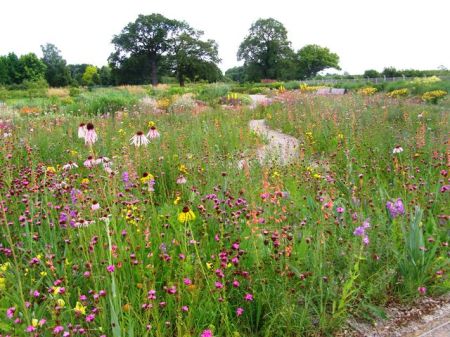
The prairie garden is in danger of becoming yesterday’s design in England though we have never embraced this style in New Zealand. The Missouri Meadow at the RHS flagship garden, Wisley, south of London, is the finest example we have seen. But it relies on low rainfall and low fertility which hardly describes the dairy farming areas of New Zealand so we may never see prairie plantings popularised here.

If you want to be cutting edge, Neil’s advice is that the new trend is to keep chickens and indeed anything that is edible or food producing in the garden. I don’t think guinea pigs count. Beehives are all the rage, especially in cutsie-pie bee frames. Insect hotels are all the rage in English gardens though the research is that insects are happier in a natural environment (leave an old log to rot down) than in your designer Hilton.

Green walls are still a hot item but we agreed that they are expensive to install and a lot of work to maintain. It is easier to grow plants in the ground rather than in vertical frames, if you can.

Glass is in fashion, preferably exquisite, hand-blown glass features. At a pinch wine bottles might fit the bill in a creative wall construction which may suit the winos amongst us. But the suggestion I have seen to use old wine bottles as a garden edging is a really bad idea from a practical point of view, let alone the dodgy aesthetics. As you plunge your spade in to turn over the soil, you are just as likely to hit a bottle and break it.

Predicting the Return of the Conifer

Predicting the Return of the Conifer

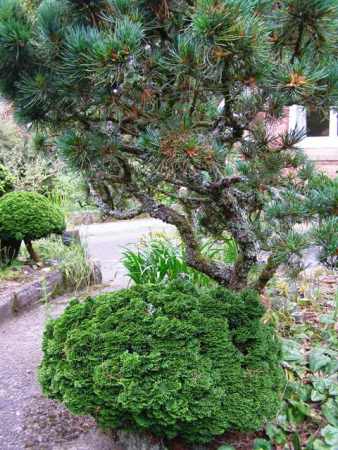
And conifers are due to make a return. Not in a reincarnation of the awful 1970s style some readers may recall – a mass of prostrate junipers and the like plonked in through black plastic and then covered with that nasty red scoria. There were good reasons why that particular style of gardening fell from grace but the poor old conifers themselves did not deserve to be cast out to the wilderness along with the garden style. The conifer family is huge and there are many fine specimens from tiny treasures to handsome, long-lived landscape specimens. Used judiciously as accent plants throughout the garden, they can give a splendid year round shape and definition as well as variations in colour. Thank goodness we still have ours – after sixty years, some are getting venerable and we would not be without them.

In place of prairies and meadows, more block planting of perennials is returning – check out the work of Tom Stuart Smith or Piet Oudolf.

The final caution comes not from Neil but from the Garden of Jury – beware of rills and obelisks. They are on the cusp of passing from innovative to hackneyed. It is a very short step.

First published in the Waikato Times and reproduced here with their permission.