Category Archives: Abbie’s column

Abbie’s newspaper columns

Tales of the Christmas Tree

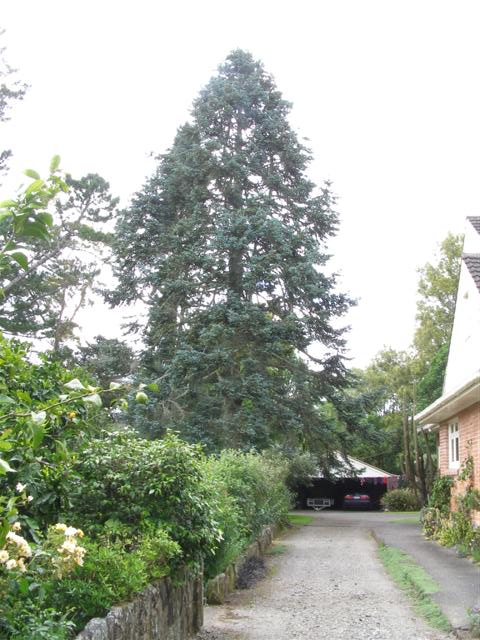
Fortunately this handsome Abies procera beside our house was not cut off in its infancy fifty years ago to act as a Christmas tree for two short weeks

The need for the Christmas tree is starting to weigh upon me. The deadline is December 17, the day when our first returnees arrive home for the traditional family Christmas. We could of course join the throngs who have sacrificed authenticity for convenience and bought an artificial tree. I was listening to a panelist on National Radio last week who mentioned his tree. A man’s tree, he called it. It comes complete with all decorations glued on to the branches so all he has to do is fold it out each year. It just would not do here. I would be pilloried and derided by the returning children who would take such a purchase as a cop-out on every front. They would probably assume that it indicated their mother was entering premature old age.

Alternatively, we could join the throngs who go out and buy a tree. Wash my mouth out with soap. How could I suggest such an action? No, our tree must be harvested at home.
Mind you, if you head out and buy a tree, you will generally buy a nice, dense tree of the correct, prescribed pyramidal shape. In New Zealand this tends to mean a choice of a pine tree, another pine tree, the common pine or pinus radiata. We have made the pine tree (a native of Monterey in California) our own in this country, for Christmas trees as well as timber. In the past Mark has been stung by criticism of his selection of wildling pines and has even resorted to wiring in additional branches to increase the volume in sparse areas. Last year he selected a particular tree which he then trimmed a couple of times to encourage shorter, bushy growth. Alas, in the ten days between checking it for the final time to make sure that there were no feathered friends of the ornithological persuasion resident in the tree and when he went out with the pruning saw to harvest it, a family of chaffinches had moved in. He could not cut it down and we had to make do with an emergency installation of four clipped matai trees in pots.

Over the years we have had a variety of different trees. One year I despaired of the pine needles with which my vacuum cleaner struggled to cope and I tried a tree skeleton, spray painted white. It was not a hit with the children. These days it might be seen as more environmentally friendly because when you think about it, entire forests of conifers are felled each year to furnish the homes of the western world for a few short weeks. I was in London in early December one year when the markets were full of Christmas trees which had been shipped in from Norway and Scotland. These were beautiful, dense trees, mostly Abies nordmanniana or Abies procera (the Noble Fir), and, being horticulturally inclined, I knew that such plants are initially very slow growing. The trees had to be at least eight years old and probably more. My oh my, eight or more years of growth to furnish the front rooms of Londoners for two weeks. Second Daughter was equally struck by these and I recall a blog she posted soon after her first Christmas away from home. Wandering around Maida Vale where she was staying, she took photos of the discarded trees out the front of all the residences where they were awaiting the green collection. Christmas Is Over in London, she entitled this on-line photographic essay.

An American friend is a little scathing about our New Zealand habit of using pinus radiata. The needles, she points out, are too long to allow the decorations to stay on easily. If you look at synthetic Christmas trees, they are certainly not modeled on the pine tree. Most are abies (fir trees) which have tufted growths that are much shorter and easier to work with. But the ideal tree needs a certain amount of horizontal branching from which to hang individual Christmas baubles. If the cone shape is too tight, all you can do is to wreathe it in tinsel and lights. In the US, my friend points out, you have a choice of several different varieties of tree. Internationally, abies are favoured because they don’t shed needles, picea or spruce are common but are less happy about surviving cut off in their prime and show it by shedding needles and there are many different pines to the common radiata which are used overseas. The Norfolk Island pine (Araucaria heterophylla) and its smaller cousin Araucaria columnaris make perfectly shaped trees. If you want to be indigenous, matais and miros could be suitable candidates (totara are a little too prickly, as are rimu). But the bottom line is, which trees are you willing to cut off for a mere two weeks Christmas gratification? Call me a snob, but I worry less about sacrificing the common pine whereas it is distinctly sacrilegious to sever the nobler conifers from their roots. My conscience is soothed even further when we recycle trees or branches that are for the chop anyway, even if this means some rather odd installations. This year it involves the extension ladder and cutting the top out of a mature golden chamaecyparis because its top knot has reverted to a much more open growth. The difficulty for Mark may be getting it down intact from ten metres up but my challenge is greater. See, it is a green and gold variegation and they are devilishly difficult to decorate with any aesthetics at all because they just make tinsel look even tackier than usual.

The final word on the topic has to rest with our dentist who regaled us with the charming story of heading out to buy a Christmas tree one year from the foremost supplier locally and finding that he had managed to bring home a specimen with a nest containing a fledgling thrush. The mother had presumably scarpered at the first sign of disturbance (and we won’t dwell on the mental image of bereft Mother Thrush left behind). Said dentist and wife then spent the two weeks leading up to Christmas hand rearing the thrush with worms dug fresh each morning. After all, how could you have a Christmas tree in the house knowing that you had consigned its now homeless inhabitant to an early death? As the thrush gained in size, they set about teaching it to fly with regular lessons outdoors, tossing it in the air until it caught on to the process. It would be a sentimental lie to say that it flew to freedom on Christmas Day. In fact it spent some time sitting around perched on the washing line (and no doubt pooing indiscriminately on the washing) but let that not detract from what is a charming home grown Christmas story.

Dining al fresco – furniture options

Getting my eye in for outdoor furniture options

I see that summer officially starts on Tuesday but our thoughts turned to the first of the summer wines a few weeks ago. That is to say that I floated the idea of some new outdoor furniture for us to sit in greater comfort with glass in hand. My Mark is a man of many talents but shopping is not one of them. When it comes to larger purchases, I have to do the legwork in advance, narrow it down to a preferred option plus a back up position and then psyche us both up for a joint shopping expedition. So I have been getting my eye in on current options, both in shops and on line.

Wooden furniture largely falls into two camps: Indonesian teak and kwila (hardwoods) or Cape Cod style which is more commonly made in tanalised pine and often painted. We have an existing teak table and eight chairs which are fine but I have another use for them and I want more comfort. I have a twinge of conscience each time I look at the current furniture. I suspect an orang-utan may have been made homeless in order to supply the timber for my patio furniture. Back about eight to ten years ago when we bought it, sustainable logging was not a key selling point. Now it is a huge issue and every purveyor of Indonesian hardwood outdoor furniture from the cheapest to the considerably more upmarket outlets claims that their source is sustainably managed. Call me a cynic, but I wonder if in fact all these offshore buyers were not booked in for consecutive days to visit the one and same model plantation with the claim that it is a fine example of wonderful environmental management and their furniture is being made exclusively from timber milled from this location. The bottom line is that Indonesia’s hard wood forests are disappearing at a completely alarming rate and the timber is going somewhere. It may be optimistic to think that they are not going to supply the decking and outdoor furniture for wealthy Western al fresco living. It is more likely that sustainable logging in heartland Indonesia means cutting out the hardwood forest to replant in high yield palms.

I won’t be buying more furniture made from Indonesian hardwoods at this stage. If you have some (and who hasn’t), you may like to try extending its life by painting it with a mix of about half raw linseed oil and half turpentine. If the mix is a little thick, add more turps. The proportions are not critical. The turps helps the mix get absorbed readily and stops the timber from being sticky. Sadly, I must warn that you can’t put it in a huffer bottle and spray it on (I tried but the mix is too viscous) so you need to brush it or apply it with a rag. It will wreck the brush and if you use a rag, be cautious what you do with it afterwards because it can combust. However it is a great deal cheaper and just as effective as expensive wood preservers sold for the same purpose, though it will darken the wood.

The Cape Cod furniture is allegedly in the American style (fairly loosely speaking, I suspect) favoured on that peninsular of Massachusetts. Personally I think the common style of chair looks as if it were designed for the human equivalent of Jack Russell dogs – long in the upper leg (deep seats) but extremely short in the lower leg (close to the ground) and with a sharply angled back to the chair which looks really bad for posture. They are quite cute to look at in that picket fence sort of genre and it appears to be fashionable to have them painted in alarming garish colours, rather than in gently weathering timber but at least they are made from ethical timber.

Next is that tubular aluminium and nylon look. At its best, it is very stylish in its contemporary appearance with clean lines and it is probably very practical. At its worst, it just looks utility and cheap – and there are very cheap options from some outlets. It is not for me but if I lived in a penthouse apartment with lots of shiny stainless steel and, perspex panels and glass, I would probably feel it was entirely appropriate to the environment but I would only want the more upmarket quality of this style.

So to the French provincial look (sometimes Italian), marketed these days as shabby chic. It is usually cast iron, sometimes wrought iron and I admit I love the look. When we bought our old wooden suite, what I would really have adored was the French provincial dining table and eight chairs which was a mere $6000 close to a decade ago. It wasn’t overly comfortable, it couldn’t accommodate a sun umbrella and it certainly wasn’t practical (the heavy chairs would have been difficult to push in and out on our imperfect, outdoor surface) but it was stylish. These days the price has dropped (the quality too) and alas shabby chic has come to mean chipped paintwork in pastel colours peppered with rust. I don’t want chipped paintwork and rust and I do want comfort. Shabby chic is founded on the real McCoy – weathered by time and of undeniable quality. Repro shabby chic does not do it for me.

Finally we come to the option of African colonial which is outdoor wicker. Proper wicker is a wonderfully organic and aesthetically pleasing material (though it can descend from chic to plain shabby alarmingly quickly) but it is designed for a very dry climate. So what is on offer here is made from synthetic materials. I was surprised to find that if you buy good quality, the guarantee runs to five years which is a lot longer than I expected. African colonial probably takes the prize for all round comfort – clearly the gin drinking representatives of HM Government in that continent knew a thing or two about comfort.
We have yet to make our decision but certainly my forays on the topic have highlighted three points:

1) Like most things in life, you get the quality you pay for.
2) The really, really, really stylish options are found on the internet and are divine but out of our league altogether. I may even rather have the new car I could buy with the money instead.
3) Bringing your outdoor furniture under cover at the end of summer greatly extends the life expectancy of same.

I did not see any of the polyester resin furniture that I have maligned over a period of many years. Maybe it has gone – I wish. I will not even deign to comment on the naff swinging love seats under their own little awnings which look like a floral surrey with a fringe on top. But I would comment that the cantilevered umbrellas that are for sale everywhere this year are desirable. We haven’t owned one yet but we have used one and they completely eliminate the intrusive presence of an umbrella pole in the middle of everything. We are looking forward to being well set up shortly for the summer wines.

Taming the Wilderness – workshop notes

Create space around individual plants to avoid an overgrown, unkempt look

Create space around individual plants to avoid an overgrown, unkempt look

TAMING THE WILDERNESS

Handout notes from the workshop taken here in our garden November 7, 2009 as part of the Taranaki Rhododendron and Garden Festival.

  1. If you are new to the garden, don’t charge straight in immediately and start dropping trees and shrubs. Ideally, give it about nine months to go through the seasons so you can see what is there before you do major felling and removal. In the meantime you can be clearing the lower grade plants – most plants that sucker, clump or seed down can be safely attacked.
  2. Track the path of the sun so you can see where your winter sun and summer shade positions are.
  3. Unless you know what you are doing, seek advice as to which trees are quality, long term trees worth preserving. Somebody at the botanic garden or public park, or an enthusiastic member of a group such as the International Dendrology Society will likely know more than a tree surgeon (whose skills often lie more in safely felling a tree and using chainsaws than in deciding which trees are of value).
  4. Overgrown gardens lose the detail and small treasures, but can give you a framework and maturity to work with. Don’t reduce it all to a blank canvas by clearing everything.
  5. Stand at each window in the house and plan views if possible. Also spend plenty of time looking from every angle in the garden to work out potential view shafts, sun and shade through the seasons.
  6. Make the most of maturity of plants. LIFT AND LIMB. Allow light through underneath and build up layers of garden. Many, if not most, young gardens are badly overplanted to get a quick effect. It is likely that you will need to thin out a number of these plants.
  7. Mature gardens are usually about shade conditions. LEARN TO GARDEN WITH SHADE. Don’t try and turn it all back to sun and a juvenile garden.
  8. CREATE SPACE AROUND PLANTS. The fresh appeal of young gardens is often because each plant stands alone in its own space. As gardens grow, that space gets swallowed up and the plants become entangled. Creating a sense of space again is good for the plant (less competition, more light and more air flow) and creates a more cared for look in the garden. Most gardens need to restrict the size of trees and shrubs.
  9. LEARN ABOUT PRUNING – especially the right times of the year to prune plants and the general rules of pruning. A good pruning saw is worth the expense, as are good loppers. Supervise chainsaw operators carefully – you can not glue branches on later.
  10. Widen paths. Remove anything spiky or prickly beside the path. Creating a sharp edge between a path and garden immediately makes a place look better cared for.
  11. As a general rule, woody trees and shrubs are best left well alone in the root area. Just a feed (preferably in spring) if the plant is looking hungry and pile on the mulch. Herbaceous or clumping plants prefer friable or fluffed soil and in a neglected garden may need to be lifted, divided and rejuvenated.
  12. If you are gardening on a slope or even on a hill, trim the branches and prunings and lay them around the contours of the slope and use them to start building up layers of humus. It is all part of the natural cycle. Bare earth is not a good look.
  13. Be a vigilant weeder from the start. It saves a great deal of time and effort later. Once an area is weeded, lay mulch to suppress fresh young seedlings. You will have many dormant weed seeds in your soil which will spring into life with a bit of light and cultivation.
  14. In our opinions, gardens need some logic to them and this usually means that detailed and tightly maintained areas of the garden are closest to the house, to living areas and entranceways. As you radiate out further, the theme becomes looser and more casual. Most people use outdoor living areas which are close to the house, rather than at the bottom of the garden.
  15. Vegetable gardens need full sun.
  16. As a general rule, water features are best in full sun.

The growing popularity of garden workshops

Lifting and limbing allows us to garden below our avenue of huge rimu trees

Lifting and limbing allows us to garden below our avenue of huge rimu trees, now 130 years old (which is very old for New Zealand gardens where there is a widespread apprehension of anything older than about 20 years)

In one of those rash moments when our annual garden festival was a long way out, I volunteered to take a workshop here in our garden. These are fast becoming a feature of our event. The popularity of workshops suggests a growing demand for quality information. Predictably, muck and mystery (as English garden writer Alan Titchmarsh used to call compost) attracted the largest number – presumably those driven by a desire to demystify the secrets of making the good stuff. I say predictably because compost is closely tied in to the Great Vegetable Garden Boom still in full swing. But all workshops attracted good attendances and all but one were based in festival gardens.

Several of our attendees commented later that one of the unexpected bonuses of coming to our garden festival here was the presence of knowledgeable gardeners who are available and willing to share ideas, name plants and give good advice. It is one of the characteristics that set us apart from other such events around the country. Back in the early days of our festival when most gardens were free and there were many more open gardens, there was little expectation placed on garden owners. They weren’t even required to be there. In fact, some just left the gate open when they went to work. I always wondered why there weren’t more burglaries because I felt sure that any burglar worth their salt would have cased out the joints. But maybe forward planning is not a mandatory qualification for your average burglar and thief. That aside, there is something slightly disturbing about not being formally invited onto private property to look around the garden and quite often garden visitors would comment that they felt very uncomfortable looking around where there was nobody home and they left quickly. It is all a bit like snooping into your host’s private cupboards or drawers.

It was precisely because of this, the requirement that every garden be hosted was brought in some years ago. Nowadays we expect a great deal of our garden openers and most in fact deliver even more than is expected of them. Not only do they have to get their gardens up to opening standards (and pretty well without exception, our garden openers are their own toughest critics and have lifted standards higher every year), but then we expect them to front up to the public and meet and greet and chat to them for ten days on end. There are other festivals where this does not happen, where the garden owners are not visible or available. The Trinity Garden Festival in Auckland (which doesn’t seem to be running any longer) was the most often cited event – students employed to do the gate and a completely impersonal experience with nary a gardener and garden owner in sight. But it is not just that our gardeners are available, it is also that they are voluntarily up-skilling themselves so that they are more knowledgeable hosts. It is one of the defining characteristics of our festival and a reason why it has run without interruption for 22 years and is apparently going into another growth period.

I started by saying it was a rash impulse which saw me offering to take a workshop here. It always looks a long way out when you agree to do something but it is a bit like an exam – some of us don’t start worrying until it is almost upon us. It actually takes quite a bit of thought and discussion to marshall one’s ideas and key points and it may even be harder to make a casual workshop coherent than it is to present a formal lecture. Whatever, we chose the title of Taming the Wilderness and then started worrying about what direction to take it. I am not going to try and summarise all we covered but it was interesting that for us, personally, there were three critical points.

  1. If you have a property with large trees and shrubs and you are not sure what is what, seek out some good advice as to which plants are special so worth saving and which are the long term trees. You can’t buy maturity and too often, ignorance sees some pretty special plants lost forever. At the risk of making enemies, tree surgeons and arborists tend to be the people you seek out when you have decided which trees you want saved and which ones felled. They should do the work safely and efficiently for you but by no means are all these people knowledgeable about tree varieties. You need a plantsperson or dendrologist for this and the really able enthusiasts are often found in the voluntary or amateur sectors.
  2. Lift and limb. Gardening is about working with nature. Just by cutting off the lower branches of trees, you can open up an area to light and air movement. You don’t have to return a tree back to juvenile size if it is too large. You can celebrate the stature of large plants by managing the lower metres of trunks and canopies so you can garden below, rather than growing dense forest. At our workshop, Mark did a memorable demonstration of lifting and limbing – showing what a difference dropping merely a couple of large limbs can make, creating vistas and views and opening up around the plants.
  3. Reclaim space around individual plants. Much of the appeal of juvenile, freshly planted gardens is that each plant stands alone in its own space. As gardens grow, plants become intertwined and thugs can dominate. Over time, plantings can become forests or hedges. To reclaim a sense of managed garden, create space around individual plants by judicious pruning and thinning. It is also better for plant health.

In a place with some very large trees and a well established garden, we are constantly working to hold the forest and potential overgrown wilderness at bay and to keep a sense of garden and open space within that mature framework. It is simply what we do here.

Maintaining social status if not economic value – the rhododendron in Taranaki

DSC01880 (Small)

The generic pink rhododendron photo - in fact an unnamed seedling from our park


2009 may not go down in history as having the best ever display of rhododendrons in Taranaki because spring came somewhat early this year and festival dates are somewhat late. But it is rather a happy collision of different occurrences that sees us wearing a rhododendron crown in the first place. It is not that we grow them hugely better than everywhere else. We just happen to have Pukeiti here and that organisation and identity has given an enduring regional focus to the plant genus, along with our longstanding annual garden festival. In fact going back in history, that garden festival was first floated by Pukeiti and owned and run in the early years by the Taranaki Rhododendron Group.

Why rhododendrons? Just as tulips commanded prestige and price well beyond their actual worth in Holland in centuries past, rhododendrons were the high status and high prestige plant for the post World War 11 gardeners and we had a cluster of serious gardeners in Taranaki at the time.

Douglas Cook, the father of Pukeiti, bought land here primarily for rhododendrons because it was clear to him that these aristocrats from lower mountain slopes in Asia would never be an option for his first choice location near Gisborne, where he set up Eastwood Hill with its heavy focus on drought tolerant deciduous trees.

Around the same time, a number of Taranaki gardeners and plantspeople were creating their gardening masterpieces. These included Bernard and Rose Hollard near Kaponga, Russell and Mary Matthews on Mangorei Road (Tupare), Les Jury at Sunnybank on Tukapa Street, Harold Marchant and Les Taylor near Stratford, Jack Goodwin at Pukekura Park and Pukeiti – and Felix and Mimosa Jury in the garden here at Tikorangi. The rhododendron family featured large in their plans and individual collections were highly prized.

Historically, back in those mists of time around the late forties and fifties, Duncan and Davies were becoming the major force in commercial production and that happened in Taranaki partly because all plants were field grown in those days (in other words in the ground in real soil, rather than in containers and planter bags in modern nurseries). With its friable, volcanic soils, high sunshine and regular rainfall for 12 months, Taranaki just happened to have the best conditions in the country for field production. It needs also to be said that the charisma and dynamism of V.C. Davies was a major influence.

Times keep changing. These days the market value of a rhododendron plant has plummeted so far that you can go to any plant shop and buy one for around the same price as a perennial, a clipped bay tree, even a semi-clipped buxus or a large succulent. I can tell you, dear Reader, that there is a vast amount more skill and time required to get that rhododendron onto the shop floor than the other plants and that they are dreadfully underpriced, almost without exception. I am frankly astonished that rhododendrons have to some extent kept their elevated status in theory, even though reality has them relegated well down the plant equivalent of the social scale. It is a conundrum.

But then we still lay claim to the rhododendron in Taranaki even though the local nursery industry continues to dwindle away (we certainly can’t claim to be the Southern hemisphere power house of plant production these days!) and even though most home gardeners would rather plant a fruit tree than a rhodo. The rhododendron gives a focus, an icon, to our garden festival which sets it a little apart from others all round the country – except for Dunedin who shamelessly (though quite justifiably) continue to challenge our claim to having the Rhododendron Festival.

As our festival starts today, never underestimate the importance of this annual event on our regional garden calendar. It is the single event which keeps Taranaki right up at the top nationally in the garden scene. The 10 days of festival deliver more visitors into most of our open gardens than will be seen on the other 355 days of the year. It is the single event which makes it worthwhile to maintain gardens to the high standards we currently reach. Without festival, there would be no incentive to keep lifting gardening standards and setting the benchmarks.