“You’ve got to know when to hold ’em Know when to fold ’em Know when to walk away And know when to run”
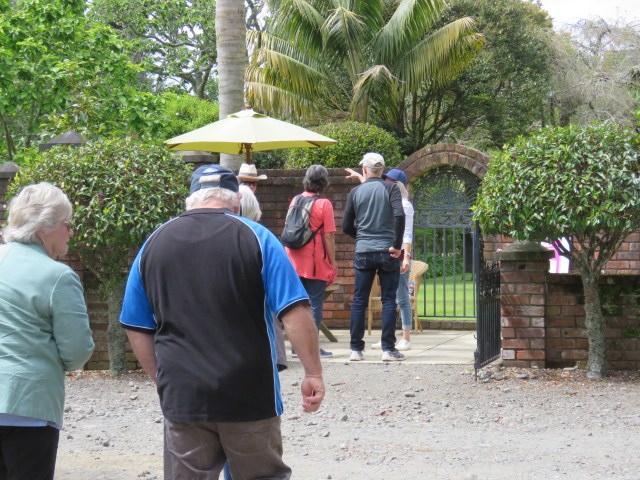
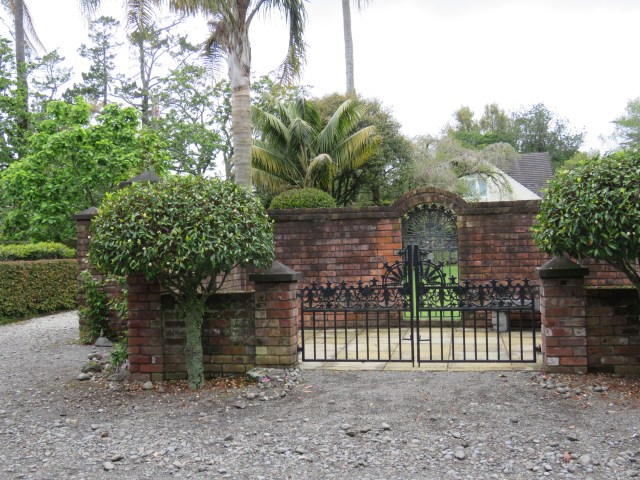
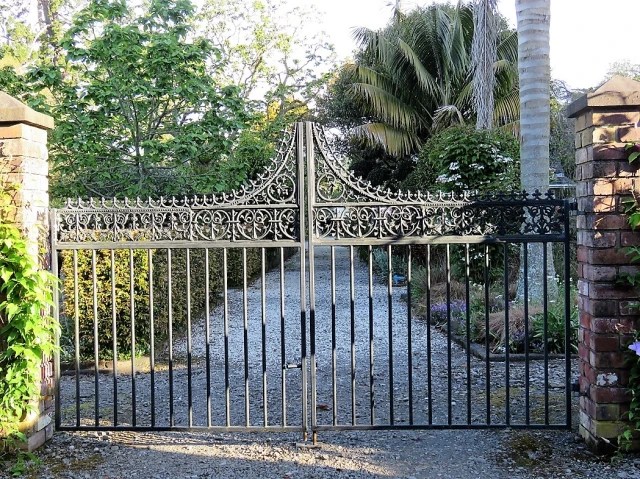
I found myself humming to Kenny Rogers this morning, although I had the lyrics saying ‘You gotta know when to go”. We are not going anywhere but we have metaphorically shut the garden gates to the general public. It is very odd, the end of a personal era. But, for us, it is the right thing to do. As I have said countless times in recent weeks, ‘I do not want to be the Tim Shadbolt or Winston Peters of the gardening world.’
New Zealanders know instantly what I mean, For overseas readers, Tim Shadbolt and Winston Peters were both major players – institutions, even – on our political landscape over several decades. But they did not know when to retire and it is very sad to see old men devastated when even the patience of their most loyal voter base finally runs out. It is way better to go out on a high note.
“What a difference a day makes 24 little hours”
If I was in a small, town garden, I am sure I would enjoy continuing to open to the public and meeting many different people – but we are not. To get our garden to opening standard is such a major undertaking that I can not face doing it for another year. It is time for us to call it a day and to just accept the occasional specialist tour group to keep us on our hosting toes.
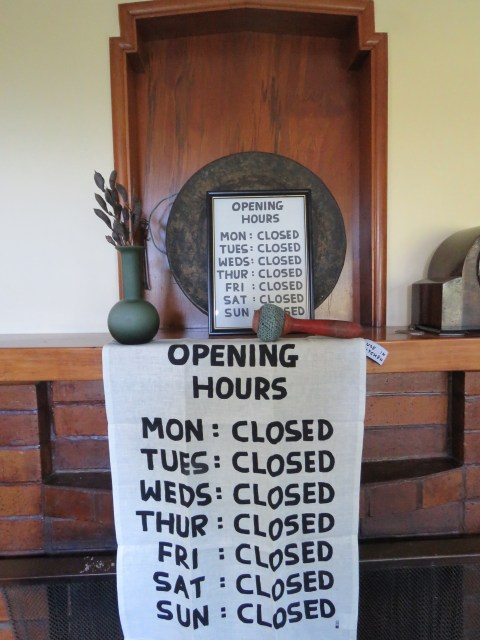
It was a very successful garden festival this year and that is a great memory to hold close as we choose to enter a new era as gardening recluses.
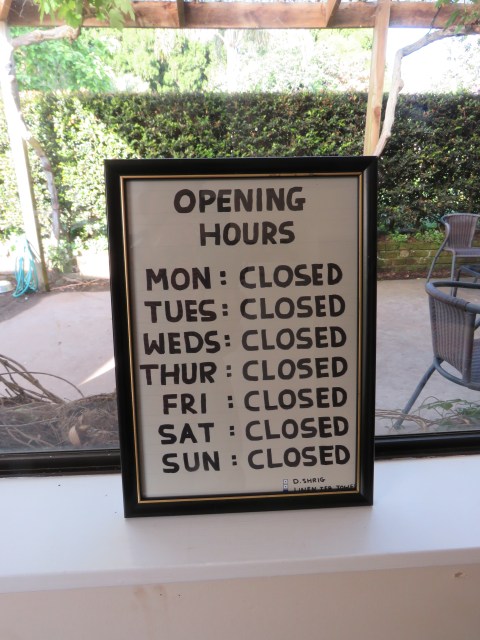
We laughed out loud when our artist in residence this festival, Jennifer Duval-Smith, presented us with the perfect present. We had been discussing linen tea towels and this one is beautiful linen. However, it was Jennifer who laughed when I rushed off the trim the packaging to fit in a frame I had in order to have a second version of it for our staff kitchen in the shed. “It is like a cat,” she said. You give it a gift and it is more interested in the box.”
I will still keep writing, taking photos and posting on line, Mark will continue breeding new plants, we will continue gardening. Zach and Lloyd are staying with us. It will be very quiet but we will enjoy that, too.
Thanks to any and all who have visited us over the past 35 years. None of us can know what the future holds but it won’t be another garden festival for us. It has been a real pleasure meeting so many of you. Thank you for coming.
I will admit that I felt a sense of relief to wake this morning to the sound of rain. Experience has taught me that it means a slow start to the morning and that takes a bit of pressure off us all. It was forecast to clear later in the day and it did so that was fine.
It is a busy garden festival. Not on a par with what we refer to as the Covid festival in 2020 – that period of time when the rest of the world was in the worst grip of the pandemic but we were gloriously Covid-free in these islands of ours with no restrictions, bar a closed border. So many people were clearly suffering from cabin fever that they grabbed the opportunity to travel internally. That was also the year we reopened after being closed for seven years and the crowds came.
So not quite in that league in 2022 but we are not far off it. Clearly the message has been received that this is our last festival and we are closing to the general public as of this Sunday at 5pm. Lots of lovely people who have really enjoyed the garden – and lots of vehicles to be managed.
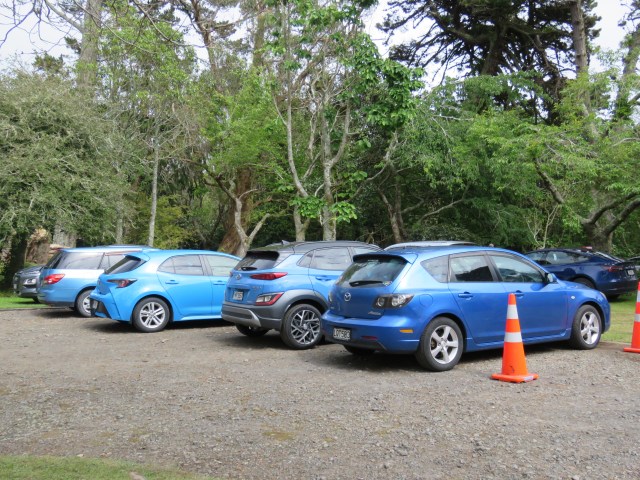
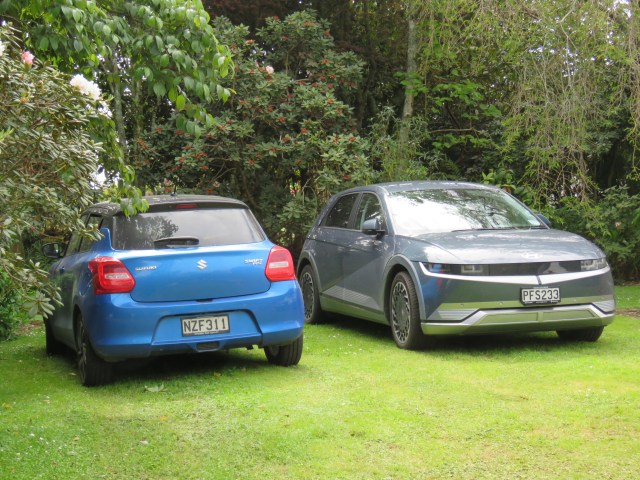
All blues together
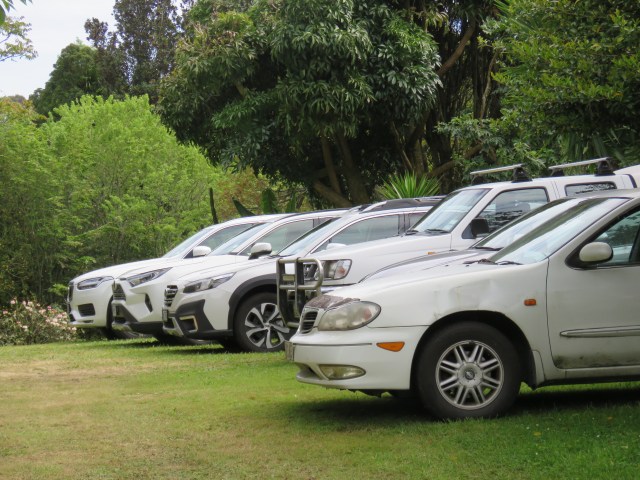
A tidy row of whites
Car parking, like clean toilets, is one of those back room logistical issues that we spend a lot of time and effort managing but that is rarely noticed. Yesterday’s brief triumph by Zach was only commented on by one visitor but amused us all greatly. For one beautiful moment in time, he had the car parking area colour toned – the blues grouped together, the whites in a row, the silvers across under the trees. True, there was one blue car in the wrong place and those of us with OCD tendencies wondered if we could locate the driver to move that car to the blue section. But then somebody left and red cars started arriving. The moment was over.
“Excuse me, madam, would you mind moving your car to the blue area?”
I was doubly amused when told that our friend who helps with the parking over the weekends had been attempting to get the front row alternating black and white vehicles but had not managed that feat on the day.
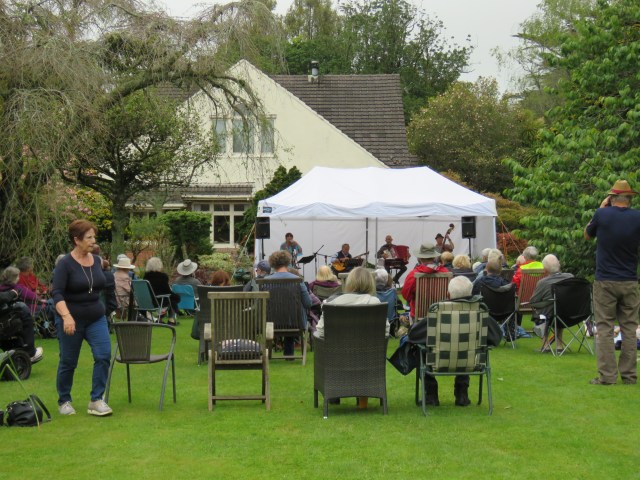
La Mer in concert
Rain caused us great anxiety on Sunday because the concert in the garden by La Mer was weather dependent. We had to make a call by 11am when the rain was still falling, albeit forecast to clear. We decided to take the risk and, miraculously, the rain stopped shortly after, any surface water drained quickly and it was full steam ahead. The carpark was controlled chaos and we had to stop latecomers at the gate to get them to park on the road, something we try hard to avoid on our narrow rural road. The contrast between the busy entrance and the calmness just through the courtyard behind the wall was magical as the strains of music wafted across the front lawn and through the house gardens. It was everything I hoped for in terms of ambience and a delightful experience.
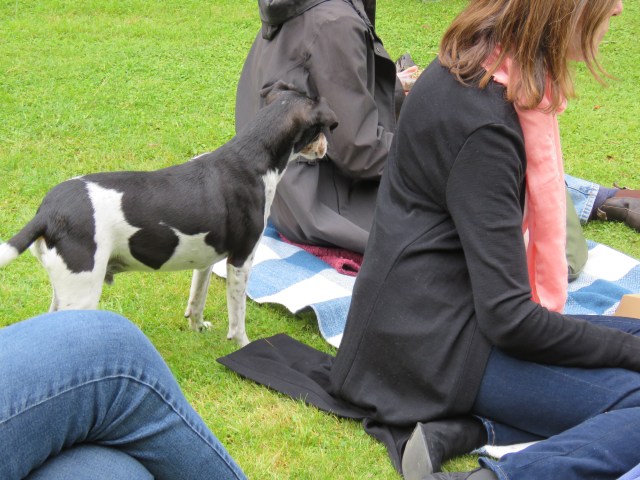
That is our Dudley quietly working the crowd in the hope of delicious tidbits
Small servings of these sorts of tidbits is what he was hoping for – and quite probably scored. Cakes from Rose at the Garden Cake Kitchen
True, the window of fine weather didn’t last but we had 80 minutes of music, coffee, cake and savoury platters in pleasant, calm and warm conditions before the heavy rain returned. People may have been a tad damp as they left, but at least the spell in the middle had its own magic.
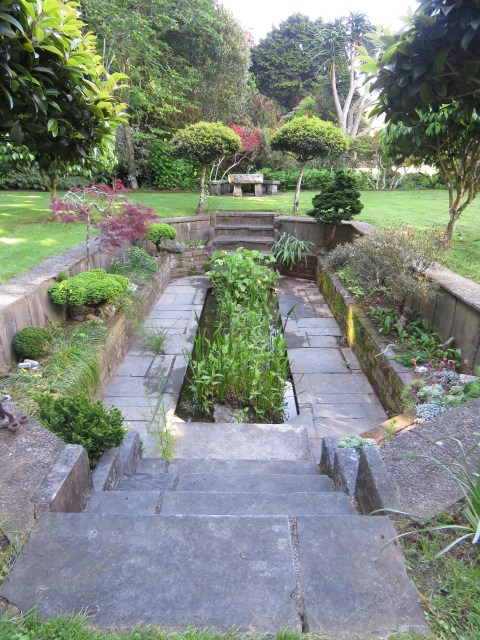
A coach tour came in yesterday and large groups can come and go in something of a blur but one participant stood out. A gentleman clad in black told me he was not a gardener, he was an artist; he liked to view gardens as pictures. When he returned from his walk, the coach was waiting for him so the conversation was brief but he assured us we are true artistes. Vanitas was mentioned but Jennifer, our artist in residence, gently suggested that perhaps it was more memento mori – a reminder of our mortality and the transience of life. He mentioned one particular view that he adored – our ‘large pond’ framed so perfectly and the end point punctuated by – wait for it – a stone sacrificial altar.
Is that a sacrificial altar I see at the end of the view-line?
The mention of the large pond had me mentally picturing down in the park meadow where we have large ponds but for the life of me I could not think what constituted a sacrificial altar in that area. Further questioning ascertained that he was talking about the sunken garden and the altar was in fact the large stone millwheel that Mark’s parents repurposed as a garden table with stone benches to sit on.
I may never look at the millwheel with the same eyes again. We are rather too down to earth to regard ourselves as true artistes here but at least he found plenty of rewarding pictures in our garden so we can’t be too bad on our proportions and definition.
I must pay tribute to the small team who back us up this week. Lloyd and Zach are a tower of strength and able to handle problems both large and small. And we are blessed to have good friends who come and help us, too. We simply couldn’t do it without them.
The Centuria Taranaki Garden Festival finishes for 2022 this coming Sunday. It will continue next year but without us. We will be bowing out on Sunday. Three days left.
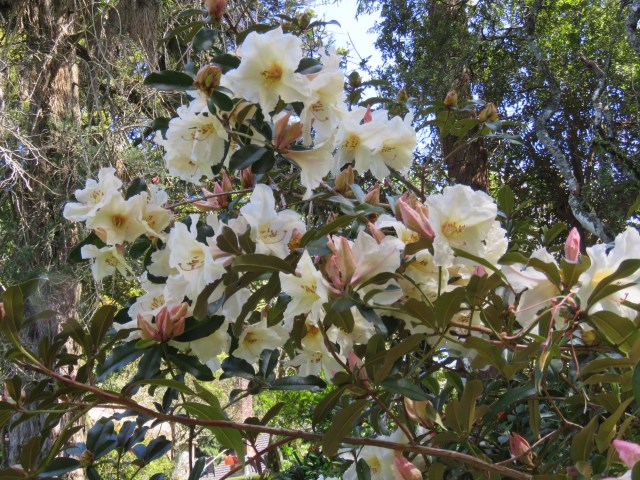
The garden festival started 33 years ago as the Taranaki Rhododendron Festival and to this day, I rate R. polyandrum as one of the loveliest sights as well as one of the most fragrant.
We are down to the last few days before we open this coming Friday as part of the Centuria Taranaki Garden Festival. I may write about how we prepare our very large garden for opening one day soon, but not today. There is still too much to do. All I will say is that it never ceases to amaze me how the final garden round (The Great Rake Over, as Mark calls it) brings all the earlier work together to present the garden at its best – or certainly its tidiest.
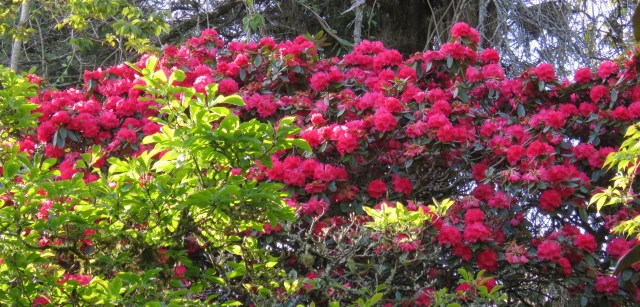
Some people prefer the classic ball truss on rhododendrons and we have those, too – in this case, ‘Noyo Chief’
At the risk of being repetitive, this is our final festival so a last chance to visit our garden. We have no plans to open for the general public after this event from the coming Friday 28 October to Sunday 6 November.
I am really hoping for fine weather next Sunday 30 October for our Music in the Garden event and also for a good turnout because other people are involved so I feel personally responsible that it be a success for them. Music is from La Mer, cake sold by the slice from Rose at the Garden Cake Kitchen, pre-ordered savoury platters from Becky at Humble Grazing and the Etta Coffee Van on site selling teas and cold drinks as well as coffee. Our gardener, Zach, will also be selling his plants including the sought-after Stipa gigantea, Curculigo recurvata, Elegia capensis and assorted perennials. Bring folding chairs or a rug and, if you wish, your own bottle of wine.
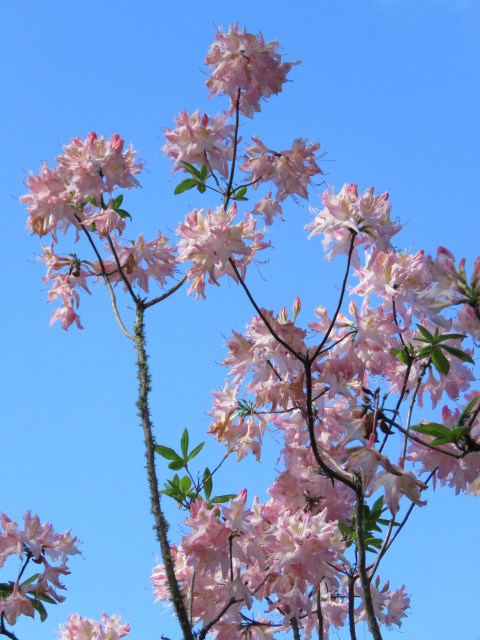
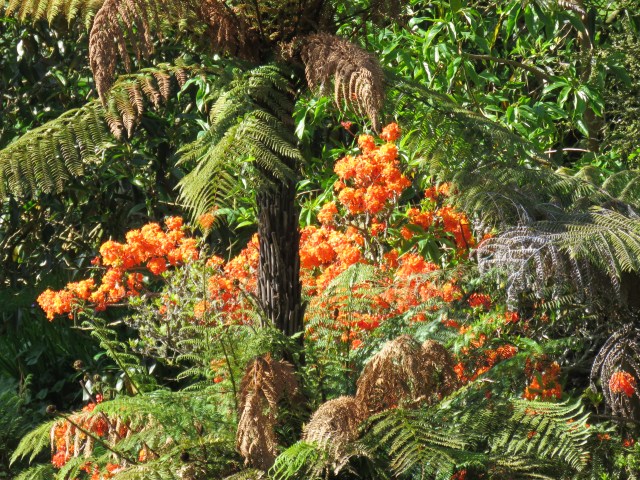
Azaleas are also members of the rhododendron family and can come in colours that may be described as vibrant or garish, depending on your liking for them. I can go with vibrant when they light up an area which would otherwise be just green.
I am offering free garden tours at 11am on Friday 28 Oct, Tuesday 1 and Thursday 3 Nov. Just turn up five minutes early if you want to join one of these.
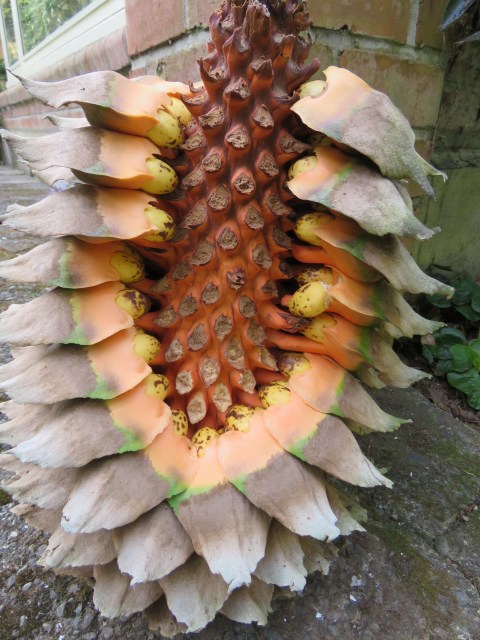
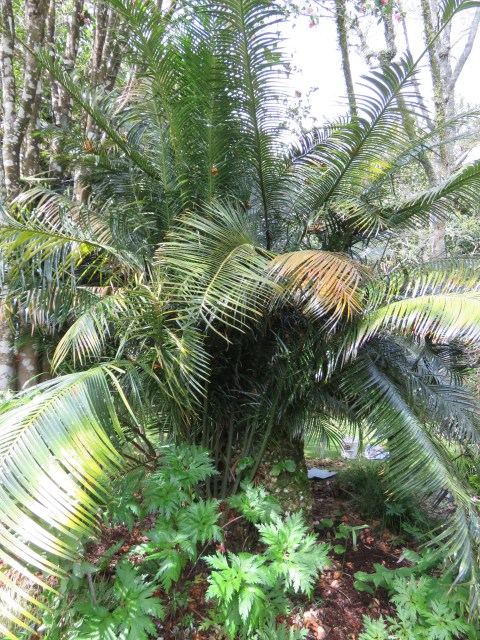
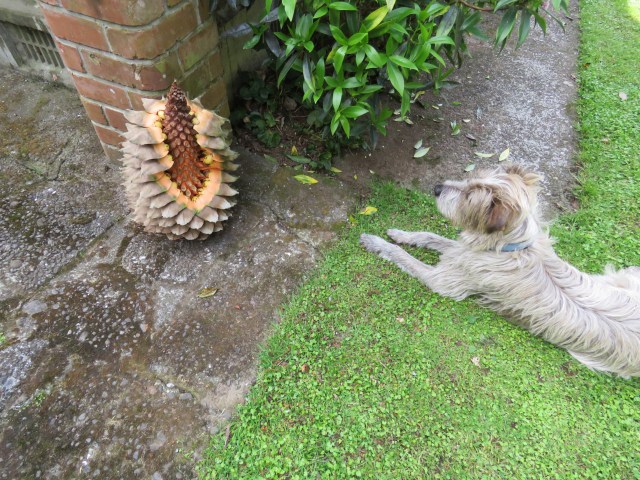
Look at this cycad cone. It is from the very handsome Lepidozamia peroffskyana, sometimes known – Wiki tells me – as Scaly Zamia or Pineapple Cycad. It is an Australian native coming from areas that are more warm-temperate than tropical which will be why it is thriving here. I see it is one of the tallest cycads and can reach up to seven metres tall but it is clearly going to take a long time to get anywhere near that height here. We cut the cone off because our experience is that if we leave it on the plant, it reacts by turning the new growth yellow which is distinctly unsightly. Neither of us being botanists, we are uncertain why this happens although Mark vaguely mentioned ‘something to do with a chemical reaction’.
Lepidozamia peroffskyana
Ralph was particularly fascinated by it and felt sure that the segments should be edible. There is not much that bypasses that dog’s nose. There is some anxiety here about how Ralph will cope with festival, this being his first (and last, as it turns out). We bought a new chest harness for him in case we have to keep him on a lead or tie him up but he is fairly sure that harness is a punishment and an instrument of torture. Dudley dog is more experienced and likely to take on his seasonal role of Carpark Biosecurity Officer as he optimistically checks all arrivals for hidden food.
The summer gardens are our newest area and starting to mature well
This is it, folks. The die has been cast, the decision made. This is our last festival. I am referring to the Centuria Taranaki Garden Festival that starts in under three weeks – on Friday 28 October. This is likely to be your last chance to visit our garden.
Much and all as we love meeting you and seeing you enjoy our garden, we would rather go out on a high note than fade away. The garden is looking its very best – or it will be in another couple of weeks. This festival looks as though it will be a cracker event and that seems a good time for us to say farewell before we close the gates to visitors.
If you are one of the people who say, “I have been meaning to come for ages,” this is your last opportunity. We won’t stop gardening or sell up but we will be closed to the public from November 7 and we won’t be opening next year.
La Mer
We are particularly keen that our music in the garden event on Sunday 30 October be a success. We can’t control the weather (and the music from La Mer is weather dependent) but we have everything else in hand. La Mer is a four-piece group playing a mix of gypsy swing and French chanson which blends delightfully with a garden setting.
Delights from the Garden Cake Kitchen, available by the slice on the day
Not only is Rose from the Garden Cake Kitchen selling her dreamy cakes by the slice, but there is more.
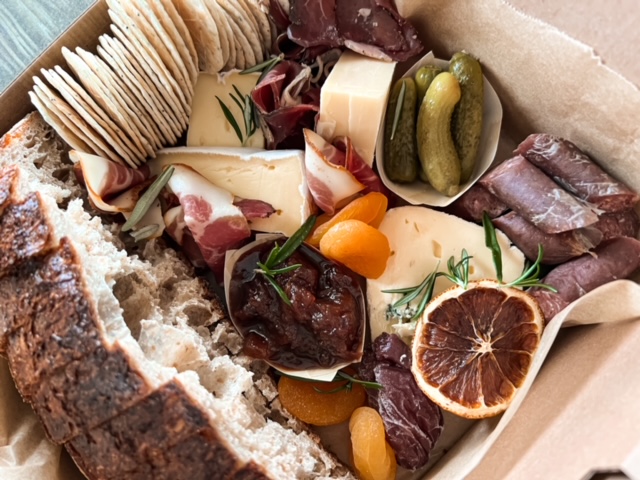
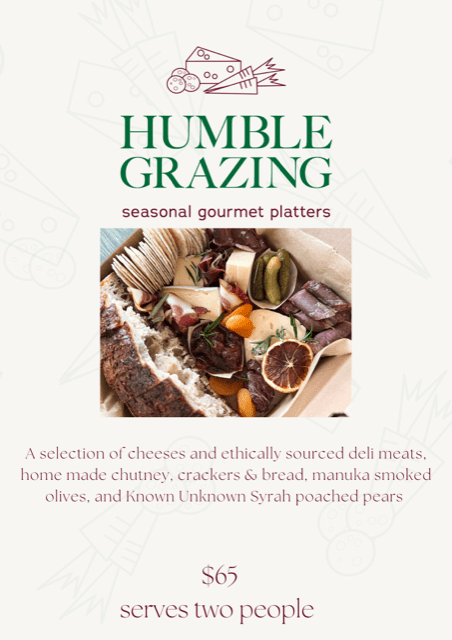
Humble Grazing’s platters need to be pre-ordered
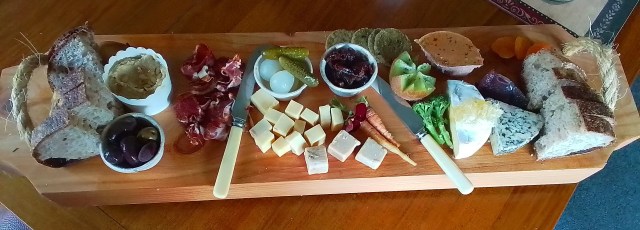
Look! I have been lucky enough to try Humble Grazing’s platters before. This is most of one taken out of the box and plattered for our consumption. And consume it we did, with great gusto.
Becky from Humble Grazing is offering pre-ordered platters for those of a more savoury persuasion. Becky can be contacted through her Facebook page, her website under the name of Humble Grazing or Instagram. If the weather forces a cancellation of the music and you have pre-ordered a platter, you can pick it up from here and take it back to your accommodation to consume. You are welcome to bring a bottle of wine to accompany your platter – or indeed bring your own picnic.
Good coffee and more from Etta
But we will also have the Etta Coffee Van on site selling both hot and cold drinks. These include iced coffee and chocolate (the day may even be hot!), smoothies and a range of organic teas, if coffee is not your favoured afternoon drink.
Seating is limited so maybe add a picnic blanket or folding chairs if you want to be seated. La Mer will be playing from 2.00pm onwards. Please come. There is no additional charge for the event – just the garden entry fee of $10. You are free to sit and enjoy the music or to wander the garden at your leisure. For those of us who are still Covid-anxious, we have plenty of space and being able to physically distance is not an issue.
Jennifer
Auckland botanical artist, Jennifer Duval-Smith is our artist in residence. Three of her four nature journaling workshops are already fully booked and there are just a few places left on her Tuesday 1 Nov workshop centred on the grandeur and glory of rhododendrons.
If you are interested in my garden tours on Friday 28 Oct, Tuesday 1 and Thursday 3 Nov, no bookings are needed. Just be here at 11am and we will be starting from the main lawn. These tours last between about 75 to 90 minutes but you don’t have to stay the whole distance. That said, Mark is in awe at my ability to enter the garden with a group and return later with pretty much the same number as I started.
And it will all end on November 6 when we close our gates (metaphorically speaking).
First published in the September 2022 issue of Woman magazine
“… an ecologically dead status symbol.” Douglas W. Tallamy
Let’s talk about lawns.
I remember doing a profile on a gardening couple who took great pride in their lawn. “Visitors say they just want to take their shoes off and luxuriate in the grass,” declared the lawn man of the pair. I had taken my gardening and life partner, Mark, along for moral support and as soon as we were safely in the car and departing, he expostulated, “People want to let their bare skin touch that?”
We both knew what sort of chemical arsenal was used to achieve a lawn that looked like green velvet and we would not be wanting our skin touching it. It is a value that originates from American suburbia – all those perfect street frontages – and I am not sure that is of merit.
There is the perfect lawn and then there is mown grass. It is many years since Mark declared that he would not routinely spray the lawn to try and keep it to the chosen grass varieties that give a handsome sward. As long as it was small-leafed, green and able to be mown, that was fine. I notice that it is me, not him, who goes around on my hands and knees rooting out the flat weeds but the excessive daisies, dandelions and docks worry me more than him.
I would make an exception if we had small children in our lives. I might then agitate for spraying Onehunga weed, or prickle weed as it is often called. It makes going barefooted unpleasant. If you are going to resort to spraying it, you need to understand that it germinates in winter, grows madly all spring and, when the prickles appear in summer, it has already set its seed and the plant will die so there is no point at all in spraying at that time. You need to spray in spring when it is in full growth to break the seeding cycle and you will need to do it for several years as dormant seeds will keep germinating.
If you are not keen on spraying, you can let the grass grow long in the spring flush which will force the Onehunga weed to grow taller to reach the light. Then set the mower level lower than usual and you will be cutting off most of the Onehunga weed before it has a chance to flower and seed.
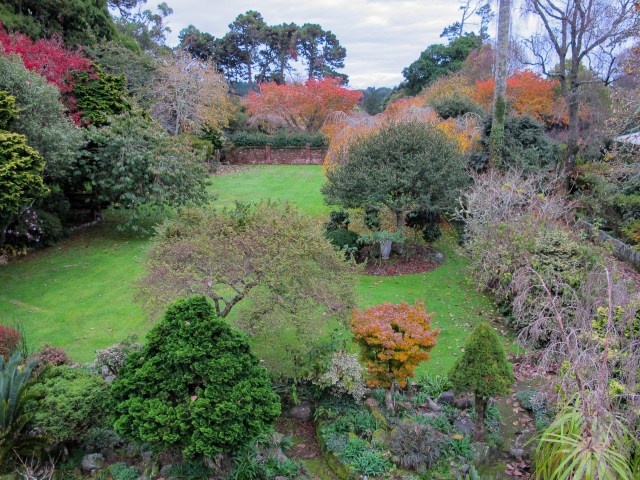
Our front lawn, seen here in autumn, is a fairly major feature and I wasn’t sure about letting it grow wild.
What about not mowing at all? It is a controversial position to take in an urban setting. We recently let our front lawn grow over summer and there is no doubt it is alive with bees and butterflies when in flower. The Californian quail love it too with its abundance of seed. Our main interlopers are clover, lotus major and self-heal (Prunella vulgaris) which means it flowers pink, white, yellow and blue. Mark refers to it as a low meadow.
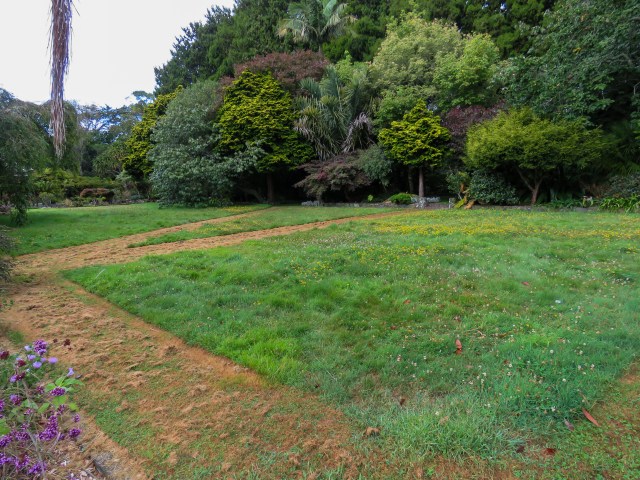
Mowing the perimeter of the lawn and paths gave instant form to what would otherwise look unkempt. It would look better had we raked the paths or collected the clippings as well. The mulcher mower was not equal to the sheer volume of grass to be cut down on this occasion.
Because our front lawn is quite a major statement, it worried me when it looked …. well… rank and unloved in the early stages. I had a stroke of genius, drawing on what I had seen overseas, and asked for a double width to be mown around the perimeter and our most used paths across the lawn to be mown, again a generous two mower widths wide. It made all the difference visually and transformed it from unmown lawn to managed meadow. We kept it that way until the flowering was finished and then cut it all down again.
Our ‘low meadow’ in full flower
On the topic of mowing, get yourself a mulcher mower that chomps up the clippings to a fine tilth that is absorbed back into the grass. It means you don’t ever need to feed your lawn with nitrogen fertiliser again and it makes mowing faster without faffing around with lawn clippings which are the bane of landfill. The only reason lawns need fertilising is because constant mowing and collecting the clippings strips out any goodness and doesn’t allow for a natural cycle of replenishment. We haven’t fed our lawns for years, maybe even decades, but they remain green, well-covered and healthy simply because we use a mulcher mower.
If you choose to spray your lawn, then at least educate yourself as to what the active ingredients are and choose accordingly. There are more environmentally friendly options coming available but lawn sprays in the past – some of which will still be in garden sheds around the country and some may still be available – were a toxic brew.
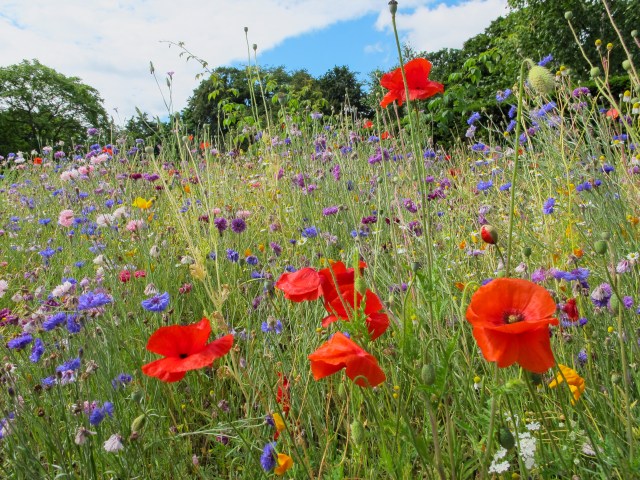
Contrary to widespread opinion in NZ, this is not a wildflower meadow. It is a pretty sowing of annuals in a casual style and is not an easy-care alternative to lawn.
Proper meadows and wildflowers are a whole different topic. When wildflowers are mentioned, most people think of wildflower seed mixes – the ones that are soldier poppies, cornflowers, cosmos, daisies white and daisies yellow and a whole lot more. Pretty though they can be at their peak, they are neither meadow nor wildflower, or certainly not our wildflowers. Essentially it is gardening with annuals and such plantings are generally short-lived and need quite a bit of work to stop them deteriorating to a flattened, weedy mess. There are alternative approaches but they are not an easy answer and take a much higher level of gardening skill than a simple lawn requires.
What does a lawn achieve? If you are the sort of family who gets out for wholesome games in the garden, be it backyard cricket, rugby, badminton or even croquet, then yes, the lawn provides a suitable recreational space. Most of us persist with lawns long past the time when we have children frolicking outdoors, assuming they ever did.
Mondo grass creates a green breathing space that is every bit as effective as mown grass.
I came to the conclusion that there are two reasons for lawns. The first is practical; they are lower maintenance than most styles of garden. The second reason is aesthetic; an expanse of mown grass gives a breathing space in a garden and can frame the more detailed, decorative areas. The mistake is to think that you can only get that breathing space with a lawn. There are other ways and it doesn’t have to be the courtyard approach of paving or decking. I remember Gil Hanly’s garden in Auckland where she created a simple breathing space with green mondo grass beneath palm trees. It would have been lower maintenance than mown grass and, in a highly detailed garden with lots of colour, it gave that space to draw breath and relax.
In the end, lawns are on a spectrum. At the extreme end are the lawn fanatics who will de-thatch, aerate (because they have killed off the earthworms), core, oversow, irrigate, use sprays frequently, fertilise extensively and mow every day or every second day to maintain a perfect velvet monoculture comparable to a bowling green. I see this as an environmental travesty and a political statement from people who are proudly declaring total control and supremacy over nature by every means in their chemical and mechanical arsenals.
At the other end of the scale are those who either dispense with lawns entirely or simply give up mowing. There is a lot of room to move in between those two extremes where most of us can find a level which sits better with us in environmental, aesthetic and practical terms.
There is a different charm to a casual seating arrangement in long grass rather than on mown lawn although my practical side says this probably works better in a drier climate.
We just need to stop thinking of one end as admirable and aspirational and the other end as disgraceful and lazy. Nature would prefer it if more of us were inclined to land on the laissez faire end of the spectrum.
“Over three-quarters of all garden chemicals sold in Britain are for the improvement of our lawns.” The Curious Gardener’s Almanac by Niall Edworthy (2006)
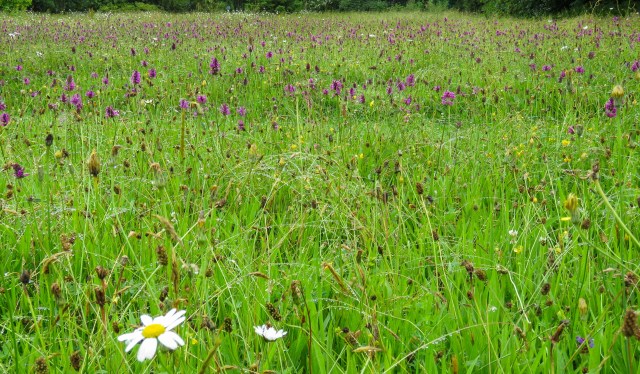
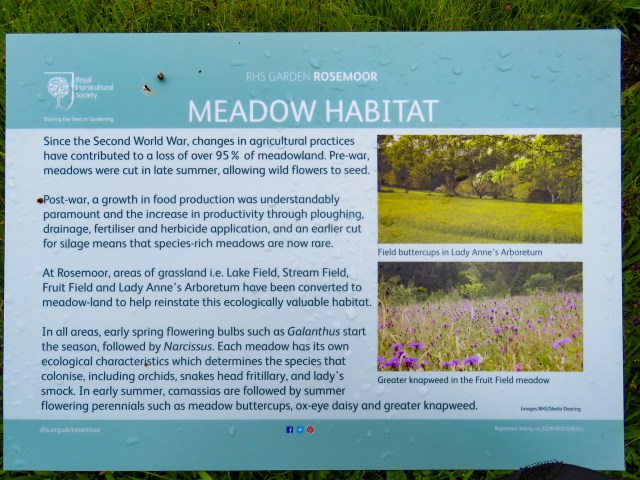
Once was mown lawn at RHS Rosemoor. English friends tell me that the sight of mown grass in public parks and gardens is increasingly rare










 Tikorangi The Jury Garden