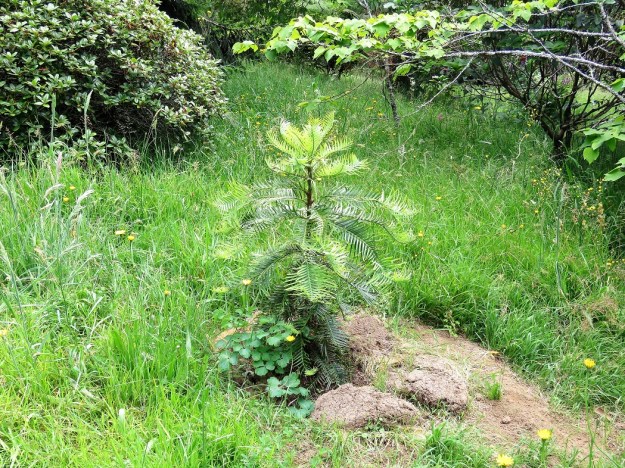
Our gifted wollemi
We were enormously touched when friends gave us their wollemi pine to plant in our park, where it has every chance to reach maturity. They had bought one of the first NZ releases of this endangered Australian plant – at a pretty hefty price tag of several hundred dollars – but were relocating from a large country property to a smaller town section and the wollemi would have been highly threatened by future property owners or neighbours, had they planted it in suburbia. In the longer term, it has the potential to reach 40 metres in height. It was a gift of love when they brought it out to us because it was a tree that meant a great deal to them and one that we were honoured to receive.
The wollemi – botanically Wollemia nobilis – is an ancient tree, dating back to the Jurassic period of dinosaurs. Yet it was not even discovered until 1994, when observant bushwalker, David Noble, came across a plant he didn’t recognise in a relatively remote canyon in the Wollemi National Park, a mere 150 kilometres from Sydney. Until then, it had only been seen in fossil form and it was thought to have died out, maybe millions of years ago.

A multi branched wollemi at Sydney Botanic Gardens last week
It is referred to as a pine and in time it produces cones but it has been declared a single species within a genus all of its own. So nobilis is the species. One step up the botanical nomenclature tree is the genus and this plant is so unique it was a given a genus of its own which is the wollemia part of the name. Only on the third step do we start to place its relatives and they are not pine trees (which are Pinaceae); it is Araucariacea which puts it in the same family as monkey puzzle trees and our native kauri. You have to go another step up to the order of Pinales before you get the botanical intersection with pines.
To the layperson, it looks closer to the podocarps – of the Podocarpus macrophyllus type – although they are in the same Pinales order referred to above so no more closely related to the wollemi than the pines are.

The wollemi at the Australian National Arboretum is already mature enough to bear cones
I mention this because it leads me to the story of an old rogue we knew (now deceased) who never felt obliged to follow the law when it came to plant imports. He turned up here triumphantly one day, totally unasked, bearing cuttings that he declared were the wollemi – purloined from the Melbourne Botanical Gardens, from memory. I had seen one of the earliest wollemi plants in the Canberra Botanical Gardens locked in a cage which was an interesting indicator of its perceived value. Mark was sure that the stolen cuttings were in fact a podocarp and to this day, we wonder whether the Melbourne garden staff named one of the podocarps as a wollemi to fool people such as the old rogue who shall remain nameless. If so, it worked.

The Canberra wollemi again – it was home to a rather large, showy, orange beetle which we do not have in NZ, I think.
The story of the discovery is interesting, as is the botany of this ancient plant (and its adaptability and very survival). But also the control of propagation, marketing and sales is remarkable. Getting it into wide circulation is one method of ensuring its continued survival. Intensive searching has led to the identification of fewer than 100 adult plants in a very limited natural habitat which makes it extremely vulnerable in the wild. Its original location remains a tightly guarded secret to protect the remaining trees. With the spread of kauri dieback (Phytophthora agathidicida) in this country where a main disease vector is human footwear, this seems a wise move. I have no idea who controlled the propagation (a lot of it is through tissue culture), distribution and marketing of the wollemi pine but it has been interesting to view from afar. There was a heavy emphasis from the start on “telling the story”, as is oft said, and the pricing has always been high which conferred considerable status on this unique plant. Especially considering it is not instantly appealing as a small plant and it is going to make a forest giant. It was the first new plant species that we were aware of being imported into New Zealand when our borders all but closed down to new plant imports. The fee for risk assessment at the time was around $65 000 and, from memory, it was a Christchurch institution that came up with that money to get it into the country legally. No individual or plant nursery is likely to come up with that sum for a single plant.
We will watch our precious plant grow over our lifetime. The well-established specimens in both the National Arboretum in Canberra and Sydney Botanic Gardens both promise that it will mature into an interesting character plant to match its interesting back story.

This is the Sydney wollemi again, viewed from the other side. I didn’t even register the bedding plants because I was looking at the sculpture.
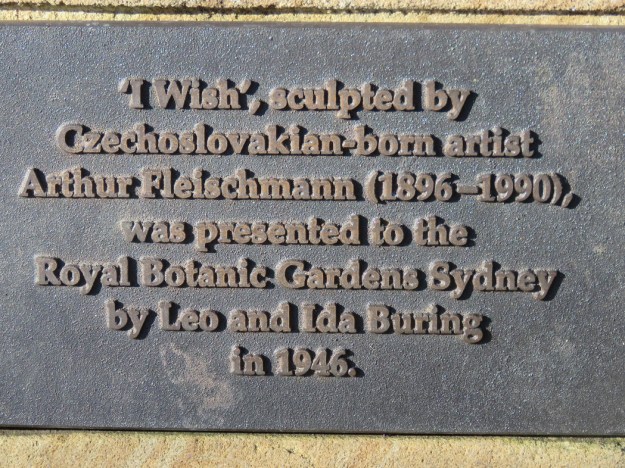
It is clearly a sculpture with its own history, although I personally have no knowledge of the work of Andrew Fleischmann.
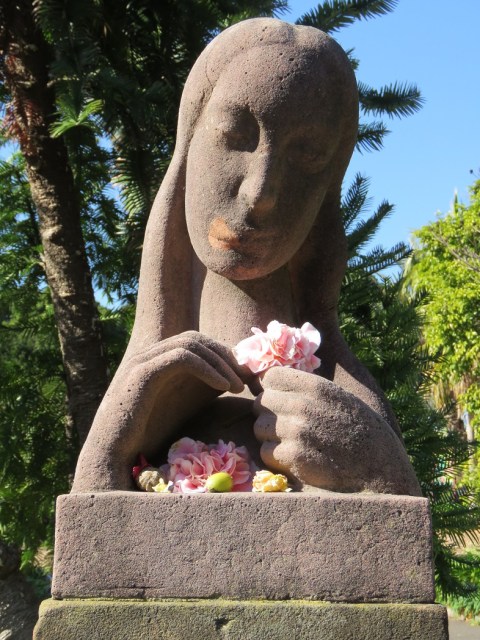
I was completely unconvinced that the addition of the camellias enhanced the sculpture, I am afraid. With bedding plants below, it smacked more of the descent of what I call “naffdom” rendering it merely sentimental. Or naff.
As a postscript, a reader has just sent me the following photo of her wollemi which she was thrilled to be given as a birthday present. This one is growing in the Dartmoor area of south east England. Just as the metasequoia was rapidly dispersed throughout the world after its rediscovery by plant hunters in China in the 1940s (we have an early one from that collection in our park), so too is the wollemi becoming a significant tree around the world. 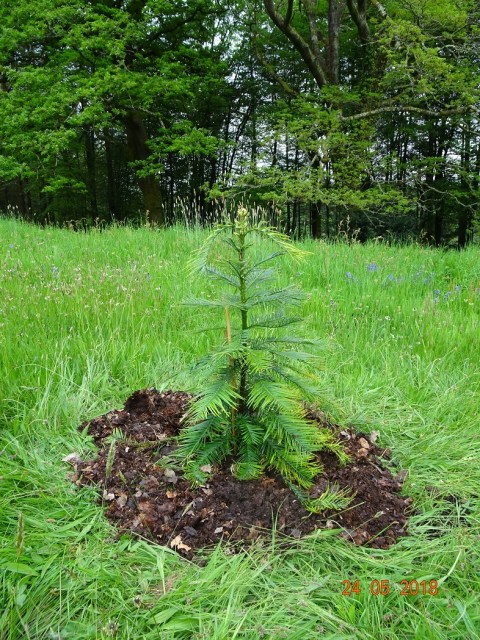
 Back in the heady gardening days of the 1980s and 1990s, there were many specialist nurseries carrying a very wide range of unusual plants, mostly selling by mail-order. I described Peter Cave of Cave’s Tree Nursery, Glyn Church of Woodleigh Nursery and Mark Jury as being like the three musketeers but Mark reminded me of Chris and Linda Ryan at Top Trees and the late Os Blumhardt who led the way. Times changed. I think Top Trees may have closed first, followed by Peter, Glyn sold his business and Mark and I were the last of that quartet to stop selling plants, I think.


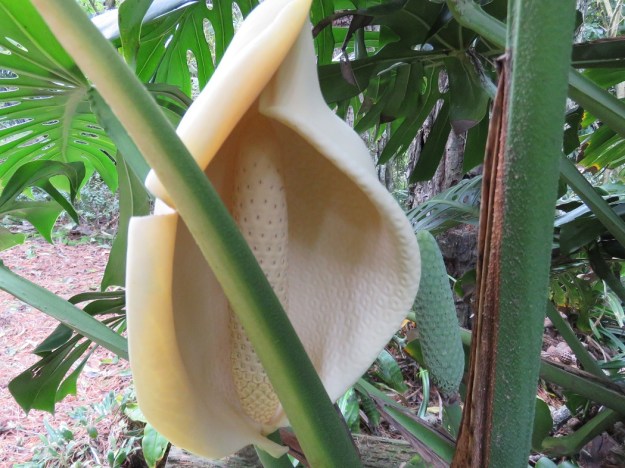
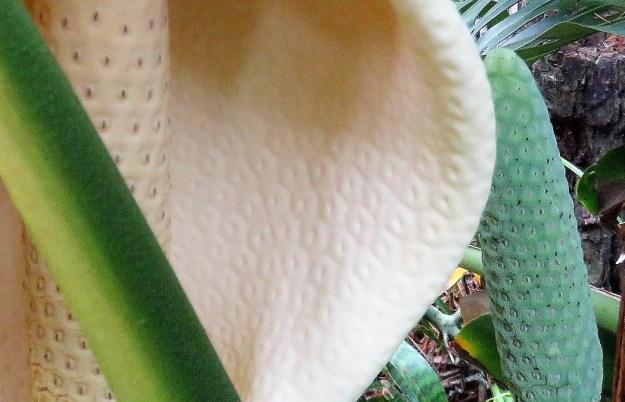 I had not noticed until yesterday that the interior of the spathe on the Monstera deliciosa is delightfully quilted. For quilting enthusiasts, they are hexagons – six-sided figures. The spathe is the curved hood on the flower – botanically a modified leaf but most of us will continue to call it a flower. Some readers will know the monstera better as the fruit salad plant – most often seen as a house plant or perhaps more as an office plant where there is greater space. I would rather doubt that it flowers, let alone fruits, when it is treated as an indoor plant.