Category Archives: Abbie’s column

Abbie’s newspaper columns

Tikorangi Notes: Things that go crash in the night, recommended hostas and our pretty meadow

It was not Dudley crashing in the night but he did look somewhat noble down in the meadow yesterday

Things that go crash in the night. On a dead calm night, both of us heard the unmistakeable noise of a large branch falling to the ground. I was pretty sure it was not an entire tree because there was no whump as it hit the ground so it clearly did not bounce, as large trees usually do. Morning light revealed that it was as expected – a branch from one of our old man pine trees. In this case it must have fallen 30 or 40 metres to the ground and it appears to have taken out the two camellias that had more or less staged a revival from being clipped by the last two falling trees.
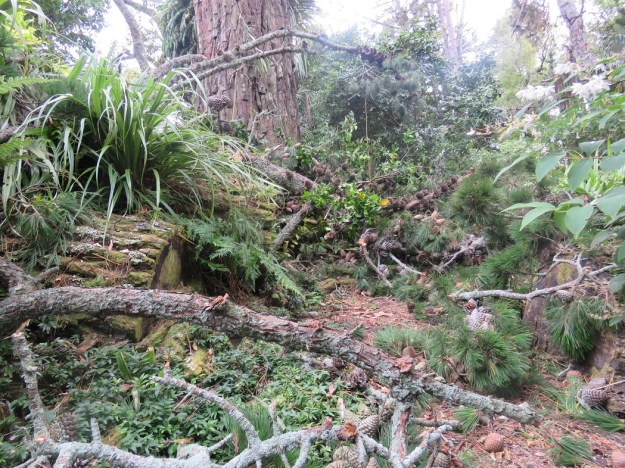
The damage from a falling branch

As usual, we will gather all the pine cones and get out what firewood we can but it appears that there is some surrounding damage this time.  We are philosophical. It is just part of gardening beneath huge trees that are now up to 145 years old. The fallen epiphytic collospermum may be a clue as to why the branch fell. There will be a big weight in just that chunk of vegetation sitting on the branch. The birds spread the seeds and they can germinate, grow and hang on for grim death up high.

It may have been this massive epiphtye that caused the branch to break

Blue hostas raised from seed

After last week’s post on Hosta Jade Cascade (which is settling in just as well in other parts of the garden where I planted it out), I have been looking anew at the varieties that are thriving on zero maintenance. Some of the enormous clumps will have been in 20 or more years now and just keep reappearing a little larger each season. A lot of our big blue clumps are unnamed, raised from seed – some of them from Hosta seiboldiana.

Hosta undulata variegata is getting smaller, I think, over the years

In a big garden, we need big clumps of plants to have an effect. In this area, the stand out gold is Goldrush, raised and named by Felix Jury. It is a terrific performer and puts up a good floral display of purple flowers. The blue is a seedling. Neither of us can name the variegated hosta which is not the showiest of varieties but it has done well and that is not to be sniffed at. There aren’t many variegated hostas that we have planted that have thrived in garden conditions under a regime of benign neglect. Too many, like this poor little specimen of H. undulata variegata have reduced in size over the years, rather than grown larger.

In the smaller growers, variegated Golden Tiara is again not particularly exciting but a very good garden plant. The blue green, little Flora Dora has increased freely and gold Blonde Elf has also surprised me with how well it has established for a very small grower. On the other hand, I haven’t seen dwarf Kabitan for a while so I wonder if it has shrunk away altogether, which would be a pity.

It looks like Guacamole to me and I am not making up that name

Of the variegated types, this one which I think is Guacamole from memory, is doing very well. It is a reverse variegation sport of Hosta Fragrant Bouquet. I will have planted out large specimens of the latter at a similar time as Guacamole but I have yet to find them in the garden, which means they are not growing as strongly at all.
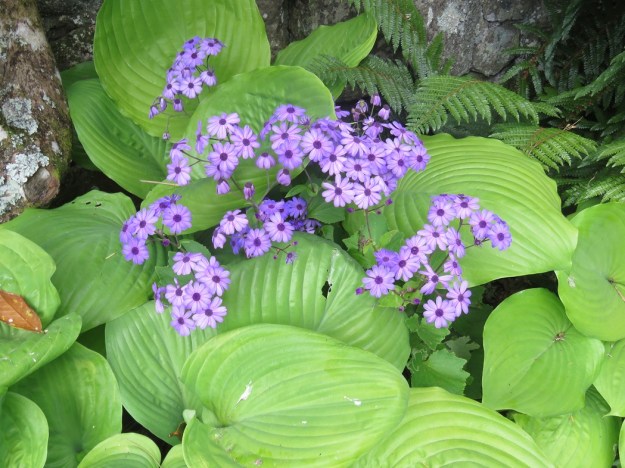
Sum and Substance

Add Blue Boy as a good, reliable garden plant. We stopped growing it commercially towards the end of our time because there were other, showier, bluer cultivars that sold more readily but while they are not starring in the garden, Blue Boy is a strong survivor. That is my short list of top performers as garden plants that have caught my eye this week and that have proven themselves over several years. Oh, Add Sum and Substance which is surprising me by its willingness to grow suitably large in the spot where I planted it.

As a postscript to the hostas, these are grown with no slug bait or slug and snail control. We now have such a rich bird life that they enable us to grow these plants without having to protect them. Well, I assume it is the birds carrying out this task because there is no reason at all for us to have any fewer slugs and snails to start with than anybody else gardening in similar conditions.
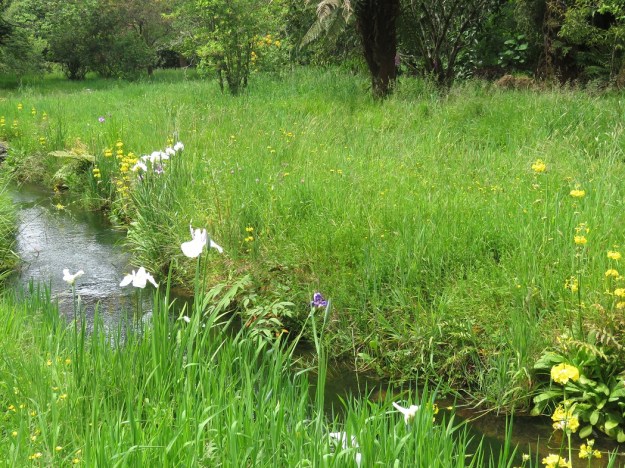
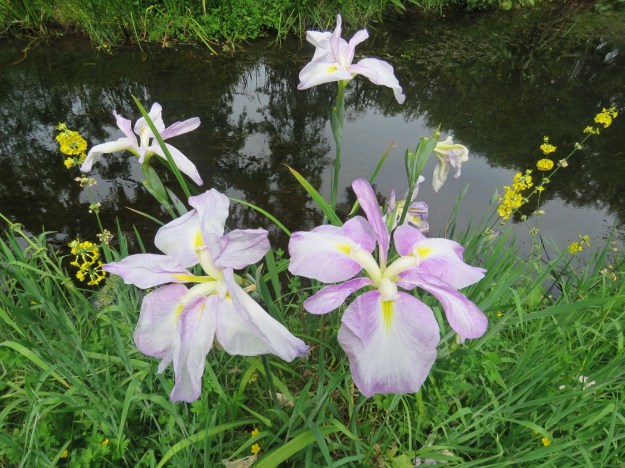
The meadow! The meadow!

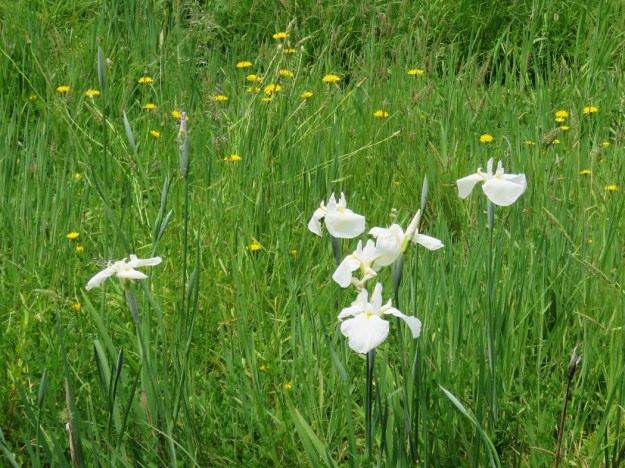
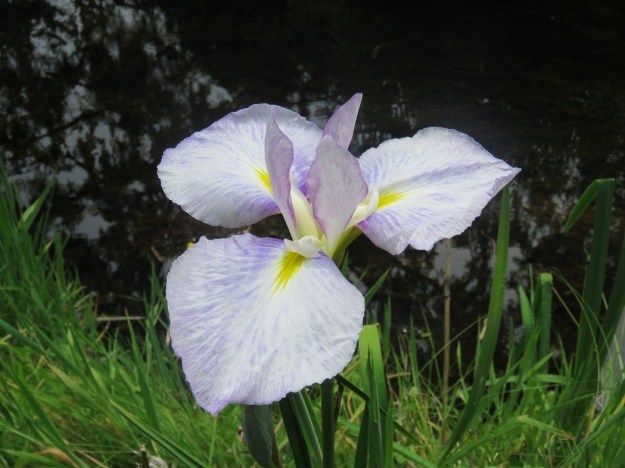
At the risk of repeating myself – but we all know that gardening is a seasonal activity that is, by definition, repetitive – the meadow below is bringing me great joy as the Higo irises all come into bloom, interspersed with the Primula helodoxa that has been at its peak for a full month now. What more can I say?
 

A love-hate affair with rose bushes continues

Is there anything lovelier than beautiful, soft, fragrant rose blooms? Not for me the stiff, hybrid tea types. I will leave those for others. But the David Austins are so deliciously voluptuous that I just want to bury my nose in all those scented petals. In a vase. And therein lies the rub.
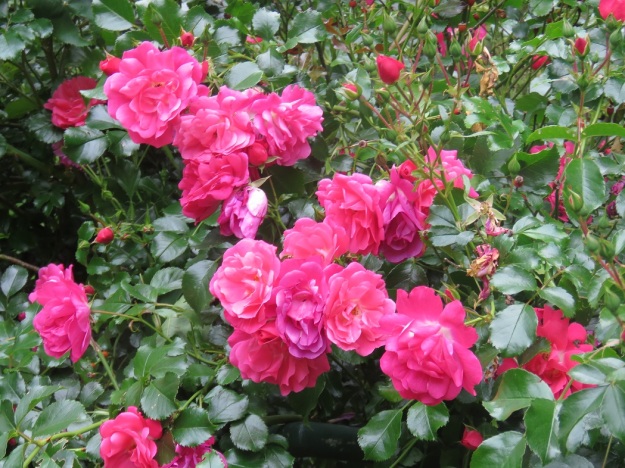
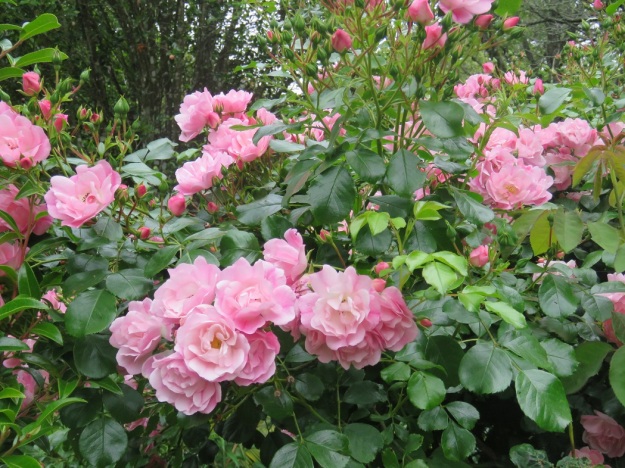
The rose garden here is on borrowed time. It dates back to Mark’s mother who had a love affair with old fashioned roses and it has undergone several makeovers in the decades since. But it just doesn’t work aesthetically. We are not a good rose climate here – humid and high  rainfall without enough winter chill to kill off the greeblies, fungi and diseases that afflict roses. Our rose garden is too sheltered which restricts air movement. One of the beds is now too dry and the competition from the roots of our massive rimu trees nearby are an issue. Mark has always refused point blank to spray roses, being of the opinion that they must thrive on their own merits.

I have tried. Oh I have tried. I was recommended varieties by experienced rose producers and growers and I have crowd sourced others. Alas I have pulled out and burned more roses for poor performance than any other plant I have had to buy. After 20 years, I am going to cut my losses this winter and pull out the central beds that surround our sunken garden.

Not all will be burned. Fortunately we have large vegetable gardens, but not a picking garden as such. A couple of years ago when I was getting discouraged at  the underperforming, defoliated, ugly rose bushes, I dug some out and Mark planted them in a row in one of his veg gardens. He has several. Veg gardens, that is. The rose bushes with the most gorgeous blooms can be added to that row. It does not matter there if they have black spot and are defoliated and ugly. I can go and pick the blooms when I wish. But only those with gorgeous blooms will be relocated to this position.

It is very, very pink is Rose Flower Carpet Pink but just look at that foliage. Superb.

Rose Flower Carpet Appleblossom – a prettier pink, still with good foliage though it does not flower as long through for us. The white version flowers all year round, however.

Not all the roses are a dead loss. What the Rose Flower Carpet series lacks in individual flower form and scent is more than made up for in fantastic performance throughout the season and brilliantly healthy foliage. They are what we call *good garden plants*. Not blooms for cutting, but all-round garden performers.

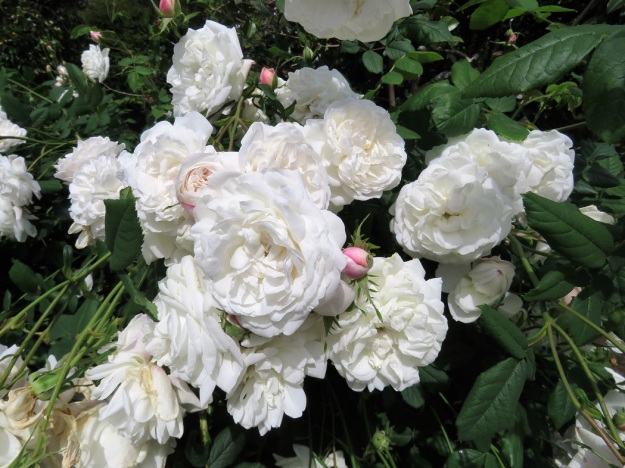
Mme Plantier, I believe?

Madame Plantier is only once flowering but I can forgive that for her month or so of glory, her gorgeous scent and healthy foliage. There is one super healthy rose that I think is a David Austen but I have lost its name – again lush, strong growth and very good blooms in apricot pink. That one is to be relocated and trained as a climber up a pergola pole. Though as the pergola is not yet built, it may have to go to temporary quarters. The white rugosa, Rosa Blanc Double de Coubert, stays a healthy bush for us though there are more prolific bloomers in the rose world.

The central borders in the grass are to go. This may take a year or so.

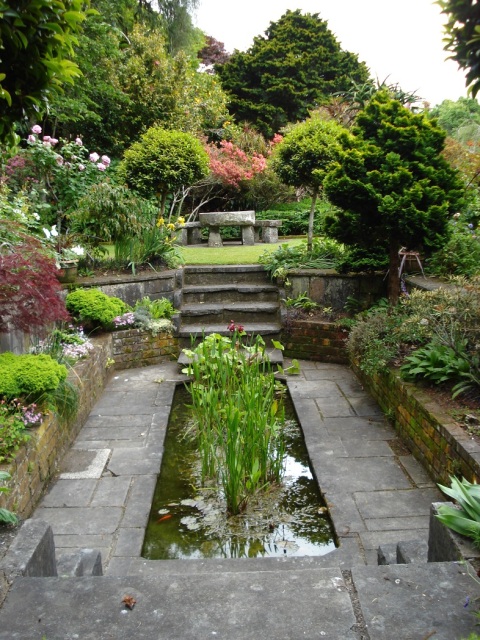
The sunken garden, seen here at its tidiest, is to be the feature without the distraction of the borders

The so-called rose garden here is the area of the garden where I have put in the greatest effort  over the last 20 years. And while it has times when it looks pretty enough, I have come to realise that it is also the one area of the garden that I really do not enjoy maintaining at all. In fact, I avoid it as much as I can which is an indicator that all is not well. A landscaper friend looked at it recently and immediately suggested that we pull out all of the central borders that edge the deep, marble and granite sunken garden. “Feature the sunken garden,” he said. “The borders just detract.” I had to think about it for a while. But he is right. It was just a bit of a shock after all my efforts down the years. More on that in the future. We can’t do much going into summer but mentally I am relocating the plants that are worth saving and discarding the rest.

And I am mentally remaking the one border that we will save but renovate which runs along to the left. It is the garden we look out to from a favoured late afternoon seating position. Not a lot has changed in the nine years since the photo above was taken. We are still often to be found in the same seats in the same location. But it is a good reminder of why we want that one border looking good with a high level of plant interest, because we see it often.
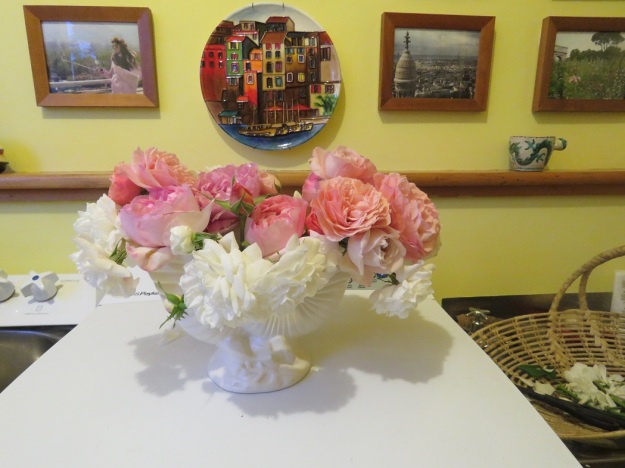
“Doing the flowers” in the laundry. I only show this for overseas readers because I love my laundry room, a space much favoured in NZ and Australian houses that does not seem to be adopted as widely in other parts of the world. I can’t imagine living without a separate laundry room.

For the love of umbellifers

I am having a love affair with umbelliferous plants. Poppies, daisies and umbellifers. It is the simplicity of form, I think, that appeals to me. And my favourite of these are the umbellifers for their ability to seemingly dance lightly in the space above other weightier plants.
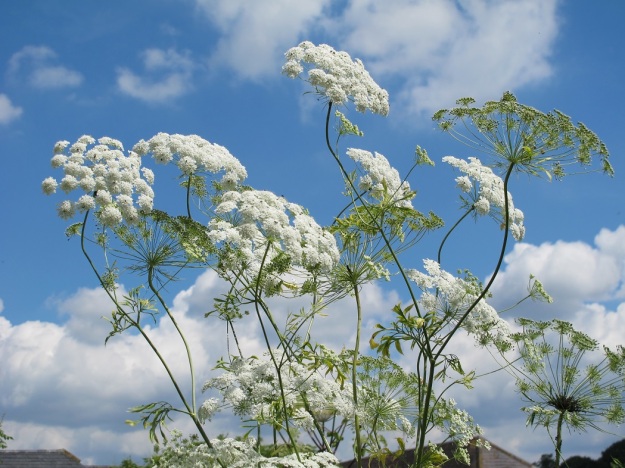
There is a scarily technical, botanical description of what umbelliferous plants are on Wikipedia.  They are mostly herbs – annuals, biennials or perennial, often aromatic. Typically, they have long stems often with very light, feathery foliage (though not always) and the flower heads are held above in flattish or gently mounded formation of a collection of lacy umbels. The flowers are much valued for their contribution to the garden eco-system because they attract beneficial insects. Many set seed very freely and will provide a source of food for seed-eating birds in autumn and winter.

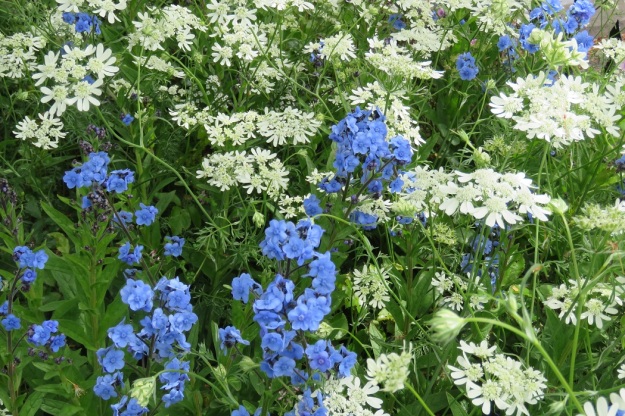
Orlaya with blue cynoglossum at the New Plymouth cemetery

Carrots are umbellifers, as are parsley, coriander, fennel and angelica, amongst many others. The common ornamental ones include the pretty Orlaya grandiflora in flower here now (it cuts well, I have just found, and combines prettily with pastel roses in a vase) and Ammi majus.

I first started noticing the use of umbellifers in English gardens back in 2009 and predicted then that they would become a fashion flower. I can report that they have maintained their popularity in England but have yet to become a hot ticket item in New Zealand, except for the orlaya and ammi.

As seen at RHS Wisley – my lily border does not have a water feature

My new long border of auratum lilies is destined to become my nod to a garden of white umbellifers. At this stage, I am still hoeing off germinating weeds to get it as weed-free as possible before I introduce plants which I expect to seed down season after season. I will use the pretty and wayward Orlaya grandiflora with coriander for the lower growing layer, Ammi majus and maybe  carrot for the middle height and I am still debating about the tallest layer.  Will angelica be too strong a grower, I wonder? The edible angelica. I don’t want plants that will choke out the auratum lilies that are the main stars of the border.

What is referred to as ‘cow parsley’ (botanically Anthriscus sylvestris) is a common wildflower in the UK, often seen on roadsides. So too is Queen Anne’s Lace or Daucus carota, commonly referred to as wild carrot (the version we grow to eat is a form of the same thing – D. carota ssp sativus). The one to fear that comes with frankly alarming warnings is the giant hogweed – Heracleum mantegazzianum. It is a common garden escape in the UK and is apparently in New Zealand though I can’t say I have ever seen it here. The problem lies in the sap which can harm the skin by making it extremely sensitive to sunlight, causing blistering, for long periods after contact – stretching out to years, even. Don’t be tempted by giant hogweed.

Pimpinella major ‘Rosea’ at Beth Chatto’s garden where I thought to photograph the plant label as well as the pretty, airy, dancing pink flower heads

Not all umbellifers are white. Despite it being a roadside weed where we live, I have planted some wild fennel in my new summer borders. I love the way it is so tall and graceful, silhouetted against the summer sky.

Purple flowers from purple carrots at Parham House

We were very taken by the purple carrot flowers we saw in the cutting gardens at Parham House. So taken with it that I looked it up. The heritage purple carrots that have been reintroduced to the seed range (carrots did not start off orange) are the ones that produce the purple flowers.

Angelica gigas – as popular with wasps as bees

Angelica gigas is another purple flowered umbellifer, in this case a biennial which bees adore.

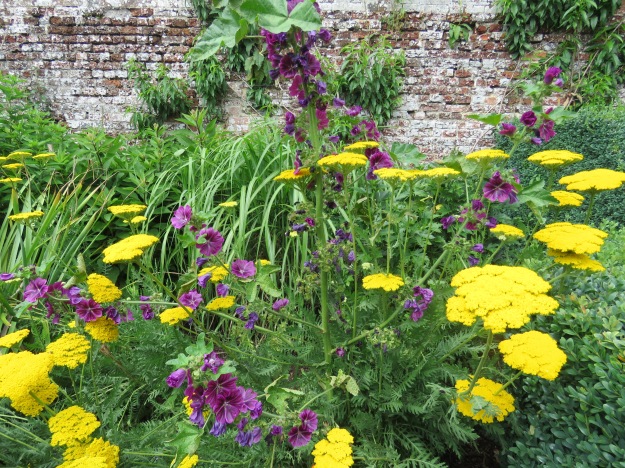
I have just planted a single plant of the yellow achillea, photographed here at Parham House

I had thought, based on flower form and habit, that achilleas were members of the umbellifer family. Botanically, they are not (as far as I can see) but in practical terms, they fulfil a similar garden role. Now that I have a hot, sunny, newly cultivated area, I am trying again with coloured achillea. I find them charming but they are not plants to co-exist in borders where they get overshadowed or lose all day sun.

Common fennel can look wonderful against the summer and autumn skies

My new weeding friend

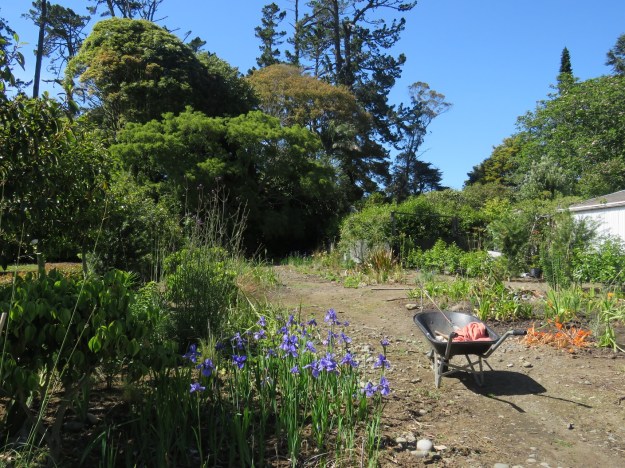
The weed growth in this new area under development was scary after a few weeks of spring

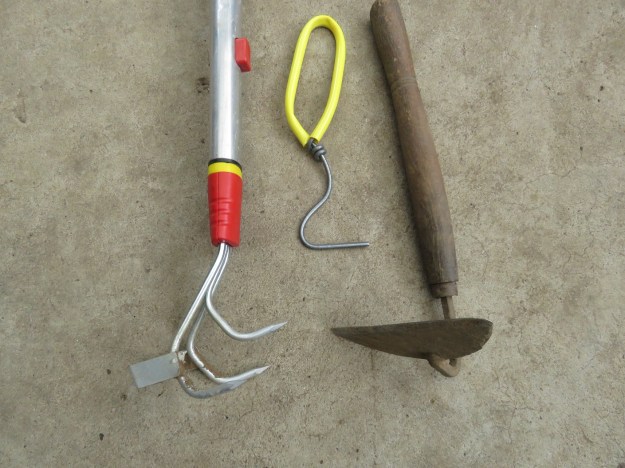
I have a new weeding implement and a very good one it is too. Meet my little Wolf-Garten Multi-Star Cultivator Weeder LBM (I wrote the full name down from an internet search). It is my new best friend.

Having been away to Australia, then coming home somewhat unwell followed by other demands on my time, the weeds in my newly planted borders were threatening to get away on me. With my trusty weeding armoury, I made short work of quite large areas. It was the little cultivator on the long handle that covered the area quickly and efficiently. Unlike a hoe, it does not cut the plant off and being very narrow, it can get in close to plants without damage. It is only 7cm at its widest point.

My new Wolf-Garten cultivator, the modest Wonder Weeder and my short handled hoeing implement deal to most weeding situations

One weeding tool does not suit all situations. This cultivator makes short work of scuffing up the surface and dislodging the weeds where soil is friable or there is mulch. It is no good on compacted soil. It also needs to be used before the weeds have set seed and is best on a sunny day so the dislodged weeds shrivel and dry in the sun. As long as they haven’t reached the seeding stage, the weeds do not need to be removed. It is so easy to use, saving bending and stretching, that weeding is not something to dread. A quick follow-up the next day despatched the few weeds that had escaped the first round. If you have similar conditions, buy one is my advice.

Where the plants are closer together (these were newly planted areas that I was speeding around with my cultivator), I resort to the hooked wires known in this country as Wonder Weeders (cheap as chips at under $5 when I bought another three at the garden centre last week). In the case of compacted ground with club moss, liverwort or clover, I use the short-handled implement that looks like a small Dutch hoe. You can get long handled versions of the Dutch hoe to avoid having to bend or kneel, but I am fine with the precision of my short version.


The new baby cultivator and its full-sized companion on the left and the trusty old Planet Junior to the right

Mark is a push hoe man (the Dutch hoe is pulled towards the user whereas the push hoe is pushed away from the user) but it takes some skill to be a reliable operator and it is all too easy to accidentally sever desirable plants from their roots.  Where there is more space to move, such as in his vegetable patches (known here as Mark’s allotment), he will reach for his trusty old Planet Junior that makes quick work of surface cultivation or the big granddaddy cultivator relative of my new, small version.

What about weed sprays? Mark follows the international debate and research on glyphosate (the active ingredient of Round Up) with reasonably keen interest. When Round Up hit the outdoor maintenance world in 1974, it was seen as saving the equivalent of a labour unit and it changed attitudes to weeds in the garden. Being seen to be weed-free became mandatory for “good” gardening. Mark has used a fair amount of it over the years to maintain our gardens and wider property. With the huge volume of glyphosate that has been used throughout the world over 43 years, if it was the worst thing since Paraquat, DDT and the likes, we would expect there to be more compelling evidence but it is not an open and shut case. That said, caution is always advisable and I worry about its use as a desiccant on commercial food crops.  Certainly, Mark has hugely reduced how much he uses it, which has seen us returning to some older, tried and true methods of cultivation.

I would comment that with the amount of conflicting evidence on the safety of glyphosate, we are a little concerned about what is mixed with it to give the near instant knockdown capabilities of the over the counter, ready to use spray dispensers that are widely sold. Glyphosate used to take up to three weeks in cooler weather to kill weeds and there are various plants that are resistant to it. Those ready-mixed spray cans can kill within hours. When I used to write for the newspapers, I was sent samples of two different such sprays called “Weed Weapon” with ‘breakthrough technology’. I rarely use them but they are both scarily easy to use and efficient at killing plants, even ones that I would not expect them to knock out. The combined effects of glyphosate and saflufenacil are much greater than glyphosate alone.

Compacted soil, the result of years of no surface cultivation and likely use of weed spraying for maintenance – not our garden.

In terms of garden maintenance, repeated use of weed sprays as routine control leads to soil compaction and the growth of liverwort which we find unsightly. We are guilty of judging open gardens on their visible use of weed sprays for maintenance. But then we are subscribers to the school of soil cultivation and mulching when it comes to gardening.

With the growing antipathy to chemical controls for weeds, we may need to revise the aesthetic value placed on weed-free gardens. Even my new-found cultivator friend has its limitations. But weeding a little often is probably the best way to go for most keen gardeners.


The modest tea harvest

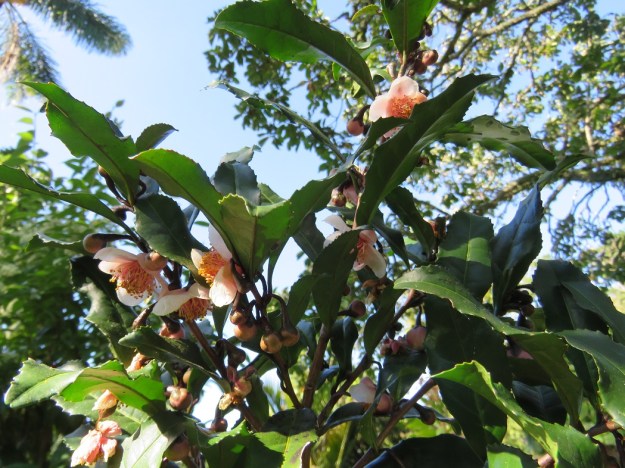
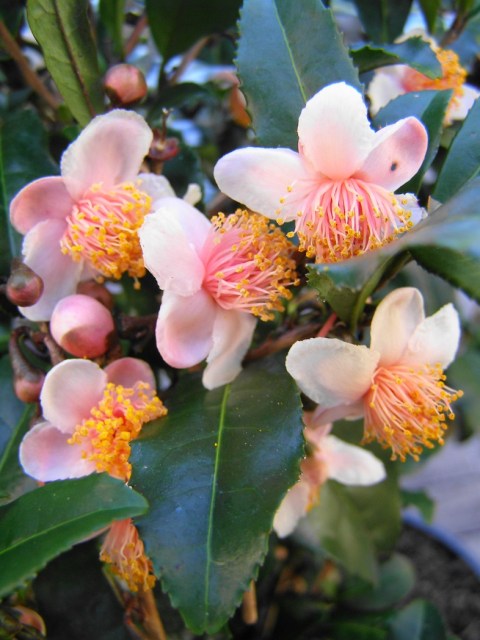
Camellia sinensis, the tea camellia, flowering at the end of March

With just one sizeable bush of the tea camellia, C. sinensis, the harvest was never going to be huge but after fiddly-faddling with a few minor efforts in recent years, I was determined to get as much as I could this year. I now have considerable respect for the tea-pickers of Sri Lanka and India but I assume one gets faster with practice. Mark tells me he has another three plants ready to be put out into the garden so we should, with more attention, be able to increase the harvest, though we are unlikely to achieve self sufficiency.

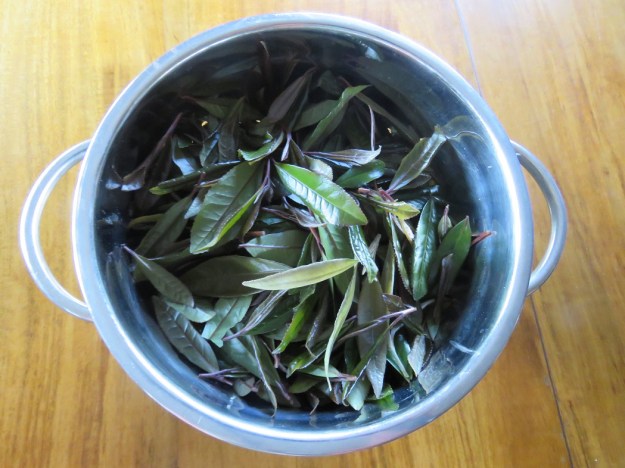
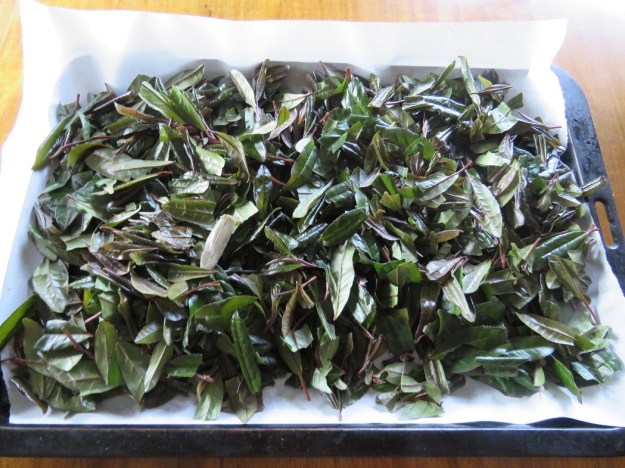
The first, small pick of tender tea tips

Harvesting is picking just the top two or sometimes three leaves from each growing tip, just as they are unfurling and still very soft and young.

The tea bag has a lot to answer for in terms of reducing the drinking of tea to the most convenient but mundane and utility level of activity. Where is the romance? Let alone the quality? Even worse are the gourmet tea bags which appear to be packaged in individual nylon bags and are therefore non-biodegradable, whatever the packet says. As our lives have become more leisured here at Tikorangi, we reinstated the old ways of making good loose-leaf tea in a teapot for the afternoon cup. Sometimes I bring T2 loose leaf tea back with me from Australia but we also have a New Zealand mailorder supplier at Tea Total and I have come to conclusion I prefer their teas. It is not as cheap as supermarket tea but for the afternoon ritual, we think the better quality and flavour is worth every cent.

Spreading on a flat tray to lightly oxidise and dry

My home-grown tea is free. Because we like aromatic teas, I have flavoured three batches differently. The first is lemon scented – I added some of the young leaves of the lemon myrtle – Backhousia citriodora. The second batch I dried with orange blossom (proper orange, not the mock orange philadelphus) and a few fine peelings of the outer rind of an orange and rose petals. The third was lime (lime blossoms and few young leaves) with mint and rose petals.

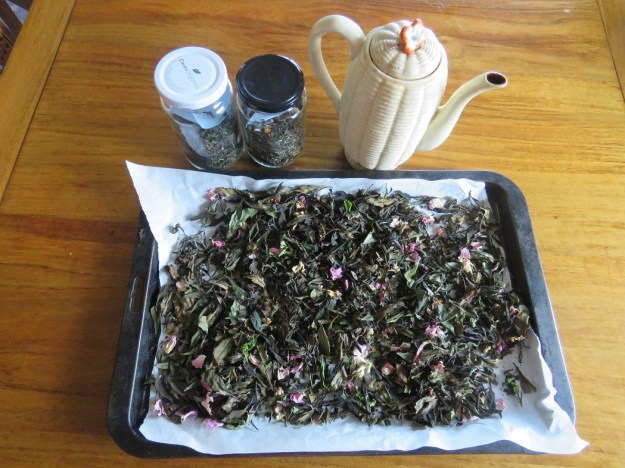
The yield from a tray is not large once it has dried – but fresh and aromatic

We tried making straight green tea in the past, first from fresh leaves straight into the pot and the then with leaves just wilted and left overnight. The taste was perhaps just a little too subtle for our palates. Now I do a process somewhere between green and black tea – bruising the leaves and leaving them covered overnight (which starts the oxidation process). Then I sun dry them on flat tray – which can take from one to three days, depending on the strength of the sun. And voila! Fresh tea ready for the pot. With no packaging and no carbon footprint.

In answer to the question as to whether there are different camellias for different teas, I quote Wikipedia: “Camellia sinensis and its subspecies, Camellia sinensis var. assamica, are two major varieties grown today. White tea, yellow tea, green tea, oolong, pu-erh tea and black tea are all harvested from one or the other, but are processed differently to attain varying levels of oxidation.” There are different selections of the species and some will have different characteristics, but the vast majority of tea sold in the world is indeed from Camellia sinensis.

Our form of sinensis is pink flowered which is unusual. But I think I strategically placed additional flowers to make this photo showier than it is in real life.