Category Archives: Plant collector

flowering this week, tried and true plants

Plant Collector: Astelia solandri

The quiet charm of self sown Astelia solandri

The quiet charm of self sown Astelia solandri

While we don’t have the global monopoly on all astelia species, most New Zealand gardeners don’t think beyond Astelia chathamica (with its big silver leaves) and bronze ‘Astelia Westland’. A. solandri is not usually available commercially, although I see Oratia Native Plants sell it if you want to have it. Ours are all seedlings, dispersed by birds and most grow as epiphytes perched on the big old trees in our woodland areas. Its common name is the perching lily, no doubt because of this ephiphytic inclination, and its Maori name is kowharawhara.

When it is not in flower, it is just a green leafy plant, akin to a softer, narrow leafed flax in appearance, with leaves over a metre long arching outwards, somewhat silvery beneath. Essentially it acts as green furnishing detail in the garden. But when the flowers come, there is a delightful twisted tangle of stems and foliage. The flowers come out creamy yellow and age to this soft pinky colour.

I hope the ignorant claim that our native plants are all boring is dying out. A. solandri may not be spectacular and showy, but it brings a quiet charm to the autumn woodland.

First published in the Waikato Times and reprinted here with their permission.
Plant Collector: tree dahlias

???????????????????????????????
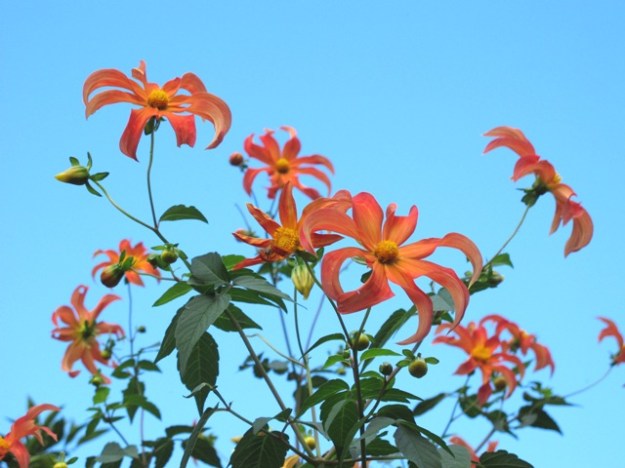
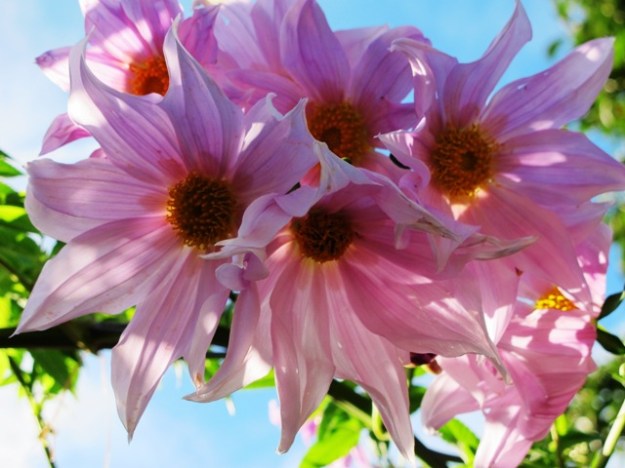
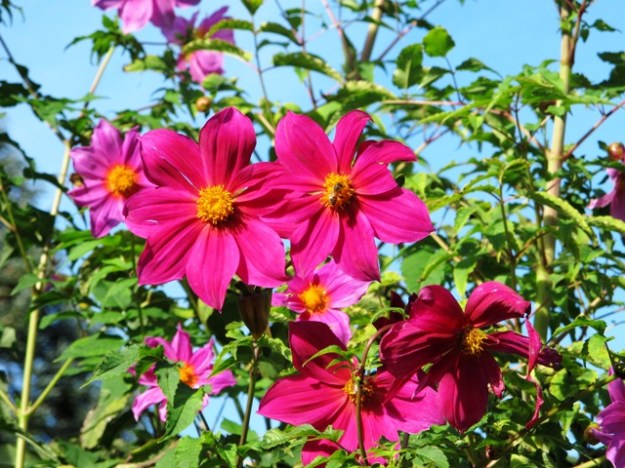
The only resemblance these dahlias have to trees lies is in the astonishing size they can reach in the space of the summer growing season. Some can get up above 3 metres high. They are just dahlias, growing from the usual tuberous roots and because they are deciduous, they die back completely every year. The best known tree dahlia is the species D.imperialis which is also the largest variety and hails from Central America. Prominent NZ plant breeder, Dr Keith Hammett, has been working with dahlias over time and using other so-called tree dahlia species in ever more complex crosses to bring different colours, flower form and sometimes more compact growth into the range.
???????????????????????????????
Tree dahlias are not the easiest plants to place in the garden. They need full sun and protection from wind because their growth is somewhat brittle. They also need some sort of support to hold them upright. They flower now, in mid to late autumn, much later than the summer dahlias and this makes them vulnerable to early frosts. If you have the right conditions, plenty of space and are willing to build some sort of structure to support them (we are fans of thick bamboo corrals), they can be a welcome addition to the autumn garden but they are never going to be tidy, well behaved plants.

Reasonably sure this is the one named Timothy Hammett

Reasonably sure this is the one named Timothy Hammett

First published in the Waikato Times and reprinted here with their permission.
Plant Collector: Dichroa versicolour

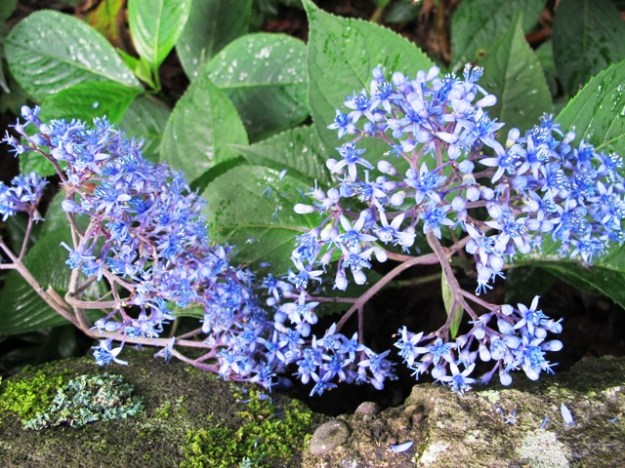
Dichroa versicolour - flowers all year round here

Dichroa versicolour – flowers all year round here

It is a member of the hydrangea family and grows like a hydrangea. But the beauty of the dichroa for us is that it flowers for pretty much twelve months of the year. The trade off is that we never get the massed seasonal display that we usually associate with hydrangeas, but it is rare not to see a few cones of pure blue flowers.

A Google search suggests that not all dichroas have as good a colour as we expect in New Zealand. It was Taranaki plantsman Glyn Church who introduced the dichroa to this country and I would guess that the form he brought in has consistently good blue colour.
blue

This is a relatively large growing evergreen which is a back of the border plant. It is quite happy in sun or shade. This plant is growing beneath a huge magnolia. If you don’t trim it from time to time, it will get large – in the 3m x 3m range. I keep this specimen under control and a little denser in growth by trimming back long branches to the lowest point where there are clearly two growth shoots on the stem. It doesn’t seem to matter what time of the year this is done so I just snip and clip when the flowers on the branch have finished or before buds have formed. It is native to North Burma and the Yunnan area of China and is reasonably hardy.

First published in the Waikato Times and reprinted here with their permission.
Plant Collector: Koelreuteria paniculata

Koelreuteria paniculata - it may be a long wait for flowers in our climate

Koelreuteria paniculata – it may be a long wait for flowers in our climate

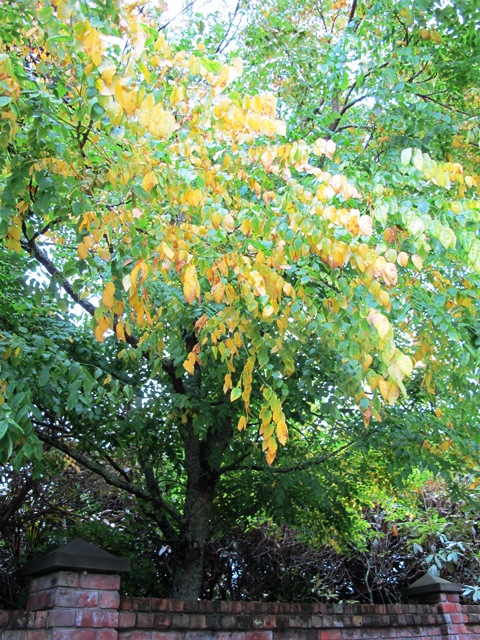
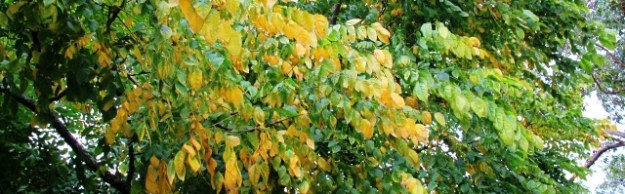
There is nothing rare about the koelreuteria which goes by the charming name of the “Golden Rain Tree” or, apparently, “Pride of India” despite the fact it comes from China. The golden epithet does not refer to the lovely golden leaves which colour-up even in our temperate coastal conditions, but to the summer flowers. Alas we have not seen these on our tree, despite it being about five metres tall and well over a decade in age. It appears that we may not ever get many flowers because this is a tree adapted to an inland or continental climate. It likes a cold, dry winter and hot, dry summer – neither of which it gets at our place. However, it is pretty enough with its fresh spring foliage and its golden autumn colours for us to keep it in the garden.

When the flowers pass over, it develops showy pinky-brown seed pods – referred to in the literature as “inflated and bladder-like”, which sounds less appealing than they look.

There is another koelreuteria species, K. bipinnata, which is sometimes referred to as the Chinese flame tree. It is not as common as K. paniculata and is more spreading, growing wider than it is tall. Its flowers, foliage and seedpods are similar although it usually flowers later in the season, heading into autumn. It is probably just as well it is not so common here because it appears to have invasive habits in certain climates and would probably prove equally problematic in areas of this country.

???????????????????????????????

First published in the Waikato Times and reprinted here with their permission.
Plant Collector – Acer griseum

Acer griseum - it's mostly about the wonderful bark

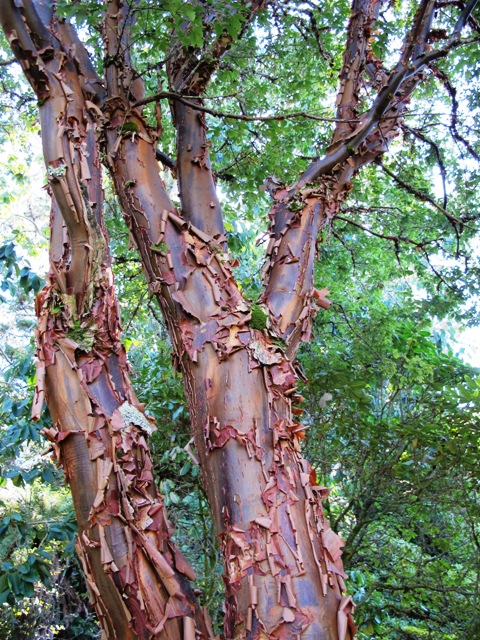
Acer griseum – it’s mostly about the wonderful bark

Mention maples and most people think of the fresh spring foliage, the burgundy lacy look of some patio maples all summer and the glorious autumn colour. It is all about the foliage but not with Acer griseum which has nondescript green leaves all summer. No, it is primarily about the bark.

Often called the paper bark maple, Acer griseum is one of the best ornamental bark trees in the world. The old bark peels back in shiny, curled layers to reveal a matt skin below and it is all in glorious copper tones, often described as cinnamon in colour. The sight of light glowing through these bark curls is nothing short of magical and it is a visual delight which lasts all year.

It comes from Central China and it was not introduced to the west until the turn of last century, 1901 to be precise. It was clearly an immediate success because within 21 years, it had been given an Award of Merit by the Royal Horticulture Society in the UK. While it will get some height, maybe 8 metres over time, it remains generally narrow in form so doesn’t take up much space. The bark starts to show within 3 or 4 years of planting. Apparently it will colour up much better and put on a good autumn show of scarlet in cooler climates though I can’t say I have ever noticed it colour here.

First published in the Waikato Times and reprinted here with their permission.