
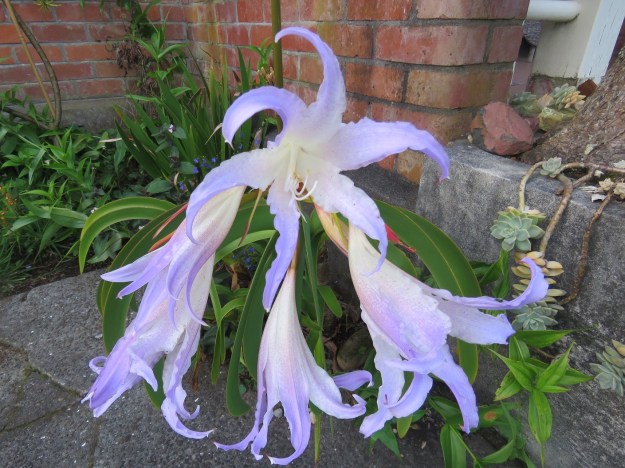
The exquisite Worsleya procera after all the rain
I shall ignore the weather, bar noting that we had over 100ml of rain on Thursday night and while we get some sunny days, this is not summer as we know it. As we enter February, we may just have to accept that full-on summer is bypassing us this year. In the meantime, large parts of the country are in drought.
At least the beautiful worsleya didn’t mind the torrential rain. Maybe it is used to heavy spray, given its natural habitat beside waterfalls in Brazil. W. procera now flowers every year for us – though rarely more than two flower spikes despite the fact we have more than two bulbs – but it never fails to wow us. This really is a most exotic bulb in a particularly unusual blue shade, though neither easy to source nor grow. Ours never set seed because they are all the same clone. It is always extremely slow to set offshoots from the bulb.

Not Hippeastrum aulicum

…despite the label
While on bulbs, I shall be a little unkind and post this photo from my visit to Auckland Botanic Gardens last week. Hippeastrum aulicum? Ahem, I think not. For they are red and flower in August and September. This patch looks mighty like belladonnas to me.
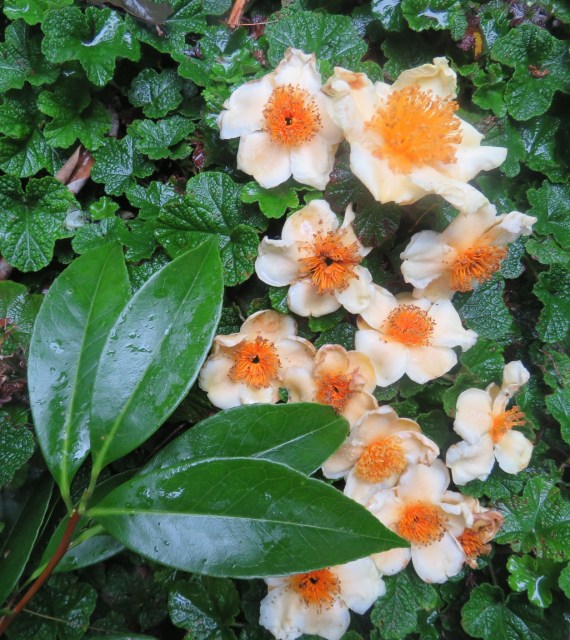
Not a camellia – a tutcheria, we think
We went to visit a friend this week for a stroll around his garden – he is very strong on hydrangeas that go way beyond the commercial mop-top macrophylla types. But, while charmed by these, it was the yellow ‘camellia’ that excited us. Here, we thought, was an interesting summer-flowering yellow camellia that was far more sun tolerant than the yellow species we grow and that we had spent some time looking at in China last year. Ignore the background foliage which is the dreaded Rubus pentalobus (though not out of control in this shady spot). I just used it as a carpet to arrange the fallen blooms upon, with a leaf of the plant to the left. It certainly looked like a camellia in flower form, bud shape and texture and it was from a recent interesting plant collection in Asia.
I was about to email photographs to an Australia expert on yellow camellias for an identification when Mark saved us great embarrassment. Sometimes he surprises me with his knowledge, as when he came in and said he thought it was a tutcheria, not a camellia. It took a while to find the right spelling to enable a net search (he is better on names than he is on spelling) and it appears to be Tutcheria championii syn spectabilis and is found in woodlands of Hong Kong. Yes it looks like a camellia bloom and the habit of growth is similar but, like the gordonia, it is simply one of those related plants in the theaceae family which includes all camellias.
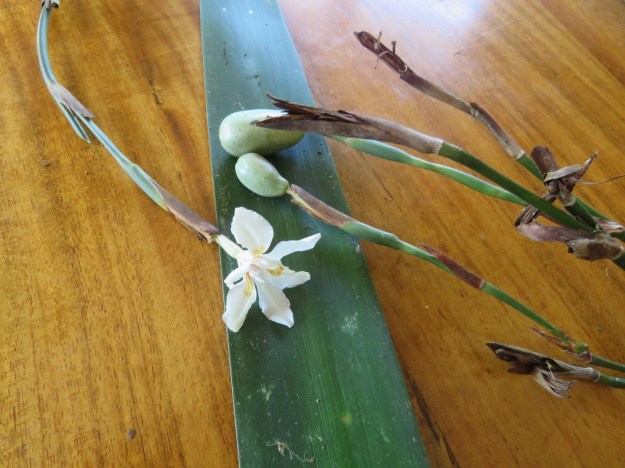
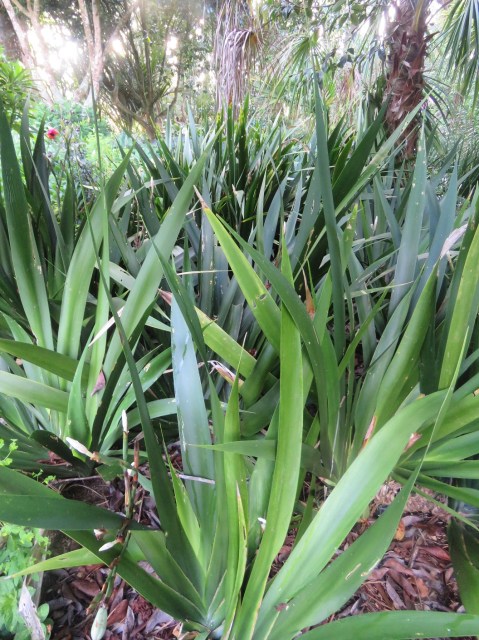
Probably Dietes butcheriana
Another plant mystery was solved when we managed to get what we think is the right species name on this dietes. After finding our neomarica was not a dietes, I wasn’t entirely sure whether Mark was right that this was one, either. The foliage is more spectacular than the flowers, which are rather small in comparison and not at all showy. But it appears it is the lesser known Dietes butcheriana that has made itself completely at home in a shaded area of the garden.
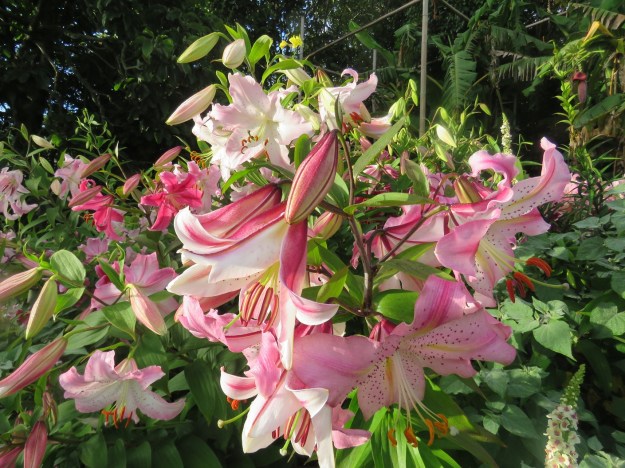 It is auratum lily season here and we have quite a few of these. I managed to get around staking the garden plants, in anticipation of the UK tour ten days ago – though they failed to flower on cue this summer. I don’t like to pick the flowers from the garden but… out in one of Mark’s vegetable patches, we have a large number of auratum lilies of many hues which Mark has hybridised and raised from seed in preparation for a new garden under construction. This has taken longer than anticipated so the lily patch has expanded and I can cut these to my heart’s content to bring indoors or give away.
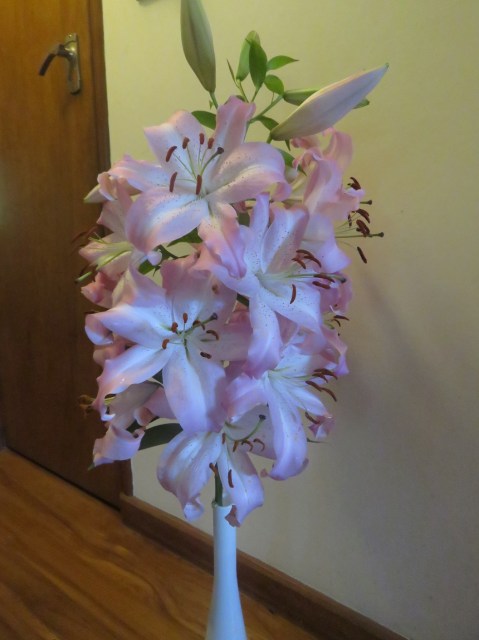
Just a one-off auratum seedling
This soft pink specimen is decidedly over the top. With 20 separate blooms, the flower spike is much too heavy to ever make a good garden plant and indeed it looked a bit gross out in the lily patch. But it looks splendid cut and put in a vase. You may notice the outward facing blooms. Florists prefer upward facing blooms and many of the auratums offered for sale are upward facing. Felix and now Mark started breeding for outward facing blooms because these make much better garden plants. They are hardier to weather conditions, do not gather debris and suffer less from pollen staining when grown in open conditions. Like many of Mark’s efforts, these are not oriented to commercial production, just to get better plants for our own garden. But oh we do get such a lot of delight from these summer flowers.
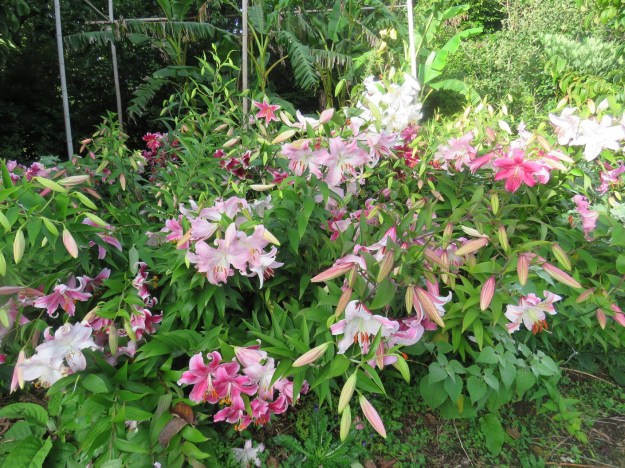
The lily patch in the vegetable garden
 A quick trip to Auckland at the weekend saw me rushing hither and yon but also enabled a face to face conversation with Tony Murrell in the studio at Radio Live. Usually we do these by phone. It is at the unseemly hour of 6.30am each Sunday morning so I had to rise even earlier to get to the studio. These conversations are remarkably complex for the early hour but both Tony and I are enjoying them enormously. Last Sunday it was partly about taking inspiration from other people’s gardens and not falling into the trap of thinking that recreating these ideas at home means using their blueprint, often from another climate, another country and another time. The link is
 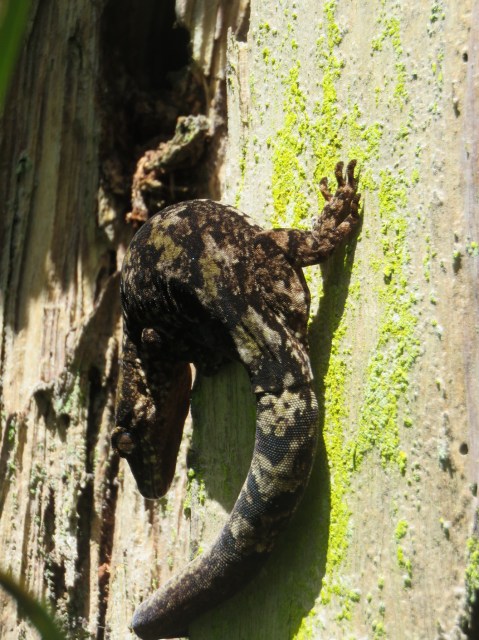 We did not see
  The UK gardening tour I mentioned last week has done been and gorn. It rained, steadily, when they arrived which was disappointing but we moved them all indoors for tea and cakes and the rain stopped a few minutes into the walk around the garden. While hosting these tours takes a bit of work and a surprisingly large amount of mental energy, the visitors often repay the efforts in more than money. Being able to share the garden with appreciative visitors who have a fairly high degree of knowledge themselves – albeit with an entirely different range of plants – is what it is all about really. We don’t garden on this scale just for ourselves and it can be extremely affirming to share it with a group like this one. I have to report that the lilies in the garden did not flower as hoped but we have enough lilies planted “out the back” as we say for me to pick an impressive display for vases indoors and they did not go unnoticed.
 Also putting on the very best display we have ever seen here is
 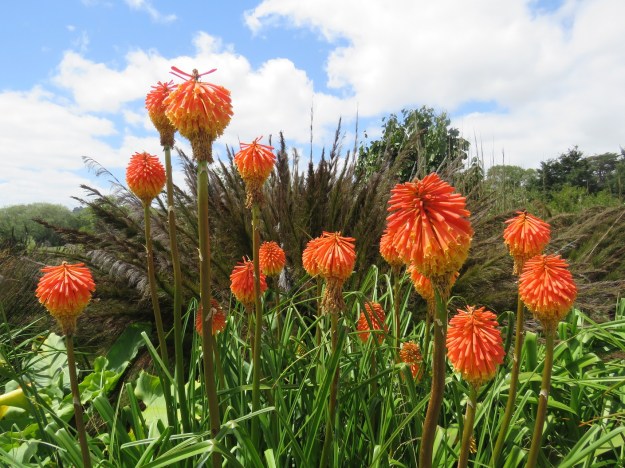 Finally, a few snapshots of summer flowers I liked this weekend. I called in to Joy Plants to check out their perennials and the kniphofia in the gardens were looking marvellous.

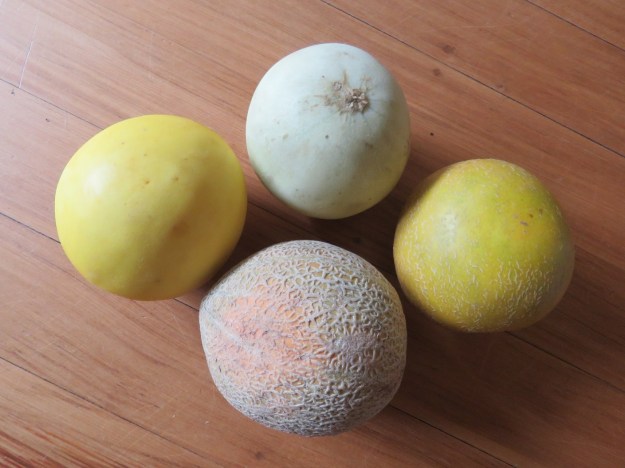
 The Otara Markets in South Auckland are held each Saturday morning. Because I come from rural New Zealand, I find the mix of cultures, different styles and colour fascinating. We don’t see much of this in Taranaki and New Plymouth. We also pay a great deal more for our fruit and vegetables and have a way more limited range from which to choose.
 Selling quick maturing Asian greens from the carpark.
  Preaching with a loud sound system but no visible congregation or audience.
 A spot of faith healing being carried out beside the carpark.
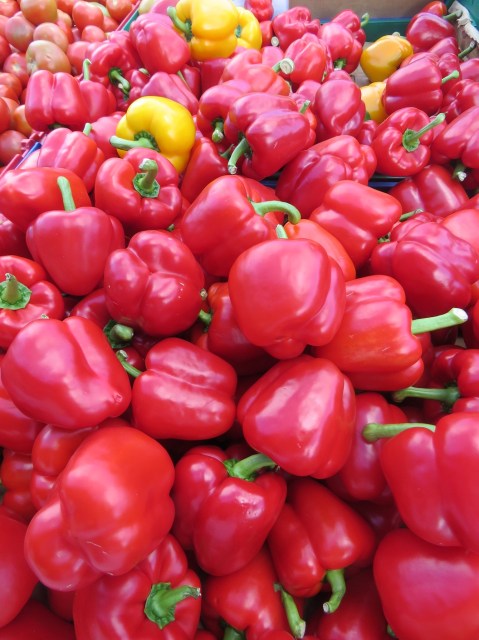
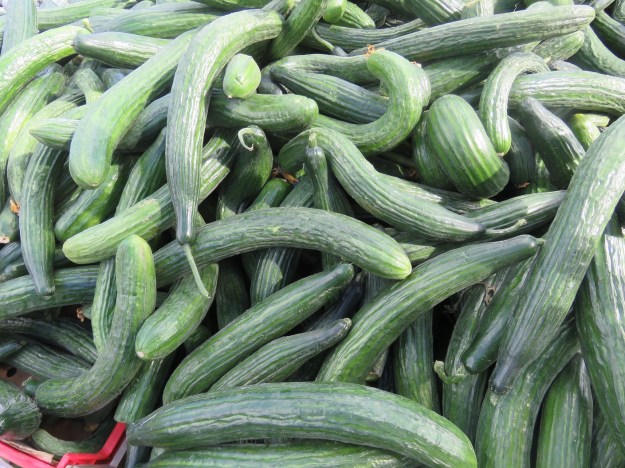
 There is something so visually appealing about piles of fresh garden vegetables being sold on market stalls.
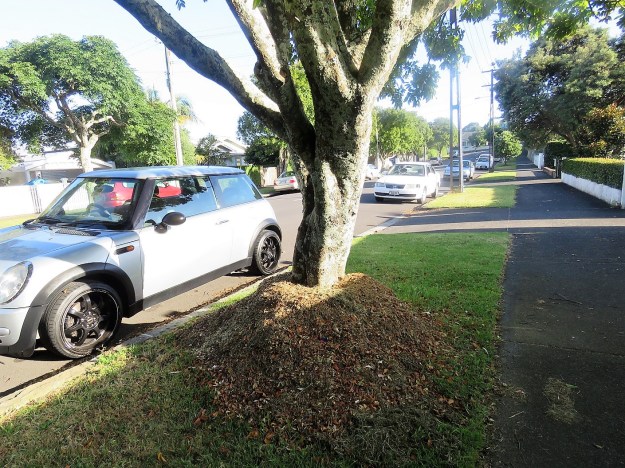 Well lookee here. When I was submitting three new articles a week to the Waikato Times – that was in the days before syndicated features and the resulting copy that became the newspaper equivalent of elevator muzak – I used to be on constant alert for subject matter. Old habits die hard and I reached for my camera to bring you this example of what not to do, photographed on a street in Auckland’s upmarket Mount Eden.
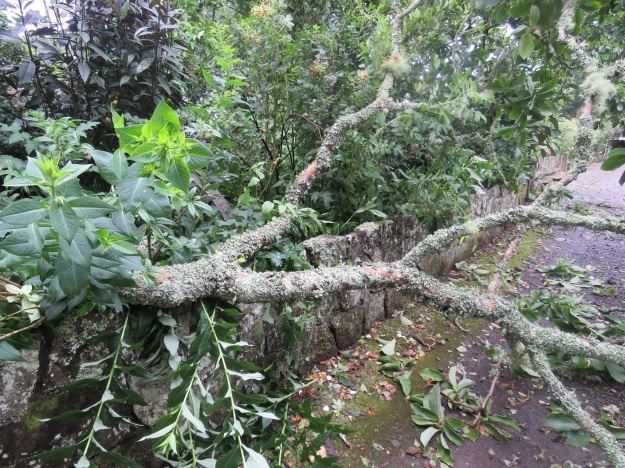 We had the next three days planned for a concerted swoop through the garden in preparation for a small UK gardening tour due on Thursday. While the garden is generally closed, this tour is coming through the Royal Horticultural Society – an organisation to which we have a few personal links and which has resulted in some really interesting and enjoyable garden visitors in the past. We maintain the garden at all times, but there are final grooming tweaks that make all the difference in presenting it well to paying visitors. We may be scrambling for the next few days with the added storm damage. Unless we get some of the elusive commodity this summer – uninterrupted sun – the lilies may not open in time to wow the visitors.
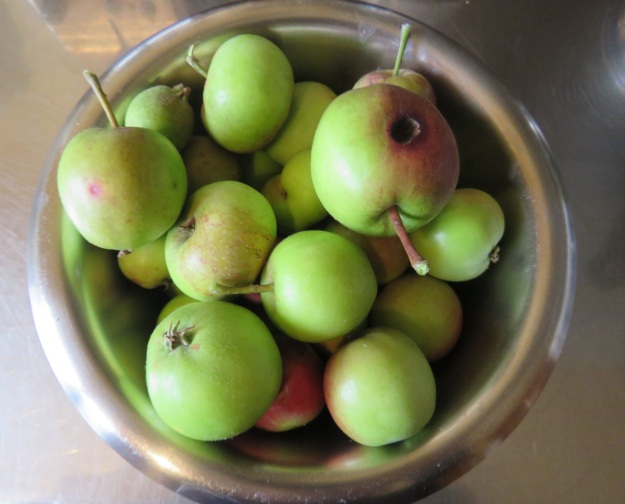 Yesterday was so miserable that I retreated to the kitchen, in part to deal with a surplus of Sultan plums. The tree is cropping very heavily this year but is not particularly flavourful. Mark put this down to his failure to thin the crop earlier in the season but I am sure the shortage of hot sun hasn’t helped, either. Jam, I thought. I shall make some Sultan plum jam, channelling my late mother-in-law who was the best jam-maker ever. These days I only make small batches – we are not great consumers of jam and a few jars for gifts are all I really need. I have learned that reducing the boiling time to set is what makes all the difference. Sometimes I resort to using the jam setting sugar which is, presumably, so heavily laced with pectin that it only takes 4 minutes of boiling to reach setting point. But I didn’t have any in the cupboard and it seems excessive to get in the car to drive to the supermarket for just one item. But fear not. I now know that one can make one’s own pectin by boiling up little green apples and those we have in abundance. I thinned some of the apple crops and chopped and boiled the fruit, using that liquid instead of water in the jam.
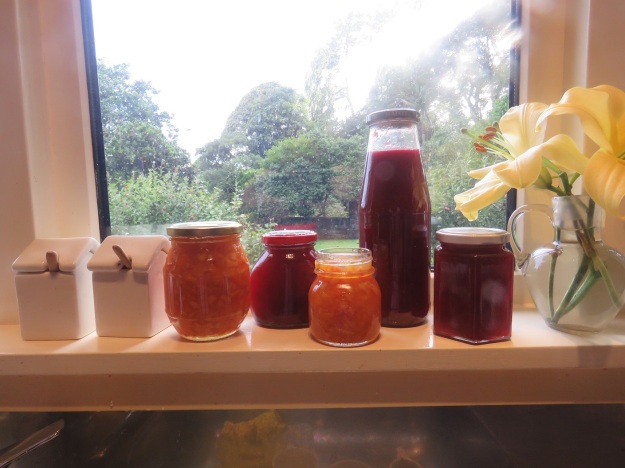 The result was a few jars of brandied Sultan plum jam though the brandy was a bit of a waste. I am not sure it is discernible except, maybe, to those with the most refined jammy palates. I then went onto fresh orange and ginger marmalade and finished up making some plum sauce. After all that, I felt so virtuous I opened a bottle of wine.
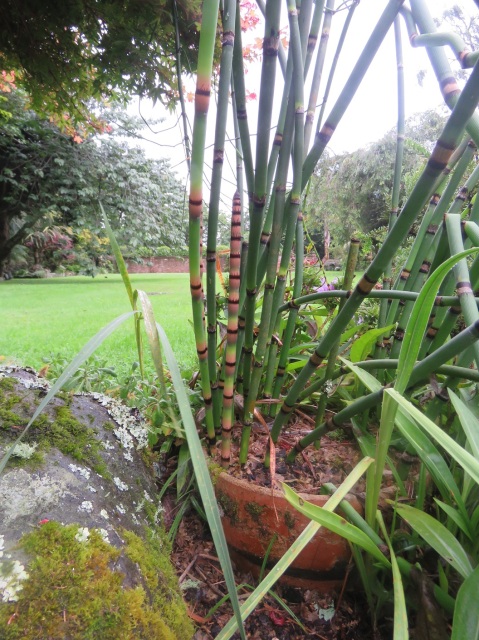 At least we knew the showy equisetum was invasive. I planted it in a pot because it was an interesting looking plant. It succeeded in breaking the first terracotta pot and making a bid for freedom but I was quick enough to nip that in the bud. This week, I will lift this second pot and get rid of it altogether. It is not good enough to keep sacrificing pots to the cause and it is a high risk plant. I asked Mark if he knew which species it was and he shrugged, saying he has zero interest in equisetums except he does know that it can be dried and used as a polishing agent, though we are talking about fine sandpaper polishing rather than furniture oil. We have another little equisetum that his father planted in the rockery and we have been attempting to eradicate ever since – for decades. We will not be inviting any more members of this ancient plant family into our garden.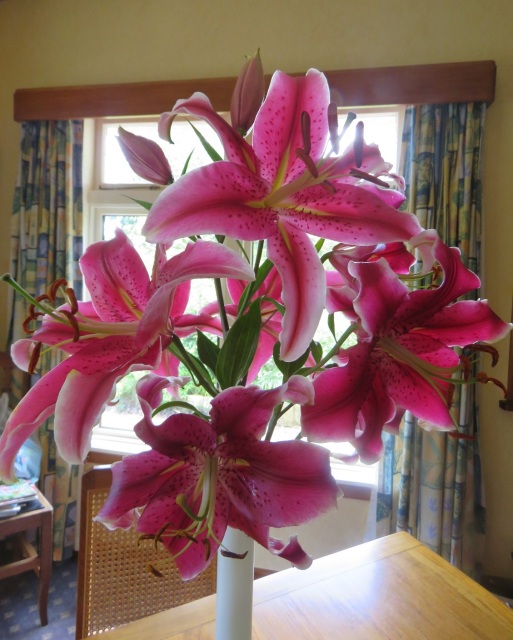
 Tikorangi The Jury Garden