

Camellia impressinvervis
When I published my article on The Golden Camellias of China and Vietnam back in early June, I added an excited postscript noting that one of our plants of a yellow species was about to bloom for the first time.
Not just one, it turned out, but three! These were plants that we bought in 2001, back in the heady days of Neville Haydon and his Camellia Haven Nursery and they were probably two-year old grafts at the time. So it has only taken about 17 years for them to flower in our conditions. We are marginal for these tropical species.
Fortunately, Neville is still available and switched- on, despite advancing years, and was able to identify the species from photographs. The labels on the plants here had long since gone. So this year, we have flowered C. euphlebia, nitidissima and impressinervis. The nitidissima we will have bought under that name because we already had C. chrysantha and would not have bought a second one and it is likely that they were thought to be different species back then. So we probably have two different forms of it.

Camellia euphlebia
They did not all flower at the same time, so I could not get a photo of all three in a row. What I can say is that C. euphlebia only had a four or five blooms in total and they were very small but the foliage is the largest of all and handsome in its own right.

Camellia nitidissima
C. nitidissima is the stand-out for us – plenty of flowers. Too many to count, even. Blooms were large enough to stand out on the bush and the foliage and form is handsome. Unfortunately our earlier form of C. nitidissima that we have under the name of C. chrysantha did not flower this year, so I could not compare the two forms.
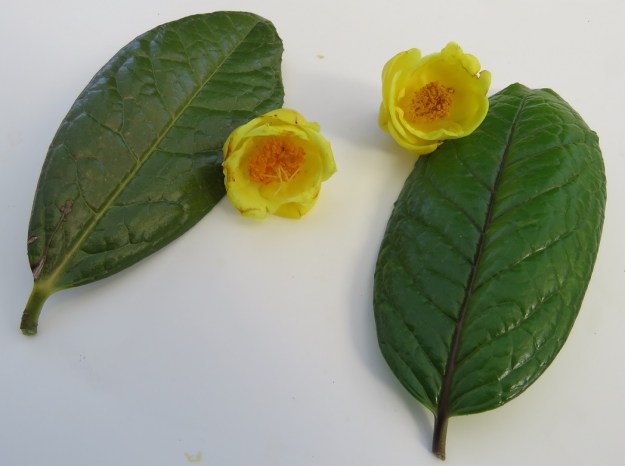
C. impressinervis to the left, C. nitidissima to the right
C. impressinervis has blooms of similar size, substance and colour to nitidissima but not as many of them. It also appears to put up filaments (presumably petaloids?) in the centre of the showy boss of stamens. Our plant is upright with the typical bullate foliage and it set at least 100% more blooms than C. euphlebia this year (in other words, about 10).
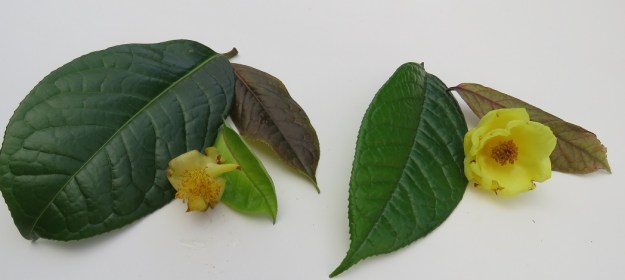
C. euphlebia to the left, C. nitidissima on the right.
These are collectors’ plants. I am not aware of them still being in commercial cultivation in New Zealand. But at least they are in the country and anybody determined to get hold of them will be able to find material to graft plants for themselves. Though most people will need to learn how to graft first but the decline in technical skills is another topic altogether.
When you have waited 17 years for flowers, it is a pretty exciting experience (in an understated gardening sort of way) when the first blooms open.
 I read a report last week about leading Auckland mayoral candidate,
  Why, when we live in a country that was until very recently, heavily forested, do so many people hate trees here? Why do so many folk want to hack back or cut out anything over two metres in height? And why do we so often see the death sentence pronounced and carried out on trees once they have reached about fifty years of age? “Past their use-by date”, it is often claimed even though the tree may in fact have a life expectancy of hundreds of years.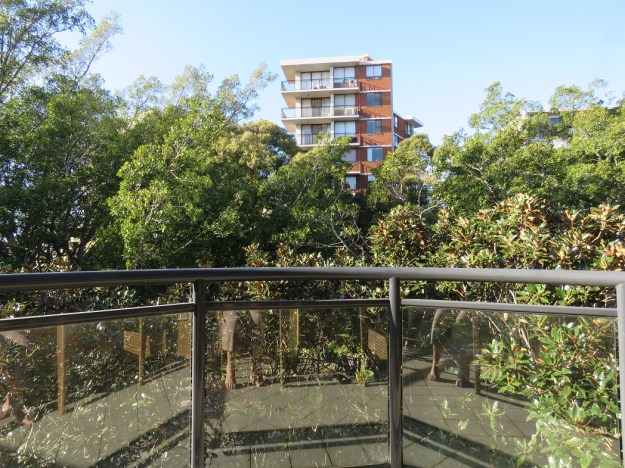

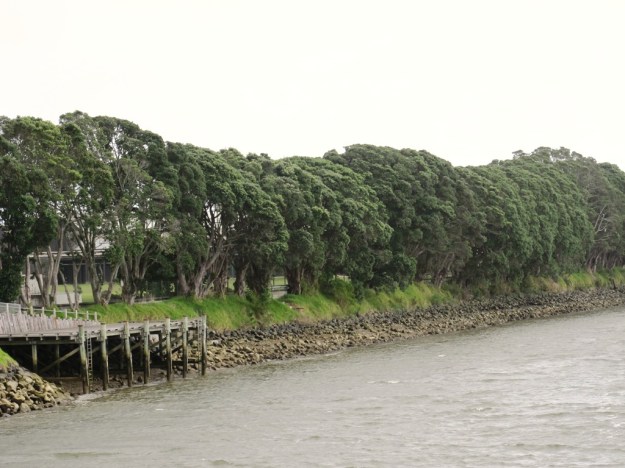 Some readers may recall our lost campaign to try and
  Believe it or not, some folk actually think this barren wasteland (now grassed) is an improvement. Three small specimens have been planted to replace the missing twenty-nine. Eventually, that is. As long as tree-hating local residents and the powers-that-be don’t hack them out before they ever reach maturity. For this is New Zealand and urban trees are not greatly valued by many.


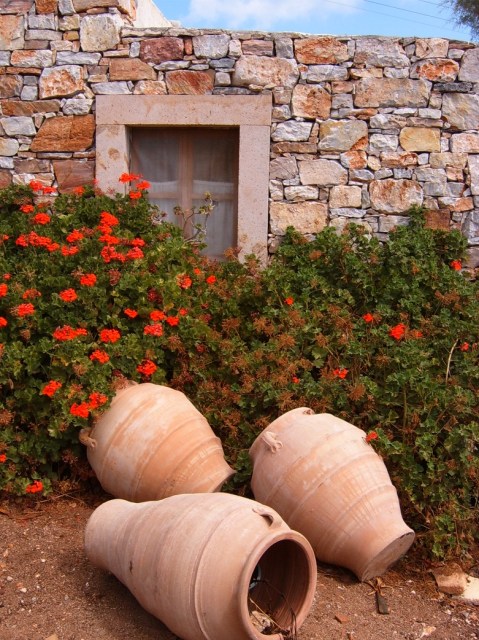 These are the genuine article when it comes to terracotta urns – Greek oil jars. I spotted them just lying about looking absurdly decorative out the back of a shed on a tiny island just off Patmos. It was not until I saw Greek oil jars that I ever considered the different shades of terracotta that come depending on the local clay. On the eastern isles, the terracotta was quite pale with a white powdery finish which I find much more attractive than the more usual orange shades. If I could have shipped some lovely oil jars home, I would have.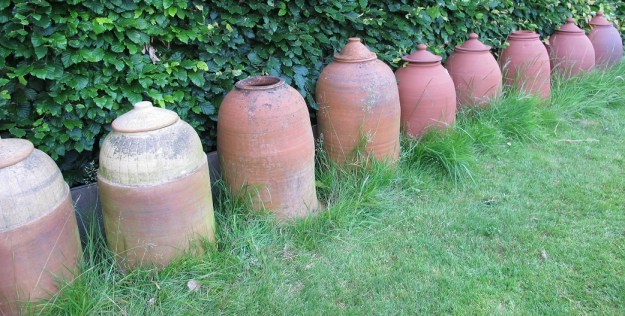
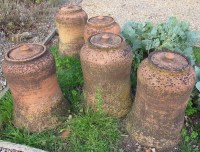 Hardly urns, but a handy segue on how attractive older utility gear can be, forcing pots, just hangin’ about waiting to be used again in the vegetable garden. Placed over vegetables that need blanching (rhubarb, kale, white asparagus, celery and the like) they produce more tender shoots. We saw them in more than one English garden. I think they are available in New Zealand but with a hefty price tag that will ensure they are used as ornament, not their designated purpose.
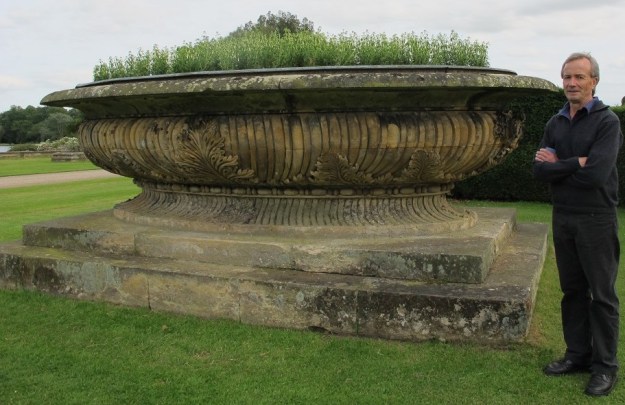 If you are going to have an urn, or a font, maybe, and have a property that is of a suitable scale, then you might as well make it a B I G one. This is at Castle Howard in Yorkshire with Mark standing beside it. I am not sure what is growing in it but it did not really enhance the Experience of the Urn. It may have been more effective left empty.
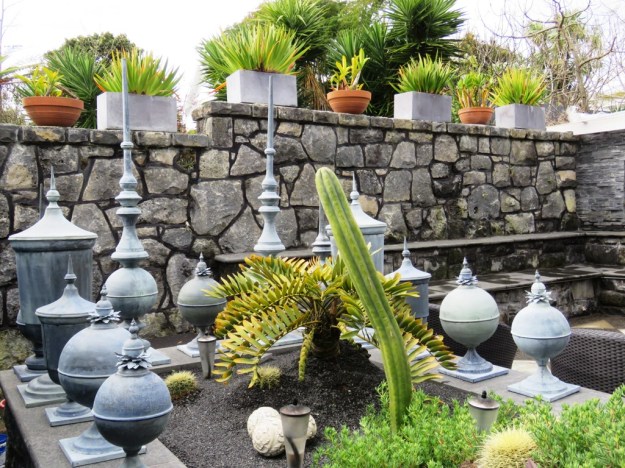 When it comes to lidded urns that bear a slight resemblance to a certain style of funeral urn, the same principle may apply. If you are going to have one, it may well look considerably more dramatic if you have many, as in this interesting and contemporary small Auckland garden.
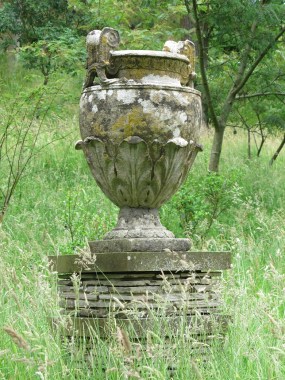 Still with the greys, these two handsome urns are from Arabella Lennox-Boyd’s garden at Gresgarth. The squatter pot was nestled into the garden by the stream, making a charming scene to be viewed at close quarters. The use of a plinth makes the taller pot a statement all on its own. I admired it enormously, even more so in its understated meadow setting.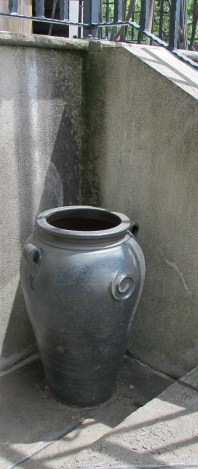
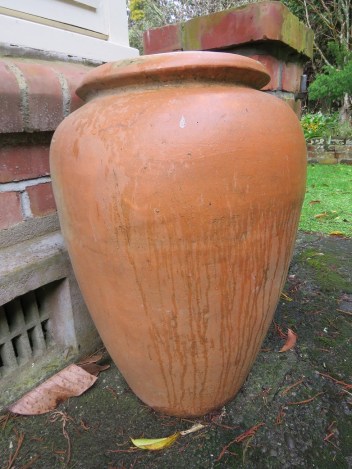
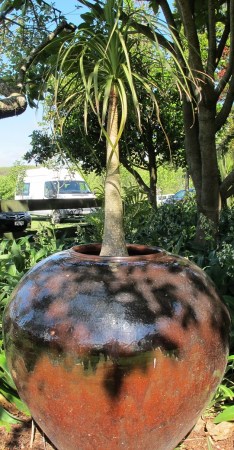
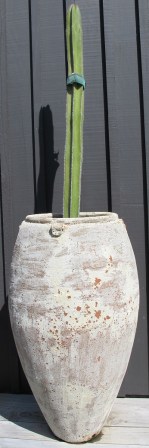 I feel some gardeners haven’t quite taken on board the message that some pots are sufficiently elegant to exist simply as a decorative pot, without a plant in it. Very deep pots can drain poorly – some even come without any drainage holes in the bottom at all – meaning that the roots are going to be very wet all the time. A tall pot on a narrow base is not the most stable design. Adding in a tall plant will make it even more top-heavy. Further, to keep container plants healthy and growing well, they really need to be completely repotted in new mix at least every second year, if not annually. Getting a plant out of a pot with a narrow top is a mission and usually involves either damaging the plant or breaking the pot.
 This modern urn filled with copper foliage (posssibly a cirsium -one of the ornamental thistles) sat on a plinth in an otherwise austere setting – the stable yard, I think it was – in a private Yorkshire garden. One of a pair or maybe even more, I am sure they were not cheap to buy but they were very effective. I thought from one of my photos that they were marble, but looking at the others, it appears they may be a composite stone that is made to resemble marble and the run-off from the copper is giving a subtle patina over time,
 Nobody does cheerful urnage like the Spanish and the Portuguese. At least nobody that I have seen. I photographed these two in Seville because they were so shamelessly flamboyant. The amazing thing is that these pots can be placed in a public area and not be smashed as they would likely be in this country. But honestly, I think it is very difficult to transfer this sort of decoration away from that bright light and cultural context of southern Europe without running the dire risk of it simply looking, well, vulgar. The only time I have seen something similar done successfully was by Lynda Hallinan in Auckland. Her elaborate pot sits empty, you will notice (filling it would really be over-gilding an already gilded lily), nestled in amongst lots of foliage and flowers where it caught my eye.
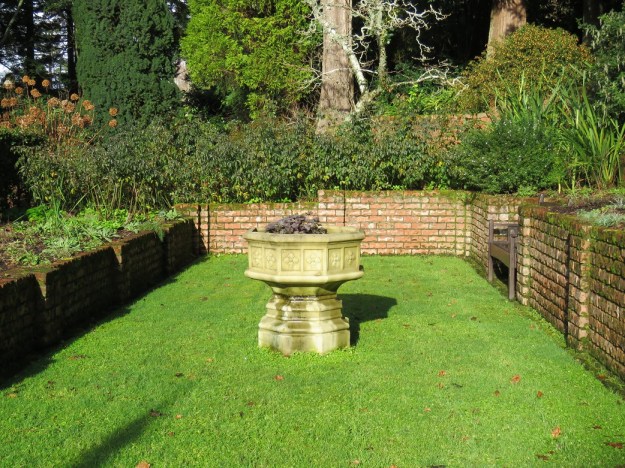 And the modern take on the baptismal font? This is in the middle of the raised beds at Tupare Garden in New Plymouth. I am not sure it is a good enough piece to take centre stage. It may have looked more at home were it in grey stone but that sort of modern take on mellow Cotswold stone is not so much at home across the world. But I guess it comes down to personal taste.

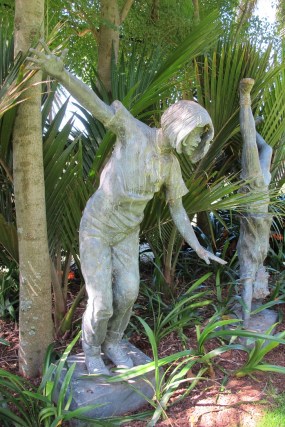
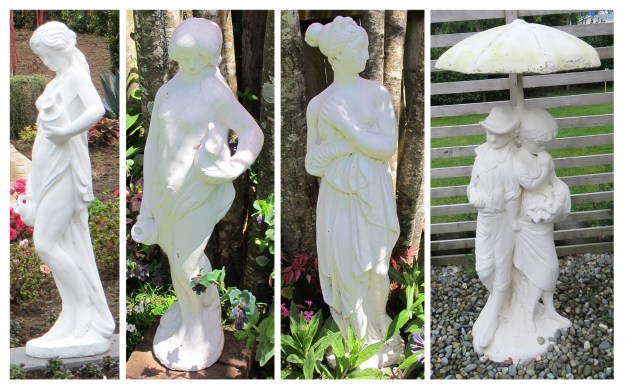 Much of the white domestic garden figurine decoration here probably has a closer debt to the pre Raphaelites and Victorian sentimentality, but personally, I remain unconvinced as to what it adds to home gardens. Especially as so many garden owners appear to feel the need to repaint their figures every year or two, to maintain that pristine whiteness. Each to their own, is all I can say.

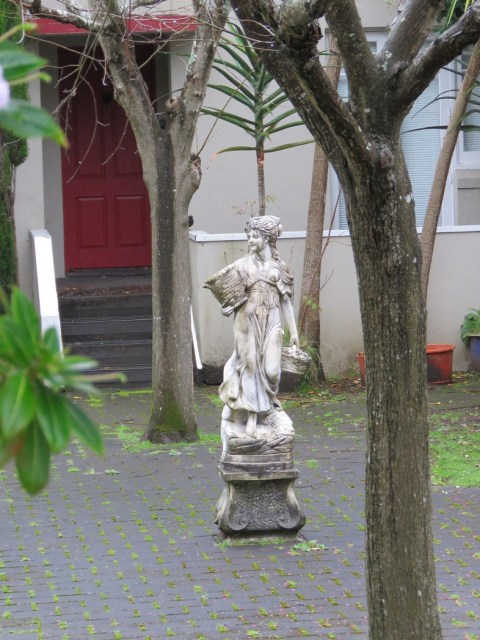 In a similar mould, I think I could even find the right spot for this unloved figure of the harvest maid that is marooned in the area serving some equally unloved apartments in Auckland. By the Countdown Supermarket on the corner of Dominion Road in Mt Eden, if my memory serves me right. But Mark may disagree. “Why,” he says, “must we import the art and history of other countries? Can we not evolve our own?”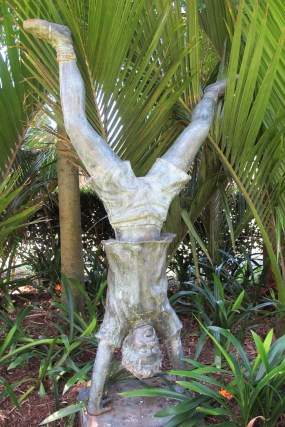
 Similarly, the Holyoakes in New Plymouth are strongly family oriented and told me that their large Lego man makes them smile and acts as a constant reminder of the delights of child rearing. While uncompromising as a piece of garden sculpture, they have placed it in a small courtyard visible only from their living room, surrounded by the grandeur of the very large bird of paradise plant – Strelitzia nicolai.
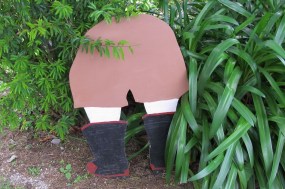
 By no means can all garden statuary be called sculpture. Some is more akin to craft than art although at its best, crafty efforts can cross over to folk art (more on this another time). Figures made from terracotta pots are found relatively frequently, usually created by the garden owner. This is affordable garden decoration, not sculpture or art.

 Tikorangi The Jury Garden