

Metrosideros excelsa ‘Aurea” or pōhutukawa in Waitara
Taonga is a Maori word, enshrined in New Zealand law through the Treaty of Waitangi. At its loosest translation, it means a treasure but more than the European understanding of treasure. It can be tangible or intangible and the transfer of a taonga carries with it great responsibility. It is not to be taken lightly. Unless you are the Taranaki Regional Council in which case you can, apparently, dismiss it out of hand and deny its very existence.
The battle to save the mature pōhutukawa on the bank of the Waitara River has been running for maybe 10 months now. True, the Council has altered its plans. To start with, their consulting engineer said no trees needed to be removed in order to get the flood protection in place. He then changed it to ALL the trees need to be removed – all 125 of the row. The plans changed yet again and the number to be removed was reduced to 23. Such a shame that they are the biggest and best 23 and the reasons for removal are less than clear to most. The Taranaki Regional Council (TRC) has dug their collective toes in, drawn lines not in sand but in concrete and refused all pleas to get a second expert opinion on ways to save the trees while getting effective flood protection in place.
Four of the trees to be removed are yellow – Metrosideros excelsa ‘Aurea’. Pōhutukawa is the Maori name for these trees and the most commonly used. Not only that, but it is widely recognised that these four yellows are of considerable note. Ask any Taranaki horticulturist over a certain age and the first comment they will make is along the lines of: “Aren’t the yellows in that stretch to be felled? Surely they can’t be going to fell those. They are historically very important.”
For it is widely known that the owner of Duncan and Davies (the powerhouse plant nursery of the southern hemisphere from the 1940s to the 1980s), Sir Victor Davies personally organised the planting of those pōhutukawa on the banks of the river and that included the first known planting on mainland New Zealand of the special yellow variety. He was told about the Motiti Island yellow variant in the 1940s. The vast majority are in shades of red and the yellows are a rare sport. His nursery subsequently went on to sell other plants of the yellow selections in later years but it was because they were so special and so unique that Sir Victor Davies approached Sir Thomas Borthwick to plant them in front of the latter’s huge industrial abattoirs (known as freezing works in New Zealand), in order to provide a visual screen to beautify the river and to retain the eroding river bank. That is the Pakeha (European New Zealander) history.
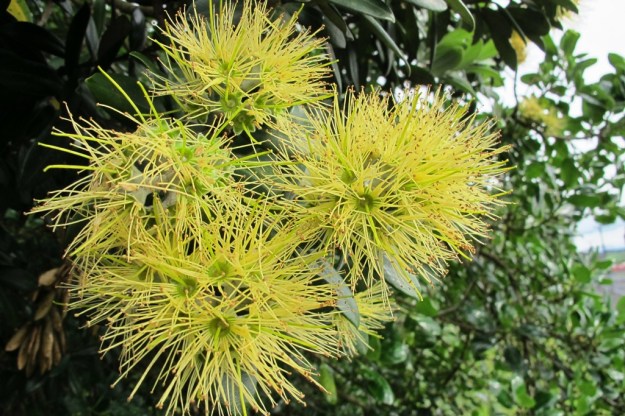
The Maori history of those trees adds another dimension altogether. For the yellow pōhutukawa originated only on Motiti Island which is the turangawaewae (loosely translated to home territory) of Ngai Te Hapu. They knew those yellow flowered trees were special. The decision to allow Sir Victor Davies access to plant material from these trees was made with hapu (sub-tribe) blessing. This is what makes those yellow specimens a taonga – a valued treasure that was gifted. In so doing, it conferred prestige upon the receiver but also an obligation to respect that taonga down the generations. It is a concept that is part of our New Zealand history. Maori need no explanation of what is a strong and enduring cultural value. An increasing number of non Maori New Zealanders also understand and we have come a long way in the last 30 years incorporating that dual heritage of our country.
Some of us have. In fact many of our institutions recognise and acknowledge that dual heritage and the respect that comes with it. So it was a genuine shock to find that the Taranaki Regional Council does not, even in 2015.
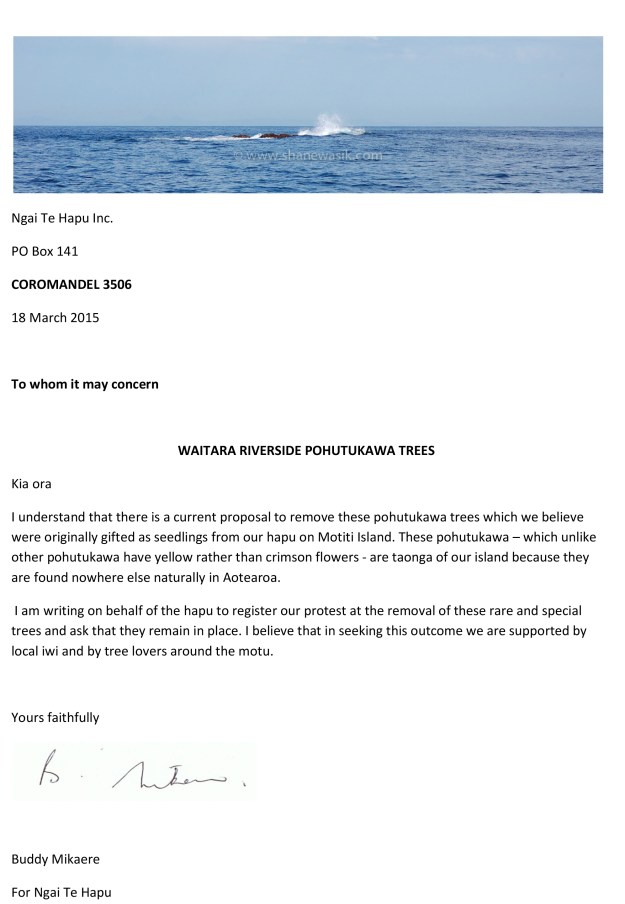
Ngai Te Hapu wrote a letter to support retaining those trees, pointing out the status of taonga. The letter was signed by hapu elder, Buddy Mikaere – a man of huge mana (prestige, authority, influence) widely recognised and respected throughout the country. The letter was hand delivered to the TRC with the request that it be tabled at the Executive Committee meeting in six days time. Not only did the CEO and the committee chair refuse to table the letter (it arrived “too late” for agenda inclusion, they claimed – six days in advance), but they felt it appropriate to have a staff member issue a statement denying the taonga status of the trees.
“However, the regional council remains unmoved by Mikaere’s request and removal of the trees will proceed as planned, according to operations director Stephen Hall. He confirmed the council had received the letter but disputed the significance of the Motiti Island link to the yellow-flowered pohutukawa in Waitara.
“There is clear evidence in Duncan and Davies catalogues that they were available commercially for more than a decade in the 1950s and 1960s.
“The tree has been planted at a number of other locations in Taranaki,” he said.” (Taranaki Daily News March 31, 2013).
Pause for breath.
1) The letter has not at this time been received by elected councillors, let alone discussed.
2) Whether the yellow variety has been planted at other locations in Taranaki is a complete red herring, utterly irrelevant to the historical significance of the four river bank specimens.
3) To have a paid staff member speak to the media denying and refuting taonga status declared by a such a respected Maori leader shows a breathtaking lack of sensitivity and process, along with arrogance that is remarkable.
The final word, perhaps, rests with the Auckland person on Twitter who commented: “If Buddy Mikaere says they are taonga then they are taonga. What is wrong with these people?”
Plenty.
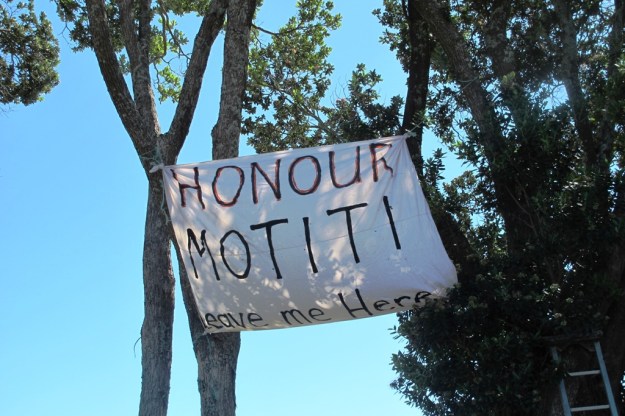
If you feel strongly about adding your support to this campaign, please go to Action Station and add your email of concern. It ain’t over til the 23rd tree is chainsawed down and chipped to mulch.
 After picking flowers, I couldn’t resist laying out some samples of the autumn harvest. I didn’t get too obsessive. There is much that I forgot to include – a good potato crop, sweet corn, another year’s supply of dried beans (not sure we have finished the 2013 bean harvest yet) and I forgot entirely about the show-off avocados which we have in such abundance that we are giving them away by the supermarket bag full.
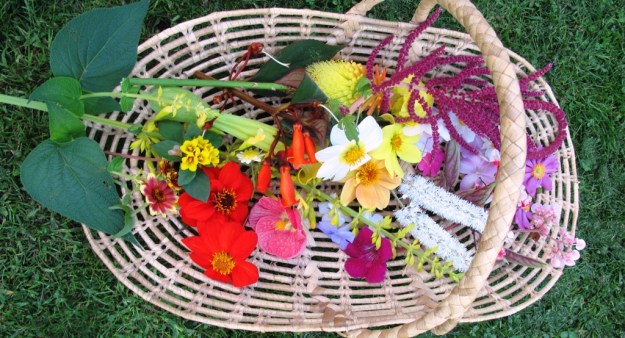 It is indubitably autumnal, but no sign of the leaves colouring or dropping yet as we gently drift into the cooler seasons. I shall do a survey of the plants that take us through autumn, I thought, and headed out to the garden with snips and a basket.
 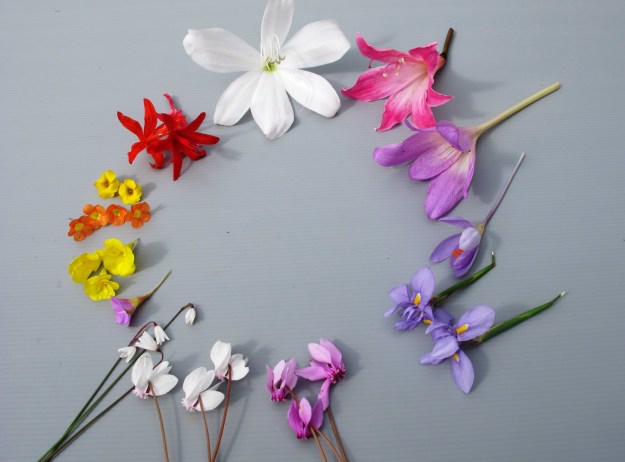 Despite that slight sense of mournful decay that can characterise the autumnal garden, there was so much flying the flag for flowers that I had to group them. It is still early for the autumn bulbs. There is a whole lot more to come but the nine in bloom at least indicate that not all bulbs belong to spring. Starting with the white flower at the top of the photo, going clockwise, these are: Crinum moorei, belladonna, Colchicum autumnale, one of the autumn crocus (could be C. serotinus), Moraea polystachya which is an unsung star amongst the autumn bulbs, Cyclamen hederafolium both pink and white, the dainty little Leucojum autumnale, the earliest of the oxalis (hirta, luteola, massoniana and lobata) and the first of the nerines that will become the rockery stars over the next few weeks.
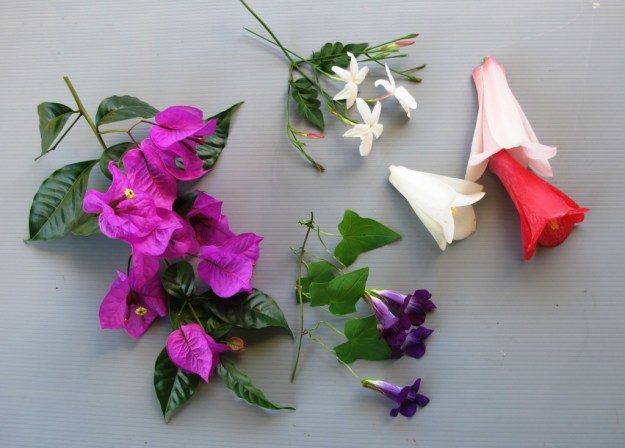 Climbers can be a little bothersome to place. Too many are strangling, invasive things, smothering their host as they scramble to the top, or, like the Rhodochiton atrosanguineus, seeding down in perpetuity. Others are such retiring little dainties that they can be difficult to keep going. Flowering for us at the moment are the bougainvillea (very much in the rampant camp) and one of the more garden-friendly jasmines at the top but we have lost track of which one it is. It has good fragrance, flowers pretty much all the time and is strong growing – bordering on rampant – but not as aggressive as the weedy jasmines. It is planted on the corner of the bedroom once inhabited by our daughter of the same name. Immediately below, the purple flower like a mini streptocarpus is on a soft vine, but its name escapes us at the moment. Well, I have never known it and Mark thinks he raised it from commercial seed but has yet to recall what it is. To the right are the lapagerias – Chilean bell flowers – with their wonderfully long blooming season and obliging habits. Sure it can take several – many, even – years to get a vine established but once there, these are rewarding plants for the shaded side of the house.
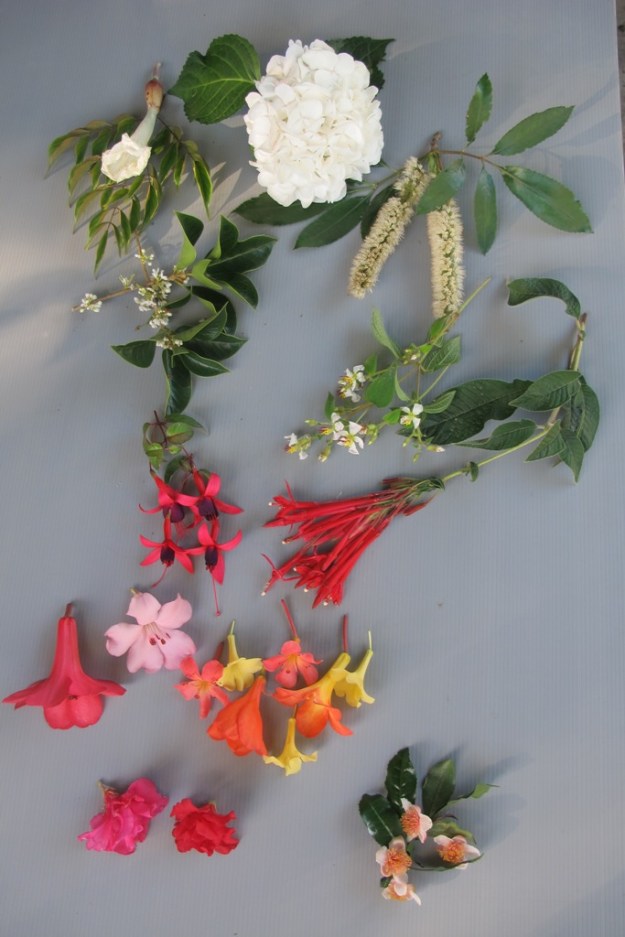 The flowering shrubs and trees are not so numerous at this time of the year. Top row left, we have Radermachera sinica (more on this below), Hydrangea Immaculata which is still at peak rather than that fading over to dusky spent flowerheads, next row down is the fragrant osmanthus (though not sure which one) and the so-called African butter knife plant or Cunonia capensis. Then comes the white flowered tibouchina which seeds down far too freely here but does compensate by flowering pretty much all the time in semi woodland conditions. Fuchsias are not a strong point for us, but the one on the left has been here forever it seems, surviving even falling over, splitting apart and drought. The one on the right is the attractive but dangerously weedy Fuchsia boliviana. Second row from the bottom is a sampling of vireya rhododendrons – have enough of these around the place and there are always some in flower, 52 weeks of the year. In the bottom row are the first of the evergreen azaleas embarking on their marathon blooming from early autumn right through to mid spring and the first camellia.
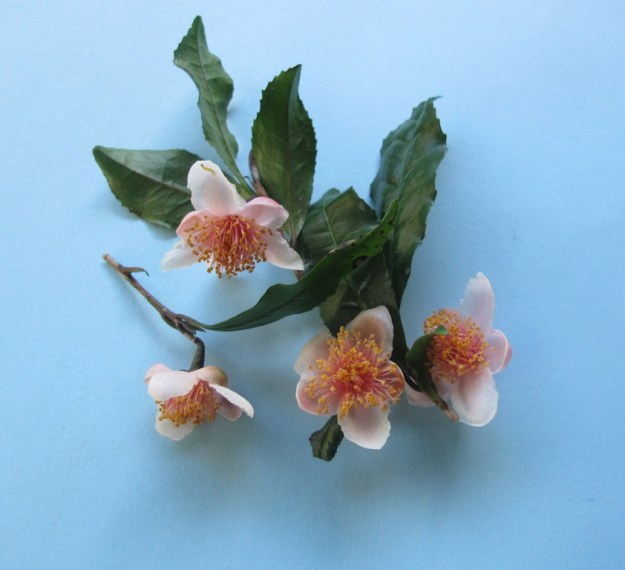 Camellia sinensis will no doubt be of interest to some. It is always the first to flower though with such insignificant blooms that they are easy to miss. This is the tea camellia, and yes, sometimes we do harvest the young leaves to make green tea. White flowered tea camellias are more common and we have a plant somewhere – in the “plant out” area, I think, waiting to get out of its pot.
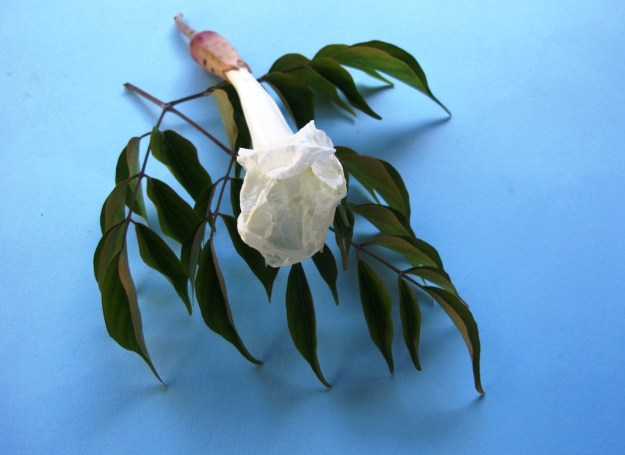 I was pretty thrilled by the Radermachera sinica when Mark alerted me to it in bloom. It has a divine and heady fragrance. The trouble is that it is sub tropical to tropical so treated as a house plant in the temperate world. But it is a tree and ours is shooting skywards. Besides, we don’t do houseplants so we are yet to decide what to do with this plant besides enjoying its current flowering.
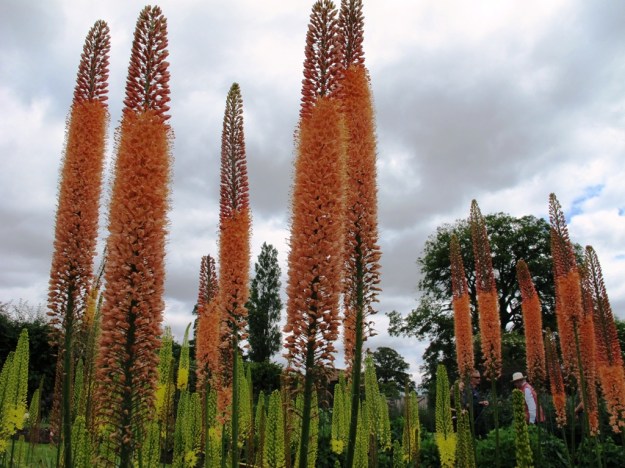
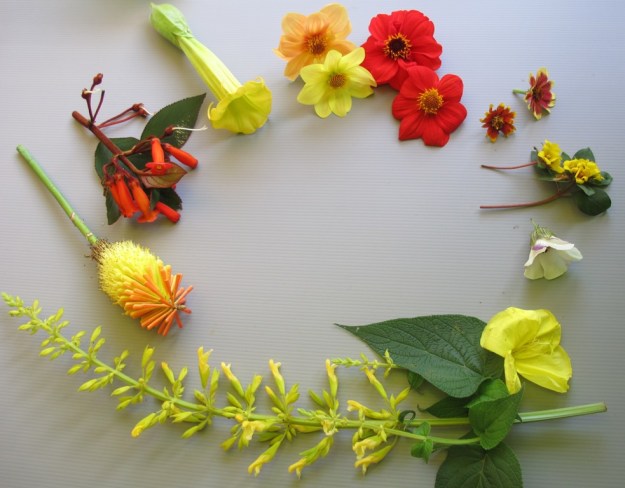 Finally there are the perennials and annuals still in full bloom. In brief in the yellow tones, we start with a damn big yellow salvia at the base and head around clockwise: kniphofia species, one of the gesneriad family whose name we have currently forgotten but which makes an excellent woodland plant, datura, dahlias, simple little autumn zinnias (none of the over-bred, bushy, compact, modern hybrid bedding plants), a handy yellow ground cover which flowers for a very long time and whose name will come back to us at some point, Hibiscus trionum and the common wildflower oenothera which is remarkably rewarding when it comes to blooming on and on.
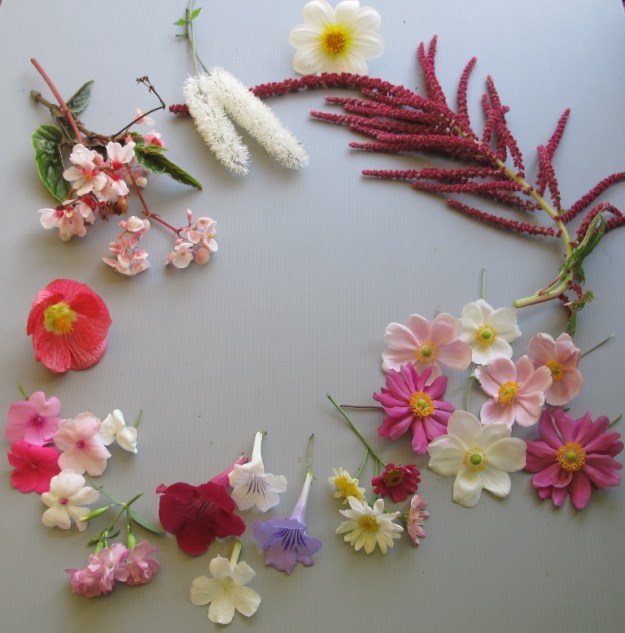 In the pinks and whites, we start at the top with the under-sung white plumes of Actaea racemosa (syn Cimcifuga racemosa) whose fairy candles light up a woodland area, a simple dahlia seedling, the annual Amaranthus caudatus which is self sown, the lovely wind anemones, assorted daisies, streptocarpus (bit of one-upmanship here – we use these as permanent bedding plants in frost-free locations), one of the saponarias, a really old, self-maintaining strain of impatiens that has naturalised in our woodland, a self-seeded abutilon which should have been amongst the shrubs and some rather large and resilient begonias.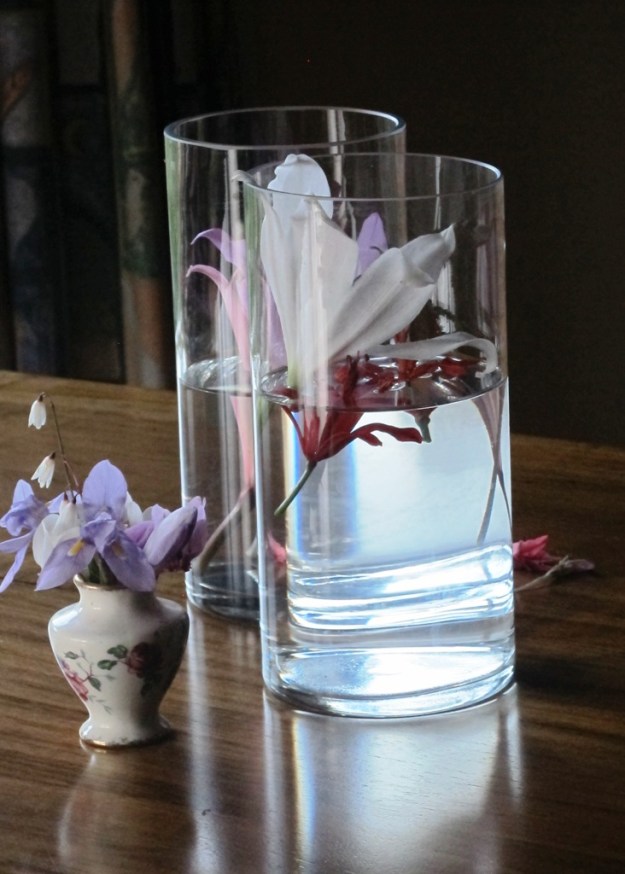

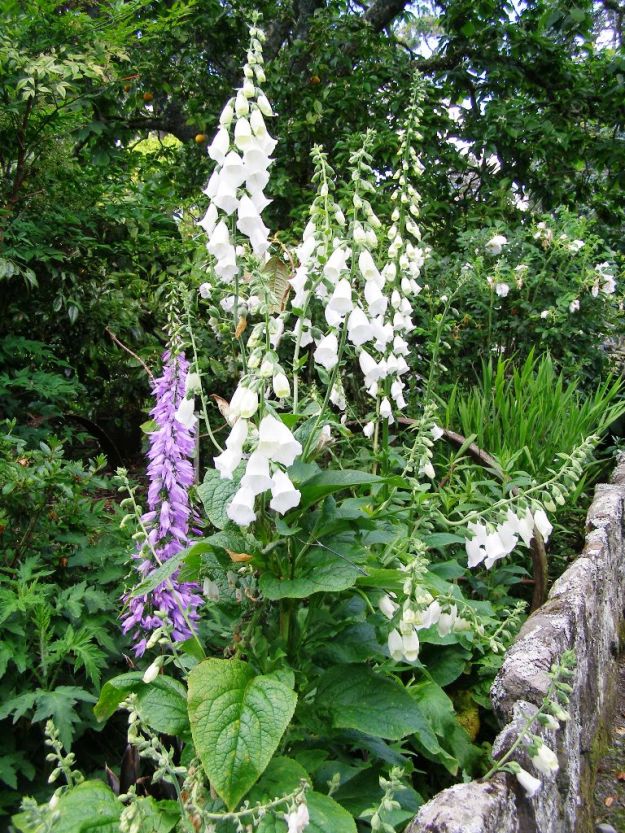

 The whites I wanted for my rose and perennial garden. After a few years, I am now moving them. They are too big and choke and swamp the smaller perennials I have in that area. I have found a couple of spots which they can have all to themselves. I was amused to see English gardener, Keith Wiley – for whom we have huge respect – on TV talking about growing plants in colonies but noting that some plants are so dominant that they do not want to grow in colonies. He cited foxgloves as an example. They are way too thuggish to co-exist happily with many other plants.
 Carol Klein on BBC’s Gardeners’ World, once said that she sorted her foxgloves as juvenile plants – the pink ones had pink veining in the leaves and the crown whereas the white ones were all green. I am not convinced she is right though I went through a stage of culling all pink-veined seedlings. I am happy to stand corrected if somebody has been more systematic in assessing this, but I am pretty sure that I have pink-veined ones flowering white and vice versa.
 Tikorangi The Jury Garden