
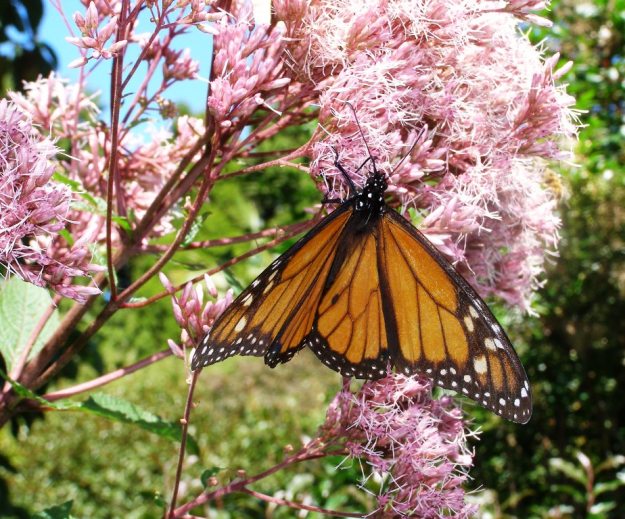
Joe Pye weed is a handy source of nectar for the monarch butterflies. We have always known Joe Pye as a eupatorium but it has now been renamed Eutrochium purpureum
March is the month when we become aware that the days are shortening and night temperatures cooling but autumn? Not yet, at least not in North Taranaki where we drift ever so slowly from season to season. But every year, the same pressure comes on – the plight of the monarch butterflies.March is the start of the critical period. We have monarchs on the wing twelve months of the year in our garden. To a large extent, that is because we take active steps to guard the late season caterpillars. These are the ones that will chrysalis and hatch out as conditions for them grow more difficult. Given the short life span of a monarch butterfly – usually only a month, the internet tells me – it is these late season candidates which will winter over and guarantee continuance through next summer.
In North America monarchs migrate vast distances to over-winter in the mountains of Mexico but our monarchs are not as determined and will stay at home. Occasionally we find a tree where many are clustered together and it is truly a small wonder in our world to see them stretching and flexing their wings in what little warmth there is on a sunny winter’s morning. More often, we will see raggedy specimens bravely feeding from seasonal plants. The so-called Edgeworthia papyrifera (yellow daphne) can be an astounding sight in August. The key to keeping our monarchs close to home is year-round food supplies, which means plenty of flowers with visible stamens and pollen which are a fair indicator of available nectar.
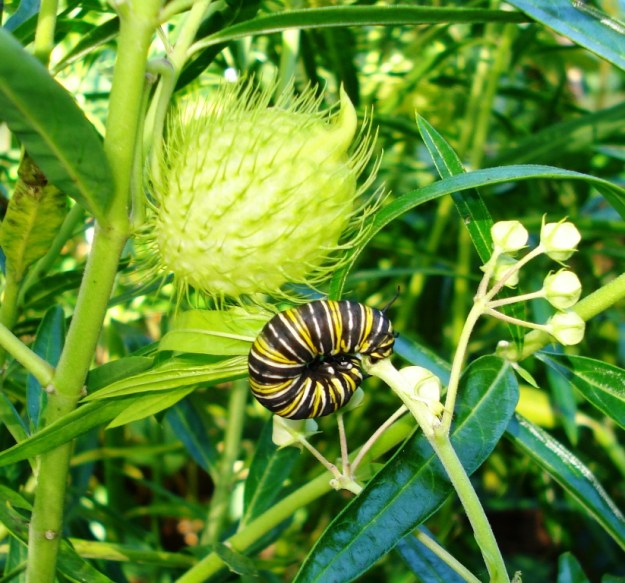
Swan plants are the food source for monarch caterpillars
No doubt many readers are currently suffering the seasonal anxiety of stripped swan plants and a surfeit of caterpillars at all stages of development. The caterpillars are very selective about food sources. Basically they need swan plants. We always knew these as Asclepias fruticosa but I see they have now been reclassified as Gomphocarpus fruticosus for the common one and G. physocarpus for the giant swan plant and I can’t commit either of those names to my memory. You can – and we have in the past – get medium and large caterpillars to chrysalis-size on slices of pumpkin but you have to confine them because they will head off looking for their preferred food source given the opportunity. Is there anything as brave as the sight of a procession of monarch caterpillars heading away in search of more food?
Nowadays we try and reserve plants for late season caterpillars, covering them with netting and taking steps to rid them of the nasty yellow aphid that can decimate the plants. There is a specific aphid spray that does not harm the caterpillars when infestations are really bad. Both Yates and Tui have organic products that target mites, whitefly and aphids. Later in the season, Mark will start his chrysalis rescue programme, carefully tying them with cotton to suspend them safely because they can rarely hatch successfully if lying on the ground.
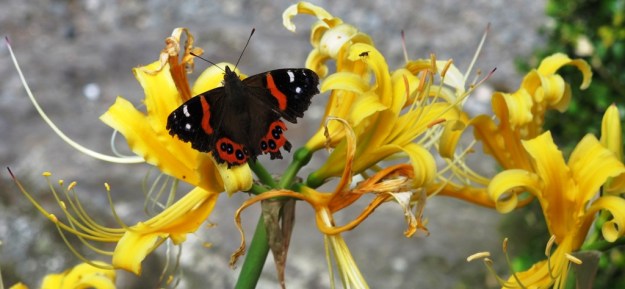
We are working to establish the admirals in the garden, seen here feeding from Lycoris aurea last autumn
We are finally getting patches of stinging nettle established. The only reason for this is to encourage the admirals, both red and yellow, to move into our garden. It is not our large native tree nettle – Urtica ferox – but one of the dwarf ones which has turned up which we are allowing to stay. Unlike the monarchs, which are self-introduced to this country and were first recorded around 1840, our brand of red admirals are truly indigenous and not found anywhere else in the world. Because their host plant is not as obliging and hospitable as the monarch’s swan plant, they need all the help we can give them. That said, there was a news item that came through at the start of this year reporting that the US Fish and Wildlife Service is taking steps to protect the monarch butterfly under the Endangered Species Act. Loss of habitat and modern farming methods have caused a massive drop in the monarch population and there are fears that, without intervention, they may die out.
Some utilitarians may ask what useful contribution butterflies make to human life. It is true that there their direct contribution does not equal that of bees. But as gardeners, most of us set out to cultivate transient and ephemeral blooms for no other reason than that they are beautiful and bring delight. Butterflies are beauties of the insect world and their continued presence is a good indicator of a healthy ecosystem.
New Zealand has an active Monarch Butterfly Trust with a comprehensive website. While the obliging monarch is their main focus, they cover the whole range of butterflies found in New Zealand (which is not large by international standards) and they touch on the moths (which are considerably more numerous here but less appealing to most people). You will find answers to many specific problems on that site. While the obliging monarch is their main focus, the site has information on a whole range of butterflies found in New Zealand, which is not large by international standards, and they touch on the moths, which are considerably more numerous here…but perhaps less appealing to most people.
 First published in March issue of New Zealand Gardener magazine and reprinted here with their permission.



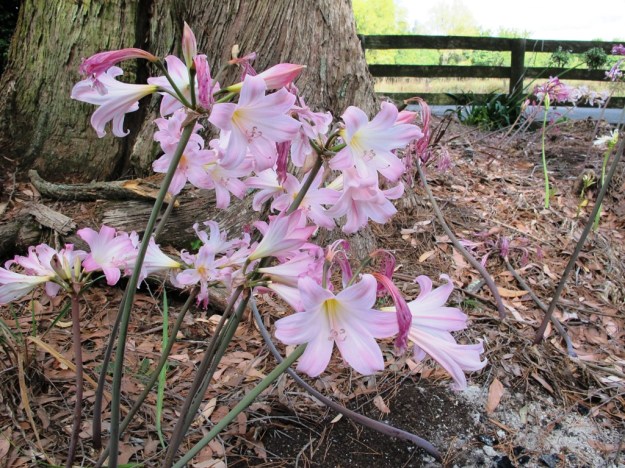 We are inching gently into autumn and the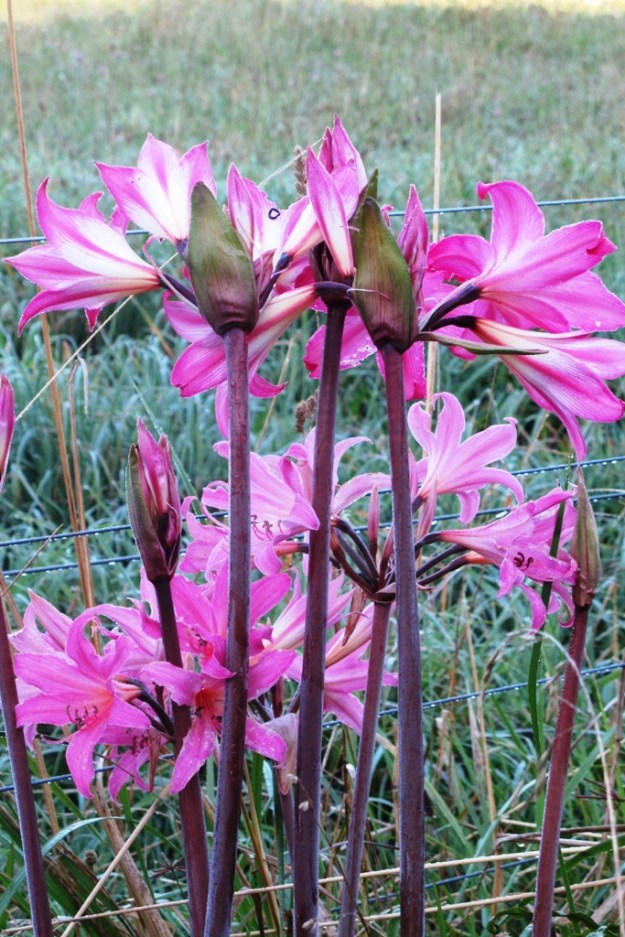
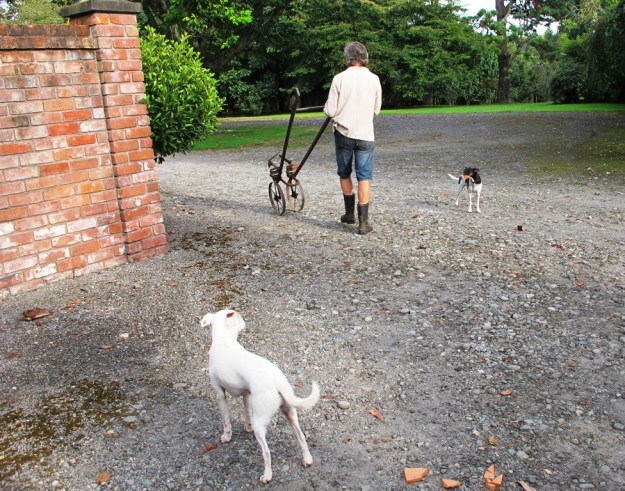 And finally, I leave you with Man, Planet Junior and Dogs this quiet Sunday morning – Mark heading over to his vegetable patch with a treasured implement from times past which he still uses on a regular basis.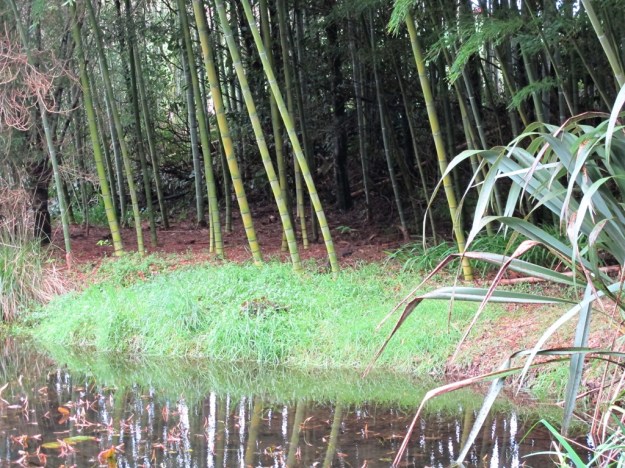
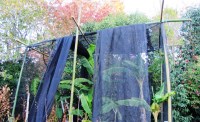
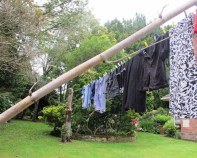 ot sufficiently inspiring to ensure that they became a dietary staple. It is, however, a useful source of very long and remarkably stable poles. One is a prop for the washing line. Mark uses it to build shelter frames for his bananas and even to make super long handles for the rake he uses to clean out our ponds. Inspired by our awe of bamboo scaffolding in Hong Kong, seen on high-rise buildings, he threatens to construct our own scaffolding but I think it is all talk.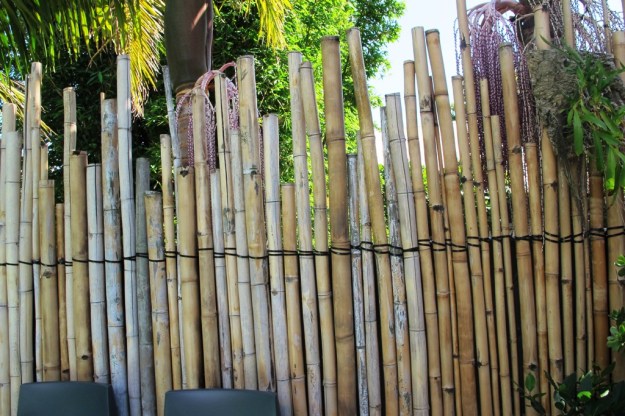
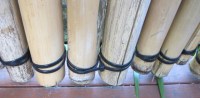

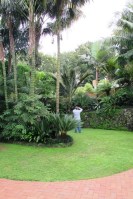 Also seen at Heroic was this crafted bamboo gate in a Mount Eden garden, which was beautifully executed and appropriate to the restrained, immaculately maintained sub-tropical back garden. This is located in the heart of a densely populated urban area but the garden gives no hint of that. The gate has clearly been coated, presumably both to prolong its life but also to stop the weathering process and preserve the smart, new appearance. Sealing the bamboo will also stop the growth of lichens.
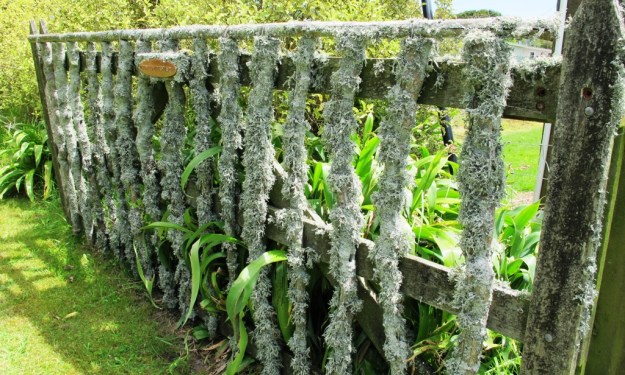 At the other end of the sophistication scale, I photographed these two bamboo gates in an Okato garden last spring. These have been added on to existing gate frames in a garden where many different bamboos are grown, and then left to weather over many years. You can see the high humidity environment and clean atmosphere in our coastal Taranaki that encourages such abundant lichen growth. As long as the bamboo is kept off the ground, it can last a surprisingly long time.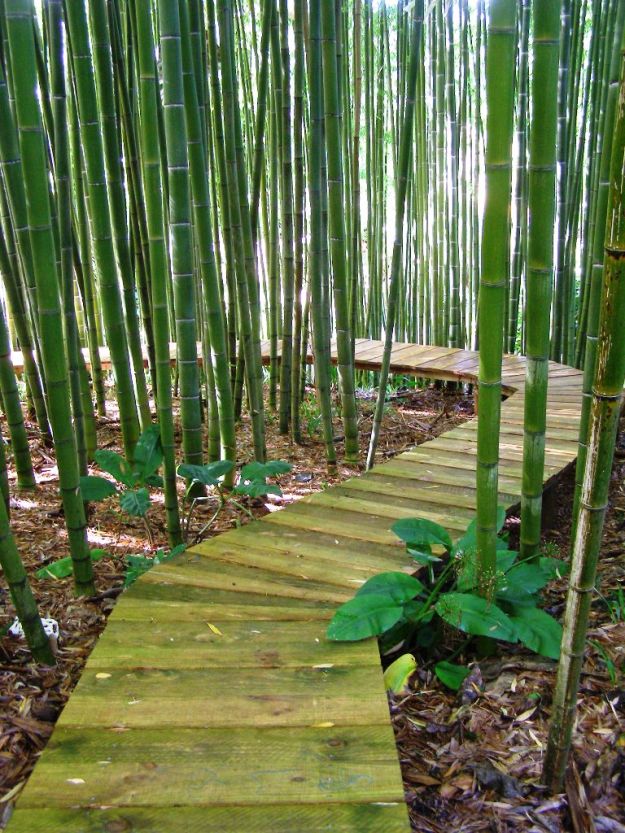
 Overseas gardeners find our attitude to agapanthus perplexing. These plants are much more prized elsewhere, whereas we largely consign them to roadsides. It is much rarer to see them used as garden plants in New Zealand, even though there are some very good named cultivars which are sterile, so don’t set seed. Their future is sometimes under threat as they are seen by some to be noxious weeds. And they are very difficult to get rid of if you no longer want them.
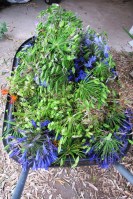 This leaves the problem of what do with the seed heads. While we make a hot compost mix, it is not always hot enough to destroy viable seed. In the past, I have been guilty of putting seed and noxious weeds out for rubbish collection but we now think that sending even very limited amounts of green waste to landfill is not justifiable.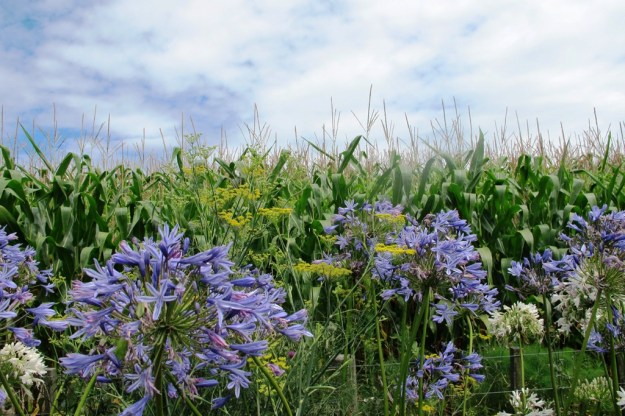
 Tikorangi The Jury Garden