Garden adornment

Soaring herons

Soaring herons

The owners of this garden admitted to me that they were very nervous about what I would think of their garden, given my strong opinions about over-ornamentation. This did not stop them from urging me to visiting. They are opening their garden to the public for the first time this spring and want all the input they can get because they are determined to do things properly and ensure they deliver an exceptional visitor experience.
026
The garden is still having a lot of work done on it but the garden sculpture and decoration were a revelation. They have some really lovely pieces. I even coveted some myself and ,from an under-ornamented gardener, that is something. What made me stop in my tracks was the exceptional skill shown in placing these pieces so that they enriched the scene without dominating and without the transparent connivance of creating the dreaded “focal points”. To place an eclectic collection of art works so that they enhance and belong in the location is a rare skill. It made me realise that it is not that I don’t like sculpture or decoration in a garden. It is that it is rarely placed well to benefit the garden and the location as much as the work itself.

I think both garden owners (and they are clearly a close team) have an exceptional eye. A working life spent in upper-end retail must have assisted in developing skills in display and design. They also give credit to their architect son and placing these decorative pieces is clearly a matter that warrants considerable thought.
016029
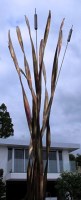
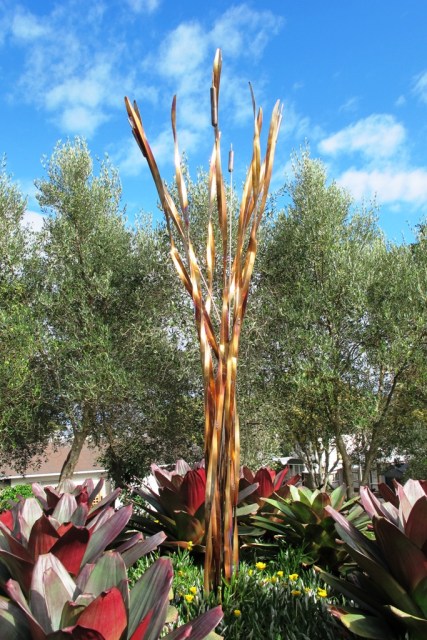
The one piece I really coveted was this structure from super-heated stainless steel. The reflections and colours were simply lovely. I would have this in my garden. I could also be be mighty tempted by the herons above. “Tell me you don’t have coloured ceramic balls,” I said. Over the years, I have developed considerable dislike for the use of these mass produced and thoroughly useless items from the villages of Asia which are widely sold in this country by purveyors of cheap ornaments. Blue has always been the most popular colour in the area where I live, but you can have red or orange, too, I found. I am unconvinced that these items justify the grandeur of a plinth but it all comes down to personal taste in the end. Yes, these people did have colour balls but they were not at all like this threesome I photographed in other people’s gardens


Hirst Cottage (3)042049

Theirs were considerably larger, hand crafted, detailed and placed discreetly.

019

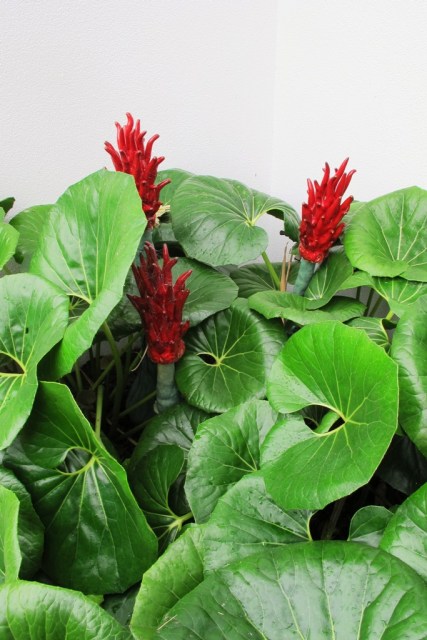
008The ceramic detail amongst the simple planting of Ligularia reniformis, set against a stark white wall, added an understated detail that enhanced an otherwise predictable scene.

021The large lego man was a pretty strong statement and not, I admit, one I could ever imagine in my own garden. But the owners love it. As parents of five children – all now adults – lego featured very large in their lives and this sculpture is placed in an intimate and enclosed section of garden which opens up from the family living area. Its placement was superb and it brought great delight to the owners.

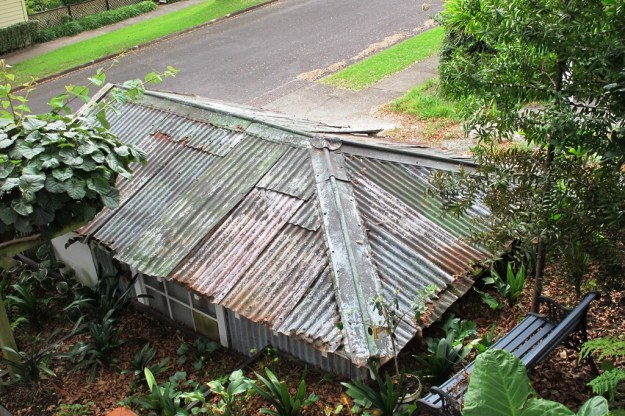
In a setting with a large, modern, sharp-edged, architecturally designed house and a heavily structured garden, the decision to leave the old rusted garage in place as an installation was simply inspirational. It gave a tension to the scene which anchored the modern into its past. The owners commented that people either responded with horror at them leaving something so old and scruffy or they were delighted as I was.
025
This garden is open for the Powerco Taranaki Garden Spectacular in the first week of November this year. Visitors might like to go and learn from their skills in integrating sculpture and ornamentation into the garden. It is done as well as I have ever seen and considerably better than most.


Garden lore – the autumn trim of the hellebores

???????????????????????????????I am cutting all the old foliage off the Helleborus orientalis and I am pleased I have my timing right. Few plants are putting out their new foliage yet. We never used to do this. Indeed, for decades, the main hellebore border (about 30 metres long) was just left to its own devices. Then I read about NZ hellebore expert, Terry Hatch, cutting off all the foliage – even putting a lawnmower through them, though you would have to get your timing absolutely right to carry out this approach.
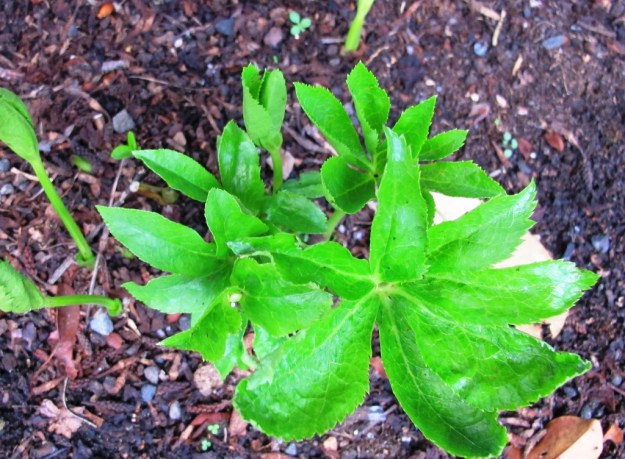
I tried it and the hellebore display was hugely more charming in winter because the flowers were visible and the fresh foliage was light and bright. It also gave more light to bulbs beneath the plants and cleared out the aphid infestations we can get in the foliage. While about it, I weed out the multitudes of seedlings we get beneath. We do not need yet more hellebores in this area which is already quite congested.

Last year, Mark demurred. He wondered if cutting off all the foliage from evergreen plants would weaken them over time. Fortunately, when we headed over to England on our summer garden trip, we stayed with a new friend. Diana is one of those wonderful English gardeners – an amateur enthusiast but with a specific technical knowledge allied to practical experience which exceeds that of many professionals. We were happy to accept her opinion and indeed she does clean off all the old foliage.

I get dirty knees and do it all with grape snips. One year we tried putting the strimmer or weedeater over the bed. While it was speedy, I didn’t like the chewed stems it left and it didn’t do the weeding either. The trick is all in the timing. Leave it much later and it takes much longer because it involves trimming carefully around fresh new growth. The rewards will come in a few weeks because I can see fresh growth and flower stems starting to push through. We used to follow up with a compost mulch but the soil is now so rich in humus that this is no longer necessary.

I only carry out this extreme trimming on H. orientalis. The other species we grow just need an occasional trim of spent stems.
???????????????????????????????

The April garden – vireya rhododendrons

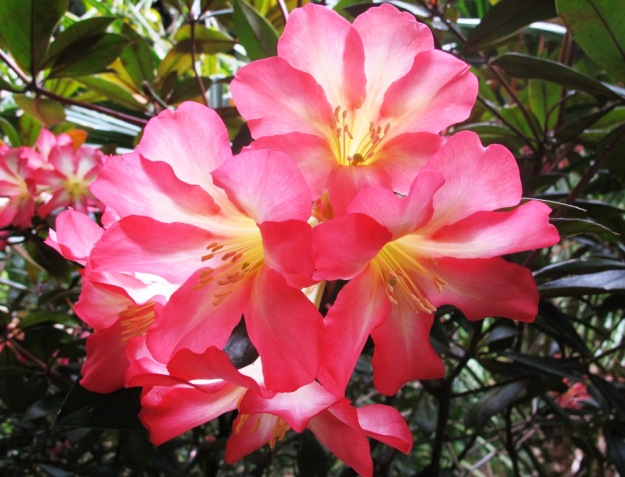
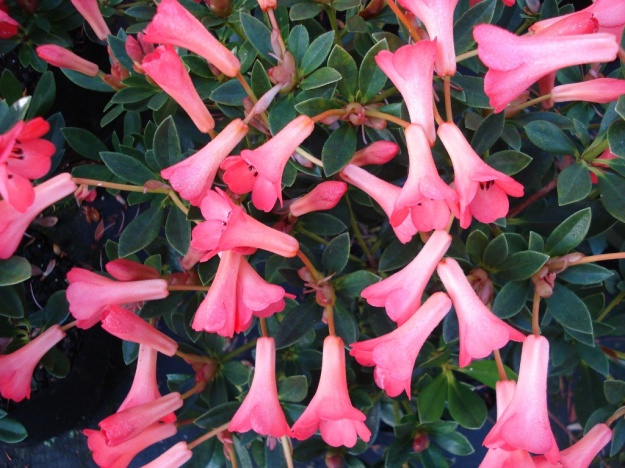
Pink Jazz, one of Mark’s hybrids that is standing the test of time here as a healthy garden plant. It was named for our elder daughter, Jasmine, who had a passion for hot pink in her teen years.

Pink Jazz, one of Mark’s hybrids that is standing the test of time here as a healthy garden plant. It was named for our elder daughter, Jasmine, who had a passion for hot pink in her teen years.

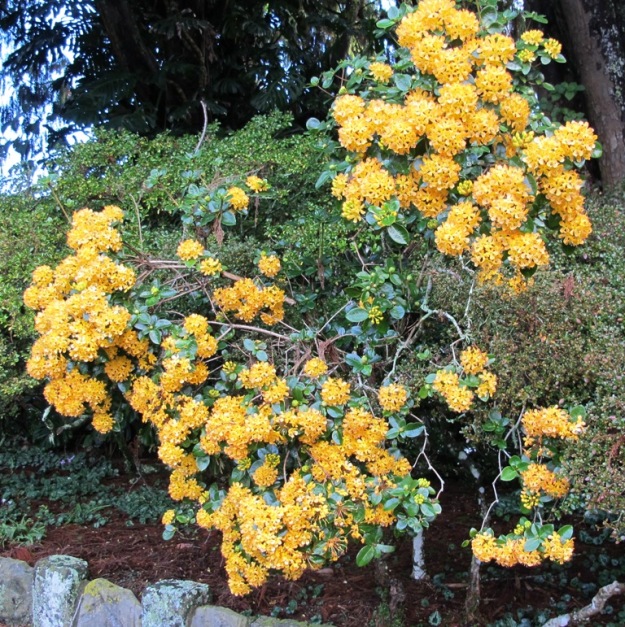
Gardening is as driven by fashion and trends as many other pursuits. It is vireya rhododendrons that brought this to mind. Back in the late 1980s and 90s, they were a seriously hot ticket item. Because they are really easy to propagate, the market was saturated with small plants surrounded by big hype and an endless stream of new varieties being unleashed on an eager buying public. The big luscious looking ones with heavy, felted foliage and big, fragrant trumpets were the most sought after. Here was tropicalia at home even though New Zealand does not have a tropical climate.

Back then, we had a commercial nursery and vireyas were one of our big lines. We produced thousands of them every year and Mark had a full scale breeding programme running on them, naming new cultivars at a cracking rate. I can tell you that they were one of the easiest lines to propagate with the highest success rate from cutting, taking half the time to get to a large grade than the hardy rhododendrons and camellias. It was all downhill from then on. They needed the most intensive spray programme of any plant we produced and even so, there was a high death rate before we ever got them to the market. They are vulnerable to almost every disease that is going, they have pathetically small root systems to support quite abundant top growth, they are frost tender and needed full-scale frost protection in commercial production – even under shade cloth – and they can die almost overnight.

I recall the odd visitor asking the names of certain plants and Mark would toss off that it was a Vireya wiltanddieonyou. Because so many did just that – wilt and die. The species were particularly touchy along the big luscious ones that everybody wanted.

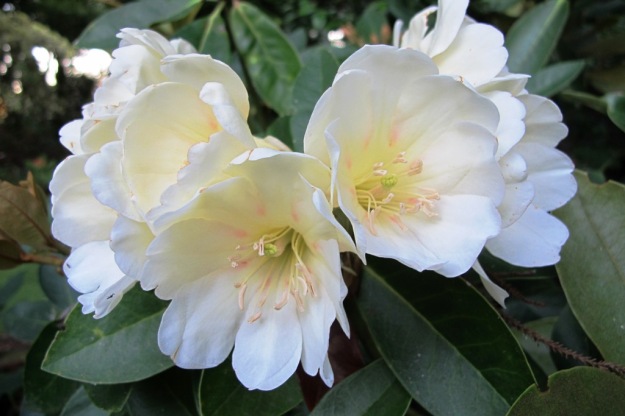
R. konorii is a species with the desirable traits of large flowers, strong fragrance and heavy foliage but the resulting hybrids are not always easy to keep growing well. This is an unnamed one of Mark’s that is still doing well in our garden.

R. konorii is a species with the desirable traits of large flowers, strong fragrance and heavy foliage but the resulting hybrids are not always easy to keep growing well. This is an unnamed one of Mark’s that is still doing well in our garden.

But we would not be without them in the garden. If you have enough of them, you can guarantee that there will be vireya rhododendrons in flower all year round. They don’t get large. They fit in well to subtropical woodland conditions and they don’t need a whole lot of attention. We accept that some will suddenly die, even after many years and we don’t expect every plant to thrive. Those that do, make a worthwhile contribution.

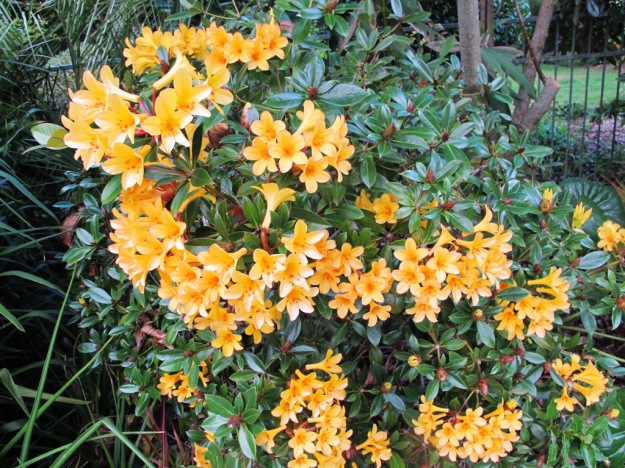
 The late Os Blumhardt had a major breeding programme on vireyas and gave us a number of his seedlings, including this good performing one in our swimming pool garden. It is reliable and healthy rather than outstandingly showy


The late Os Blumhardt had a major breeding programme on vireyas and gave us a number of his seedlings, including this good performing one in our swimming pool garden. It is reliable and healthy rather than outstandingly showy

Because vireyas originate from near the equator where day and night length remains pretty even all year round, their flowering is not triggered by changes in day length. This is why they tend to flower randomly and for extended periods, at times many months although we get the best blooming in autumn and spring and that will show up from this month on. With our free draining volcanic soils, we just grow them in the ground.

Common wisdom, particularly in Auckland, was that vireyas are epiphytic so best grown either as an epiphyte on established trees or in containers with their roots tightly confined. Ponga pots used to be rage, maybe still are in some circles. While it is true that in the wild, many species are ephiphytic, the vast majority that are sold are modern hybrids with a distant connection at best. What they want is excellent drainage without getting too dry. Only hard frost will kill a vireya faster than wet roots in a heavy, clay soil. But if you have the roots heavily confined, they can dry out too much and start to look hard done by and scruffy.

Jiminy Cricket is another of Os Blumhardt’s hybrids and is a sister plant to Saxon Glow and Saxon Blush which are widely available

Jiminy Cricket is another of Os Blumhardt’s hybrids and is a sister plant to Saxon Glow and Saxon Blush which are widely available

These days, we rank ongoing survival, good bushy growth and an abundance of bloom above other characteristics – often features of the smaller flowered, less extravagant looking cultivars. These are the ones that are standing the test of time as garden plants. The oldest vireya in our garden is the plant of R. macgregoriae that Mark’s father, Felix Jury, brought back from New Guinea in 1957, kickstarting the breeding programme. Astonishingly, it is still alive and healthy when many others have fallen by the wayside.

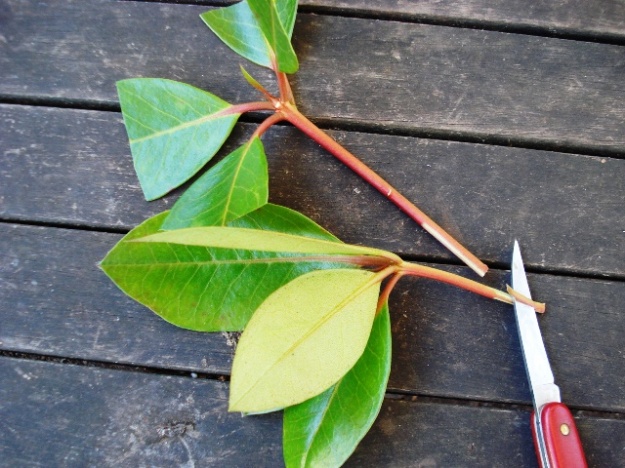
???????????????????????????????If you want to try growing plants from cuttings, vireyas can root without special facilities and equipment. You need to use green stems which are firm, not floppy. Cut off a sliver (called “wounding”) on two sides of the stem of the cutting, extending for 2 – 3 cm. Unlike most plants, the roots will form from the wound or callous, which is why you want two to get a balanced root system. Cut the leaves in half to reduce water loss and stick in potting mix. Keep the pot in shaded conditions until roots start to form – usually within about six weeks.
First published in the April issue of NZ Gardener and reprinted here with their permission.

R. macgregoriae is still going strong in our garden after 60 years

R. macgregoriae is still going strong in our garden after 60 years

An understated beauty – autumn seed heads

Clematis at top, left to right  rhododendron, Schima khasiana, Hibiscus trionum, Schizophragma hydrangeoides

Clematis at top, left to right rhododendron, Schima khasiana, Hibiscus trionum, Schizophragma hydrangeoides

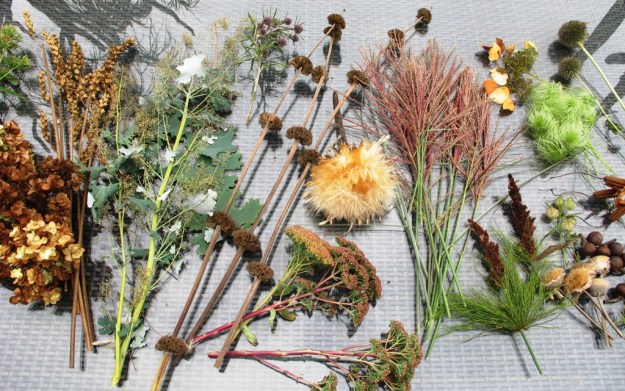
When I was doing my informal census on autumn flowering plants last week, my eye kept being drawn to equally attractive seed heads. I see I recorded some of these last year when I was still writing for the newspaper , but it has taken me quite a few years to get my eye in for these seasonal pictures of understated beauty.

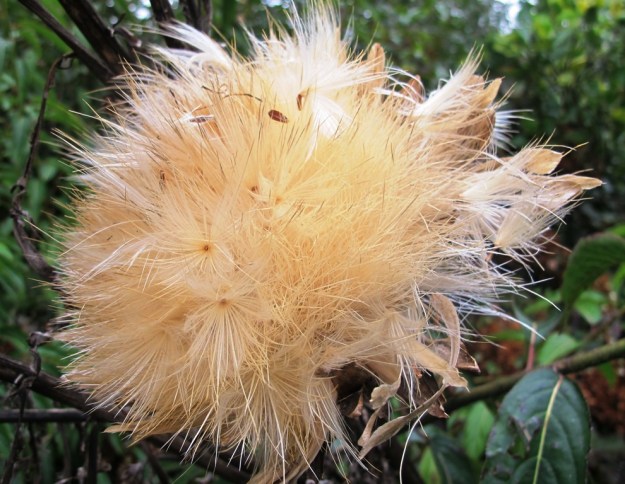
Cardoon!

Cardoon!

It is hard to beat the big fluffy heads of the cardoon. I don’t do dried flower and seed head arrangements for indoors, but if you are thinking that way, be warned that all that soft fluff is designed to detach easily and float away in the lightest breeze to disperse. Indoors this head will fall apart very quickly.
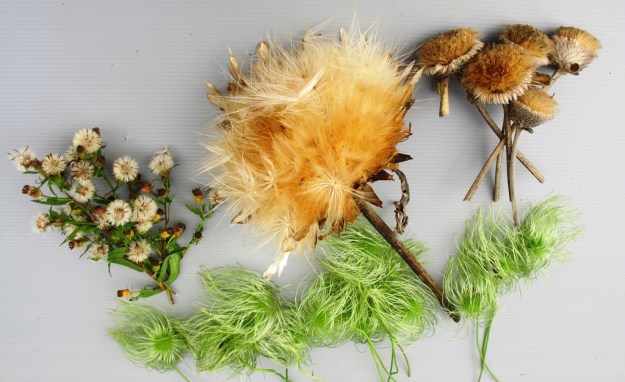
???????????????????????????????The aster to the left has a similar fluffy seed head, as does the pachystegia to the right. Along the bottom are the highly decorative clematis seed heads – in this case C. tangutica.
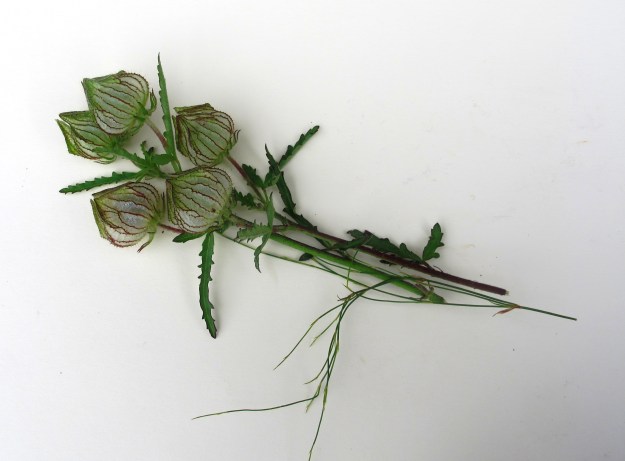
The lovely Hibiscus trionum seed heads

The lovely Hibiscus trionum seed heads

Rhododendron sino nuttallii seed head

Rhododendron sino nuttallii seed head

Phlomis russeliana at top, one of the echinops below

Phlomis russeliana at top, one of the echinops below


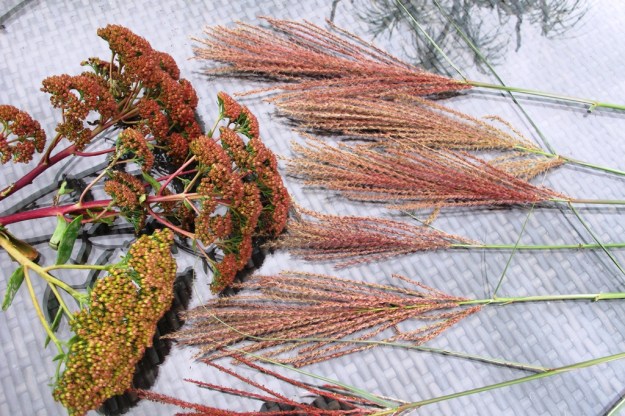
Sedum and miscanthus

Sedum and miscanthus

Francoa and Hydrangea quercifolia 'Snowflake'

Francoa and Hydrangea quercifolia ‘Snowflake’


I have often read advice to leave all seeding plants standing until early spring as they are a valuable food source for birds. This is cold climate advice that is much less of an issue in our temperate climate and our own situation which is rich in food sources all year round. However, we do get a great deal of pleasure watching the quail feeding from an assortment of seed sources. Pansies appear to be a particular favourite. We try and dead head problem plants that seed down far too freely but I am cultivating a more relaxed attitude to others. It is all about the cycle of nature and the change of season.
???????????????????????????????

Sole survivor – Tecomanthe speciosa

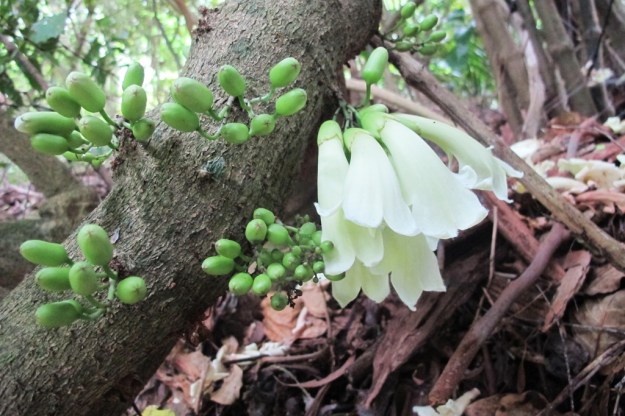
Tecomanthe speciosa - a sole surviving specimen was found in the wild

Tecomanthe speciosa – a sole surviving specimen was found in the wild

Plants cannot come more endangered than our native Tecomanthe speciosa. Only one has ever been found in the wild and that was back in 1945-6 on Manawa Tawhi, the biggest island of the Three Kings group off the northern coast of New Zealand. Blame the goats which were introduced to our offshore islands, as I understand it, to provide food for shipwrecked sailors back in the days when this was a more common event.

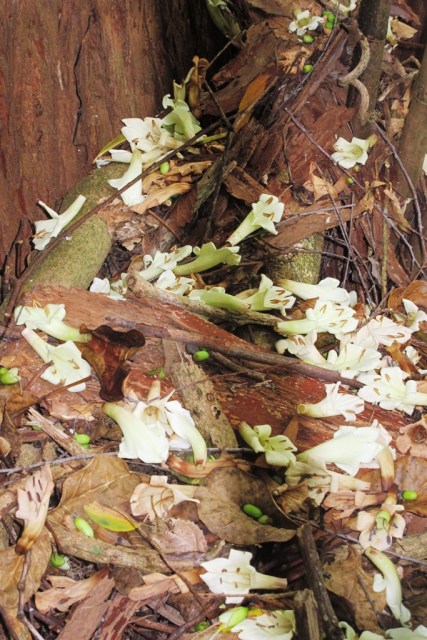
I have a fondness for carpets of fallen blooms

I have a fondness for carpets of fallen blooms

Fortunately T. speciosa is not difficult to propagate and it is its use as a garden plant in frost-free areas of the country that has ensured its survival. I usually miss the autumn flowering on our vines because most of it occurs about 10 metres up in the sky where it has clambered its way up to the light on one of our road boundaries. I only noticed it this season because I happened across the flower carpet below and looked more closely. I must admit that I did not realise it put out clusters of blooms on bare wood in its lower reaches too.

Tecomanthe  venusta

Tecomanthe venusta

There aren’t many tecomanthe species, all of which are members of the bignoniaceae family and evergreen. There seems some agreement on the number five, maybe six. There is our T. speciosa, one maybe two from Queensland in Australia (T. hillii is the most recognised) and three from New Guinea. We have two New Guinea forms here. The first is what we call T. venusta (syn dendrophylla).

It is distinctly tropical but shows the same characteristics as T. speciosa when it comes to putting up strong tendrils and flowering in clusters from bare wood.

Tecomanthe montana

Tecomanthe montana

We had T. hillii which was sold commercially in NZ some years ago but it didn’t look like too much of a gem here so we didn’t take care of it and no longer have it. The real gem for us is not even on the usual lists of species but we have it under the name T. montana from New Guinea. It flowers in mid spring and is much finer leafed, finer growing and more floriferous than its larger two cousins we also grow.

Our native speciosa appears to be the giant in the family. The vines on our well established plant are as thick as human limbs. It also has much larger, glossy leaves. The best plants I have seen have been trained and kept pruned along the verandah fronts of houses. You need a very strong structure to hold them and to be consistent on pruning but it does at least get them flowering well at a level where it is visible.

Vines are large as human limbs on our native T. speciosa

Vines are large as human limbs on our native T. speciosa

On the same botanical survey of the Three Kings that the sole tecomanthe plant was found, another sole remaining specimen of a tree species was found – Pennantia balyisiana.