Introducing (drum roll please) Daphne Perfume Princess

Mark's Daphne Perfume Princess

Mark’s Daphne Perfume Princess

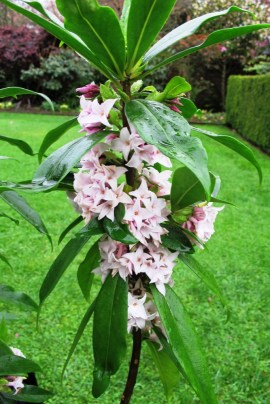
By the time a new plant bred by Mark finally gets released onto the market, it has been a part of our lives for so many years that it no longer feels new or exciting to us. Mark has long since moved on to the next generation of plants. But we remain excited by this daphne, named Perfume Princess.

Perfume Princess to the left, centre is a large flowered D. odora 'Grace Stewart', right is a normal sized Daphne odora

Perfume Princess to the left, centre is a large flowered D. odora ‘Grace Stewart’, right is a normal sized Daphne odora

It is “just a daphne”, as Mark is wont to say, but what a daphne. For starters, the flower is significantly larger than comparable odora types. The flowering season is also a great deal longer. This is both the first and the last daphne to bloom each year in our garden. The plant itself is noticeably more robust than other odoras. It looks like a particularly healthy odora – and many gardeners will know that the common daphne is not remarkable for vigour, health or indeed longevity so any improvement in that area is welcome. It smells like a daphne and is that not why we grow them?

But it also has the capacity to flower down the stem when growing strongly. I describe it as the eucomis look. This characteristic adds a great deal to its flower power. So yes, even we are still excited by this new daphne.
046The eucomis look


Back around 1996, Mark was taken to meet UK breeder, Robin White. Some readers will know him for his Daphne Eternal Fragrance although back then, it was his work on the Party Dress series of double hellebores that fascinated Mark more. However, that visit inspired Mark to renew his efforts with daphnes after he had been disappointed with initial efforts. It was not to be as straightforward as other plant genera he works with. The progeny were few. Poor Perfume Princess was nearly lost before she ever got to show her strengths and that, we think, would have been pity.

Please, admire my restraint in not using a naff heading such as “Birth of a Princess”. Any coincidence with the arrival of the British royal baby was just that – coincidence.

Perfume Princess was released in New Zealand last weekend, launched in Australia at the Melbourne Flower Show and is available in UK and Europe. It has yet to be released in North America. It is managed on our behalf by Anthony Tesselaar Plants. We do not handle the production or distribution so any enquiries regarding availability need to be directed to them.
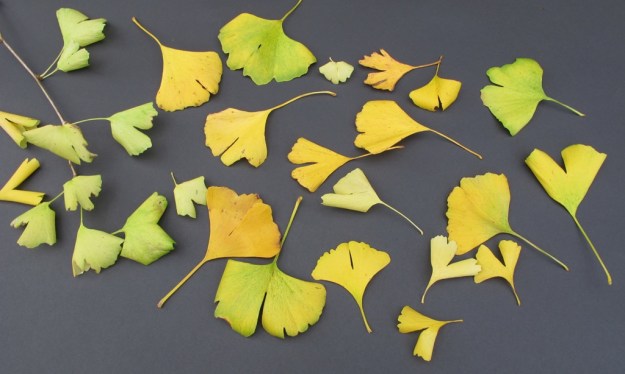

Garden lore: another use for gingko leaves

Ginkgo leaves

Ginkgo leaves

Bay leaves – from the culinary bay tree or Laurus nobilis – are so widely recommended as a means of discouraging pantry moth that I assume this lore has been tested by time. I have to admit to not having tried it myself but I think the idea is that you strew bay leaves in your pantry. Given that pantry moth can cost quite a bit in spoiled food, it may be worth a try if you are dogged by these pervasive critters.

I had to burn books. so badly infested were they

I had to burn books. so badly infested were they

What I did not know until I read this month’s NZ Gardener magazine is that gingko leaves are reputed to repel silver fish and whatever moth it is that likes to lay its eggs in books. I shall be trying this but I imagine it will take a year or two before I can comment on its veracity. We are in the process of building a designated library area and this has involved removing every book in the house into stacks. I was a bit shocked to find three titles amongst the teen fiction in our son’s bedroom which were disintegrating due to insect infestation. Poor Philip Pullman and Robert Jordan – such an ignominious end to be burned but inspection ascertained that nobody would ever want to read these books again. I shall be placing ginkgo leaves inside the books that were adjacent to these titles and particularly inside one which is only lightly damaged.

Now I guess the question to be asked is whether gingko leaves will also repel pantry moth.

It was only last year when I was still writing for the Waikato Times, that I featured the fascinating gingko trees.

A specious and fallacious argument

Native, but not native enough, some say

Native, but not native enough, some say

“Those pohutukawa aren’t worth saving. They not even native to the area.” So runs the latest argument for cutting out the Waitara riverbank pohutukawa. This simplistic argument is just wrong on so many levels but those who espouse the line think it sounds right.

Apparently they think (though I fear they do not in fact think at all, except how to trump those they decry as *environmentalists* – or The Green Taliban, even – with what they think is an appropriate argument) that only vegetation that existed in pre-European days should be saved. Trouble is, there’s precious little of that left in this country and none in this particular area of the Waitara River.

Pohutukawa are of course native to New Zealand. In fact their pre-European spread has been traced to the Mimi river-mouth area which, as the crow flies, is maybe 15km north of the Waitara River. Not close enough, apparently, for those who decry the trees we are trying to save. No matter that 200 years have passed and the natural spread southwards would likely have continued without human intervention. And let us not factor in the small matter of evidence that Maori recognised the use of pohutukawa for river bank retention and deliberately took steps to spread the plant further. Nope, they are not native to the Waitara so they can be felled with impunity.

The logical extension of the argument is that NO tree is worth saving unless there is incontrovertible evidence that it occurred naturally in that particular location in pre-European times and has the correct provenance. That could have dramatic ramifications for significant trees all round the country.

The chainsaw brigade see the predominantly African planting in the foreground as being of more value than the established pohutukawa seen in the background

The chainsaw brigade see the predominantly African planting in the foreground as being of more value than the established pohutukawa seen in the background

No matter that the planting adjacent to the threatened pohutukawa is predominantly exotic South African, full of aloes, agaves and succulents. I am sure these folk will think that is worth preserving because it cost good money.

No matter that the Waitara River bears no resemblance at all to what it must have been like in 1800. The oh-so modern engineer is determined to render it a bare, grassed canal as testimony to his engineering skills. You know, using grasses that aren’t even native to this country. There is no plan to restore the plantings to how they were before human intervention. In fact, these folk who decry the existing trees as “not even native to the area” are almost certainly totally ignorant of what was native to the area.

Do these proponents of ecological purity ensure that any plant they choose for their own garden is an eco-sourced native plant? Nah. All they are trying to do is to discredit those who wish to retain the trees by using an argument that they think sounds frightfully clever.

The trees behind are to be clear felled. Removed entirely.

The trees behind are to be clear felled. Removed entirely.

Because, according to local Community Board member Joe Rauner, it is going to “look amazing” when these trees behind the concrete wall are felled soon. Note the supports going into the top of the concrete wall (the Berlin Wall of Waitara or the Graffiti Wall as some of us call it). That is to be overhanging security fencing which always means barbed wire. Visualise the backdrop without a single tree left. That is what is coming.

Postscript: I wonder if these naysayers who claim “not native enough to warrant saving” would use the same argument against protecting and valuing the kauri trees growing around our area. By their definition, they are even lower value than the Waitara pohutukawa because they certainly did not grow anywhere near this far south in pre-European times.

Human design vs nature’s ways

I have been waiting for an opportunity to use this photo - see the final paragraph below

I have been waiting for an opportunity to use this photo – see the final paragraph below


“… he relays a story … about living with the American landscape architect Dan Kiley on the shores of Lake Champlain in Vermont in the late 1950s, and of the Kiley’s eight children, ‘living wild like an independent tribe’. Kiley once got his children to help him with tree placement for a project by giving each one a rubber or metal stamp with a different tree on it, then telling them them to bang their stamps down wherever they chose across a large sheet of paper until told to stop. The different tree types were mixed and dispersed in a way that avoided any of the tired symmetries of classical, beaux-arts garden planning: Kiley was ‘looking for actions that didn’t look contrived’.”

Allan Smith, What I learned from Momo: or, When is a house a stand of trees? (reprinted in Tell You What: Great New Zealand Nonfiction 2015).

It was a light-bulb moment for me when I read that paragraph this week. Not because it was an attempt to get away from the rigidity of classical symmetry, but because I am guessing that Kiley realised how very difficult it is for people to recreate genuinely random sequences in gardening.

I first became aware of this when I asked one of our nursery staff to plant out the surplus black mondo grass as a carpet beneath an orange tree. She felt the need to create a pattern, to plant in an arc. I sighed and replanted it myself, putting this down to her inexperience.

Years later, I visited a gardening friend to whom I had given a large surplus of hosta divisions and in her informal woodland, she had instinctively planted in straight rows alongside the path. So it is not inexperience that leads many, if not most, to plant in an orderly fashion, even in informal settings. I think it is more visceral than that – a human instinct to impose order on wild and random nature.

I was recently asked for ideas to under plant a tightly defined, quite formal planting of fruit. As the owners had mentioned they had a beehive on order, I suggested bee and butterfly food – a mix of lower growing annuals and perennials with simple, single flowers. My mental image was of a froth of artfully casual bloom which would teem with insect life, contrasting with the formal structure and permanent plants. As soon as the owner mentioned going to buy punnets of annuals, I knew. I just knew that when I return, I will see a mix of plants spaced at regular intervals and in patterns. Rows perhaps, or worse – alternating two varieties along a row. No artful casualness is likely. The Victorian bedding plant genre and the French parterres still have a lot to answer for when it comes to suburban-style planting in the new millenium.

The advice when planting bulbs in a carpet or meadow situation is to scatter them by hand and then plant where they land. This should give genuinely irregular spacings, mimicking nature, and avoid the serried rows of commercial production (think tulip fields, for an example of the latter). It is more problematic to do this with anything but bulbs – hence the Kiley approach. I would hazard a guess that if Kiley sent his workers out to plant the trees in a random fashion, they would instinctively revert to a grid or phalanx.

Not unrelated, perhaps, is the compulsion so many gardeners have to use edging plants. How curious that this imposition of human will and order on random and wayward nature is such an instinctive response for many.

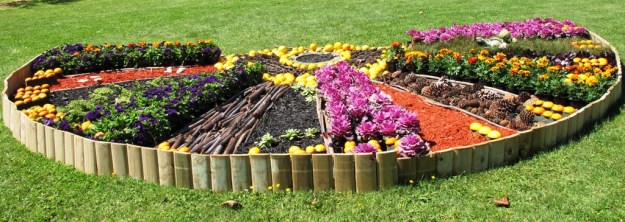
About the photo at the top: I think it was a temporary floral art exhibit. Even that cannot be said to redeem it in any manner.

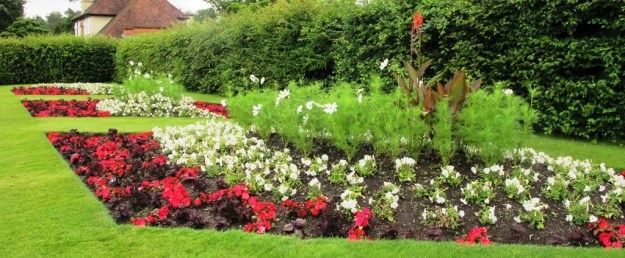
I lack many photos of bedding plant schemes, hence this one from Wisley.

I lack many photos of bedding plant schemes, hence this one from Wisley.

A brief diversionary activity for moments of extreme boredom

Monet-ish or Monet-esque. Perhaps.

Monet-ish or Monet-esque. Perhaps.

Should you need a minor diversion in your life, may I introduce you to the brief amusement of the DIY Monet site offered by our national museum, Te Papa? The site is quite old and no longer appears to be fully functioning so I had to call upon the skills of a more technically-inclined friend to save my image. He did it by a screen capture and then cropping in, in case you want to save your DIY Monetesque photograph.

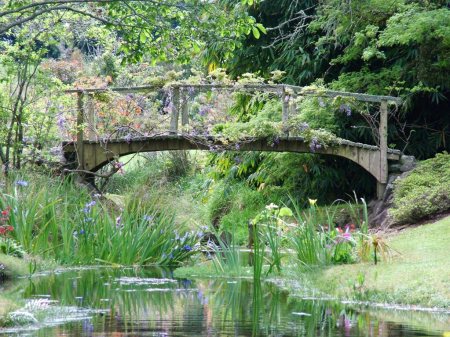
Our bridge is weathered timber, not the synthetic green shade favoured in Monet’s own garden at Giverny so far less distinctive as a landscape feature. But no matter, we like it in real life. We made the pilgrimage to Monet’s garden in Giverny last year.

The Monet bridge - one of two at Giverny

The Monet bridge – one of two at Giverny

Our own bridge, pre- Monet-ising

Our own bridge, pre- Monet-ising