Tikorangi Notes: the virtues of little green apples

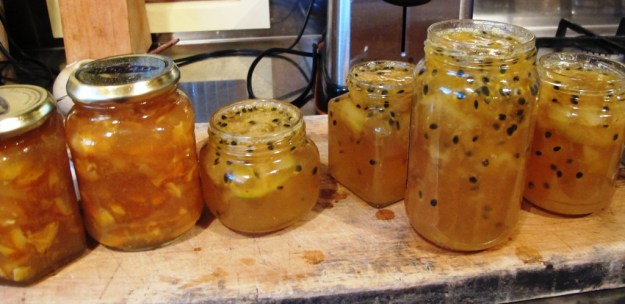
The latest efforts are ginger and tangelo marmalade (in apple base) and feijoa and passionfruit jam.

The latest efforts are ginger and tangelo marmalade (in apple base) and feijoa and passionfruit jam.

I have never been a great maker of jam. I used to try. Raised by a mother well versed in the traditional skills, I would put on the jam pan and make an excessively large amount of one type of jam. If the stars were in alignment, this jam would set adequately. If not, the jam pan would boil away for ages while I valiantly added additional sugar and lemon juice to try and reach setting point. At the end of it, the jam would be brownish in hue and there would be far too many jars of less than stellar jam.

My late mother-in-law was a superb jam maker and my efforts never came within cooee of matching her delicious jams. Her fruit salad jam was my all time favourite but I recall her Sultan plum and cape gooseberry jams being exceptionally good, too. I got rid of my jam pan and would buy the occasional jar at the supermarket. We are not big jam eaters, I reasoned.

But I am a born-again maker of jam due to three recent discoveries. The first was the realisation that jam tastes best when very fresh and that it is therefore logical to make smaller quantities at a time.

The second was the discovery of Chelsea jam sugar. It costs more than ordinary sugar with its added pectin but reduces the time needed to boil the jam down to as little as four minutes before the setting point is reached. This means the jam keeps its bright colour and fresh flavour, while the fruit stays nice and chunky.

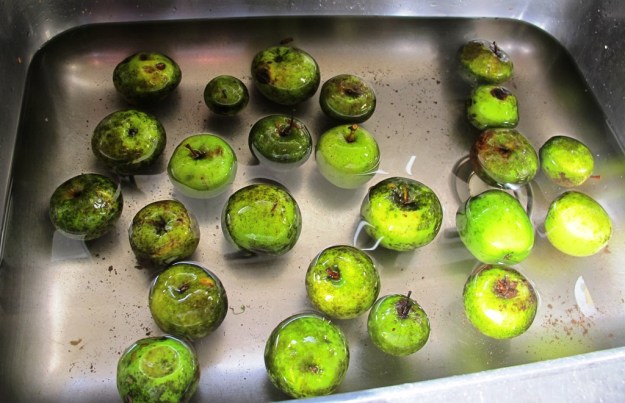
Unripe windfall Granny Smiths

Unripe windfall Granny Smiths

013
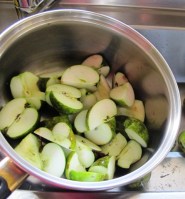
The third discovery was about little green apples, but in the autumn time. I had read about using green apples to make one’s own pectin but didn’t try it until this year. It works! It works a treat. Combined with jam sugar, I think I have rediscovered a (minor) passion for jam. I just wash the apples, cut them in bits and remove any bad bits, codling moth or similar before boiling them up. Once strained off, there is a liquid base which lends itself to the addition of any manner of fruit.

The latest efforts are ginger and tangelo marmalade (in apple base) and feijoa and passionfruit jam. Having frozen some apple liquid, I anticipate continuing to make mixed fruit jams which may even be said to rival those of my very late mother in law. There is much more incentive when the process of making the actual jam becomes a 10 minute job with guaranteed results.

When near enough is not far enough

012It being autumn, ‘tis the season of sasanqua camellias here. Ever since camellia petal blight arrived to wreak havoc on the later flowering japonicas, we have been a great deal more appreciative of the sasanquas. What they lack in flower form, they make up in performance.

Gay Border on the left, Navajo to the  right

Gay Border on the left, Navajo to the right

On a grey and somewhat bleak day, I thought to entertain myself with photographing the flowers but became sidetracked onto comparisons. When we had our nursery in full production, Mark would regularly make calls as to which cultivars we would propagate and sell. Would it be Navajo or Gay Border? We chose Navajo. It is not just the flowers that are the deciding factor. The habit of growth, foliage, size, performance and ease of propagation and production were also considered although the decisions were often a little ad hoc. When it came to Sparkling Burgundy and Elfin Rose, we chose the latter because its foliage looked better.


Sparkling  Burgundy left, Elfin Rose right

Sparkling Burgundy left, Elfin Rose right

We felt that it is not helpful to a customer to look at a range of plants with very subtle differences. “The man on the galloping horse” test, Mark calls it – the differences should be obvious, not just subtle variations. As far as we were concerned, we were professionals and customers had a right to expect us to do some filtering in selections and to pick good performers.

When it comes to naming his own cultivars from his breeding programme, Mark is hugely more rigorous and restrained. A new release has to be significantly different, distinctive or a major improvement. He has only named four of his own deciduous magnolias so far and that is out of many, many hundreds – maybe into the thousands – of seedlings he has raised. This restraint is somewhat unusual in the world of plant breeding.

Honey Tulip top left with other named cultivars. Might we have seen this as a breakthrough in flower form?

Honey Tulip top left with other named cultivars. Might we have seen this as a breakthrough in flower form?

When we released Magnolia Honey Tulip, we received an email from an overseas self-appointed expert acknowledging that Mark was extremely – excessively, some may say – restrained about the new selections that he named and released but he should not have released a yellow magnolia. The world has enough yellow magnolias already, he loftily told us. Right-o then. We knew what he meant – there are many yellow magnolias named which all look very similar, but apparently it had not occurred to him that Mark, with his self-imposed restraint, may actually have managed to breed one that was a breakthrough and very different. We did not reply.

Anybody can raise seedlings of Black Tulip but are they then all worth naming? We think not.

Anybody can raise seedlings of Black Tulip but are they then all worth naming? We think not.

A plant breeder, by our definition, does more than just raise open pollinated seed. Not so the gentleman who visited us (again from overseas). He loved Mark’s Magnolia Black Tulip which sets seed. So he raised a whole batch of seed and spawned a whole lot of similar looking flowers which he then named and insisted on showing Mark all the photographs. None looked to be distinctive, a breakthrough or an improvement. They were just subtly different, as seedlings usually are. That sort of willy-nilly approach is not helpful to the plant and gardening world but we see it often.

That is why we have never coveted a National Collection – of anything really. The UK is very big on national collections. The parent website states:

“Plant Heritage’s (NCCPG’s) mission is to conserve, grow, propagate, document and make available the amazing resource of cultivated plants that exists in the UK….

Our main conservation vehicle is the Plant Heritage National Plant Collection® scheme where individuals or organisations undertake to document, develop and preserve a comprehensive collection of one group of plants in trust for the future.”

Camellia brevistyla left, microphylla right. They look mighty similar to us.

Camellia brevistyla left, microphylla right. They look mighty similar to us.

It is one thing to collect species – that is important for biodiversity and many are endangered in the wild. Mind you, we remain unconvinced that Camellias brevistyla and microphylla are actually different species. It looks more like seedling variation to us.

"For I have seen the national rhubarb collection"

“For I have seen the national rhubarb collection”

Also the compilation and maintenance of a wide genetic pool is important when it comes to crops like fruit and veg. “For I have seen the National Rhubarb Collection”, I tweeted when we visited Wisley. It seemed such a random and esoteric plant to collect, which is not meant in any way to deride its worth. And it was certainly a beautifully maintained collection.

But a National Collection that takes in many named hybrids? We have seen too many inferior and indistinct hybrids named to ever want to start a collection of any plant genus. We would rather have plants that are selected on individual merit in our garden.

Plant collecting is like stamp collecting, Mark explained. The search for a particular named cultivar may be challenging, rewarded by the thrill of acquisition. Whether the plant was actually worth acquiring – whether it warranted naming in the first place – becomes irrelevant.

Postscript: we don’t like to dwell too much on the travesty of our Cordyline Red Fountain and the ring-in Cordyline Burgundy though this was not, we think, motivated by misplaced breeder pride but by much baser motives indeed.

Her last butterfly (of the season)

018It is a somewhat gloomy grey and damp day here today, brightened by a knock at the door. There stood a woman, slightly abashed. She had read a piece I wrote recently about monarch butterflies and decided that we were better placed than she was to offer a good home to her last monarch of the season. It had hatched last night and was yet to fly. This little delivery involved a drive of at least 20 minutes to get here (and presumably the same to get home again) but we are not going to discuss the carbon footprint.
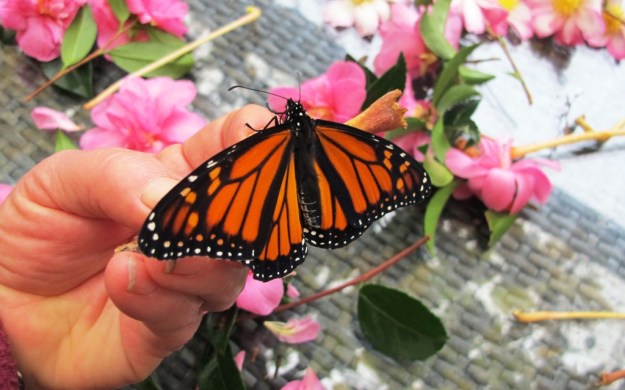
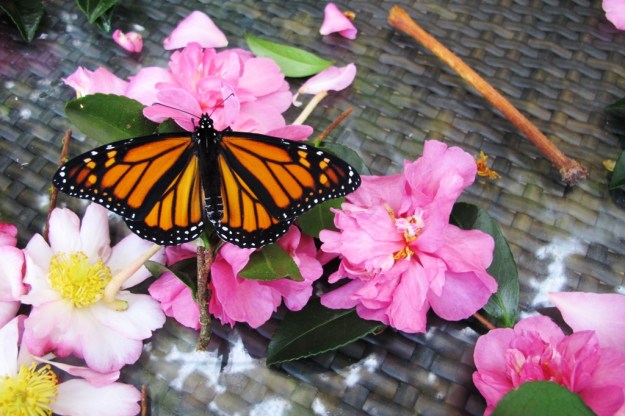
What a lovely ray of vibrant colour this butterfly offers, perched on the discarded sasanqua camellia flowers I was photographing yesterday. When he is ready to fly, he will find some friends over on our butterfly hillside. I was charmed.
002

Late Bloomers – the tree dahlias in autumn

Tree dahlia 'Orchid', bred by Keith Hammett

Tree dahlia ‘Orchid’, bred by Keith Hammett

The last clarion call of the autumn flowers here are the tree dahlias, wildly impractical plants to grow but I absolutely love them. There is nothing like their over the top blooms soaring skywards in late autumn.  At least we are lucky in this country that we get clear blue skies with strong light all year round. Otherwise they might be soaring up to the gloom of lower light levels of other climates.

For problem number one is that these are frost tender plants which is not surprising when you consider they originate from Central American areas like Mexico, Columbia and Guatemala. We are not actually frost free in Tikorangi. We have areas of the garden that are so protected now by overhead cover that we can grow the most tender material, but out in the open we still get sufficient frost to require placing tender plants carefully. We may only get three visible frosts each winter, but the air chill on a calm night can get low enough to wreak havoc. And because these tree dahlias don’t start flowering until May and continue into June, they can get hit late in their season.

Left to right: 'Chameleon" , 'Orchid' (both Hammett varieties), D. imperialis and an unnamed Hammett variety.

Left to right: ‘Chameleon” , ‘Orchid’ (both Hammett varieties), D. imperialis and an unnamed Hammett variety.

A hint to the second problem lies in the name – the ‘tree’ part. These are not trees. They have nothing to do with trees. They are a fully deciduous herbaceous perennial but their rapid growth in summer and autumn sees them take on tree-like proportions. It is nothing for them to be 3 metres high, sometimes 4 or even 5 metres. Being dahlias, they are plants for sunny, open positions but they also benefit from some support and shelter from wind which can knock their brittle stems over. They have the hollow stems that are typical of dahlias. Some we grow against sheds or to the side of frames already in place for runner beans and frost protection frames for the bananas and sugar cane.  Some we fence in with heavy duty bamboo cross bars – hitching rails, Mark calls them.

Below ground, they have big, chunky tubers which mean that they are difficult to grow amongst other plants and they take up quite a bit of space for their six weeks of glory.

Not many gardens have both the space and the conditions that suit such particular requirements, along with a tolerance for their scruffy off-times. But if you have and can, they are as easy to grow as your more modest dahlia but with more spectacular results.

New Zealand plant breeder, Keith Hammett, has done a lot of work with dahlias, including tree dahlias. The orange starburst variety which he named ‘Orchid’,  with its twisted petals is more compact than any of the others we grow. It only reaches about 2 metres maximum though that is 2 metres high  and 2 metres wide. We have it by a big mandarin tree whose fruit are ripening as the dahlia blooms. It is a lovely combination.

Dahlia imperialis, my personal favourite

Dahlia imperialis, my personal favourite

My favourite is the simple Dahlia imperialis species and it is the most commonly available plant. When it first comes out, it looks like a clematis from a distance. Yes the blooms are a little floppy and the petals are larger and soft, so easily damaged, but I like the somewhat pendulous form and I think the lilac pink colouring is pretty.

Dahlia imperialis Alba - soaring skywards as winter descends upon us

Dahlia imperialis Alba – soaring skywards as winter descends upon us

Being a species, there are a fair number of different selections of D. imperialis. Our late season double white is Dahlia imperialis alba plena. ‘Alba’ of course means white and ‘plena’ means full and is applied to fully double flower forms. This one towers above a shed and puts on a wonderful display with its shaggy blooms but usually gets cut back by the cold when still in bloom in early June.

While tree dahlias can be grown from tubers in the same way as their smaller dahlia cousins, they are also commonly propagated from cuttings which are easier to handle than their oversized tubers. I admit I have yet to try it – there is a limit to how many tree dahlias we can place here – but the advice is to cut the stems that flowered in autumn, making sure that you have at least two nodes per cutting. Lay it flat because the new roots form from the nodes and cover to a depth of about 10cm. Or you can take spring cuttings from fresh growth. It does not appear to be difficult. I may report back on this because we are taking cuttings this year. We have a newly available position where a large tree fell, opening up what looks to be an ideal space for a tree dahlia or maybe two.

022 - CopyFirst published in the May issue of NZ Gardener and reprinted here with their permission. 
Tramps in the garden. Trampolines, for the avoidance of doubt.

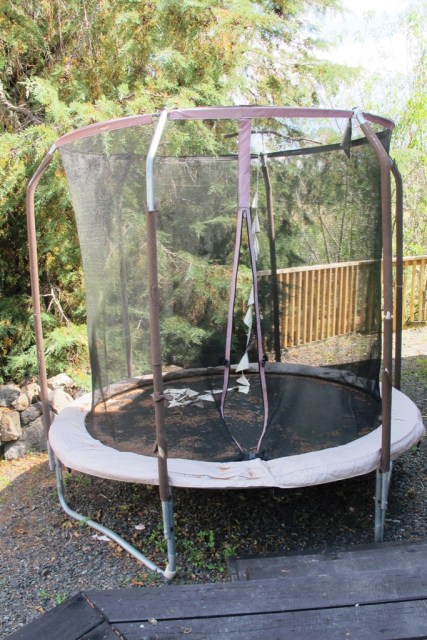
The modern safety version of the family trampoline is not going to have the life expectancy of the traditional design so grin and bear it

The modern safety version of the family trampoline is not going to have the life expectancy of the traditional design so grin and bear it

My final article when I wrote for the Waikato Times was on washing lines.  Before the axe fell upon my contributions (replaced, I was, by syndicated copy which is “generic” in  nature, shall I say?), I always intended to follow up at some stage with a piece on that other awkward feature of so many New Zealand gardens – the children’s trampoline. What to do with this cumbersome eyesore?

Honestly, I do not believe there is a great deal you can do besides grin and bear it. The attempts I have seen to camouflage trampolines (or tramps, as we call them) have been doomed to failure. The bottom line is that if you want your children to use this large and relatively expensive piece of equipment, it needs to be in prime position – full sun, flat land, alongside your main living area where all the action is happening. In the other words, right in the heart of your outdoor space where it will look irredeemably ugly but it should at least deliver the squeals of happy, active children.

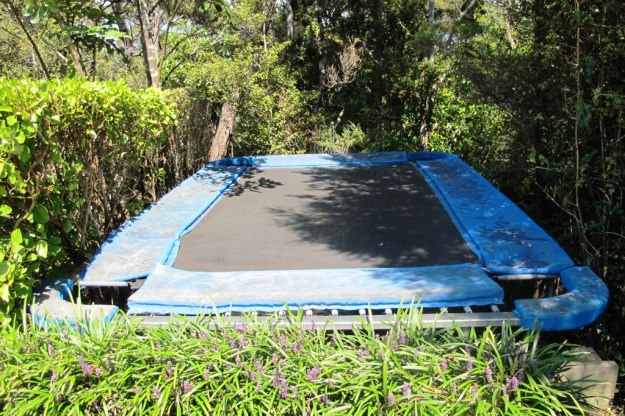
Attempting to hide the trampoline in a more aesthetically pleasing manner is more likely to ensure that it won't be used much. The spiky stumps on the hard trimmed hedge to the left looked downright dangerous to me.

Attempting to hide the trampoline in a more aesthetically pleasing manner is more likely to ensure that it won’t be used much. The spiky stumps on the hard trimmed hedge to the left looked downright dangerous to me.

Try and screen it – and I have seen this done – and you immediately create shade issues and banish the children from the centre of family activity. They will not use it anywhere near as much and you may well wonder why you bother having it.

Somebody once told me that it was easy to dig a huge pit in the lawn and set the tramp level to the ground. Yeah right. In many soils the water will not drain away and you develop a festering swamp of mosquito larvae below. It is nowhere near as much fun for the children and when you get rid of the tramp, you have a great big pit that needs filling.

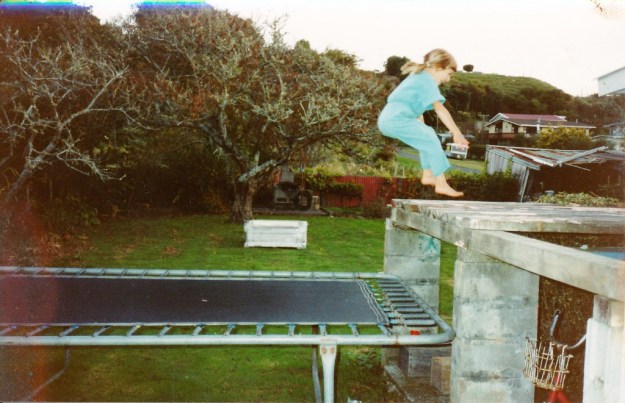
The disused water tank stand which made the tramp twice the fun. I see from the date that our daughter was only 6 at this time. By modern standards, we clearly allowed our children to take physical risks.

The disused water tank stand which made the tramp twice the fun. I see from the date that our daughter was only 6 at this time. By modern standards, we clearly allowed our children to take physical risks.

We had a very large tramp for our children, large enough to accommodate three smallish people and their rioting and tumbling father. It was large enough, even, for two teenagers. True, it required a stool to climb up to it and it was of the traditional design shunned today as unsafe. It lacked both a mesh cage and covers for its springs. What is more, we discovered by chance that when located by an adjacent platform, the fun increased exponentially. The disused stand for the water tanks was the first platform. When we dismantled this, we built a custom platform from which the kids could jump up and down. It gave both a rest area and a launch pad. More cautious parents may shudder, but in the decade or more that we had the trampoline, there were no serious injuries and I can’t recall minor ones either. The tramp received a huge amount of use. It was a problem when it came to tipping on its side to mow the lawn. It took up a lot of space. When the kids stopped using it (our youngest was well into his teens), it was with great relief that I sold it. Should grandchildren enter our lives, I will not be getting a tramp for them at our place. Their parents can endure it at their own home.

Essentially, children’s play equipment is incompatible with the beautiful designer garden look. I have never seen them combined well. I am philosophical. Once the children have grown, there is plenty of time to achieve the designer look. And the modern safety design of the trampoline makes it more the plaything of younger children so the useful life span of it is halved.

As a postscript, if you have a swimming pool and think that relocating the tramp to that play area seems sensible, it is illegal in this country. Not only must swimming pools be fenced to code, no additional activity such as the barbecue, washing line or children’s play area is permitted inside that fence.

A friend has responded through Facebook with two links to creative ideas on reusing your old trampoline. The first is for hanging beds which look really stylish but will take a great deal of effort. These would never have worked for our super-sized rectangular trampoline but there is a whole section of the internet on repurposing trampoline parts, including some interesting constructions for keeping chickens. In case you wish to. If my memory serves me right, we bought our trampoline for $250 and sold it again, maybe 12 years later, for $180. That is the easier option.

Oh, and should you live in a tornado prone area, trampolines have a large wind sale area and become airborne. While hardly the equivalent of USA’s tornado alley, we can get small twisters here and I have seen a trampoline suspended maybe 10 metres up a pine tree. I have no idea how the owners ever got it back down.