
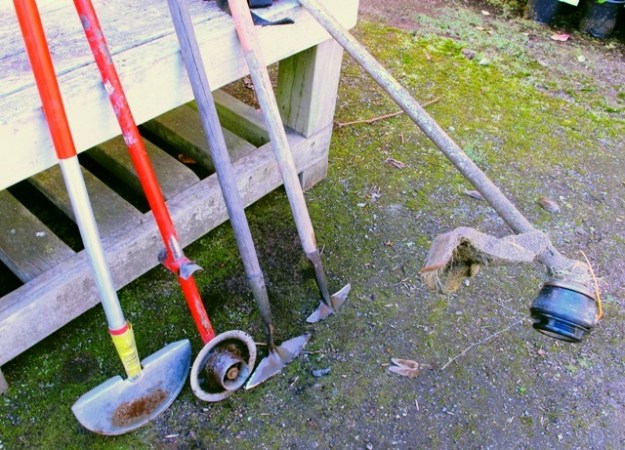
Edging tools, push hoes and our well-used petrol powered line trimmer
Weeding. It’s the garden equivalent of vacuuming really. Tedious, repetitive and while the place looks great when you have finished, all too soon you need to start again. I guess you could ignore the weeding part (if not the vacuuming) but most of us prefer a garden that is pretty much free of weeds. In fact most of us place a high priority on this state.
There is a much higher tolerance for weeds in some other gardening countries, particularly in Britain. This may well have something to do with the fact that the vast majority of our weeds in this country are imports and a fair number are in fact native to Britain and Europe – plants like dandelion and blackberry, for example. We are probably more tolerant of our self seeding native plants too. I don’t refer to the scores of nikau palms we pull out and dig out as weeds. They are merely self seeded plants in the wrong place whereas the buttercup and campanulata cherry seedlings are indubitably weeds.
I have to admit we weed spray here though Mark is trying to reduce the amount he does. Glyphosate is pretty much all that stands between us and claiming organic status, but in a large garden, glyphosate is oft described as the equivalent of a labour unit. It is much faster to whip around with the knapsack sprayer than to hand weed. Mark has spent the last decade gently worrying that research will come up with definitive arguments against the use of glyphosate. It hasn’t happened yet, to his relief. But in this day of heightened sensibilities, he is rarely to be spotted by any garden visitor with the knapsack on his back. He hides, dear Reader. True.
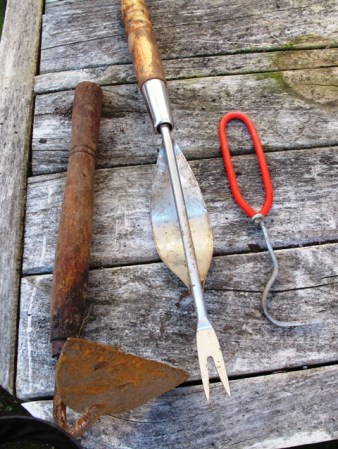
The rusted Niwashi, implement for flat weeds and aptly branded Wonder Weeder
We have a repertoire of weeding implements here and do a fair amount of hand weeding too. Others swear by the Niwashi weeder, to the extent that Mark bought one and it was relatively expensive as I recall. I asked him this week if he had ever used it because I never have. Neither has he, apparently, but somebody here must have because it made the trip right through the compost heaps emerging after about a year at the other end. Mark is a push hoe man and keeps his favourite two well sharpened. However push hoes come with a warning – refer to the quote of the day below! I have heard of one public garden which banned push hoes in the hands of volunteers because they caused so much damage. I favour the precision of close up work with the cheap and cheerful Wonder Weeder – so cheap that I have several and so sturdy that they can emerge from the compost heap pretty much unscathed. These implements work best in loose, friable soil. It is much harder work in compacted earth but a breeze where it is easy to scuff up the surface and hook out or sever weeds.
We also have edging tools – ones designed for both hard edges (where grass meets a solid surface like a path) and soft edges. And let’s not forget the petrol powered line trimmer but that is excessive unless you have a large section. These are because of a strongly held opinion on Mark’s part that little looks worse than sprayed edges. You know that dead brown line others have? Not here. The lawn weeder is also well used since we made the decision not to spray the lawns. Nothing works as well on flat weeds as this handy implement.
The bottom line of weeding is that vigilance and early intervention lessens the task. There is an old saying: “one year’s seeding, seven year’s weeding”. You can never completely eliminate weeding but if you can stop seeding, you certainly lessen the load considerably. We are lucky in that we took over this garden from Mark’s father who was a vigilant weeder. True, he leaned towards the chemical arsenal to carry this out as so many of that generation did. But at least we don’t have soils jampacked with weed seeds waiting to germinate. Where a patch may have got away from us and set seed heads, we usually have a bucket on hand to receive them. If you cut them off and leave them lying on the ground, the seeds can still ripen and live to germinate another day. For the same reason, gardening clothes with pockets can be handy.
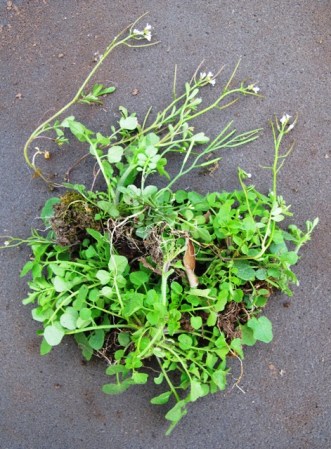
Spitting cress
Get ‘em when they are small and much easier to deal with. Soon after germinating is the best time, before they have well established root systems. They are far easier to hoick out of the ground and far more likely to die instantly at that tender stage. While the saying that a weed is merely a plant in the wrong place is repeated so often it has become a cliché, I can not think that the nasty spitting cress fits this kind interpretation. Every gardener knows it – the little flat weed which can go from first appearance to setting seed in a matter of days in full summer. As soon as you touch it, it jet propels its seeds around to ensure immortality. Vigilance – that is the single most important mantra. Target the worst offenders and maybe be a bit more relaxed about some of the others.
First published in the Waikato Times and reprinted here with their permission.
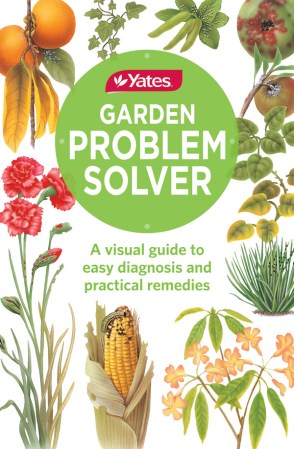 This is a handy reference book for diagnosing many common problems in the garden, predominantly of the pest or disease variety. It is reasonably comprehensive though not encyclopaedic. Each ailment is given a brief description, usually with a clear illustration, and then advice for dealing with it or avoiding the problem happening again. I like the fact the illustrations are paintings, not photographs because it gives a much clearer picture. I also like the fact that not every recommended treatment involves buying a Yates product. So when spinach bolts to seed prematurely, the advice is that this can be caused by long days, summer temperatures, dry conditions and overcrowding. Sow summer spinach (well, ‘Summer Supreme’ actually – presumably one of Yates’ own). There is a fair amount of handy general information which is not commercially driven, though the organic section is pretty perfunctory. That said, we are talking an interventionist approach to gardening and where products are recommended, they are branded Yates products – it is their book after all. We double checked the ingredients of branded sprays and the in-house expert here gave the advice a general thumbs up for accuracy. I am a bit suspect about spraying cheap annuals like pansies and hollyhocks. I am more of the view that you rip out diseased plants and try a different strategy with replacements but if you are an older style gardener who reaches for the sprayer at the drop of a hat, at least you will have a diagnosis and know which spray to use.


 Tikorangi The Jury Garden