Grow it Yourself – cauliflower

There is a finite number of vegetables and I am nearing the end of them in this column, which must be why cauliflower is still left. It is, I am afraid, amongst my least favourite of vegetables (palatable in cheese sauce with walnuts but little going for it otherwise). However, it has stood the test of time so clearly others view it more kindly. It is a brassica, like cabbage and broccoli, so in our milder areas, it is better to avoid growing the crop through summer when the cabbage white butterfly will wreak havoc and make the heads even less appealing. It will also bolt to flower too quickly in warmer temperatures. This means planting late winter and early spring to get through before summer (it can take up to 4 months to mature), or any time from early autumn onwards for winter harvest.

Because you only want a small number to mature at once, it is often easier to buy a few seedlings at a time from the garden centre though if you are an organised gardener, you could successionally sow half a dozen seeds in small pots each month or two. Being a leafy style veg, cauliflower wants rich soil full of nutrients. If you are using animal manure, make sure it is well rotted. We prefer compost to add nutrition and texture to the soils. Plant at around 50cm spacings to allow room to develop. Most modern varieties no longer require the heads covered to keep them white, as older varieties did, but it does no harm to bend over the top leaves to give some protection if you wish. If you actually enjoy cauli, there are trendy purple, golden and green options to try and there is some evidence that these coloured veg bring even greater health benefits to the standard white form.

First published in the Waikato Times and reprinted here with their permission.

Tikorangi Notes: Friday 13 July, 2012

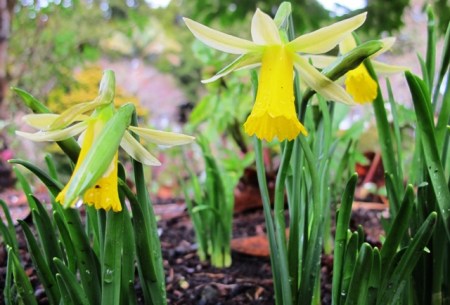
Spring must be getting close - dwarf Narcissus Twilight is opening

Spring must be getting close – dwarf Narcissus Twilight is opening


Last week was garden bed...

Last week was garden bed…

Latest posts:
1) The Great Garden Make Over (aka renovating the rose garden). Not quick, not even that easy, but hugely satisfying.
2) They were the first narcissi to flower this season – Narcissus bulbocodium citrinus ‘Pandora’. However, others are starting to open, including the little Felix Jury hybrid ‘Twinkle’ above.
3) Grow it Yourself – tamarillos, this week. Yet another subtropical fruit, from South America again this one, that we have taken over in this country as if it were our own – even to the extent of branding it tamarillo!
4) Away from gardening and on to recipe books – 500 Tapas reviewed.

Tikorangi Notes: Friday 13 July 2012

The work in the rose garden has absorbed all my recent energies, and a good deal of Lloyd’s too. If the rain had just held off for another couple of days, it would have been finished but intermittent showers and the developing mud has driven me indoors.

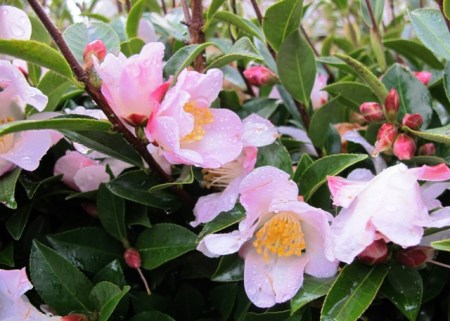
Camellia Fairy Blush

Camellia Fairy Blush

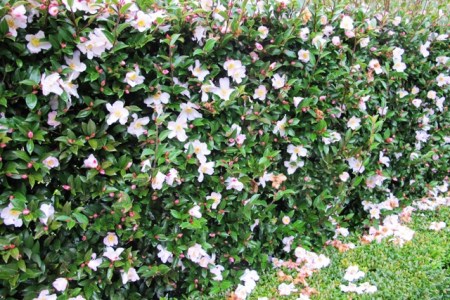
Camellia Fairy Blush is looking particularly pretty in our little hedge. This was the first camellia Mark ever named – a scented, lutchuensis hybrid. Mark is not given to exaggeration or overstating matters so he was always rather deprecating about Fairy Blush. “It’s just a little single,” he would say, “but it does flower well and has reasonable scent.” Yes, it is a little single that flowers for several months on end and is as fragrant as any camellia, on a compact plant which clips very well. These days we regard it as the one that got away from us. We should probably have taken out Plant Variety Rights (a plant patent) on it. It is now a market standard in both Australia and New Zealand and it can be a little galling when nurserymen tell you how very well they have done out of your plant. Such is life. But then we have learned the hard way that even agreements and Plant Variety Rights don’t necessarily give market protection either. We would still plant Fairy Blush in our own garden and recommend it to others, even if it wasn’t our cultivar and that is a fair testimonial.

Our hedge of Camellia Fairy Blush

Our hedge of Camellia Fairy Blush

Renovating the rose garden

At its best, the rose garden looked good...

At its best, the rose garden looked good…

Don’t ask us for garden advice. We hand out endless plant advice and I write regularly about many gardening matters but we do not dispense personal on site advice. This is not for want of requests but oft-times, all the person asking wants is for you to affirm that they are right. Besides, advice carries an implicit suggestion that you think the gardener is not doing it as well as you could. And that doesn’t always go down well.

But there are times when an outside view can be extremely helpful. We have a garden which we loosely call the rose garden or the “sunken garden area”. It is a formal area, laid out in the early fifties and planted by Mark’s mother with her beloved old fashioned roses. These days it would be called a garden room. Over the years, it has had a lot of work done on it including several major renovations. And still it didn’t work as well as I wanted. Sure it looked pretty in spring but it didn’t look pretty enough for long enough. Worse, I just didn’t like working in the garden. I would avoid it until it could no longer be ignored. Clearly something wasn’t right but we were failing to come up with a diagnosis.

Enter a house guest last spring. It was Neil Ross, whom some readers will know from his writing in NZ Gardener. He used to be head gardener at Ayrlies in Auckland but since then, has been working in gardening and design in England. I asked for his thoughts but in busy schedules, it came down to grabbing a few minutes at dusk. To my surprise, that was all we needed. We stood in the garden, wine glasses in hand and Neil nailed it for me.

“Gosh,” he said, “that really is a deep sunken garden.” (This had never even occurred to me. I just knew it had been dug by hand by Mark’s dad, aided by a draught horse). “And that is accentuated by the height of the standard roses. They’re really high. I’ve never seen such tall standards.”

In the following 90 seconds, he fired out suggestions. Get rid of the tallest standard roses. Remove the far border “which merely creates yet another path that I bet nobody ever walks down” (true, Neil). Make the borders wider on the main bed to compensate and lift all the perennials and reorganise them. Instead of the classic mix and match of perennials and bulbs, he suggested I opt for “more blocky plantings” and simple combinations of two or three plants in each block.

That was it. I knew instantly that he was right on the mark but I left it to percolate in my brain until a couple of weeks ago. Besides, such drastic changes needed to be done in winter. It clearly involved moving a lot of plants. Besides, while the advice may have been given in 90 seconds of inspiration, there was quite a lot of solid work in implementation. The garden beds are all hard edged – with footed concrete. Getting rid of one bed entirely is a major operation in itself, especially as we wanted to salvage the 15 year old maples and handsome weeping camellia. There are a lot of plants in just one bed. That said, roses are easy to move – at least compared to other shrubs.

Recycling the turf from the extended borders to the defunct garden bed

Recycling the turf from the extended borders to the defunct garden bed

I admit I have had help. The concrete garden edgings have been cut into manageable lengths and recycled where needed. This means that once completed and in full growth again, the garden will look as if it has been in place forever. Nothing shouts recent renovation more than pristine fresh concrete. And I am not the one who is recycling the squares of turf from the enlarged borders over to the area where the surplus bed has gone. But my job involves digging the entire garden, lifting all the perennials and bulbs, dividing them and replanting in new combinations. That has been Serious Fun. I speak in gardening terms and while gardening is many things, Serious Fun is not usually one of them. More on new perennial plantings next week.

We have been blessed with wonderful weather. A very wet winter would not have made this easy at all and I am hoping to finish this week before we get the wet, cold rains that will arrive, without doubt, sometime soon.

The upshot of all this, is that I would counsel readers that if you have an area of your garden that you do not enjoy working in, this may be an indication that there is something inherently wrong with it. I was lucky that the right person happened along eventually and gave me a rapid fire diagnosis. The best people to give advice are those who know at least as much as you do about gardening and design and who do not have an emotional investment in you acting on their advice. If you can find a really good garden designer (not just any old one), who gives on-site consultations, they should be able to assess the situation quickly and decisively but they are not easy to find. You may end up having to listen to a lot of ideas from different people before someone hits the mark for you. Just, don’t ask us, please.

A major makeover in mid flight

A major makeover in mid flight

As it was - the borders are too narrow and proportions wrong

As it was – the borders are too narrow and proportions wrong


First published in the Waikato Times and reproduced here with their permission.

Plant Collector: Narcissus bulbocodium citrinus “Pandora”

The first narcissus of the season - N. bulbocodium citrinus 'Pandora'

The first narcissus of the season – N. bulbocodium citrinus ‘Pandora’

Always the first little narcissi to flower in winter, these lemon hoop petticoats are pretty as a picture at the moment. I guess they gained their common name because they resemble those wired underskirts from times past. The bright yellow bulbocodiums flower later in the season. In contrast, the citrinus are very early, coming out with the snowdrops. These are easy bulbs to grow. In fact this clump is naturalised in hard conditions where our gravel driveway meets an elevated concrete path – which is why the flowers show some splash and wear. There is no mollycoddling involved with them but they do need good drainage and full sun. N. bulbocodium is native to the south of France, Portugal and Spain so will occur naturally in relatively hard conditions. Given that the foliage is distinctly grassy in appearance, you just need to make sure you are not mowing it off in the early stages.

Daffodils go far beyond the common big King Alfred types and we like a range of them so we can have them in flower for many months. We prefer earlier flowering ones overall because they are generally finished by the time the dreaded narcissi fly is on the wing. It lays its eggs in the crown of the foliage and each bulb becomes home to one fly larvae (big, fat creamy grub) which spends a year sustaining itself by eating the bulb from the inside out, only to metamorphose and repeat the cycle. A breeder told me that narcissi only need 65 days of growth to build up strength in the bulb for next year’s flowering so you can remove foliage early if you need to beat the fly. We also favour the littlies, the dwarf varieties, which are much more compact and showy in the garden.

Bulbocodiums increase readily by division and some will set viable seed.

First published in the Waikato Times and reprinted here with their permission.

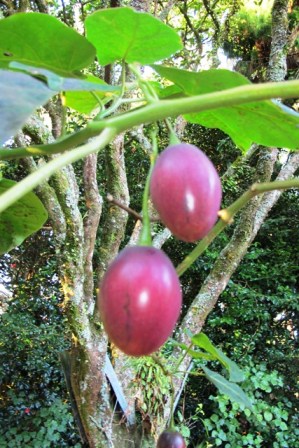
Grow it Yourself: tamarillos

This is not a crop for inland or southern residents unless you have a holiday house on the coast. Even then, it is becoming an endangered species but ours still staggers on. This is another South American fruit which we have made our own in this country (along with the feijoa). In fact, it was NZ that conferred the name tamarillo. Older readers may remember when it was still called a tree tomato, though botanically it is Solanum betaceum.

Problem number one for inland gardeners is that it is very frost tender. It is a solanum so think same family as the potato and tomato (and nightshade but we can ignore that). It has to be completely frost free in its first year or so and will only take the lightest hints of frost once established. With its big, soft leaves and brittle growth, it doesn’t take kindly to wind, either. But readers, probably coastal, who can give protected and warm conditions, should have more success. It is not at all difficult to grow if you can find the right position.

Problem number two is more recent – the dreaded potato psyllid which is a fairly new arrival. It weakens the plant so badly that it usually dies. It takes up to two years for a plant to get large enough to crop, so it is relatively fast growing for a fruiting shrub. If you are really keen on tamarillos, it is probably advisable to keep raising replacements from cuttings, to ensure continued supply. They are not too bad from seed, either, though plants you buy will be superior selections. Because the psyllid is airborne, you can replant in the same area. Being a solanum, it is a gross feeder and will respond to rich soils full of compost and well rotted manure. Plants are self fertile meaning you only need one to get fruit though they do seem to crop more heavily in company.

First published in the Waikato Times and reproduced here with their permission.