Plant Collector: Tetracentron sinense

Tetracentron sinense

Tetracentron sinense

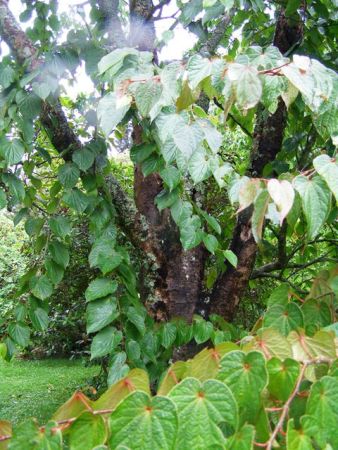
The Tetracentron sinense growing in our park is a pretty special tree for us. We rate it as a small tree – after five decades it is still only about six metres high and with a graceful, arching habit of growth. It is deciduous and the fresh spring growth emerges pink which seems appropriate for heart shaped leaves, but only briefly before it turns green, though keeping the red stems.

Sinense means it comes from China, on the western reaches where it borders with Nepal. It is a relatively late discovery, dating to 1901. As far as is known, there are no other members of the Tetracentron family (which makes it monotypic – meaning one of a kind). Our tree grew from seed collected in the 1950s. Frank Kingdon-Ward (often incorrectly referred to as Kingdom Ward) was an intrepid British plant collector and, like many of his forbears, financed some of his expeditions by selling subscriptions in return for seed. Mark’s father, Felix Jury, subscribed though we don’t know now how much he contributed. He received the tetracentron and a rhus which we could have done without.

It flowers in summer with relatively insignificant yellow catkins, though loved by bees. In our climate we don’t get autumn colour and I can’t find any mention in the literature so I would guess nobody else does either. I did find wildly varied accounts of its ultimate size – up to 40 metres in fact which is enormous. I can’t think that our specimen, rated by international experts who have seen it as a large example, is ever going to get to that stature. However it is apparently rare in the wild (sightings are recorded) so perhaps the heights are more a case of guesstimates.

First published in the Waikato Times and reproduced here with their permission.

Grow It Yourself – leeks

Dedicated leek growers (not all of Welsh descent, I am sure) know that if they want a good sized harvest, plants need to be a finger thickness by Christmas. But it is not too late to sow seed now – the plants will just be a bit smaller. Leeks have a long growing season of up to 6 months and because they are a winter plant, they can then hold in the cold ground until you are ready to pick them.

Leeks are not fussy or particular. They grow easily in most soils. Because they belong in the leafy vegetable group, they thrive on nitrogen based fertilisers. This means they are going to be quite happy growing where you have recently dug in a green crop or if you have an area where you have previously added animal manures.

If you are going to sow seed, get it in as soon as possible. As the seeds germinate, you can use the thinnings as salad veg (they are a little like chives with an oniony tang). Final spacing needs to be about 10cm to achieve full sized leeks. If you are using seedling plants, you have a few more weeks up your sleeve and you generally plant them at final spacing. They are likely to need watering for the first few weeks while they get their roots out.

With vegetable gardening, you work one to two seasons ahead. Planting for winter now means you can avoid the hefty prices of bought fresh veg and have a change from interminable frozen peas. And leeks are an easy option. You just have to plant them in good soil and keep them relatively weed free (to stop competition) and in winter they should be waiting for you.

The DIY Christmas Tree – mark 2 (for 2011)

Last year’s Christmas tree constructed from toetoe plumes (overseas readers may like to think pampas grass) was a tour de force, though I say so myself. On the downside, it did moult badly and I can recall quite a mess as we manoeuvred it out of the house after the event. Though the same can be said for the traditional pine tree too, and pine needles are a great deal more difficult to vacuum up. The step by step instructions for this model are still available.

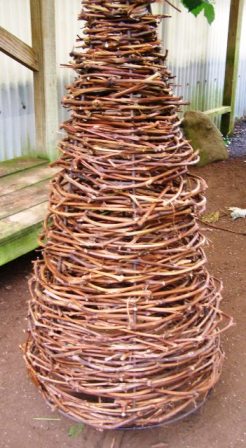
The tree this year does not lend itself to last minute creation. It needs a sturdy frame to hold the shape. Fortunately we have one, most kindly given to us by a friend.

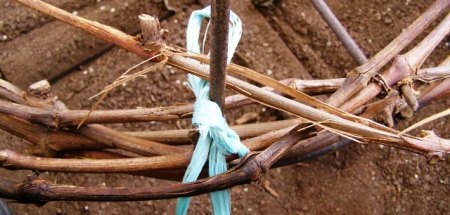
We saved the grape vine stems from the winter pruning round and kept them under cover. It takes quite a few and I only just had sufficient. Any flexible, long whippy growths could be used – willow, soft canes or wisteria come to mind.

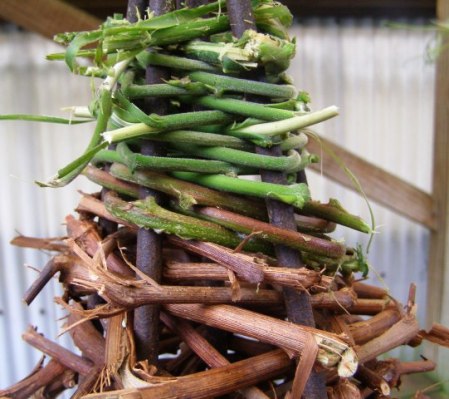
Build in layers by simple weaving. I tied the first rows in place temporarily, to hold them in place. By the following day, they had set in place and no longer wanted to spring out.

Because the top of the frame was very narrow, the grape vines were not sufficiently flexible. I swapped to fresh wisteria vine for the peak. It will dry to a brown shade but will be covered by the angel anyway.

I trimmed any large ends which spoiled the shape. If I had more grape vine, I would have packed the weaving tighter as I went, but I didn’t so I couldn’t.

The finished product is in place and decorating can start. It is possibly the easiest tree ever to decorate, because the ends of the vines make handy little hooks all over the surface. Rather than adding Christmas lights on the outside, we are lighting from the inside of the tree using a table lamp.

Tikorangi Notes: Friday 9 December, 2011

Celmisia - New Zealand's mountain daisy

Celmisia - New Zealand's mountain daisy

Latest Posts: Friday 9 December, 2011
1) No fewer than 700 Higo iris waiting to be planted out in Plant Collector this week.
2) Yet another joint venture infomercial masquerading as a reputable garden reference book – the Tui NZ Flower Garden this time.
3) The current quest for self sufficiency, of sorts at least. More a measure of a high quality of life here than a point of principle – Abbie’s column.
4) Grow it Yourself – rhubarb this week.
5) And absolutely nothing to do with gardening but a link to my other website (www.runningfurs.com) where I publish book reviews of a non gardening nature (mostly cookbooks, children’s literature and a bit of adult fiction) – the latest of which was indeed a cookbook: The Molten Cookbook by Michael Van de Elzen. Food porn, my chef friend calls it.

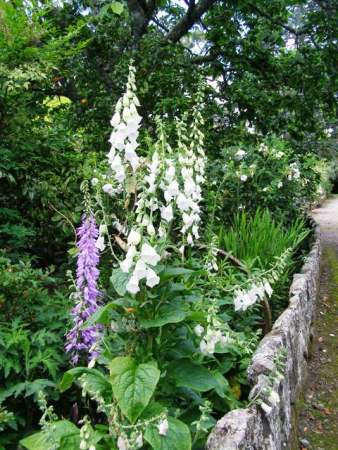
Inspired by Hidcote - the white foxgloves
Inspired by Hidcote – the white foxgloves

At last the temperatures are rising and it feels as if we may be on the cusp of summer after all. The tall white foxgloves have been bringing me much pleasure, simple though they are. We saw these used to great effect at Hidcote Manor in England but, being a biennial, it has taken eighteen months to get them performing here. I am hoping they will seed down as readily as their pink counterparts (most of which are being consigned to the compost to try and keep the white strain pure).

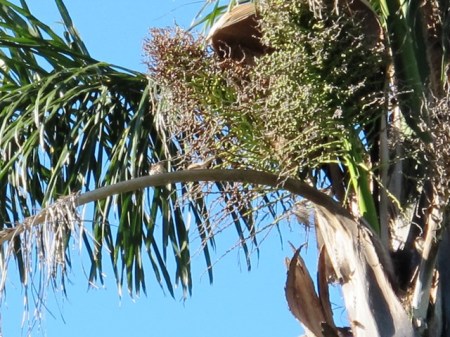
Sparrows in the Queen Palm condo

Sparrows in the Queen Palm condo

We have been somewhat amazed in recent weeks watching the entire condominium of nesting birds in the crown of the Queen Palm (Syagrus romanzoffiana) – they must be fifteen metres up and it appears that every nesting space is occupied. The dominant population is sparrows with the odd starling having made a move on vacant property. As we sit in our favourite conversation spot, we look out at the many comings and goings, while the tui nesting in the nearby rimu attempts to patrol the entire area and convince all other birds that they are deeply unwelcome.

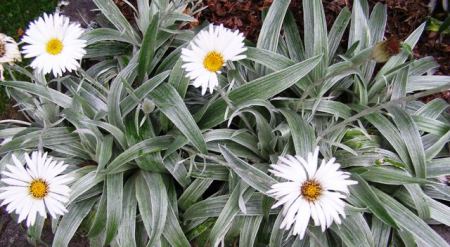
The celmisia in flower is a reminder to me of the next website project – building the record of native plants we have in the garden. This is of less interest to New Zealanders who tend to fall into one of two camps – the dedicated purist (natives only) and the rather dismissive (“natives are so boring”). In fact, we use many native plants in the garden but interspersed with exotics. I read an opinion recently that the use of native plants is an important way of anchoring a garden into its environment and its country of origin, which seemed to make good sense.

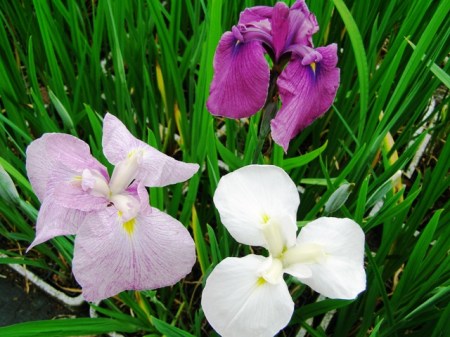
Plant Collector – Higo Iris

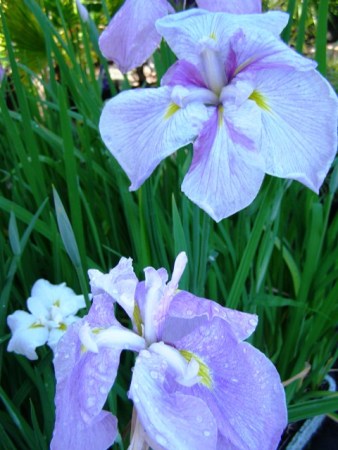
Remarkable seedling variation in the Higo Iris

Remarkable seedling variation in the Higo Iris


We are particularly delighted with the Higo irises at the moment, all 700 of them which are in small pots in the nursery awaiting planting out. These are often called the Japanese water iris because they are happy to live in pretty soggy situations.

Unravelling the family tree of Higo is not straightforward. Japanese water iris all descend from I.ensata but around 500 years of breeding has seen different strains developed – Edo, Higo and Ise. Many of these hybrids resulted from a search for perfection in a single bloom, to be brought indoors and contemplated as a transient thing of beauty. This does not necessarily make for garden plants. Mark had tried some large flowered Higos in the past and not had success with them. Not only did the blooms weather damage too readily for our climate, the plants could not cope with anything other than optimal conditions in very well cultivated soil.

Wanting a strain which is closer to the original species and therefore likely to have smaller flowers and maybe a more robust nature, Mark was delighted when Auckland plantsman, Terry Hatch, offered him a tray of plants reputedly derived from wild collected seed. It has taken a little effort to pot on the plants and grow them to flowering size but this spring it has all been worth it. There is a huge range of flower size, markings and colourings coming through in the plants though we doubt that they are anywhere close to the original species which grew in the marshes near Tokyo 500 years ago.

Most of the 700 are destined for planting in swathes on the margins of our ponds and stream though I shall get down on a few and experiment with growing them in garden borders. The critical issue appears to be ensuring that they never dry out completely.

First published in the Waikato Times and reproduced here with their permission.