Tikorangi Notes: Friday March 4, 2011

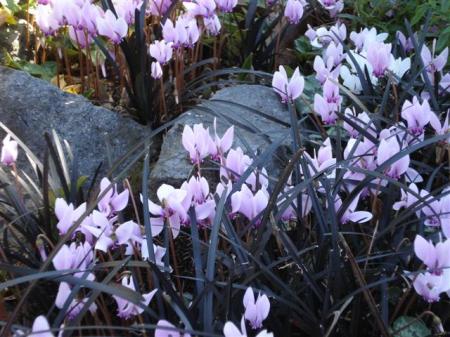
It must be autumn. The Cyclamen hederafolium are flowering again.

It must be autumn. The Cyclamen hederafolium are flowering again.

Latest Posts:

1) To say that we were simply amazed to see that Penguin is reissuing the Tui NZ Fruit Garden in May would be an understatement. Same cover, same author. This is the book they withdrew from sale extremely quickly a year ago when the massive problems of plagiarism and inaccuracy were pointed out to them. Presumably the text has been reworked because the early blurb refers to it being in conjunction with a panel of industry experts. It is to be hoped that industry experts include people with extensive personal experience in growing these plants at home throughout the country and not just the commercial producers who want to sell their plants. That aside, it is astonishing that Penguin appear to think that sticking with a discredited and blitheringly ignorant author is just fine. Are we really meant to have such short memories?

2) Alcantarea regina (or is that geniculata?) in flower this week.

3) Garden tasks for this week as autumn officially starts.

4) The third part in our series of step by step compost instructions – this time making cold compost which is the common technique for home gardeners.

Does credibility and reputation count for nothing these days, or does Penguin just think we have short memories?

Unbelievable. The second most read entry on this website is the piece on plagiarism I wrote last May which resulted in a lightning quick withdrawal from sale of Penguin’s publication: The Tui New Zealand Fruit Garden by Sally Cameron. Even now, that article attracts several hits most days. But Penguin clearly think the public will have forgotten. Exactly a year later, they will be releasing the new version of the book. To all intents and purposes it looks the same, but apparently this new edition has been written “in conjunction with a panel of industry experts”.  Well that is a relief and shows that some notice may have been taken of the earlier shortcomings, but what on earth made them think that the author, Sally Cameron, has any credibility left?

Are we to see this new edition released with all the usual hype and hollow accolades for the author? I fear it is likely, given the early blurb on Penguin’s website: The Tui NZ Fruit Garden [PDF] It is a good topic, Penguin, and you produce good looking books. You just needed a credible author and a new look. Will you be offering to replace the withdrawn copy with the new edition for those who were unfortunate to waste their money on the first attempt?

The Tui NZ Fruit Garden

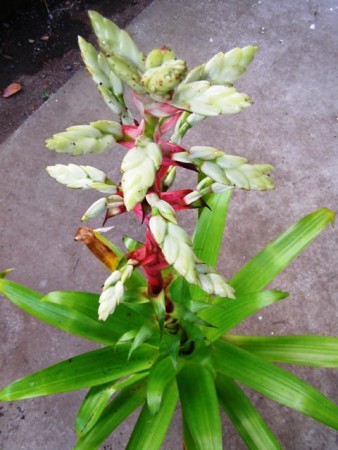
Plant Collector: Alcantarea regina

One of the most spectacular bromeliad's when in flower - Alcantarea regina

One of the most spectacular bromeliad's when in flower - Alcantarea regina

A bromeliad, or brom as they are often called, but thankfully the alcantarea family are not prickly and spiny like so many of the other species. There appears to be some debate as to whether this one is A. regina or A. geniculata – it does seem that the experts lean to the latter option but it is widely sold under the former name. Whichever, it is from eastern Brazil, as are all its alcantaera siblings. It has only been in cultivation for a little over a decade but, being easy to propagate, it is now widely grown. In leaf, it is nothing particularly spectacular – just a rosette of reasonably large green leaves. But when it shoots up a metre high, strong flower stem, it is impossible to ignore. The stem is a deep pinky red with bracts for starters, adorned by funny, waxy lemon flowers which are flat and rigid. Being a bromeliad, the flowers last a long time, after which the flowering rosette usually dies (slowly), but not before putting out pups to the side which will take over in due course.

Most bromeliads are on the tender side so we use them as woodland plants because the overhead shelter gives them protection. They have very small root systems for the size of the tops and low nutrient requirements. In other words, they need very little feeding. Most will hold water in the rosettes – which can be a breeding ground for mosquitoes as I found to my cost when working amongst ours recently. The best known bromeliad of all is the pineapple.

In the Garden: March 4, 2011

• It is now officially autumn, a much more favourable season for keen gardeners but it does bring a slight sense of melancholy to many. This is exacerbated by the national sense of shock at the Christchurch earthquake. Friends who are currently refugees from that fair city tell me that they knew that there was up and down movement as well as the more common sideways vibration because any plants in their garden which were not very well established with big root systems were thrust upwards, right out of the ground, like corks bursting out from a bottle of bubbly. Their former garden is littered with plants pushed up, tossed sideways and now lying some distance away. Sadly, that is the least of their problems but they found it an interesting phenomenon.

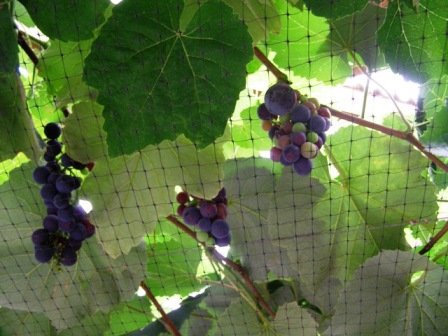
Cover grape vines urgently

Cover grape vines urgently

• If you have yet to cover your grapevines with bird netting, get onto it. Today. Otherwise you will have no crop because the birds will get there first. Even netted in, wily blackbirds will find the smallest opening but it does slow down the onslaught.

• With autumn rains threatening, harvest onions and pumpkins. It does not do them any good to be left out in the weather. Your garlic should have been gathered already.

• Most of the garden centres have their autumn bulbs in stock and the earlier you buy them, the better condition they will be in. If you are not ready to plant them, store them in the fridge but in paper bags, not plastic, so they can still breathe. Many bulbs appreciate that chill before being planted and it is recommended for anemones and ranunculus. Remember to plant anemones with the pointy side down and ranunculus with the claws down.

• Tulips are not easy to keep in our climate which is why mass displays of them are not common. Freshly purchased bulbs should give a wonderful display this spring but future seasons will be all downhill unless you live halfway up the mountain or in cold inland areas. They need winter chill to keep performing well. Even so, many of the spectacular displays in Europe depend on replanting every year and discarding the bulbs that have already flowered.

• Hyacinths are even worse in our climate which is a shame for such lovely flowers. Really, you have to see them as an annual here.

• Take out spent canes on raspberries. Next season’s crop comes on the new canes.

Tikorangi Notes: Friday 25 February, 2011

LATEST POSTS: Friday 25 February, 2011

1) The romance of the summer meadow garden and why, alas, they do not work in our climate.

2) Haemanthus coccineus in flower this week – a plant better known, perhaps, for its foliage than its paintbrush flowers.

3) Garden tasks for the last official week of summer and praise for the Japanese Black Trifele tomato.

TIKORANGI NOTES: Friday 25 February, 2011
No Tikorangi Notes today. This remains a country in shock with the Christchurch earthquake. No matter that it is quite some distance from us (different island, opposite coast and different faultlines). When the main issues remain the search for buried survivors, finding the missing (dead or alive) and, for the survivors in our second largest city, access to that most basic necessity of water, writing about our garden seems completely irrelevant.