Tikorangi notes: April 9, 2010


LATEST POSTS
1) April 9, 2010 Our chaenomeles never get bletted – Abbie’s column.
2) April 9, 2010 Autumn is the best planting time here for the ornamental garden – garden tasks this week.
3) April 7, 2010 Summer has hardly waved goodbye but it must be autumn – the early camellias are in flower. Camellia brevistyla.

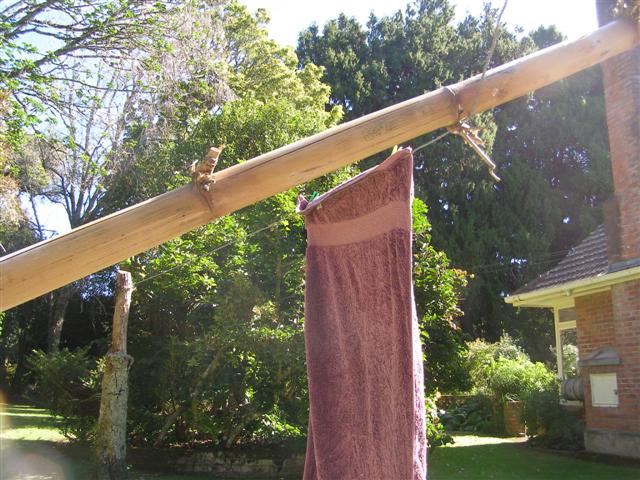
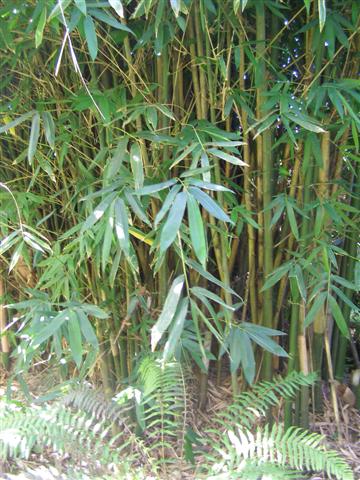
You wouldn’t credit how pleased I am with my new clothesline prop. While 95% of this country favours the rotary clothesline (originally styled the Hill’s Hoist, I am told), I quite like the nostalgia of the one wire strung between a dead tree trunk and another that looks as if it may be on the way out. This wire has served the house inhabitants well for 60 years and who am I to change traditions? The bamboo prop, however, requires replacement every five years or so. Fortunately we have a stand of this giant clumping variety on a small island in our park. Mark says he thinks this particular bamboo is one of the dendrocalamus family. There has been some resistance here to the suggestion that we could follow Asian traditions and build our own bamboo scaffolding when the upper story of the house next requires painting. The do-it-yourself ethos does not extend quite that far.

No bletting the chaenomeles in our climate

More ornamental than useful - chaenomeles or japonica apples

More ornamental than useful - chaenomeles or japonica apples

I have been harvesting the chaenomeles though harvesting is perhaps too much like hyperbole. I have been picking up a bowl of their golden yellow fruit. Most will look at the fruit and say quinces but they are not. If you said japonica apples, you would be closer to the mark. Quinces – or cydonia – are small trees from central and south eastern Europe and are closely related to apples and pears. The fruits look like golden pears. The chaenomeles are from east Asia, including Japan, and are shrubs referred to inaccurately in the past as japonicas. In fact we associate the flowering sprays of japonica strongly with Japan where the simplicity of single flowers on bare wood is evocative of that wonderful, sometimes stark, simple beauty so prized in Japanese gardening and floral art.

Back to my chaenomele fruits which are not only very decorative and long lasting, they also exude a perfume which I find pleasant. It is such a shame you have to work hard to transform the crop into something edible. The usual approach is to turn them into japonica jelly though I admit I have never tried this. My jam making efforts are limited to the raspberries these days and as it takes us about three months to get through one jar, there is a not a big incentive to be more adventurous. I did try making chaenomeles brandy one year, wooed by the delightful aroma of the fruit. I figured that I would follow the recipe for damson gin though this fruit clearly needed slicing. So I layered the slices of chaenomeles alternately with sugar in the mandatory stoneware crock, of which I happen to own several. Then I poured a bottle of brandy over it all and put it in a dark place for a year to gently steep. Yes, a whole year. Now, the damson gin recipe says that after a year, you should strain off the liquid, dilute it with another bottle of gin and leave it to mature for a second year. In my forays into damson gin, we waited the first year but never made it to the second bottle of gin and a further twelve month wait. Neither did we get past the mid stage with the chaenomeles brandy which we strained off and drank after twelve months. It was pleasant if a little underwhelming. But this is not a household where we ever drink liqueurs or indeed any sweet drinks, so perhaps our palates were just not accustomed to sweet, high octane alcohol. I prefer my brandy with lime and soda.

These days I just bring a bowl of chaenomeles into the house for aesthetic reasons. They sit for weeks without going off, golden orbs with an odd waxy coating, exuding a natural tropical perfume. So much nicer than those synthetic air fresheners marketed by Glade, I feel. The remainder of the crop hang on to the bush until their weight pulls them off and they lie below. Although the bushes are rangy, scrubby things of no merit or form out of season, in early spring the dark pink flowers are eye-catching and in autumn the fruit is a feature for a good couple of months.

In case you are wondering what a chaenomeles tastes like, I can assure you that the taste and texture does not match the fragrance. They are astringent – will pucker your mouth – but apparently in colder climates, the first frosts reduce the astringency. This is a condition referred to as bletting (there is a piece of information which you may need one day for Trivial Pursuits or quiz nights) and bletting is a key to growing good Brussels sprouts, swedes and turnips. Personally I prefer to live in a climate where we can grow oranges and avocadoes even if that means we can not have bletted crops since we never get a run of heavy frosts, or much frost at all.

Some years the chaenomeles pass me by because the good fruiting bushes (and by no means all of them fruit as spectacularly as this one) are in an area of the garden which has been a bit of a wasteland. Probably every large garden, and quite a few smaller ones, have areas where you hurry past with eyes averted because you really don’t want to address the problems there and if you ignore them, perhaps other people won’t notice them either. There comes a day when you can no longer pretend that the area does not really matter. You have to get in there. In our case, it is an area where the ever growing trees and shrubs had turned a formerly sunny position into overgrown shade forever making incursions outwards. It certainly helps to have somebody at your behest with a chainsaw and mulcher but you can get a long way with strong loppers and a sharp pruning saw. These jobs always escalate beyond what was originally envisaged as you keep penetrating onwards and inwards. We have trimmed and removed a prodigious amount of material. We have allowed sunlight into areas which haven’t seen light for nigh on a decade. We have rediscovered plants which only Mark ever knew were there. We have dug out sizeable nikau palms. It is possible to have too many self-seeded nikaus and we have more than enough. In fact we have turned dense forest or jungle into woodland.

Woodland means keeping a lighter canopy of larger plants but sufficiently open to allow reasonable growing conditions below. I haven’t finished yet but I have reached the fun stage where finally I have had the chance to try the traditional method of establishing a drift of spring bulbs. That is broadcasting handfuls of bulbs and planting them more or less where they fall. It avoids the natural tendency to plant in rows or as edgings on the margins. In this case, I have been scattering English snowdrops and interplanting with Cyclamen repandum, the last of the dwarf species to flower in spring. I have removed all the herbaceous leafy plants and relocated them. In this one patch, I don’t mind if the ground is bare for periods of the year. All I want is the higher canopy and a natural build up of leaf litter with small bulbs popping up in season.

Attractive in season but prickly and nondescript at other times

As I moved futher outwards to the sunny area again, I reached the chaenomeles and that is a bit of a challenge. Not only is it battling quite creditably with the competing growth, it seems to be attaining mammoth proportions. A mere two metres high, but it arches and layers over an area more than four metres long. I didn’t mention it is somewhat spiny and prickly, did I? It is just as well it has pretty flowers and very decorative fruit or it might have gone the way of other prickly plants – into the waiting mulcher.

In the garden this week: April 9, 2010

  • Autumn is well and truly here so the summer hiatus in the ornamental garden is over. This is a splendid gardening month. Our temperatures should stay mild well into May so there is some time left in the growing season for plants to settle in. It is a better planting time, as used to be traditional, than in the spring because the plants can establish themselves and prepare to put on a show as soon as the weather warms after winter. Spring is the planting time for very cold climates and none of Taranaki ranks as very cold by international standards.
  • If you have been intending to plant a few fruit trees or even an entire home orchard, get out to the garden centres now and see if they have the plants you want in stock yet. However, don’t be like Mark who has already purchased many fruit trees and bushes in anticipation of his new orchard but alas the space has not yet been made available as there is still the remnants of a nursery in it.
  • Make sure you buy grafted or budded walnut trees and avocados. Seedlings are a waste of time and space. Walnuts are by far the most widely successful nut in our climate. If you want to try macadamias, keep to grafted named varieties and remember they come from warmer climes so you have to live in our temperate coastal strip and to give the trees maximum warmth and shelter. Walnuts are a great deal hardier and easier to get out of the shell for the home gardener.
  • Plant hedges. Plant trees. Plant shrubs. Plant bulbs. Don’t forget the anemones, ranunculus and tulips you may have chilling in the fridge.
  • Divide clumping perennials without delay. They will settle in nicely and start re-establishing themselves so as to reward you earlier in spring and summer.
  • Don’t delay on sowing new lawns or over sowing bare patches in existing lawns. The grass needs to germinate and get established before growth slows down in winter.

Plant peas now in the hope of a super crop later

  • Continue with the autumn feeding round on ornamentals but get this done as soon as possible so the plants have a chance to take it up into their systems. Slow release fertilisers are designed for container plants not for general garden use and they are a great deal more expensive. Keep to the cheaper all purpose fertilisers for spreading on lawns and gardens – blood and bone, nitrophoska blue and Bioboost types. Good compost is also nutritious.
  • You can sow peas now for a change from brassicas and green leafy veg. Continue the autumn clean up in the vegetable garden, removing all diseased foliage from the site to break the cycle of re-infection. Sow down bare areas in a green crop. If you just leave it, the weeds will make a green crop but you are building a major problem for next summer when the weed seeds in the soil will explode exponentially.

Camellia diary – the first entry April 7, 2010

Click to see all Camellia diary entries

Click on the Camellia diary logo above to see all diary entries

Crimson King - the first of the season's sasanquas to flower

Crimson King - the first of the season's sasanquas to flower

Our interest is in camellias as good garden plants, not blooms for the show bench or scientific analysis. We remain focused on the garden. The first camellias started to come into flower here about three weeks ago, at a time when we were still reluctant to admit that summer is over for another year. The fact that we can flower camellias from March to November is perhaps one reason why they have been so popular in New Zealand.

At this stage, it is only a few species and the very earliest sasanquas with flowers. Microphylla and brevistyla were the first and while their flowers are soft and easily damaged, there are so many still to open that the simplicity and brevity does not pall. Mark had to get out the hand lens to pick the difference in the flowers of these species but microphylla seems to grow a little larger as a bush. We are raising a batch of microphylla seedlings for use as a hedge in the future, though we wonder whether what we have are natural hybrids between the two – the parent plants are in close proximity.

Punicieflora is also in flower with its tiny little daisy-like pink flowers. These are understated but charming in their own way. The foliage is a bit of a pale olive green in full sun but the upright to arching growth and small leaves mean it is a good subject for clipping as a feature plant. I am gradually shaping ours to resemble a two metre high tiered cake stand.

Sinensis, the tea camellia, is also in flower but these are of little merit despite the form we have being pink. We have tried brewing our own tea and blind taste tests from the tasting panel of two felt it came creditably close to our favoured Earl Grey.

The earliest species to flower for us this season

The earliest species to flower for us this season

Amongst the sasanquas, Crimson King is the most advanced. Mahogany red perhaps a generous descriptor of the shade of red (in the Camellia Nomenclature), it being closer to pink-red but it is an open, graceful shrub that we keep pruned to 2.5 metres. Elfin Rose has her first flowers showing colour.

In the nursery with protected conditions, flowering is usually advanced by a good couple of weeks and lo and behold, we have the first flowers on Mark’s camellia Fairy Blush. This was the first camellia he named, an open pollinated lutchuensis seedling and because it wasn’t a controlled cross, Mark was rather off-hand about it. Now we feel that it is the one that got away from us and we should have protected it with a plant patent. Hindsight is a wonderful thing. We simply did not see that it was going to be such a commercial success but a pretty little scented camellia which flowers in abundance for a good six months is a recipe for good sales. All the same, it can be a little galling when an Australian nurseryman visits and tells you just how well he has done out of Fairy Blush.

Flowering this week: Camellia brevistyla

The simple charm of the species, Camellia brevistyla

The simple charm of the species, Camellia brevistyla

Little Camellia brevistyla is in flower already, even before the sasanquas are showing colour. Individual flowers only last a day or two because they consist of a single row of between five and seven soft petals which pass over quickly but as they are tiny, measuring about 2.5cm across, they disintegrate quickly and there are plenty coming on. And the pristine white contrasts well with the dark green, small leaves. Brevistyla is a great candidate for clipping but it is also one of the best camellia options we have seen as a replacement for buxus hedging. It suckers and layers a bit which helps to make a dense hedge and it sets abundant seed so if you can find somebody with one plant, you could gather their seed (and probably seedlings) and raise your own hedge at no cost. While you will get some variations amongst the seedlings, these will be minor and barring the occasional freak (possible but unlikely), they won’t look different to the parent. While it is recorded as growing relatively tall in the wild in its native habitat of Taiwan and parts of mainland China, the plant we have in the garden hasn’t got much over a metre in a decade.

We have Camellia microphylla as well which has to be closely related to brevistyla and have raised microphylla seed as our replacements in reserve, should our buxus hedges become blighted. It grows a little taller than brevistyla but it wasn’t until Mark got out with a magnifying glass and analysed the subtle variations in the stigma length that he worked out the difference between the two species. Both make delightful autumn pictures with simple white flowers and dark foliage.