
- We are starting to dry out already. Keep a close eye on container plants. If they are showing signs of stress, it is likely they are either badly root bound (should have been potted on when we told you in winter), hungry or dried out. To get water back into dehydrated plants, a squirt of dishwashing detergent or surfactant will help absorption. However, ignore any advice given elsewhere to add water holding crystals (also called Crystal Rain) to potting mix for anything other than annuals. In our climate with high rainfall, woody plants and perennials will rot out in winter if you add these crystals, however tempting it may be in summer to use them. Partially burying pots and containers into the garden (called plunging) can reduce excessive drying out. It also stops pots with taller plants from blowing over in the wind.
- It is late in the season for planting out woody trees and shrubs, especially if they are large or root bound. Our advice is to heel them into the vegetable garden until autumn. If you are determined to plant into other garden positions, make sure that the root ball is soaked right through. A watering can just will not do. It can take hours (or leave overnight) to get the water into the middle if it is very dry. Once planted, mulch to conserve moisture and keep an eye on the plant until Christmas at least to ensure that it has not dried out again.
- If you spray for thrips on rhododendrons (the leaf sucking critters which cause silver leaves), get the first application on when you see the insects on the under side of the new growth. We are not keen on this practice and will only spray one or two special plants ourselves. We would be much happier to hear of gardeners opening up around the plant to encourage air movement, feeding and mulching to encourage more health and vigour and taking out plants which are particularly susceptible to replace with healthier selections. We have drawn a line under many of the cold loving German and American hybrids here and said that we just can not grow them well in our mild, coastal conditions.
- It is the optimum time for planting kumara runners. This is one plant which really loves warm, light soils.
- As soon as we get more rain, fungi are likely to attack potatoes and tomatoes. A copper spray applied as soon as the foliage has dried out after rain is usually necessary if you wish to guarantee a harvest later.
- Brassicas will be under siege shortly, if not already, from much of the insect population and in particular the dreaded cabbage white. This is the single biggest reason for not growing brassicas for summer harvest in our climate. If you don’t wish to spray with an insecticide, you have to start getting creative with old net curtains and the likes. However, this only stops the cabbage white laying more eggs and does nothing to deal to existing caterpillars in residence. We will be eating our remaining brassicas soon and not replanting until autumn, with the exception of brussel sprouts which are best sown in the summer for harvest next winter.
- Leeks can be sown now.
Flowering this week – Olin and Caroline (rhododendrons of course)
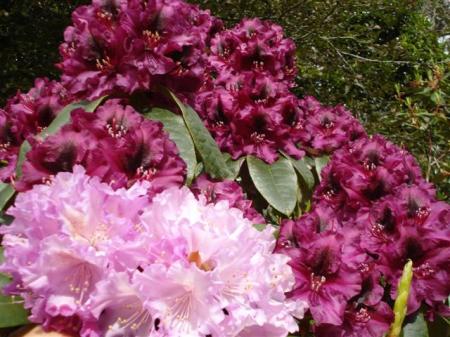
Olin O. Dobbs - a vision in blackberry and Caroline Allbrook - enchanting in lilac
The half sister, Caroline Allbrook, is a pretty, pale lavender which is a reliable performer every year here. Caro also distinguishes herself by holding well when picked which is by no means true of all rhododendrons. Great flower truss, easy to grow and should be reasonably readily available in the marketplace. She does look rather fine planted beside Olin in our carpark area but if you could use the burgundy foliage of loropetalum to contrast, in the absence of Olin.
For devotees, the seed parent of Olin is Mars and for Caro it is the species yakushimanum.

We were very taken by the juxtaposition with the purple car parked alongside by a garden visitor
In the Garden 6 November 2009
- There is precisely no gardening going on here this week as we meet and greet visitors – just the daily garden equivalent of housekeeping with the mower, the blower vac, hose, leaf rake and push hoe. It is a good exercise in keeping a garden looking sharp by maintaining freshly mown lawns and defined edges.
- Start deadheading rhododendrons as they finish flowering. Oiling your fingers (olive oil is fine), means you don’t get the sticky residue hanging on. If you only have a few plants, deadheading all of them certainly tidies them up but if you have many, then take the time to work our which ones set seed and give these priority. Try and avoid breaking off the new shoots which are coming through just underneath the spent flower.
- Be vigilant now on weeds. Early season control saves a great deal of work later on. It is warm enough now to push hoe and on a fine day, the sun will dry them to a frazzle. You can only do this if you catch them before they reach seeding stage. If you let them get too large, you really need to cut off and remove the seed heads or you are just spreading the next generation.
- Do not delay on laying garden mulch before summer. It needs to be down before the ground dries out. Laying mulch suppresses many germinating weeds, conserves moisture, improves the look of a garden and if you are using a nutritious mulch (compost) it adds nutrition and structure to the soil. It is a myth that laying pea straw adds nitrogen to the soil because the peas store all the nitrogen in their roots not their tops. If you are worried about your carbon footprint look for local alternatives – we don’t grow peas commercially in Taranaki and your cheap garden mulch is shipped from points quite some distance away.
- Top priority in the vegetable garden is getting the crops in which have the longest growing season – melons, aubergines, tomatoes, cucumbers, gherkins, kumara, Florence fennel and corn. You can continue sowing peas but it might be a little late for getting the Christmas Day harvest through in time unless they are already growing. Keep sowing the salad veg for continued harvest (lettuce, mesclun, radishes, micro greens). You can get sowings of basil and coriander in now from seed. Making pesto at home is so easy that that you will wonder why ever bought it.
- Plant main crop potatoes if you have not yet done so.
- Last year’s notes tell me that we had a triumph eating our first bowl of home grown strawberries at this time. We certainly won’t be achieving that milestone this year. I don’t think there is even a hint of red visible yet. This can be attributed to the use of a cloche last year.
Growing vireya rhododendrons from cuttings: step-by-step with Abbie and Mark Jury
A step by step guide by Abbie and Mark Jury first published in the Taranaki Daily News and reproduced here with permission as a PDF.
New Outdoor Classrooms are uploaded fortnightly.
30 October, 2009 In the Garden – including the recipe for preserved lemons as promised in the Taranaki Daily News
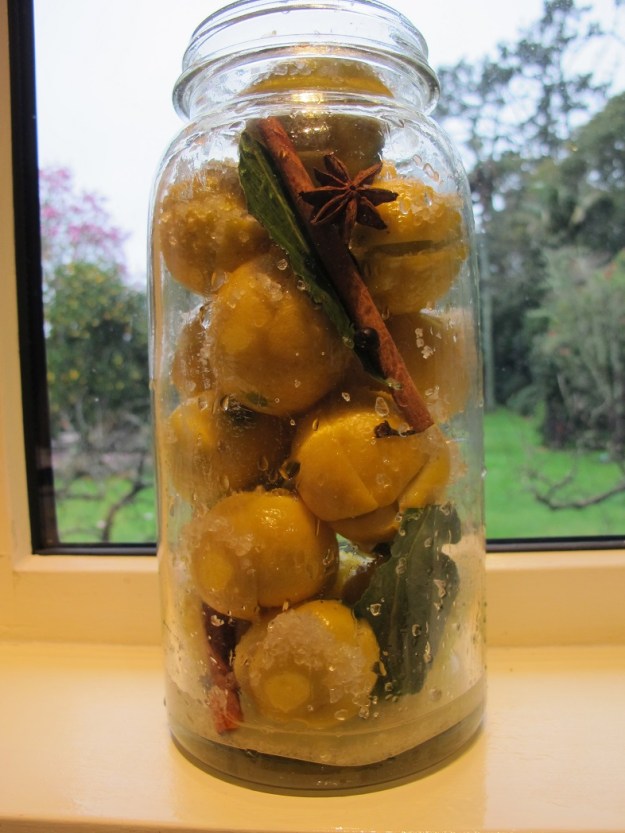
1) If you are into making home grown Christmas presents, I can vouch for the preserved lemons I made last year (except I used limes because they were a better size for the jar). I didn’t think I would use them because we have citrus available here all year, but the preserving intensified the flavour so well that I am finding all manner of uses for them. They would make a decorative festive gift in an attractive jar for very little expense and not a lot of effort.
I used a recipe from Robyn Martin’s delightful book on preserves called Relish :
Preserved Lemons
10 lemons
1 cup coarse sea salt
2 cinnamon sticks
4 bay leaves
10 coriander seeds
10 black peppercorns
1 cup lemon juice
Boiling water
Method: Cut the lemons in quarters to within 2cm of the base. Sprinkle 1 tablespoon of salt over the base of a large jar. Fill each lemon with salt and pack into the jar. When 4 lemons are packed in, place half the herbs and spices in the jar. Top with the remaining salt filled lemons and add the other herbs and spices. Pour the lemon juice over and cover with boiling water.
Seal and store in a cool dark place, shaking the jar daily to distribute the salt and spice flavours. Leave at least three weeks before using and store in the refrigerator after opening. To use, rinse the lemon well in fresh water, discard the pulp and use the skins.
Being paranoid about food safety (my toxicologist father raised us with a healthy fear of botulism), even with all that salt and lemon juice, I kept my jar in the fridge and after close to a year, the flavour is intense and delicious.
I can recommend Robyn Martin’s book for a modern take on all sorts of interesting preserves. It is a New Zealand publication by Chanel and Stylus and the ISBN is 978 0 9582729 5 7
2) This is the busiest week of the year for open gardens in Taranaki. We would encourage everyone to get out and do a spot of visiting. It is really affirming for the garden opener to receive good numbers of visitors and there is also much information sharing that goes on. All garden openers should, by definition, be a welcoming and friendly lot but the camaraderie with other garden visitors may surprise. So, no excuses. If you do not have your own garden open, then make the effort to go and get some ideas and to enjoy looking at other people’s gardens.
3) If you are tempted into buying trees and shrubs now, do not delay on getting them planted. It is not so critical with bulbs and leafy plants (perennials) but woody plants sometimes don’t recover if they get too dry and stressed. Before planting, if you can, plunge the whole plant, pot and all, into a bucket of water and hold it down until the bubbles stop rising. You can leave it overnight in the bucket. This ensures that the rootball does not have dry patches in it. If you are on coastal, sandy soil you are better to heel the plant into well cultivated soil such as the vegetable garden and relocate it to its permanent position next autumn.
4) Mulch. Mulch. Mulch. It has to go on to the garden beds before they dry out over summer if there is to be any benefit. As a general rule, if you are going to add fertiliser to your garden, apply it now and then lay the mulch on top. You don’t have to fertilise everything every year. It is best to do it when a plant starts to look a little hungry or when an area of the garden starts to look little hard done by. If you are managing your garden well, adding fertiliser should be an occasional rather than a regular occurrence.
5) In the vegetable garden, it is a continuation of the great Labour Weekend plant out. Get the kumaras and potatoes in. Start pumpkins –these are so easy to grow from seed that it is almost a crime to buy plants. Make a mound about a metre across and 60cm high comprised of layers of soil and grass. The grass will generate heat as it rots and hurry the pumpkin along. Plant tomatoes, melons, courgettes, cucumbers, gherkins – all the summer veg go in now. Unless you have a massive whanau, you will only need two or three plants of each of them, except maybe the tomatoes where a varied range of different ones is more fun all round. When you have done all that, you can be planting corn, green beans and ensuring a continuation of salad greens.

