Daphne genkwa – flowering this week

Click to see recent Flowering the week entries

Click on the logo above to see all Flowering the week entries

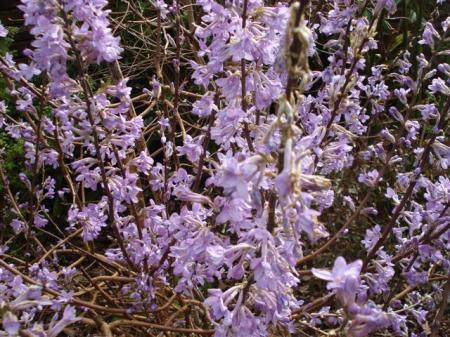
Daphne genkwa - a vision in lilac blue

Daphne genkwa - a vision in lilac blue

A daphne with no scent? What sort of plant is that? So asked a weekend visitor but we all agreed here that any plant that can look like this is worth its weight in gold. It is completely deciduous so flowers with no leaves at all and every arching branch is smothered in pure lilac blue flowers and has been for a good couple of weeks now. There are not many relatively compact shrubs that mass flower in late winter, let alone in blue. It makes such a statement in the garden that we are resolved to propagate more to use.

Genkwa is an oriental species, native to China and long prized in Japanese gardens. It can be a touchy character to get established. This specimen is our third effort but it is worth persevering. It is available on the New Zealand market though you may need to find an obliging garden centre to order it in for you if they do not have it in stock.

August 28, 2009 In the Garden

  • Members of the “Living Art” bonsai fraternity know that early spring is a critical time for repotting many of their little treasures. Bonsai is a highly specialized area of plant management and if you want to know more and to see how it is done, they will be at Cedar Lodge Nursery on Egmont Road all day this Sunday from 10.00am to 4.00pm. This is a particularly good hobby for those people who can not have outside gardens for whatever reason. Generally you can take your bonsai collection with you when you move.
  • If you are not into bonsai, you should still be heeding the advice to see to container plants at this time of year. It gives them time to settle in before summer. Trees and shrubs in containers should generally be repotted every two years. If you have them in rather small pots or slightly tortured states, repot annually to keep the plant healthy. For trees and shrubs, buy decent potting mix with controlled release fertiliser. Keep the cheap stuff for annuals. You get the quality you pay for with potting mixes and they are by no means all equal.
  • If you are not repotting your plants this year, feed them. Remember more is not better. Follow the recommended dosage rates, erring on the conservative side. Too much fertiliser can burn the plant.
  • The rule of thumb for fertilizers is that the expensive controlled release ones (mostly the coated balls of the Osmocote, Nutricote, Acticote type) are designed for container plants but cover them under the top layer of potting mix for maximum effect. Slow release fertilizers are primarily designed for topdressing container plants. These are different to controlled release and usually come in powder form. We favour one we buy in commercial quantities as Triabon (also known as Compo) which we call magic dust – albeit expensive magic dust. We only use it on containers for a three month topdressing feed. There are other brands which will be comparable – seek advice from your local garden centre but you need to understand a little first so you are buying the right fertiliser for the right use.
  • The cheap and cheerful types like Nitrophoska Blue, blood and bone or Bioboost are what you use to broadcast all over the garden where exact measurements are not needed. Liquid fertilizers are used for hanging baskets and pots of hungry annuals or top dressing fast growing vegetables where you want a quick feed and you are watering often. Compost tea, worm farm product, seaweed mixes – these are all in the quick feed liquid application group and you use them up to once a week.
  • If you plan hanging baskets for summer, get them planted up now. Don’t hang them in the full sun to start with.
  • It is still pruning, feeding, lifting and dividing, mulching and planting time in the ornamental garden.
  • At this time of the year, fruit and vegetable prices tend to soar. It is all about supply and demand. As quick turnaround crops to keep the food bills down, sprout beans at home and sow micro greens in seed trays. Swathes of parsley are a versatile standby at this time and will keep scurvy at bay.
  • If you are planting peas, the pesky sparrows may beat you to the germinating shoots unless you drape some temporary netting to discourage them. Peas can be sown on a regular basis to get continual harvests in a 90 days time.
  • New potatoes can be planted now in all but the coldest areas. Last call for planting garlic.

Yates Young Gardener Growing Things to Eat, by Janice Marriott

We are pretty keen on young children here and also on gardening so we really wanted to be positive about this book. But we can’t be. It is frenetically busy, hyped, packed with a gazillion ideas, jokes, puzzles, talking worms and snails and a whole lot more. The bottom line is that the technical information is patchy and the activities and experiments are often too superficial and lack detail so are destined to fail. By way of examples: “Put a plant into a glass jar of coloured water. Watch the leaves change colour.” I think what is meant is that you can change the colour of a white flower such as a camellia or a carnation or a variegated leaf with white patches by putting it in a jar of water with food colouring or ink added but children (or facilitating adult) need an idea of quantity of colouring to liquid. And they are not putting a plant in the water; they are putting a flower or suitable leaf into the water. We used to grow pineapple tops but when did you last see a pineapple in the supermarket with an intact rosette of leaves at the top? They are generally all cut off now. A pine cone is not a seed. Nor is pine seed dispersed by the cone rolling down hills. Get the picture? Too busy, too much content with insufficient critical thought and rigour in the underpinning information.

This is also a book which purports to be for children but it is actually a handbook of ideas and information for a sympathetic adult to use with children in shared activities. It may appeal to hands-on, dedicated parents such as home schoolers or Playcentre parents but despite the prevailing busy-ness and jokey-ness it is unlikely to keep any child busy and motivated on their own. Give it as a gift to parents, not to children.

Harper Collins ISBN 978 1 86950 7947

And lovely is the rose, by Barbara Horn, illustrated by Sheila Galbraith

A modern, small format version of classic Redoute’s Roses, this is not although it tries to be. It is a collection of 50 botanical paintings of roses with facing page of information (a bit of history, catalogue style description and a little interpretation but nothing of note that has not been written elsewhere). But the success of this book was always going to rest on the charm and quality of the flower paintings. Unfortunately the quality of printing in this book, which appears to be privately published, is so poor that it is impossible to judge whether the artist has any talent or not. The paintings are on a grey background, washed out of colour and defintion and so fuzzy they must be out of focus. It seems a shame to go to all the effort to produce a book only to end up with such a dreadfully disappointing result.

Exisle Publishing ISBN 9780908988921

Magnolia Diary number 7, 26 August 2009

Click to see all Magnolia diary entries

Click on the Magnolia diary logo above to see all diary entries

A short but fierce storm last night was a good reminder why we value firmer flowers and thicker petals in our magnolias. Nothing floppy and loose was ever going to survive hail, strong wind gusts and 3.2cm of torrential rain in a very short space of time. We were relieved this fine morning to discover that the main casualty was to shorten the season of plants which are past their peak already. Iolanthe came through almost unscathed, despite flowers which measure up to 25cm across.

The original Iolanthe this morning

The original Iolanthe this morning

Of all the magnolias here, the original Iolanthe remains the one with most impact at its peak. Mind you, that is a combination of size and location and a weekend visitor asked us to consider the effect Magnolia Felix Jury will have when it reaches that size. We hadn’t quite thought of that.

The original Iolanthe grows half way down our house driveway and now reaches around ten metres high and ten metres across. The leaf and petal drop is prodigious but the impact of Iolanthe in full flower is so astonishing that we do not mind the clean up. Nor has Mark complained about having to move the vegetable garden due to the increasing shade. The tree takes precedence.

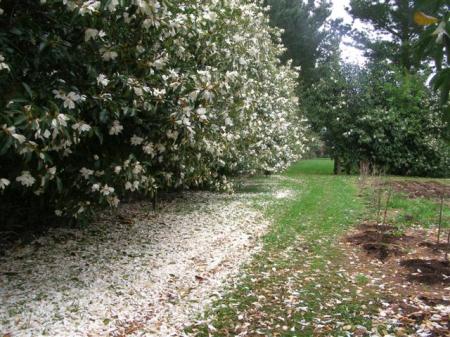
Magnolia Iolanthe after the storm

Magnolia Iolanthe after the storm

Back around 1960 when Felix did his first run of magnolia hybrids, he heeled them into the vegetable garden, planning to plant them out to beautify the local town of Waitara. But Iolanthe flowered and the very first flowering was so astonishing that the plant has remained in situ ever since. Iolanthe is soulangiana Lennei x Mark Jury and here was the full sized campbellii flower on a very young plant. The colour was not quite the pink Felix wanted but it was a huge breeding step. Iolanthe also flowers down the stem so, of all the magnolias here, it has one of the longest flowering seasons stretching over many weeks. As with many of the soulangiana types, Iolanthe will put up some summer flowers as well.

For the record, as we understand it, the magnolia sold as Eleanor May is a reject Iolanthe sister seedling. It was used as root stock at Duncan and Davies because it was easy to strike, vigorous and healthy and it was referred to as Mark One. Back in those days, Duncan and Davies made an effort to select clonal root stock best suited to individual varieties but such attention to detail is a thing of the past. At some point Duncan and Davies sent out some failed grafts under the name of Iolanthe whereas they were in fact root stock. The person who named this cultivar bought it from a garden centre, noticed when it flowered that it was different to Iolanthe so took it upon himself to name it. In fact he had no right to name it. He only owned the one plant he purchased; he did not own the cultivar itself so it was not his to name. On its day it is a good performer, as many of our sister seedlings, reject cultivars and also rans are good on their day but it is inferior to Iolanthe and we do not consider it should have been named. We take particular exception to Eleanor May ever being attributed as a Jury hybrid. As far as we are concerned, it is escaped rootstock.