Postcards of Melbourne

Cordyline Burgundy Spire

How handsome is Cordyline ‘Burgundy Spire’, seen here in the trial grounds of Anthony Tesselaar Plants in Sylvan, near Melbourne? It isn’t one of ours, though we would be happy if it was. The breeder is fellow New Zealander, Geoff Jewel. It is just a shame they never look like this in New Zealand, on account of our native moth, Epiphryne verriculata. We always have chewed and holey foliage which is the nature of the plant in its homeland; still handsome and eye-catching but as a garden plant, it would be nice to have cleaner foliage.

Mark Jury and Cordyline Red Fountain

However, I can add to the occasional series of Mark Posing Beside Jury Plants Around the World – this time Cordyline Red Fountain at Melbourne Botanic Gardens. This plant was a joint effort between Mark and his father Felix, and was the first highly successful commercial plant that generated an actual income back to the breeders. Phormium ‘Yellow Wave’ still continues to be grown widely around the world but Felix never received a single cent for that one. Ditto Mark’s Camellia ‘Fairy Blush’. While it is awfully nice to be told by Australian, French and Belgian growers what a wonderful plant that camellia is and how many they sell each year, it would have been nicer had they been paying a royalty.

Muehlenbeckia complexa

While at the aforementioned Botanic Gardens, we were somewhat charmed by these free-form animal figures created in Muehlenbeckia complexa, another New Zealand native. As the plant is generally a scrambling groundcover, I am guessing they must have trained it up over wire frames. I have forgotten the name of the fern that is used as groundcover. We have it in our garden and usually refer to it as the asparagus fern but I think the common asparagus fern that can be distinctly weedy is something entirely different. This one is rather too slow growing to threaten weed status.

Plant supports from metal

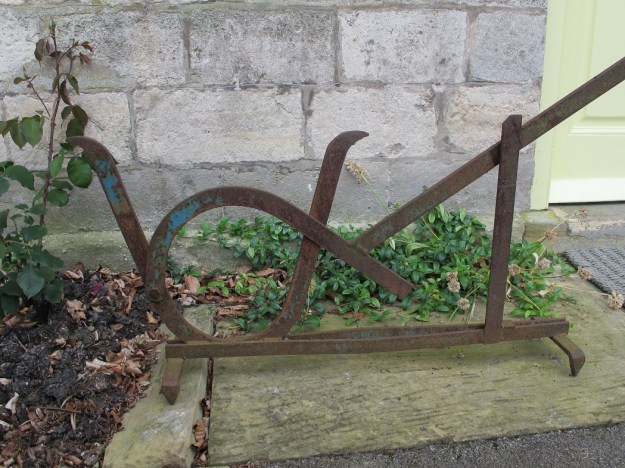
I photographed these permanent metal plant supports to add to my ideas file. In this case, ideas to keep Our Lloyd busy, should he ever run out of work to do here. This scenario seems unlikely, but there are times when some durable, attractive plant supports would be very helpful. I like gently rusting metal because it melds harmoniously with plants. I have always wanted to live in a house with Gothic arched windows. This seems an entirely unlikely event on account of Gothic arched windows never really catching on in New Zealand wooden villas and bungalows of yore and the fact that we have no plans to move house if we can possibly avoid it. But my ambition now is to have some Gothic arched plant supports, at least. As I have become more interested in managing summer perennials, the need for plant supports is becoming more pressing.

Golden bougainvillea

I would be tempted to buy a golden bougainvillea if I ever came across one for sale, though they are such monster plants, with fierce thorns, that they are very difficult to place in the garden. I first saw this colour on the Greek island of Kalymnos many years ago and I can’t recall seeing one since. Purple a-plenty, magenta, pure red, even white but the yellow and orange shades are nowhere near as ubiquitous. I was charmed to find one just down the road from where we were staying in Carlton North.

I interpreted these two scenes as what happens when city dwellers plant their Christmas trees on the road verge, although the right hand photo is not a conifer but more likely an Australian native. They amused me, though they have that look of potential vegetable time bombs.

Ziziphus jujuba

Chinese red dates! Botanically Ziziphus jujuba. I have only ever tried these dried and packaged before, and that was many years ago, but our daughter found these at the Sunday markets. They are about the size of a large crabapple and taste like a date-y apple but without the crispness of the latter fruit. I have never seen them sold fresh in New Zealand.

Bicycle friendly

Melbourne is not a city I know, having only been there twice before on brief visits. But we were very taken with the focus on infrastructure and design to make it bicycle friendly. Our son lives there and does not have a car so we were relieved to see that he is living in a city which prioritises safe cycling, even when it may inconvenience car drivers. Our apartment looked out over a protected cycleway and we were amazed at how many people moved along quickly on two wheels. Imagine the alternative of each of those cyclists sitting in a car – often just the one per car. In NZ, cyclists are fighting hard for some rights and accommodation in cities but too often car drivers see them as moving targets and act aggressively towards them on a point of principle. And god forbid that we should put in urban cycleways at the expense of a few carparks. Let alone give cyclists priority at intersections to make it safer for them.  In  our country with sprawling cities, low population density and poor to non-existent public transport, the private car rules supreme and even there, New Zealanders favour big sports utility vehicles (urban tractors, as they are sometimes called) and people movers with four wheel drive, even when they will never leave the sealed roads. We have much to learn and there are better ways of doing things than forever listening to the howling demands of incensed vehicle owners.

From the start, Melbourne was built with reasonably high density housing and sufficient money to add ornamentation in abundance to its domestic housing. It is very charming that so much of this has been retained. But – and it is a big but – what is with the graffiti, Melbourne? Graffiti everywhere. The only place we have ever seen graffiti to rival it is alongside the rail lines as we left Paris. Our son suggested it is part of the edgy urban feel Melbourne cultivates but we were not convinced.

A visit to Cloudehill Gardens

A touch of whimsy to welcome at the entrance – yes or no? 

We first visited Cloudehill Gardens about 20 years ago when it was still very much one man’s garden. Jeremy Francis took over the property in 1992 so it would still have been very new when we saw it. While there were plants and established trees from its earlier time as a nursery, there was no garden when he started. In the time since, it has matured to one of the flagship gardens of the Dandenong area, about an hour out of Melbourne. It is a large garden, created in the Arts and Crafts style with, the publicity tells me, twenty different garden rooms.

Very arts and craftsy in style 

The design may be very Hidcote/Sissinghurst, but the perennial plantings reflect the fashions of the new millenium 

While it appears that the originator, Jeremy Francis, is still on the scene, day to day management has transferred to The Diggers’ Club, which is a membership organisation unique to Australia. The upshot of this is that there is a now a retail outlet and a good café/restaurant (though the wasp infestation drove us indoors to eat), a focus on events and attractions and ‘adding interest’ to the garden. This means it has facilities and infrastructure but the trade-off is that the deeply personal touch of a single owner is no longer as evident. I found some of the novelty sculptures and touches were a little jarring in a garden where the underpinning hard landscaping is of exceptional quality. But a garden being run as a commercial entity has to strive to be all things to all people. It is now branded with the ubiquitous but rarely accurate strap-line of “a garden for all seasons’.

Not, I think, Cloudehill’s finest moment but it is hard for a garden to be all things to all people

Colour-toned belladonnas and Japanese anemones for an early autumn welcome

I have never seen a garden that can peak for twelve months of the year and at the end of a long, hot, dry Australian summer, it was not at its peak but there was still plenty of interest along the way. When I review my photographs, I see that I kept focusing on the high quality of most of the garden structures. Attention to detail, again and again. I really appreciate that. There is a timelessness to good structure that carries a garden well through the years, even though the plantings may change with the times.

I liked the cobbles set in the path, as an example of understated detail, though I am guessing the fill has washed away, leaving them as something of a trip hazard. It was the only maintenance flaw that I recall in a garden where the overall management was of a very high calibre.

Attention to detail – look at the staging of this feature pot 

The hand-crafted wrought iron fence that separated gardens took my fancy as a personalised, modern take on an old craft.

Detail again – look at the beautiful end to this balustrade. And unless I am mistaken, that is a Marlborough rock daisy from New Zealand, Pachystegia insignis, nestled into an Australian garden that is modelled on English design.

I blog. I do not instagram. This may be the reason why I forgot to photograph my lunch but as far as I recall, it was very pleasant. What I did photograph was an installation of figures created by sculptor, Graeme Foote. These I really did like, especially in their setting here. I could find a home for some of these figures. While the individual price seems very reasonable at a mere $400 each, the trouble is that we would need at least 10 to make a statement.  Plus packing and freight across the Tasman. Sometimes we have to be content with memories and photographs.

Haute couture on a cold and wet Saturday in Melbourne

After two hot days in Melbourne last week, the temperature plummeted from 27 degrees to about 10 (Celsius). Fortunately, I had looked at the weather forecast and packed extra layers but I did wonder if I was going to have to buy myself gloves as my poor arthritic fingers complained. It was a day for indoor activities so we went to Melbourne Art Gallery instead.

It was the final day for the Escher exhibition and the queues were enormous so we avoided that and went instead to the Krystyna Campbell-Pretty collection of haute couture and Parisian fashion from 1890 to the current day. Now, haute couture does not feature in my life, I admit that. But staging exhibitions has been on my radar from earlier in my life when I worked in an art gallery for close to five years. With over 150 outfits on display, the first rooms were simply staged to feature the gowns.

These are Christian Lacroix 

By Cristobal Balenciaga

I was pretty surprised to find that the fake fur coat dates back to 1955. I did not know that synthetic fabrics were being used that early but clearly Cristobal Balenciaga was right up with the new materials.

Over 150 gowns is a large number and I guess when I started photographing the models’ heads, my attention was already slipping. But then I noticed another aspect entirely. My guess is that the first gallery rooms were staged initially but then the exhibition designer and hanging assistants also found their attention straying and decided to step everything up several notches.

First it became somewhat theatrical in the staging.

Then we came across examples where the models and gowns were clearly matched to the paintings on the walls. They were witty but it does mean that one’s eyes naturally focus on the whole scene, rather than on the individual gowns. Which is fine, after 100 or so gowns.

The gallery of the little black dress was Something Else. In the centre of the room, the models were staged with a collection of 3 or 4 smaller, nude men in bronze which was pretty humorous.

But around the walls, the gowns were arrayed on a series of rising platforms on the wall, and as they rose, the models became not only elevated, but also headless.

As we exited, I saw this display which had me come home and Google when bras were invented. These three gowns came from around 1890 to 1905 and the first and third gown presumably indicated the use of binding that pre-dated bras. The middle one, it appears from the shape, was for the bra-less – a 1905 afternoon gown from Marie Callot Gerber. And in case you are dying to know when bras appeared, the first models were around this time but they did not come into widespread usage until the 1930s.

If haute couture is not your thing, may I offer you this shiny motor cycle exhibit instead? It is by Indian artist Subodh Gupta, from 2001 and predominantly cast in bronze with aluminium and stainless steel.

A day at the Melbourne Flower Show

Lots of lovely kniphofia featured which may be a reflection of the time of year for the show

I admire the skills it takes to get massed displays of tulips flowering in autumn (which will be to do with times of refrigeration and removal from the cold to controlled growing conditions). But I prefer the kniphofia.

We went to the Melbourne Flower Show last week. Never been before. There are reasons why we have never felt the desire to time one of our UK trips for the Chelsea Show. We are gardeners, first and foremost. Put us in a real-life garden and we are in our element. Flower shows are a whole different genre and it takes some effort to switch focus and orientate oneself to the small, staged gardens that are the centrepiece of such events. Added to that, we are not good shoppers and the retail outlets take up the lion’s share of display space. Clearly, we can’t buy plants in Australia to bring home or we might have taken more notice of the plant stands. But we are adaptable people and had a most pleasant day in the 27 degrees (Celsius) of an early autumn day in Melbourne. Though when the temperature plummeted to about 12 degrees max two days later, we were glad we went on the Thursday and not the Saturday.

We were not above some pride in what I called the Mark Jury Wall of Fame on the outside of the Media Centre. And Mark was sufficiently gratified to pose for my photos. All the plants except the coprosma are his breeding. Admittedly the Media Centre is organised and run by our agents, Anthony Tesselaar Plants, but it did feel a bit like having a prime position at the show. Sometimes, it is easy to lose sight of the bigger picture when we are immersed in our garden at home and New Zealanders rarely like to hail one of their own, lest that person get a swollen head, so it was pretty interesting to find his standing in Australia is greater than at home.

‘When flower shows get judgemental’

Our adult children were with us and I was greatly amused when the eldest shared her photo to Facebook with the caption: ‘When flower shows get judgemental’. These ‘Achievable Gardens’ were largely modest affairs and indeed very achievable, for the most part.

Definitely achievable

I failed to take notes but I am pretty sure this was the winner in the Achievable Gardens section

The show gardens were a mixed bag. It is hard to be genuinely original in a small, tightly constrained space and there were the usual cute cottage gardens, stylish courtyard gardens, outdoor living rooms, a rill (of course a rill), living walls and the like.

We particularly liked this informal, wildflower garden by Ben Hutchinson but the judges did not rate it as highly as we did. Very glaring light conditions so the photograph does not do it justice.

I liked the use of blue festuca grass rather than the more cliched black ophiopogon (mondo grass) between the pavers in this immaculate garden

I have to admit that at the time we didn’t analyse what trends we could pick and it is only reviewing my photos and writing that has had me turn my attention to that. It is a different country, a city with a different climate to ours (much hotter and drier than us in summer), early autumn and we are not particularly familiar with the plants favoured in Australia. Also, these are temporary show gardens so most start from the base of defining the area with hard landscaping.

Look at the lovely detail in the wooden beehive-like construction. I failed to record the designer and the programme did not help me determine that afterwards. 

But overall, I think I could declare that minimalist, hard-edged form and simplistic plantings can be consigned to the dustbin of history. I can’t recall much, if anything of potagers, either. Flowers. Most of the gardens used flowers and colour and a relatively wide plant palette, often with Australian native plants featuring large. Overall, naturalistic plantings which make an ecological contribution. We, of course, are quite happy with this trend. It fits with our own gardening philosophy.


The Best in Show was beautifully executed with a lot going on and every detail attended to with care and skill. I could see why it won. My photos don’t do justice to the exquisite management of colour.  The light was very harsh. It was also a big budget installation, but in the end, that is what these flower shows are all about.

Overall winner – and deservedly so

Framing views

We only passed through the Great Hall but I went back to photograph the ikebana. I am not into floral art at all and have never taken any interest in the refined skills, balance and allusions of ikebana. But visually, I appreciated the simplicity of the large examples on display.

As regular readers will know, we are not big on garden ornamentation and decoration, but these bark birds of prey were striking, if natural styling is your preference.

More from Melbourne to come. A visit to the Dandenongs and Cloudehill Gardens, the Melbourne Art Gallery and Botanical Gardens.


From scratch – the caterpillar garden

The caterpillar garden has been bringing me much delight this summer.

Starting to lay the area out in 2016 and marking the basket fungus shape

It is a flat area. Mark had to get up the ladder to get a view

Basket fungi

We refer to it as ‘the caterpillar garden’ but we really need to come up with a better name. It is the caterpillar garden because of an episode of BBC Gardeners’ World we watched several years ago. English designer, Tom Stuart-Smith, went into Carol Klein’s garden and clipped her buxus hedge into his trademark, undulating, wavy caterpillar style. That was the starting point for Mark’s vision for this particular area – a central backbone in clipped, undulating caterpillar-style but planted in a small leafed Camellia microphylla rather than utility buxus. He laid it out in pentagon shapes and I wondered about calling it ‘the pentagon garden’ but I would need to wait for a new president of America to go with anything that carried such strong, albeit irrelevant, connotations. Now Mark is wondering about ‘the basket garden’ on account of the basket fungus that guided his layout but that is a bit obscure.

May 2018, a few months after planting. The Podocarpus henkelii in the centre is such a handsome tree that we are keeping it and working around it. The little white flowers are Camellia microphylla in bloom in early autumn.

We both laughed when a Facebook page of Broughton Grange’s parterres came through on Facebook this week. Lo, there was Tom Stuart Smith’s undulating caterpillar hedging, filled with a tapestry of plants. Same, same but different. I think his shapes are hexagons, not pentagons and he has closed each shape rather than opening bays to the side paths as we have. He has gone for a different colour palette too – bright reds and yellows rather than our softer hues of blues, whites and lilac. And he has put the taller plants in a separate border to the side of the parterre rather than having them rising out of the central enclosures as we have. But we feel we are in excellent company with our caterpillar garden. We were a bit surprised that a small snippet of inspiration could see us end up at a similar destination several years later.

Very late spring 2018 – white iberis and Brodiaea ‘Queen Fabiola’ with the blue perennial forget-me-not (Myosotis) in the background

I wondered about appending a plant list to this post at the end, just in case any reader wanted to see what we have used but these things are never that simple. Even mass planting for impact and restricting the selection for each separate enclosure to between one and three different plants, I have kept adding to the plant palette to try and extend the seasonal interest and a quick count came to about fifty different plants so far. So I won’t be listing them. I can tell you that it gets us through three seasons with different plants being a focus but it is never going to be a great mid-winter garden. I would also comment that we could not afford to garden on this scale if we relied on buying the plant material. It takes many (many, indeed) plants to fill such an area of around 200 square metres. We have drawn on plants we already had in the garden, plants we have been given and trialled in Mark’s vegetable and meadow areas and plants we have raised. In fact, while it has taken plenty of time and effort and a lot of thought, the dollar expenditure currently sits at zero. We are quite happy to pay for special plants or ones we need to get us started, but this is not a garden for special plants. We are after mass effects and colour blocks.

The Salvia uliginosa is too floppy to be in an outside bed

This is now a garden filled with life, particularly butterflies and bees

This has been its second summer. It was patchy last year with big gaps. Some of the plants are smaller growing and more compact so take longer to spread and cover the area. This summer, I have felt it is coming together as we hoped. I have just completed the first – and most major –  reworking that is often necessary when the reality doesn’t match the vision. The pink shades had to go. Too pink and detracting from the spectrum of blues and whites. Salvia uliginosa is too tall where I had it and needs to be moved – but placed with care because it does have dangerous, invasive instincts. I am quite happy doing the fine tuning. For me, it is worth the effort.

I love the white Japanese anemones and blue asters currently in bloom

I have high hopes for next year when I think it will all come together as we envisage it. And we may have the paths laid and quite possibly some garden edging to emphasise the curves. I was going to avoid edgings if I could but I think this is a case for gently rusting Corten steel edging defining the lines and keeping the mulch from the paths. Not tanalised timber ply, not in our garden.

It feels as though this garden has taken longer to get to fruition, but what is a few short years in the greater scheme of things?

This was back in 2012 when we emptied out the capillary beds (which had been built around the Podocarpus henkelii 20 years earlier).

In 2014, we cleared and re-contoured the area. Same tree in the centre. Spike, the dog at the front is still with us but distinctly elderly and very deaf these days,

And this week. Filling in colour blocks with plants.