Haute couture on a cold and wet Saturday in Melbourne

After two hot days in Melbourne last week, the temperature plummeted from 27 degrees to about 10 (Celsius). Fortunately, I had looked at the weather forecast and packed extra layers but I did wonder if I was going to have to buy myself gloves as my poor arthritic fingers complained. It was a day for indoor activities so we went to Melbourne Art Gallery instead.

It was the final day for the Escher exhibition and the queues were enormous so we avoided that and went instead to the Krystyna Campbell-Pretty collection of haute couture and Parisian fashion from 1890 to the current day. Now, haute couture does not feature in my life, I admit that. But staging exhibitions has been on my radar from earlier in my life when I worked in an art gallery for close to five years. With over 150 outfits on display, the first rooms were simply staged to feature the gowns.

These are Christian Lacroix 

By Cristobal Balenciaga

I was pretty surprised to find that the fake fur coat dates back to 1955. I did not know that synthetic fabrics were being used that early but clearly Cristobal Balenciaga was right up with the new materials.
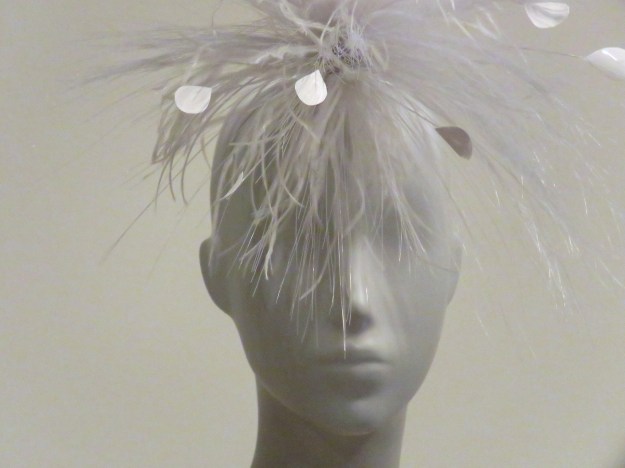
Over 150 gowns is a large number and I guess when I started photographing the models’ heads, my attention was already slipping. But then I noticed another aspect entirely. My guess is that the first gallery rooms were staged initially but then the exhibition designer and hanging assistants also found their attention straying and decided to step everything up several notches.
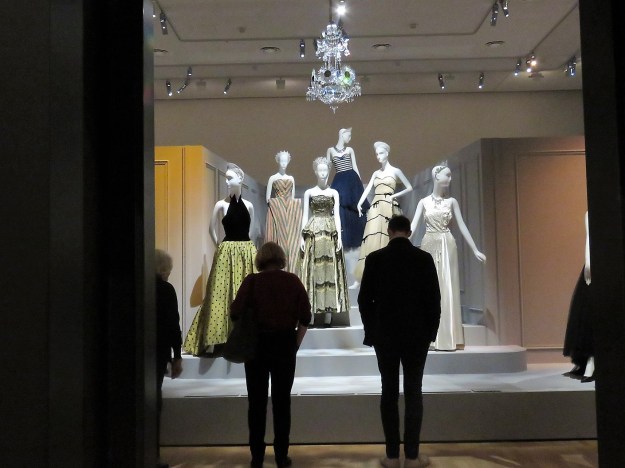
First it became somewhat theatrical in the staging.
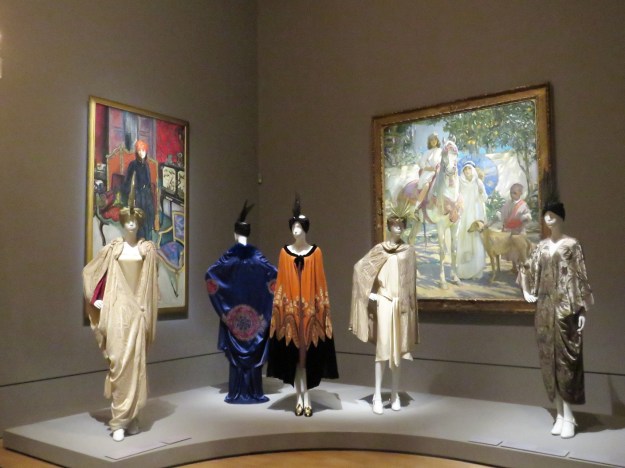
Then we came across examples where the models and gowns were clearly matched to the paintings on the walls. They were witty but it does mean that one’s eyes naturally focus on the whole scene, rather than on the individual gowns. Which is fine, after 100 or so gowns.
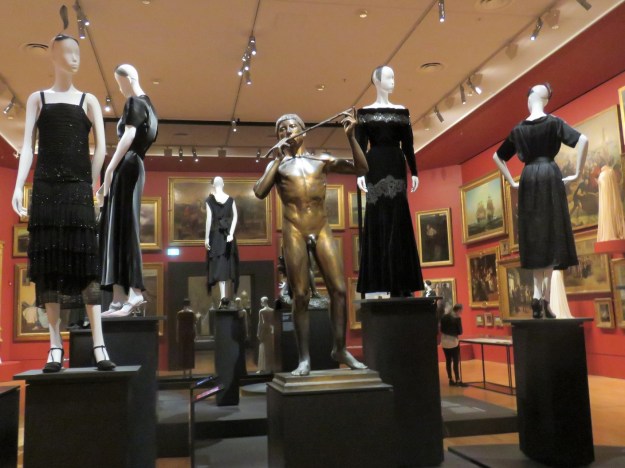
The gallery of the little black dress was Something Else. In the centre of the room, the models were staged with a collection of 3 or 4 smaller, nude men in bronze which was pretty humorous.

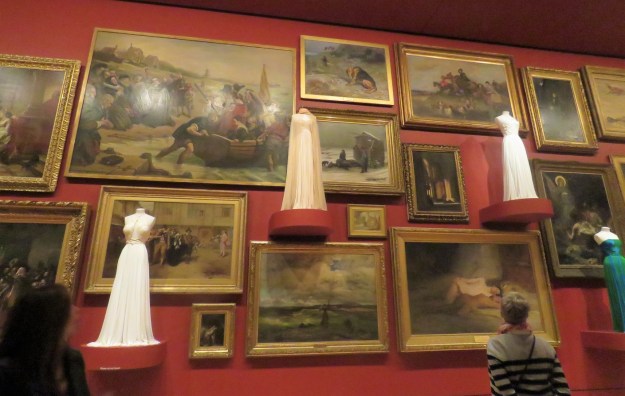
But around the walls, the gowns were arrayed on a series of rising platforms on the wall, and as they rose, the models became not only elevated, but also headless.
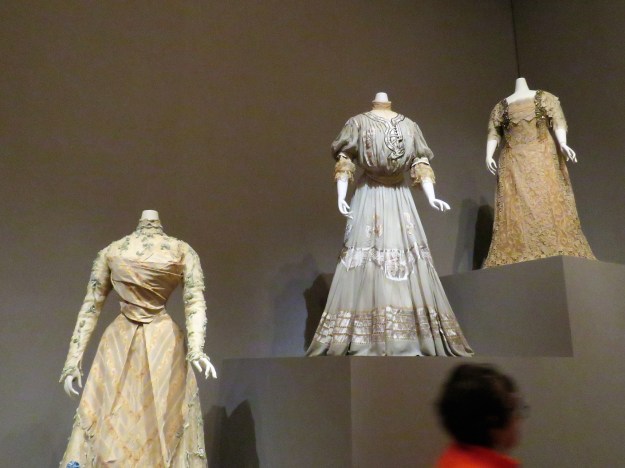
As we exited, I saw this display which had me come home and Google when bras were invented. These three gowns came from around 1890 to 1905 and the first and third gown presumably indicated the use of binding that pre-dated bras. The middle one, it appears from the shape, was for the bra-less – a 1905 afternoon gown from Marie Callot Gerber. And in case you are dying to know when bras appeared, the first models were around this time but they did not come into widespread usage until the 1930s.

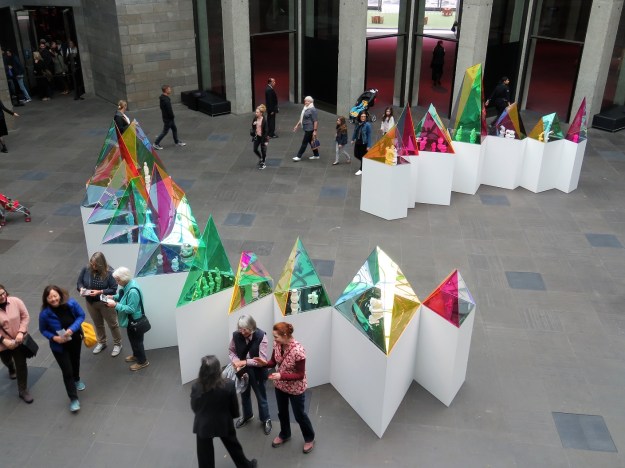
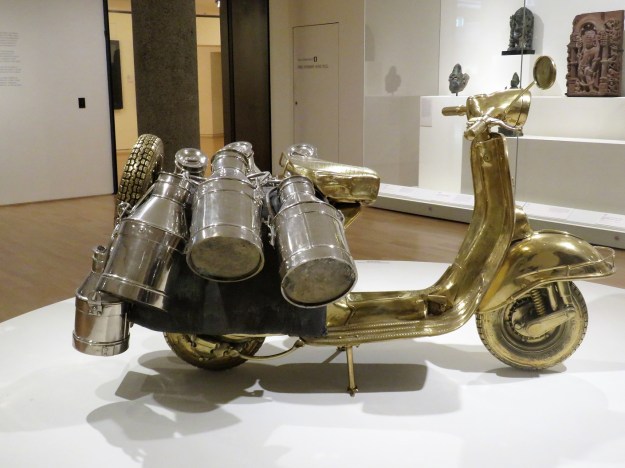
If haute couture is not your thing, may I offer you this shiny motor cycle exhibit instead? It is by Indian artist Subodh Gupta, from 2001 and predominantly cast in bronze with aluminium and stainless steel.
A day at the Melbourne Flower Show

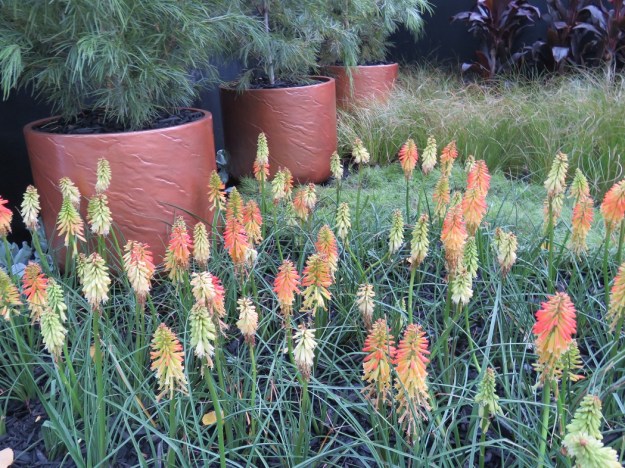
Lots of lovely kniphofia featured which may be a reflection of the time of year for the show

I admire the skills it takes to get massed displays of tulips flowering in autumn (which will be to do with times of refrigeration and removal from the cold to controlled growing conditions). But I prefer the kniphofia.

We went to the Melbourne Flower Show last week. Never been before. There are reasons why we have never felt the desire to time one of our UK trips for the Chelsea Show. We are gardeners, first and foremost. Put us in a real-life garden and we are in our element. Flower shows are a whole different genre and it takes some effort to switch focus and orientate oneself to the small, staged gardens that are the centrepiece of such events. Added to that, we are not good shoppers and the retail outlets take up the lion’s share of display space. Clearly, we can’t buy plants in Australia to bring home or we might have taken more notice of the plant stands. But we are adaptable people and had a most pleasant day in the 27 degrees (Celsius) of an early autumn day in Melbourne. Though when the temperature plummeted to about 12 degrees max two days later, we were glad we went on the Thursday and not the Saturday.

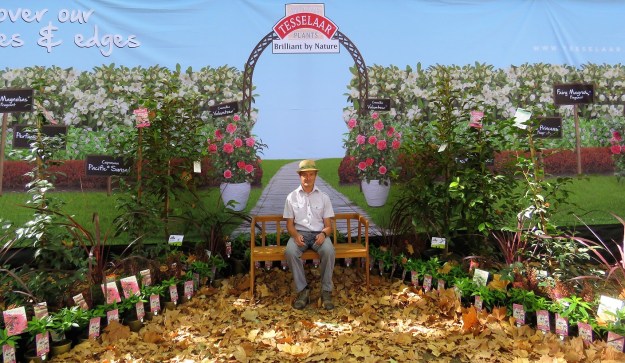
We were not above some pride in what I called the Mark Jury Wall of Fame on the outside of the Media Centre. And Mark was sufficiently gratified to pose for my photos. All the plants except the coprosma are his breeding. Admittedly the Media Centre is organised and run by our agents, Anthony Tesselaar Plants, but it did feel a bit like having a prime position at the show. Sometimes, it is easy to lose sight of the bigger picture when we are immersed in our garden at home and New Zealanders rarely like to hail one of their own, lest that person get a swollen head, so it was pretty interesting to find his standing in Australia is greater than at home.

‘When flower shows get judgemental’

Our adult children were with us and I was greatly amused when the eldest shared her photo to Facebook with the caption: ‘When flower shows get judgemental’. These ‘Achievable Gardens’ were largely modest affairs and indeed very achievable, for the most part.

Definitely achievable

I failed to take notes but I am pretty sure this was the winner in the Achievable Gardens section

The show gardens were a mixed bag. It is hard to be genuinely original in a small, tightly constrained space and there were the usual cute cottage gardens, stylish courtyard gardens, outdoor living rooms, a rill (of course a rill), living walls and the like.

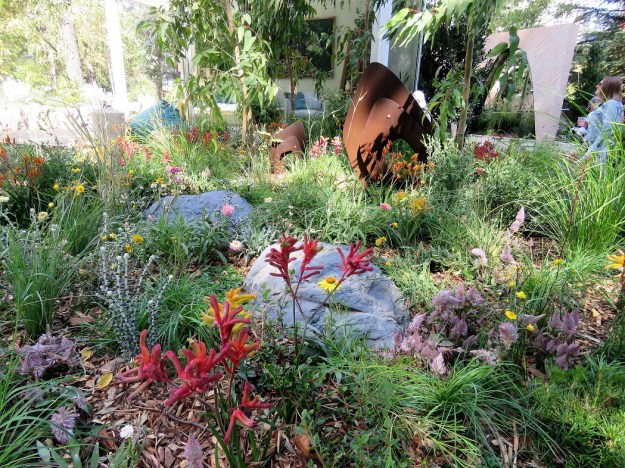
We particularly liked this informal, wildflower garden by Ben Hutchinson but the judges did not rate it as highly as we did. Very glaring light conditions so the photograph does not do it justice.

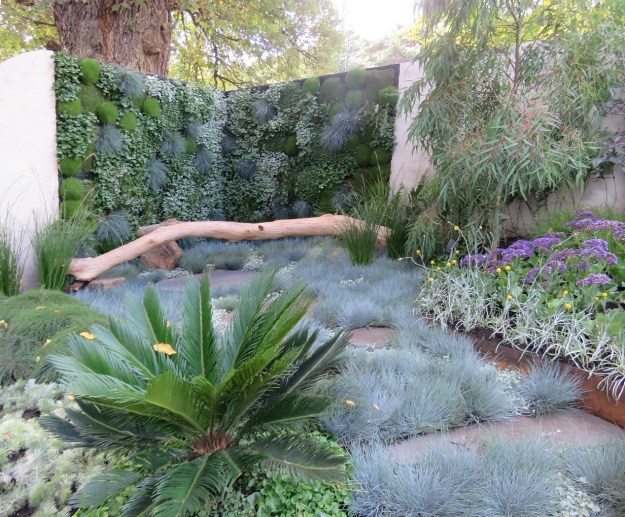
I liked the use of blue festuca grass rather than the more cliched black ophiopogon (mondo grass) between the pavers in this immaculate garden

I have to admit that at the time we didn’t analyse what trends we could pick and it is only reviewing my photos and writing that has had me turn my attention to that. It is a different country, a city with a different climate to ours (much hotter and drier than us in summer), early autumn and we are not particularly familiar with the plants favoured in Australia. Also, these are temporary show gardens so most start from the base of defining the area with hard landscaping.

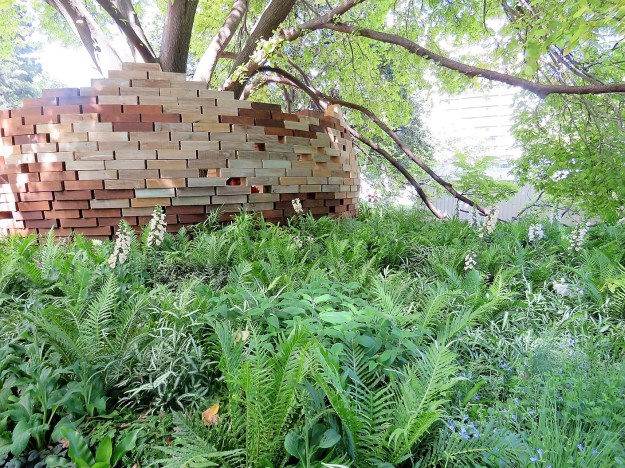
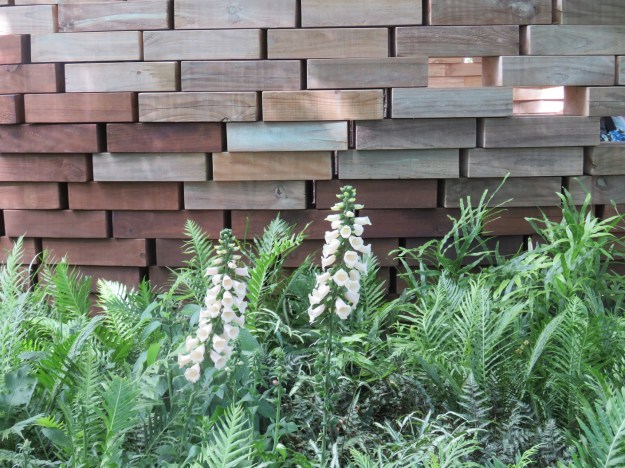
Look at the lovely detail in the wooden beehive-like construction. I failed to record the designer and the programme did not help me determine that afterwards. 

But overall, I think I could declare that minimalist, hard-edged form and simplistic plantings can be consigned to the dustbin of history. I can’t recall much, if anything of potagers, either. Flowers. Most of the gardens used flowers and colour and a relatively wide plant palette, often with Australian native plants featuring large. Overall, naturalistic plantings which make an ecological contribution. We, of course, are quite happy with this trend. It fits with our own gardening philosophy.


The Best in Show was beautifully executed with a lot going on and every detail attended to with care and skill. I could see why it won. My photos don’t do justice to the exquisite management of colour.  The light was very harsh. It was also a big budget installation, but in the end, that is what these flower shows are all about.

Overall winner – and deservedly so

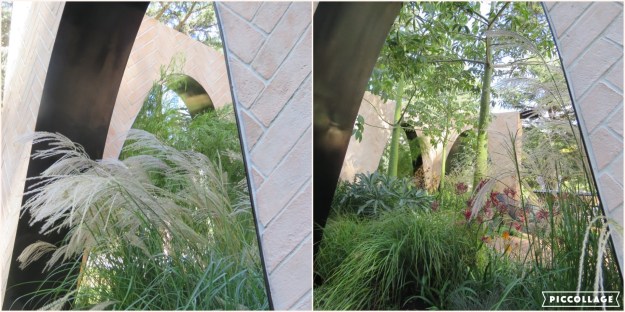
Framing views

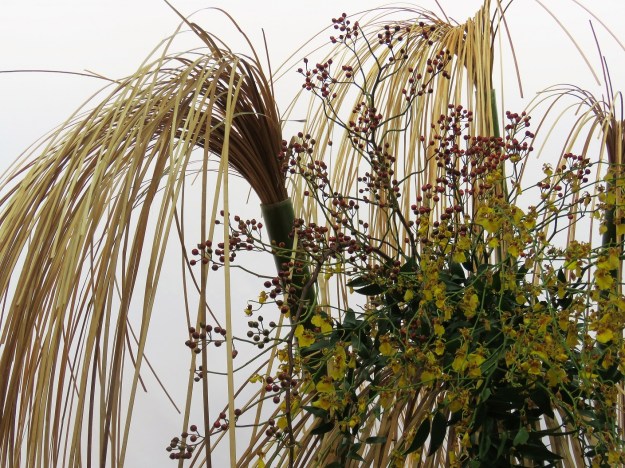
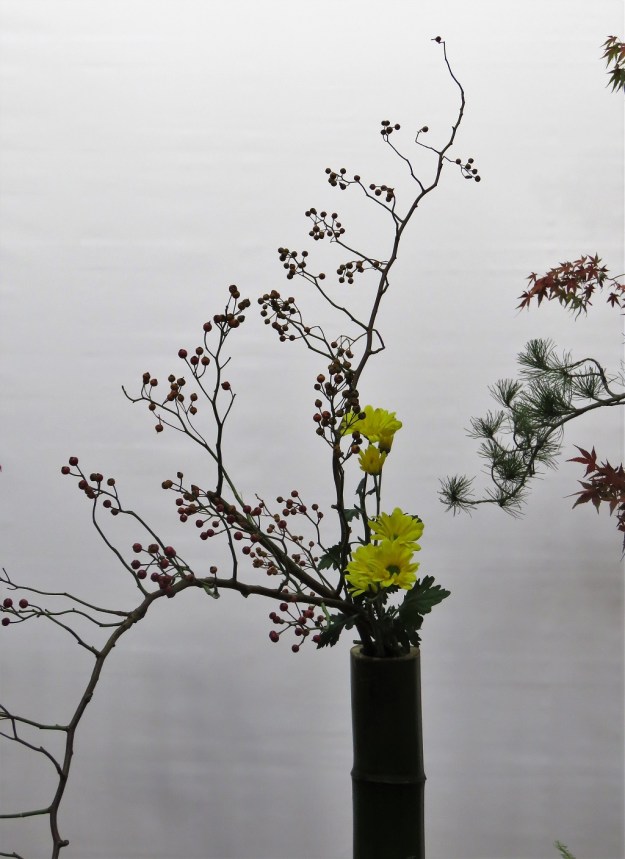
We only passed through the Great Hall but I went back to photograph the ikebana. I am not into floral art at all and have never taken any interest in the refined skills, balance and allusions of ikebana. But visually, I appreciated the simplicity of the large examples on display.

As regular readers will know, we are not big on garden ornamentation and decoration, but these bark birds of prey were striking, if natural styling is your preference.

More from Melbourne to come. A visit to the Dandenongs and Cloudehill Gardens, the Melbourne Art Gallery and Botanical Gardens.


From scratch – the caterpillar garden

The caterpillar garden has been bringing me much delight this summer.
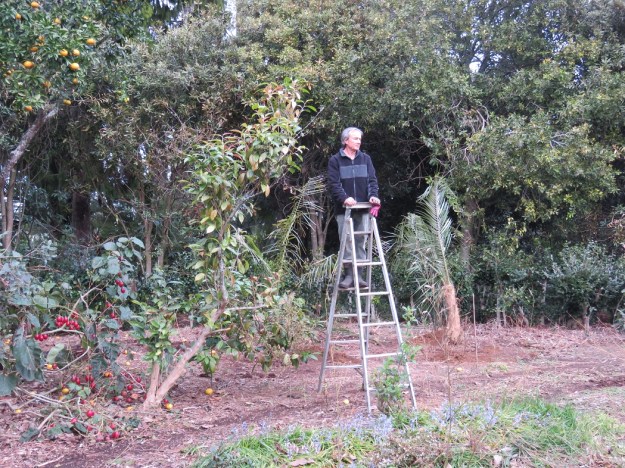
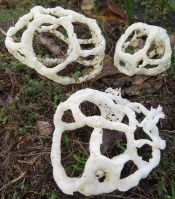
Starting to lay the area out in 2016 and marking the basket fungus shape

It is a flat area. Mark had to get up the ladder to get a view

Basket fungi

We refer to it as ‘the caterpillar garden’ but we really need to come up with a better name. It is the caterpillar garden because of an episode of BBC Gardeners’ World we watched several years ago. English designer, Tom Stuart-Smith, went into Carol Klein’s garden and clipped her buxus hedge into his trademark, undulating, wavy caterpillar style. That was the starting point for Mark’s vision for this particular area – a central backbone in clipped, undulating caterpillar-style but planted in a small leafed Camellia microphylla rather than utility buxus. He laid it out in pentagon shapes and I wondered about calling it ‘the pentagon garden’ but I would need to wait for a new president of America to go with anything that carried such strong, albeit irrelevant, connotations. Now Mark is wondering about ‘the basket garden’ on account of the basket fungus that guided his layout but that is a bit obscure.

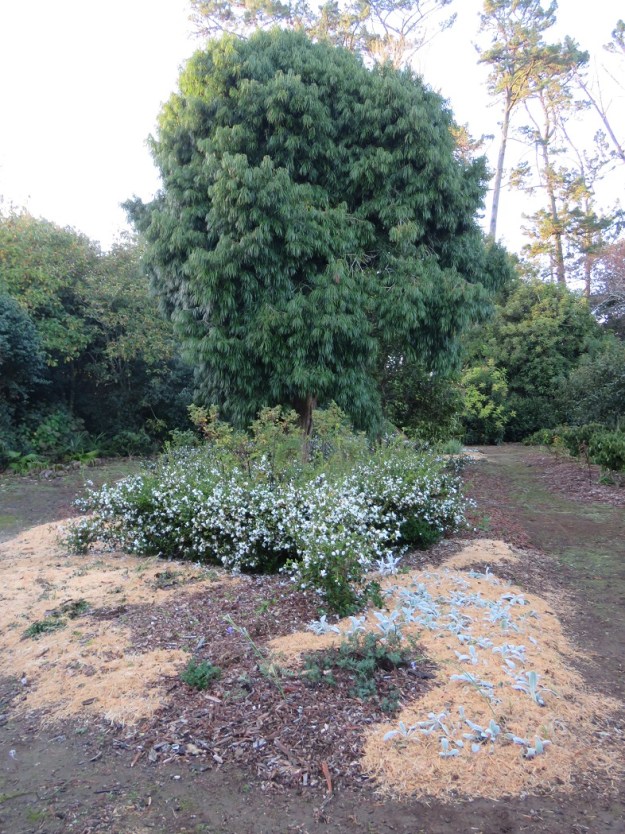
May 2018, a few months after planting. The Podocarpus henkelii in the centre is such a handsome tree that we are keeping it and working around it. The little white flowers are Camellia microphylla in bloom in early autumn.

We both laughed when a Facebook page of Broughton Grange’s parterres came through on Facebook this week. Lo, there was Tom Stuart Smith’s undulating caterpillar hedging, filled with a tapestry of plants. Same, same but different. I think his shapes are hexagons, not pentagons and he has closed each shape rather than opening bays to the side paths as we have. He has gone for a different colour palette too – bright reds and yellows rather than our softer hues of blues, whites and lilac. And he has put the taller plants in a separate border to the side of the parterre rather than having them rising out of the central enclosures as we have. But we feel we are in excellent company with our caterpillar garden. We were a bit surprised that a small snippet of inspiration could see us end up at a similar destination several years later.

Very late spring 2018 – white iberis and Brodiaea ‘Queen Fabiola’ with the blue perennial forget-me-not (Myosotis) in the background

I wondered about appending a plant list to this post at the end, just in case any reader wanted to see what we have used but these things are never that simple. Even mass planting for impact and restricting the selection for each separate enclosure to between one and three different plants, I have kept adding to the plant palette to try and extend the seasonal interest and a quick count came to about fifty different plants so far. So I won’t be listing them. I can tell you that it gets us through three seasons with different plants being a focus but it is never going to be a great mid-winter garden. I would also comment that we could not afford to garden on this scale if we relied on buying the plant material. It takes many (many, indeed) plants to fill such an area of around 200 square metres. We have drawn on plants we already had in the garden, plants we have been given and trialled in Mark’s vegetable and meadow areas and plants we have raised. In fact, while it has taken plenty of time and effort and a lot of thought, the dollar expenditure currently sits at zero. We are quite happy to pay for special plants or ones we need to get us started, but this is not a garden for special plants. We are after mass effects and colour blocks.

The Salvia uliginosa is too floppy to be in an outside bed

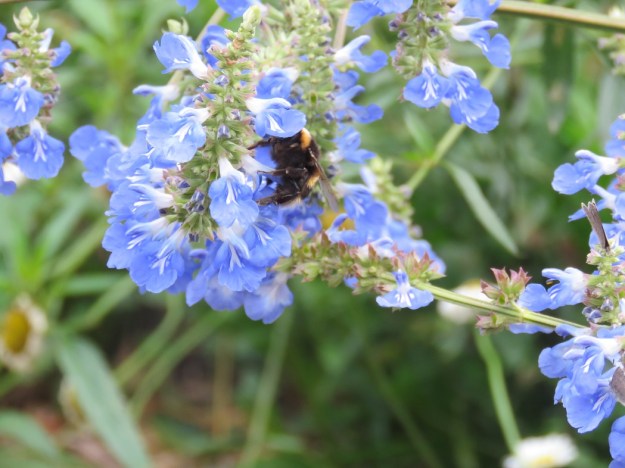
This is now a garden filled with life, particularly butterflies and bees

This has been its second summer. It was patchy last year with big gaps. Some of the plants are smaller growing and more compact so take longer to spread and cover the area. This summer, I have felt it is coming together as we hoped. I have just completed the first – and most major –  reworking that is often necessary when the reality doesn’t match the vision. The pink shades had to go. Too pink and detracting from the spectrum of blues and whites. Salvia uliginosa is too tall where I had it and needs to be moved – but placed with care because it does have dangerous, invasive instincts. I am quite happy doing the fine tuning. For me, it is worth the effort.

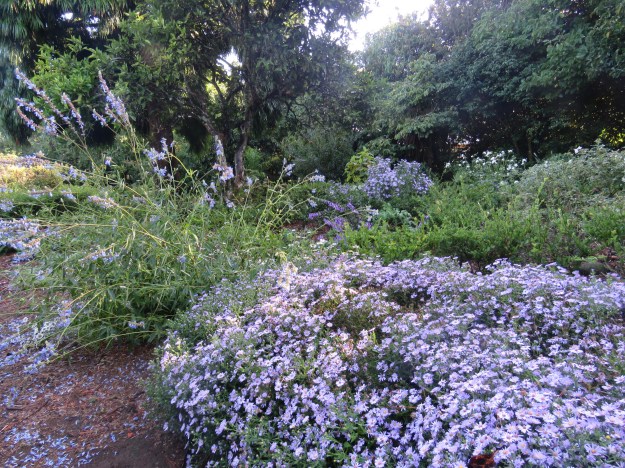
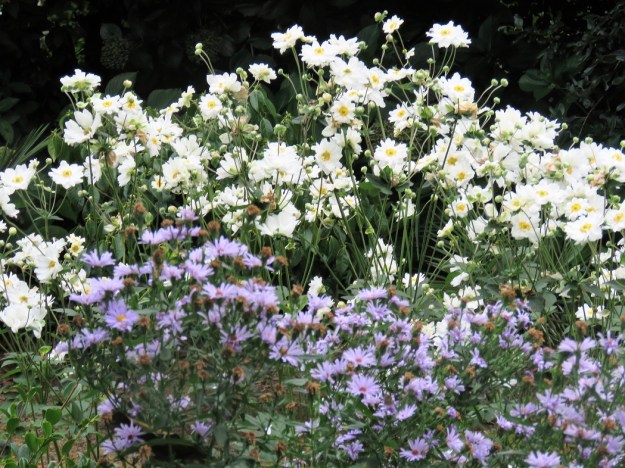
I love the white Japanese anemones and blue asters currently in bloom

I have high hopes for next year when I think it will all come together as we envisage it. And we may have the paths laid and quite possibly some garden edging to emphasise the curves. I was going to avoid edgings if I could but I think this is a case for gently rusting Corten steel edging defining the lines and keeping the mulch from the paths. Not tanalised timber ply, not in our garden.

It feels as though this garden has taken longer to get to fruition, but what is a few short years in the greater scheme of things?

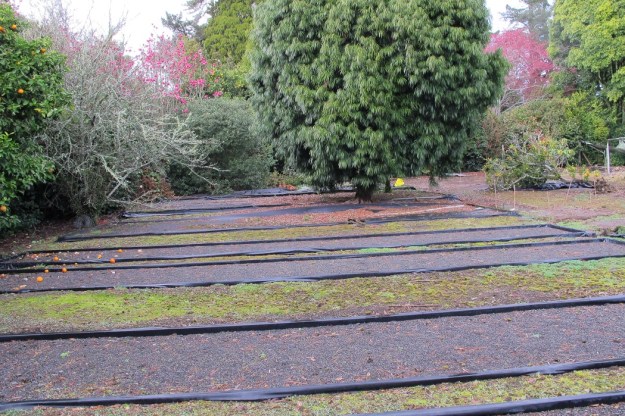
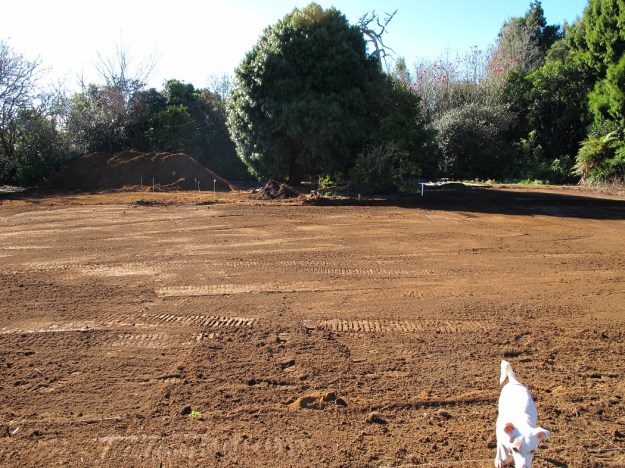
This was back in 2012 when we emptied out the capillary beds (which had been built around the Podocarpus henkelii 20 years earlier).

In 2014, we cleared and re-contoured the area. Same tree in the centre. Spike, the dog at the front is still with us but distinctly elderly and very deaf these days,

And this week. Filling in colour blocks with plants.


New Zealand in shock

I do not think I have a gardening post in me this weekend. Ours is a country in shock but none more so than our Muslim communities and the people of Christchurch. How could this happen in New Zealand? But happen it did and the soul searching going on now reveals that it should not, perhaps, have come as such a shock. The signs were there but nobody took much notice of them. Nobody, that is, except the Muslim communities and other marginalised groups and individuals who face the rising tide of hate in their everyday lives, even in our peaceful land of the long white cloud.
Sometimes I feel the ghost of my mother at my shoulder. She died nearly 20 years ago but I recall her talking of living in London in the lead-up to WW2 and how she and my father were horrified to witness the rising tide of fascism and the inevitability of major war, even as others around them ignored all the signs. It was perhaps more clear-cut then, with those fascist energies predominantly concentrated and unified in the Nazis.  But as I watch the rise and rise and the alt-right, the defence of hate speech (“But… free speech!”), Islamophobia, the extreme ugliness in many quarters enabled by social media, the political dog whistling at such people as potential voters and other political games and strategies that have merely served to strengthen and affirm such outlier views – yes, I feel my mother at my shoulder. Pandora’s box has been opened again and hatred, ignorance and blind prejudice have been unleashed, nowhere more so yesterday than in the Christchurch mosques.

It is not enough to say that this is the not the country we want. In the coming days, weeks, months and years, as the initial shock and horror fades, we must all hold the line that has now been drawn between those motivated by ugliness, hatred, fear and prejudice and those of us who want a kinder, more caring and tolerant world. I stand with our Prime Minister who epitomises kindness and compassion every day, but especially so in the last 24 hours.

It may seem trite, but if people who feel moved to leave flowers in remembrance around the country could remove the plastic wrappings and ribbons on such bouquets, it would mean their flowers could wither and return to the soil rather than having to be picked up and taken to landfill. I remember the tributes to Princess Diana – a sea of plastic and cellophane wrapped flowers and I am now seeing photos of similar floral tributes around our country. Just leave flowers in such situations, without the wrapping accoutrements. Please.

Back from a near death experience – an obscure fig


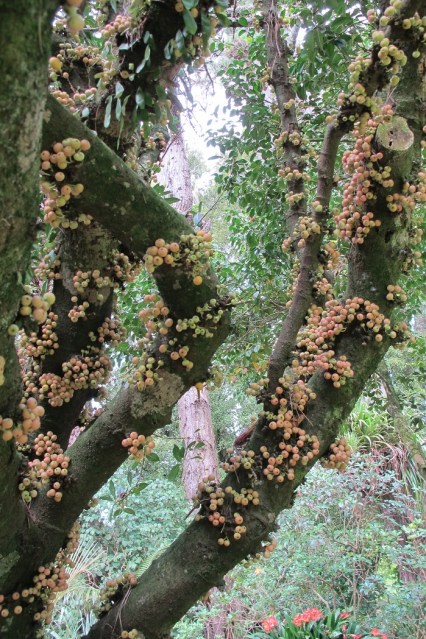
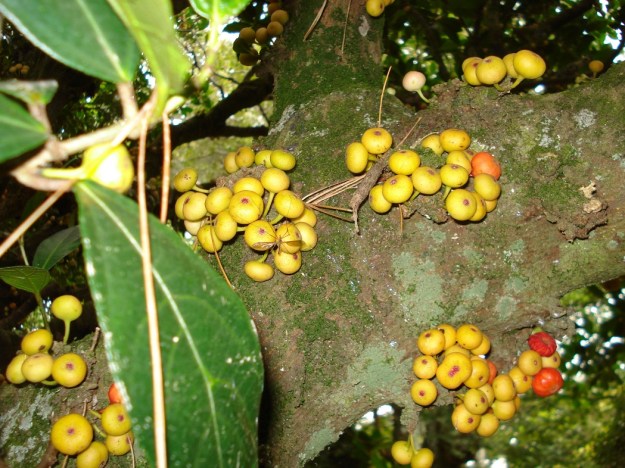
Very curious fruit on Ficus antiarus

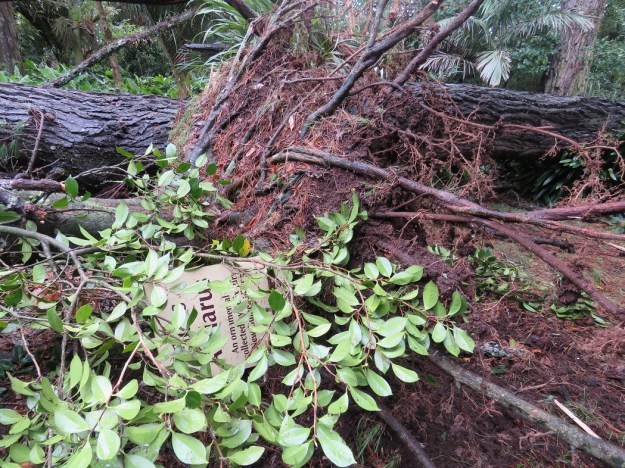
The most asked about plant in our garden was Ficus antiarus. I say was because the small tree became collateral damage when a massive pine tree fell over last April. We feared for its long-term survival as all that remained in the ground were some of the longest roots.

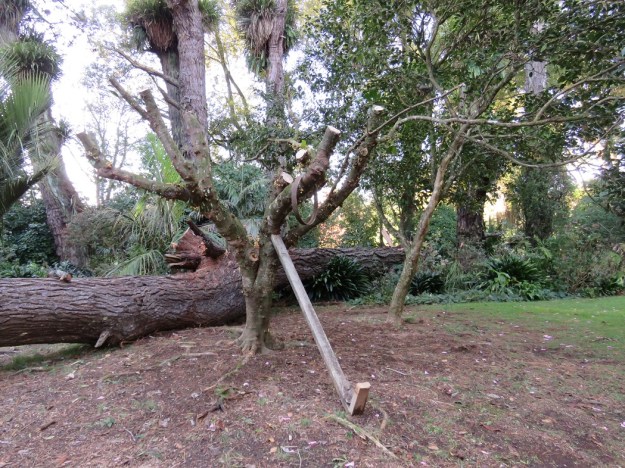
Brought down by an enormous falling pine last April. That is the root system, uprooted. 

It took a couple of weeks to clear the area sufficiently to have room to move and then Mark and Lloyd levered up what remained and installed a prop to hold it more or less upright. Mark took a chainsaw to it to remove most of the canopy and the broken branches. He pruned to keep the shape while reducing the stress on the tree by reducing the smaller branches and much of the foliage. Too much leafy growth would mean increased loss of moisture and we hoped it would put its energy into re-establishing the root system over winter. We crossed our fingers.

levered more or less upright, pruned by chainsaw and propped in place last April

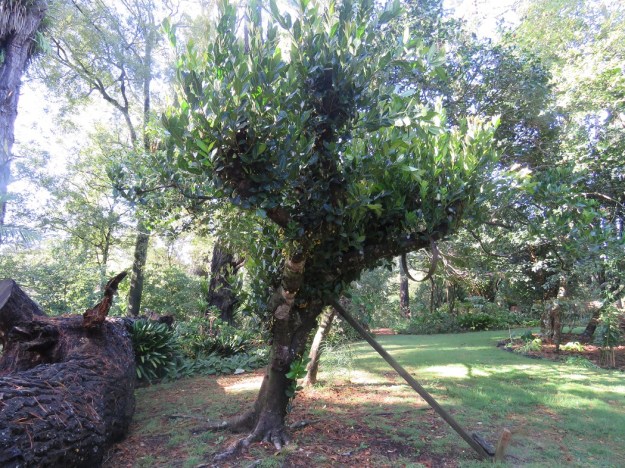
Behold the fresh leafy growth now. It is a sight to behold. It set no fruit this year but we didn’t expect it to after such a shock. It appears that it will live on for another few decades. I asked Mark how long the prop would need to remain in place and all he said was that he had no idea so I guess he hasn’t thought about that yet.

Ten months later and we are delighted by all the fresh growth

Mark’s father Felix brought Ficus antiarus back from his one and only intrepid plant-hunting trip – to the highlands of New Guinea in 1957. He thought that in the cooler temperatures of the areas with altitude that he might find interesting plants that would survive back here. He didn’t bring a big haul back but the ficus, Schefflera septulosa and Vireya rhododendron macgregoriae have all stood the test of time.

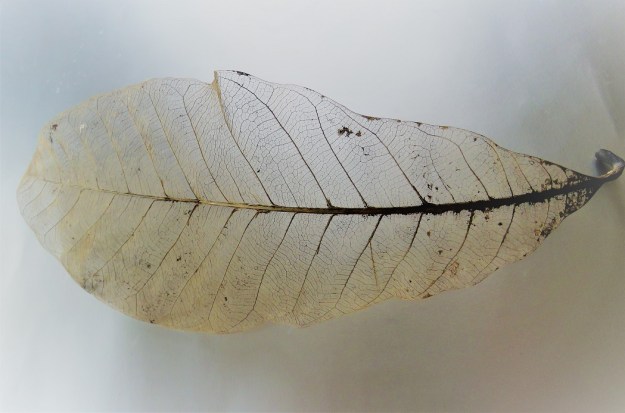
The ficus has mid to dark green leaves with an interesting rasping texture – not unlike green sandpaper. It is evergreen, unlike most eating figs. What is most remarkable about it is the generous set of tiny figs growing out of bare wood. They start out cream, ageing through orange to red. Birds don’t strip the tree so the fruit must not be very inviting to them. I have nibbled the odd red fruit and they have a faint figgy flavour but not enough to make them an addition to the diet. We just like it as a curiosity at the end of the Avenue Garden.

Before it was knocked down – we are now optimistic it will return to this state.