Give me colour, please.

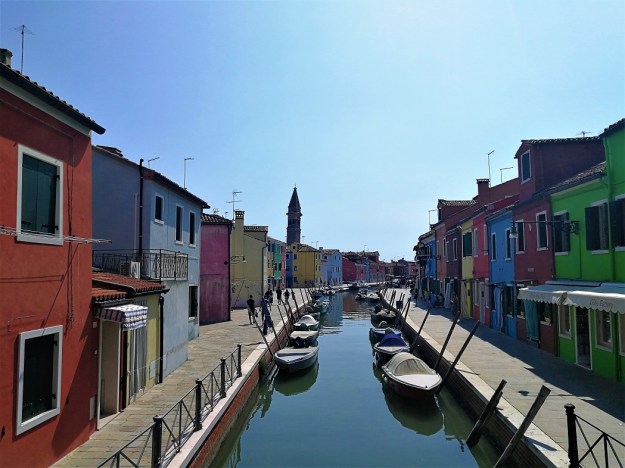
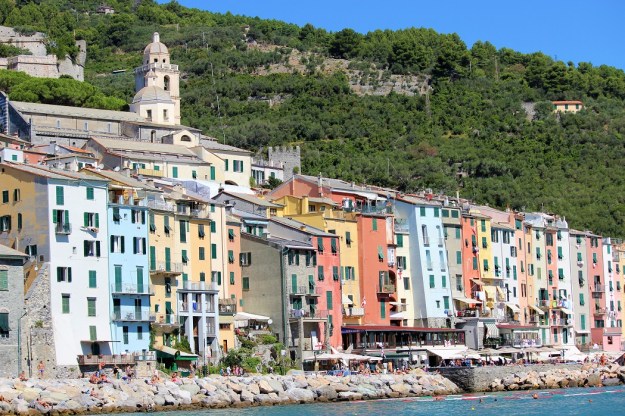
Burano, near Venice. Photo credit: Nigel Somerfield

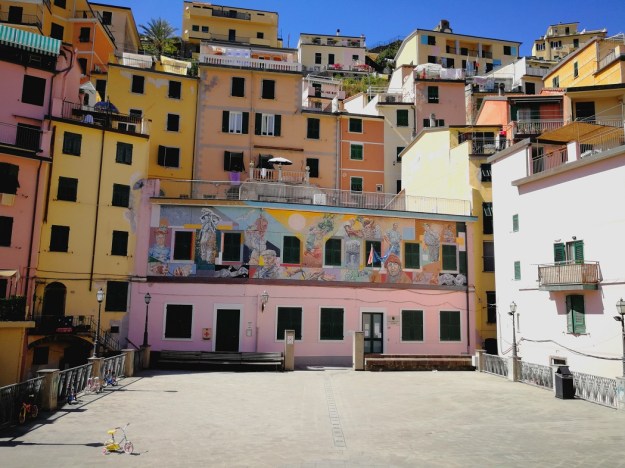
May I share a postscript to my earlier posts about colour in Italy and the greying of New Zealand? These are not my photos but shared by a family member on Facebook. Look. At. All. That. Colour.

As this country battens down the hatches, preparing for the extreme weather event that Cyclone Gita may deliver today, it is very grey out my window. Well, grey and green really as I look at a green backdrop of trees and shrubs and a grey sky. Were I living in the city – pretty much any New Zealand city these days – the landcape would be an unrelieved view of grey sky, stormy dark seas, and real estate grey, interspersed with charcoal and taupe.

Porto Venere. Photo credit: Kate Somerfield

What is worse, to my mind, is that while New Zealand’s obsession with grey has been driven by the real estate sector and the holy grail of resale value, I have heard whispers that council planning officers are now entrenching it into practice by requiring certain new building projects be what is now described as ‘colour neutral’ – translated as shades of grey. I fear for the future. Real estate agents will nail their colours to the mast of whatever sells but council officers are more inclined to dig their toes in and entrench the new absence of colour as ‘best practice’. We may face a dreary future. The cheerful red roofs of New Zealand’s past may be an historical memory at best.

Riomaggiore town square. Photo credit: Nigel Somerfield

But look, just look at the joy of a mishmash of colours in Italy. Doesn’t it make you want to smile? Have you ever gone into a modern New Zealand suburb or even looked out an aeroplane window at suburbia as you flew in to land and smiled at the colour lifting your spirits? No, I didn’t think so.

Late summer inspirations from the graveyard

I returned to the main cemetery of New Plymouth yesterday. As the season advances inexorably into what is already showing signs of late summer, I wanted to see what was in bloom. “Was She who is the Phantom of the Graveyard there?” Mark asked. He had a personalised tour last month from the bright and bubbly person who wishes to remain anonymous and unacknowledged but who has beavered away there for many years now. These days more volunteers have come forward to join her and it is a lovely place to visit.

Why go there rather than our public gardens to see what is in flower? I am delighted by what is the grown ups’ version of the miniature gardens our children used to make for Show Day in their junior school years. Grave-sized gardens, in fact, which are styled individually, often from donated plants. It is an interesting place to look at plant combinations, plant performance under a light maintenance regime (the area is huge) and incidents of serendipity.

I am planning a meadow for our new Court Garden but, influenced by the Pictorial Meadows excellence in the UK, I want to select plants that will bloom in succession from spring to autumn. At this time of summer, we are not as flowery here as earlier in the season and I was wondering what we could consider. There weren’t many answers for me as far as the proposed meadow is concerned because I think I want to at least start that with mostly annuals and biennials rather than perennials and bulbs in order to achieve the meadow look as opposed to herbaceous plantings. But there was plenty of other interest amongst the graves.

Canna liles star in these small, grave-sized gardens

Cannas and dahlias were the stars yesterday morning. I am not a fan of cannas. They are too big, dominant and blobby for our tastes here and they don’t die down gracefully. But they are certainly showy and the colour range surprised me – from whites and pale lemons through paler pinks to bright, vibrant showstopper blooms. I can admire them without needing to grow them. In fact, I prefer to admire them elsewhere.

Gaura – they do indeed dance like butterfies in the breeze

The gaura looked terrific. Ethereal even, waving in the light breeze like clouds of butterflies. I must try again with these now we have more open areas of garden in full sun. And as I admired the combination of pink lavatera and tall cosmos, I realised again that it is the lightness and movement that I want in our newer meadow and perennial plantings. The romantic prairie look, Mark just called it. That is why I am not so keen on the ponderous cannas.

Hibiscus trionum

One grave was covered in Hibiscus trionum and it was the most eye-catching display of this pretty plant that I have seen.

Lilium formasanum reaching two metres tall

We had been talking about Lilium formasanum the previous day. While it is regarded as a weed in this country and banned from sale, we are quite happy to let it pop up around our place. It is one of those plants that I think in time we may come to accept as a permanent addition to our environment. I assume its weed status is on account of its seeding ways and its ability to pop up in all sorts of situations. We are increasingly of the view that we must learn to live with many of these interlopers and only wage chemical warfare on those that endanger our natural flora – the likes of Clematis vitalba (old man’s beard), Japanese knot weed and, in the area where we live, giant gunnera and pampas grass. The Formosan lily was looking right at home and picture perfect amongst the graves. It is a beautiful flower, though without the heady fragrance of many other lilies.

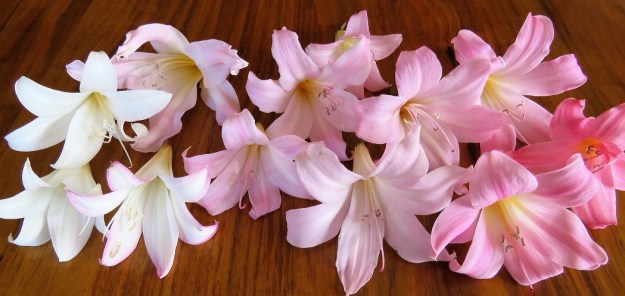
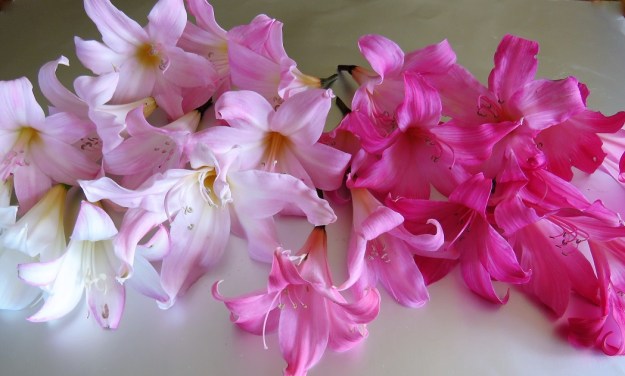
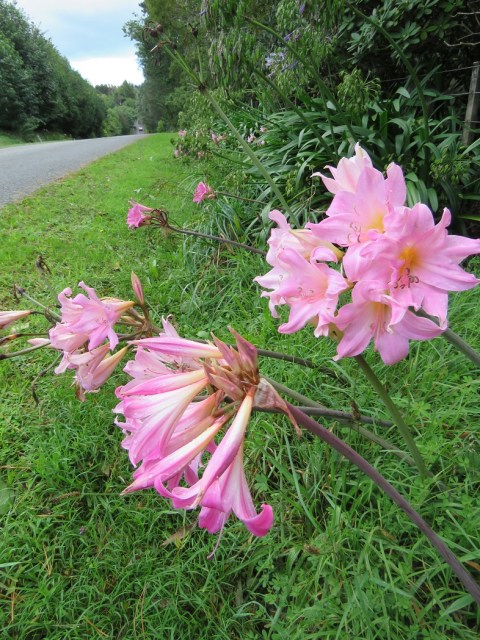
The belladonnas were also in bloom, as they are on our road verges and wilder margins of the garden here. They are so common we take them for granted, but if you look afresh at them each season, they are a lovely late summer bloom.

Alstomeria flower on and on, seen here with plumbago

In terms of bangs for the buck, alstromerias work hard. I need more of these. Not for the meadow but for my hot summer border. And definitely not the modern over-bred varieties that have been shrunk down to be bedding plants. I want more of the big, tall ones in clear reds, yellows and orange colour mixes. They seem to bloom from spring to autumn and that is not to be sniffed at, as long as you can contain their wandering ways.

Rudbeckias!

All I came up with for my meadow in the end were rudbeckias to go with the amaranthus that has already established itself as a naturalised wildflower here. I may use the Lilium formasanum, despite it being a bulb and I had already decided I wanted the white Japanese anemone in big swathes, despite it being perennial. I simply love the romance of the windflowers. They need to be managed. In a garden situation they can be thuggish and invasive but I think I can mange them in the meadow.

Butterflies, bees and no doubt a host of other insect and bird life inhabit these gardens

Graveyards can be austere, grim places and parts of the Te Henui are of this stark nature, maintained only by weed spray and lawn mowing. But the areas full of these small gardens, flowers and trees lift the spirits and it is clear the public love walking through. Each tap has a little watering receptacle for dogs which was an endearing sight. It is worth a visit and I hope our elected Council officers and paid staff appreciate the special character that the volunteers, led by the dedicated Phantom of the Graveyard, have bestowed upon this place of memories. Some of us even go there for inspiration. Life, growth, flowers and community engagement in amongst death.

Windflower romance – the white Japanese anemones

Plant Collector: Backhousia citriodora or the lemon myrtle

The graveyard specimen is in completely open conditions and looks happier for that, despite it originating from rain forest areas of Australia

A friend posted a photo of Backhousia citriodora on Facebook, asking if anybody knew what it was. I was promptly reminded of my plant and rushed out to pick some of the leaves to flavour the batch of kombucha I was just preparing. For it has one of the strongest lemon scents of any plant I know – eclipsing even grated lemon peel  – and is edible.

It is an Australian tree, the lemon myrtle. Its natural habitat is tropical rainforests of central and southern coastal Queensland but it is also an important commercial crop, grown for its very essence of lemon. Fortunately for us, it is not so tropical that it needs to be grown in frost-free conditions though it is presumably happier in milder areas of this country. Apparently it can reach 20m in height though that may be it stretching itself to reach the light in forest locations. In a more open position, ours is hovering around 3 metres but I do cut it back from time to time to keep it more compact. It does not seem to mind being trimmed.

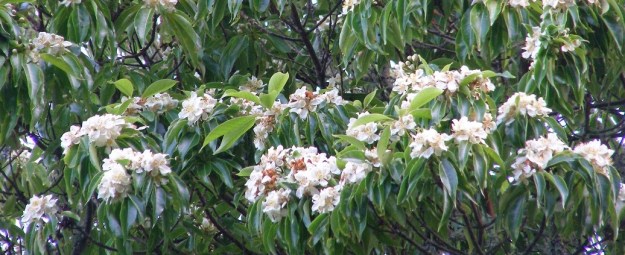
There are more distinctive trees, if I am honest. We used to grow both B. citriodora and its relative B. anisatum (now Syzygium anisatum) and the less popular aniseed flavoured myrtle had the more attractive foliage. But at this time of the year, the lemon myrtle is in full flower and I came across this specimen in the Te Henui cemetery yesterday. It was alive with bees and a wondrous sight and sound. The fluffy clusters of flowers and stamens have their own charm, in a gentle sort of way.

Covered in flowers and alive with bees at this time of the year

I have used the lemon scented leaves to flavour milk-based dishes that lemons would curdle and added it to my fresh harvest of green tea. The kombucha won’t be ready for another five days so I can’t comment yet on how strongly lemon flavoured it is but I see no reason why it will not be effective. I have not tried drying the leaves but the ever-handy internet tells me they retain their lemon aroma when dried. Indeed, Wikipedia gave the following helpful advice: “The dried leaf has free radical scavenging ability”. So now you know.

It appears that lemon myrtle is particularly vulnerable to the dreaded myrtle rust in Australia which has implications for commercial growers and for the plant in its natural habitat. It remains to be seen whether rust-resistant varieties appear but I have not heard reports of it being spotted in NZ yet. Mind you, it is not a common tree here but it is worth growing one in the edible garden alongside the more common but dull bay trees – Laurus nobilis. Unlike the bay, which gets thrips, I have never seen anything much attack the backhousia and I find I need lemon flavouring way more often than I cook with bay leaves.

Classic style statuary in New Zealand gardens – yes or no?

In an Auckland garden

Sunday mornings here are not for lying in and relaxing. My weekly radio spot with Tony Murrell on Radio Live sees to that. It takes quite a bit of thinking our way into the topic of the day and this morning we were talking about classical statuary and whether it has a place in New Zealand gardens.

Of course it has a place here. If you like classical statuary in your own garden, go for it. It is your garden so do what you like and enjoy. And stop reading here because I am not so keen on it and that is for historical and cultural reasons as much as the aesthetics.

Eden Gardens, Auckland. No further comment

I have only been to Greece once and that was to the limited area of the Dodecanese island chain but I have seen Greek originals in the British Museum. The Elgin Marbles, in fact. I struggle with British museums. On my first and only visit to the Victoria and Albert Museum in my late thirties, I was gobsmacked at the sheer quantity of treasures from around the world. But I have never managed to shrug off the queasy feeling that what I was viewing was theft, acquisition and the dominance of a ruling empire on a grand scale. Pillaging. It is the same with the Elgin Marbles which should in fact be referred to as the Parthenon Marbles. And I still feel that the use of classical reproductions that have no relevance at all to this country is somewhat a case of cultural misappropriation from the same tradition that stocked those museums of Britain. But feel free to disagree with me on that political opinion.

Baroque glory at the Trevi Fountain in Rome. The lovely dark haired young woman at the front is she whom I often refer to as Second Daughter, to preserve some level of anonymity (I rarely use photos of family here).

I have been to Italy more often and have seen a fair amount of sculpture, both original and more recent re-creations of lost originals. I will never forget the emotion of awe at seeing Bernini’s work close up at the Borghese Gallery. The rendition of human flesh and bone was so breathtakingly realistic I found it incomprehensible that it was sculpted from cold marble.

I am no expert on the traditions of sculpture that have given us the so-called classical statuary and a fair smattering of fountains in New Zealand gardens, but it occurred to me that they could be loosely classified into three different periods.

Villa Adriana in Rome but these are modern re-creations of classical statues. And a distinctly modern couple in the middle.

The first wave originated in ancient Greece and Rome where they were part of religious traditions, public art and a display of wealth. These were often the beautiful simplicity and grace of form that we associate with classical times. The second is the Baroque era of the 17th and 18th centuries, particularly the point where it became even more extreme with the over the top Rococo style (as exemplified in the Trevi Fountain in Rome). It continued to use the classical figures of the ancients while still rooted in a wealthy, religious tradition but with much more flamboyance and ostentation.

More Victorian, I think, than pre-Raphaelite in Te Henui cemetery, New Plymouth

The third strand I see must surely date back to the pre-Raphaelites of 1840s England with their nostalgia for the pre-industrial era and the desire to bring back romanticism. At its best, some of that domestic style of romantic statuary is charming. More often, I see it crossing over to Victorian sentimentality. Mawkish, even. My theory is that it is pre-Raphelite amalgamating with Victorian sentimentality that most often decorates our old graveyards.

The bottom line with the original sculptures is that they were all conceived by sculptors – practicing artists. What ends up in our gardens does not have this origin. They are derivative reproductions of varying quality, depending on the budget. And in New Zealand, there is no cultural connection to the ancient traditions. However, it could be argued that the pre-Raphaelite influence has an echo in our past, given that the British early settlers were coming from Victorian England. And that romantic look is far more domestic, personal and better suited to a smaller, private garden.

We have not gone in for statuary in any form in our garden. Overall, we are very lightly adorned compared to most. Part of that is because this garden was created with the smallest of budgets at the time. More recently, both Mark and I feel that garden decoration, statuary or sculpture must be relevant to us personally and to our environment, both the physical and the cultural environments. So classical statuary will not find a place here.

The pieces I have admired, I realise now, are more likely to date from the pre-Raphaelites. I would like to own the female figure from Gresgarth garden (above right). At least, I think I would. That garden is in the north of England and I remain uncertain how this style would transfer across the world.

The modern sculptures in the Barnett garden near New Plymouth are surely an artist’s extension of that domestic, romantic tradition of figures. The two children have an edginess to them with that slightly unnerving balance of pose. I really like them. They are relevant to a garden that is strongly family and leisure-oriented. For me, they speak far louder than any reproduction classical statue can ever be expected to in a New Zealand context.

Judging by the plethora of statuary I see in gardens here and for sale in garden centres and other purveyors of gardening bric a brac, mine is a minority opinion but I can live with that.

As a postscript and loosely related at best, I will never forget a conversation with a colleague in my teaching days. We were both young, married and female but there the common ground ended. I was of the hippie persuasion while she was prim, proper and religious. I have no idea how we got onto the subject of art in the bedroom but she declared that they could never have a picture of people in their bedroom. It had never even occurred to me that the bedroom was a place for landscapes and still life paintings only and that a two dimensional representation of the human body could be an invasion of personal privacy. Be careful what you do in front of your garden figurines. They may be watching and judging you.

For an earlier post on related thoughts, I wrote about ‘prole drift’ in 2011. 

And should you happen to own a garden with several, maybe even many, examples of European statuary, be very afraid that you may be judged as a godwotter

The peculiar affliction of gardeners’ godwottery

My apologies to those subscribers who received a draft version of this earlier. I hit “publish” instead of “preview”….

Godwottery! A friend gave me the gift of a word this morning. How can I have lived my life so far without this word?

Godwottery. A noun. “Gardening or garden design in an affected, fussily decorative, or over-elaborate style; an instance of this.” This is from the Oxford English Dictionary so it must be right. It does mention that it is an example of archaic and affected language but wot ho, jolly sir? It has only been in use since 1937 so it is but a  modern archaism at worst. So too is the second descriptor a double irony, for what could be more appropriate than an affected word to describe a garden full of affectation?

I am not deterred, I shall incorporate this word into my lexicon (or ‘my vocab’ as others less prone to archaic affectations might say). I am an experienced godwotter spotter, I tell you.

We were part of the open garden scene in the first decade of this new century when over-decorating your garden became the rage at a mass, domestic level, even amongst those who would never dream of ornamenting their interiors from the Warehouse shelves at the time. It was the Gnome Brigade exhumed from the past but on steroids and with expanded horizons. Not just Grumpy and his mates. No. Now one must add fairies, orcs, trolls, odd monster-y reinterpretations of classic grotesques and a whole lot more. Also reproduction classical statues of the armless, legless and white type. And focal points! For what is a vista or a view without a focal point? Or seats as focal points. Just a single seat painted in an eye-catching colour and placed where it is never to be sat upon but gives Yet Another Focal Point.

Godwottery goes well beyond the unrestrained approach that leads to cluttering up a garden with decoration. It takes in the “but wait! There is more” gardening syndrome where thinking that yet more points of interest, destinations, hedges, squitty garden rooms and other enclosures such as rondels, features and constructions will enhance the space.

And veneer gardening, which is what I call the DIY attempts at trompe l’oeil, garden design that emulates theatre set design and the attempts to recreate Grand Garden Design but in plywood and tanalised timber. I find it easier to accept naïve over-ornamentation (at its best it can be genuinely creative, tipping over to folk art) rather than pretentious veneer gardening.

But now I have the word. Godwottery. “He is just a pretentious godwotterer,” I may say in the future. “It is way past time they ceased godwottering.”

Just to prove that I am not alone, I give you two quotes from the OED:

1969   Guardian 18 Aug. 7/1   ‘Godwottery’, the sentimental preconception of what a garden should be, results in a very strange collection of elements.

2006   Denver Post (Nexis) 31 Mar.   If you’d like to create a godwottery of your own, you might consider ‘sundials, gnomes, fairies, plastic sculptures, fake rockery, pump-driven streams and wrought-iron furniture’.

Believe me, I have seen some godwottered gardens that have the lot detailed in that second quote. AND a giant chess set as well.

Trentham Gardens were treading a fine between enhancing the visitor experience and tipping over the edge to godwottery. Public gardens are particularly vulnerable to this trap in their attempts to pull the punters as can be seen below.

I have had to crop very heavily on these godwottery exemplars in the hope that they may remain relatively anonymous. I could have chosen many other examples. some simply appalling, but they are too readily identifiable. I would prefer to be able to cross the road without fear of being run down by a disaffected garden owner.