

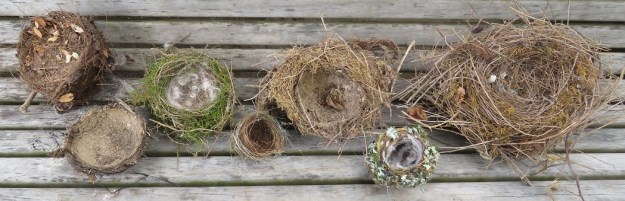
The birds’ nests have nothing to do with the content of this post. But they are more beautiful than stacks of heavy duty plastic bags, containers of spray, irrigation wherewithal and the rest.
‘Touch the earth lightly, Use the earth gently’* as we enter 2018.
Most of us are happiest when surrounded by people who share our values and think in similar ways. And that is true of the gardening world as much as any other sector. I assume that people who are not interested or irritated by my gardening views either stop reading or unsubscribe. But nothing shouts louder to me that there are many gardeners who are on an entirely different trajectory than the garden-related advertisements on TV. There are not a lot of these in this country – it is a market largely driven by small suppliers and marginal profits. But when it comes to advertising, the likes of Tui, Kiwicare and sometimes Yates have it covered. And many times, what the former two at least are selling is death. Knockdown sprays that come with a promise to kill faster and more thoroughly than ever before. Is this really what gardening is about for their target market?
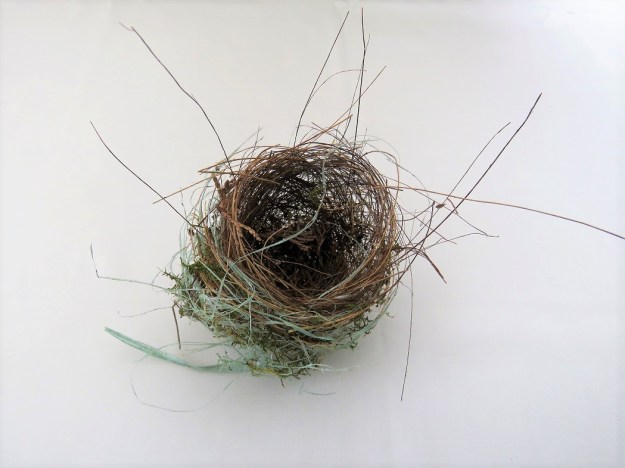
The dainty filigree weaving of the waxeye nest, held together on the outside with strands of everlasting, synthetic baling twine in the modern tones of aqua blue
There is a myth that gardening is, by very definition, good for the environment. It can be but it is not a given. As the world enters the uncharted territory of a new year and the growing awareness of the appalling and indefensible environmental harm being caused by humankind, it behoves all of us, in my opinion, to take a close look at how we live. And how we garden.
Earlier generations did not need a different type of fertiliser for every plant group. It is marketing that has convinced the consumer that they need an array of bags of fertiliser – one for tomatoes, another for citrus, yet another for roses while rhododendrons and camellias need their own unique blend. And that regular fertilising is a necessity (or ‘best gardening practice’). That is nonsense. Get your soil right, and you should be able to eliminate most purchased fertilisers by using compost, green crops, worm farm liquid or similar home-generated remedies which have a proven track record down the millennia. Powdered or granulated fertiliser is a pretty recent phenomenon and yes, it does encourage plant growth but the environmental cost is high. New Zealand’s love affair with nitrogen can be traced straight back to big business and profit which fails to factor in the wider costs.
Gardens should not need regular applications of fertiliser. It is just bad management from a gardening point of view. And expensive.

Surely the most inviting nest of those here is the exquisite creation of the chaffinch with its outside covering of lichen and inside feather-down lining
Nor should lawns need frequent fertilising and spraying. Truly, it is long past the time when we should have reviewed the prestige value of the perfect lawn. Canberra daughter tells me that a green lawn where she lives is either astro turf or a sign that the homeowner is breaching water restrictions. A perfect lawn anywhere is a sign that its owner is willing to pour all sorts of chemical concoctions onto the grass with scant regard for the environmental aspects.
I am not advocating getting rid of all your lawns. Just change the way you look at them and ponder instead, how to manage blocks of grass without the application of a whole lot of fertiliser that you then wash away into the wider environment with frequent irrigation.

The remains of a thrush’s nest is more like half a coconut shell – firmly moulded and plastered on the interior. With incorporated synthetic black twine.
Garden to your conditions rather than trying to alter your conditions to your style of garden, especially when it comes to water use. Irrigation systems for gardens are a red flag that you are growing the wrong sort of plants for your area. You should be able to grow plants in the soil by watering them in initially and then maybe the occasional drink while they settle in but then leaving them to the elements. English gardening doyenne and pioneer of the dry garden, Beth Chatto, has the simple mantra “right plant, right place”. If you are having to irrigate regularly to keep your plants alive and healthy then you have the wrong plants, not the wrong place that you alter to suit the plants. So often I read descriptions of gardens and the first thing that goes into many modern gardens with bigger budgets is the irrigation system. That is wrong on so many levels.

The soft and welcoming nest of the greenfinch, we think, lined in wool and edged with green mossy strands. The nest is too large to be a goldfinch.
We used to shudder at how much plastic we used when we had the nursery running. Look around your plant centre at how much plastic your plants involve and ponder which bits you can do without. It takes a brave and driven person to return the plastic to the retailer and insist they take responsibility for it. I read recently of someone who sorts her purchases at the supermarket checkout and leaves items of unnecessary packaging there and thought that was not really going to be my style at the local Waitara New World. But you can decline single use plastic bags to hold your plastic plant pots by simply carrying a carton or having a boot liner. You can avoid or reduce the use of the products out the front of the plant centre, all bagged in single use, heavy duty plastic sacks – the potting mix, the compost, the decorative gravel or lime chip and the host of other products, few of which you probably need.

The tui builds a big, bouffy, soft nest for its young, somewhat aerated with its coarse twigs
The planet desperately needs more trees, in New Zealand where trees are seen as expendable, as much as anywhere else in the world. And if you can plant trees, they are going to do far more to counter growing carbon dioxide levels than bedding begonias or compact shrubs will ever achieve. That said, any flowering plants which have visible stamens and pollen will support the smaller insect life that our ecosystems need – particularly bees.
Fungicides, herbicides and broad spectrum insecticides are not great at all for the environment. The more you can reduce your use of them, the better. We have tracked the glyphosate debate down the years and were not entirely convinced by the declaration that it may cause cancer. Many things cause cancer, including the charcoal on barbecued meat. But the recent research coming out from Canterbury University on the link between herbicides, including glyphosate, and antibiotic resistance in bacteria is seriously worrying. I, for one, do not look forward to living in a post-antibiotic world. I was once hospitalised for several days on a drip because of a puncture wound on my foot. The subsequent infection was resistant to all but the last line of hospital-only antibiotics. We need to worry about these things and take some responsibility at a personal level.
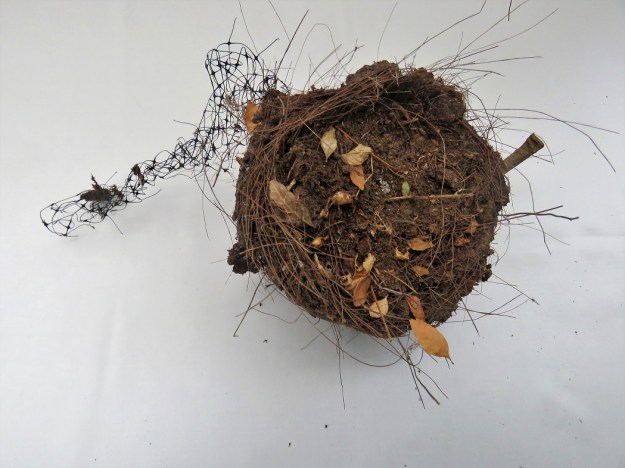
The remains of a blackbird nest, built on an internal platform of layers of mud and straw. With polyprop strawberry netting added – a reminder of how birds will find waste lying around.
For us, the very essence of good gardening is about enhancing nature, about adding to sustainable eco-systems. It is not about controlling it and being convinced by modern consumerism to use a whole lot of products that actively harm the environment. And truly, I will judge you if you tell me you are keeping your buxus hedging alive with regular spraying, that you fertilise your lawn to keep it green or I spot your irrigation system. I may not say anything to you about it but I will be mentally raising my eyebrows.
It matters how we garden. A lot. At least, to us it does. I am not given to inspirational homilies, but we could do worse than to reflect on the words of Clarissa Pinkola Estes as we enter 2018.
“Ours is not the task of fixing the entire world all at once, but of stretching out to mend the part of the world that is within our reach…. It is not given to us to know which acts or by whom, will cause the critical mass to tip toward an enduring good.
What is needed for dramatic change is an accumulation of acts, adding, adding to, adding more, continuing.”
If you want the entire quote, you will find it here.
‘Touch the earth lightly’ is from hymn but I never got past the first verse and the credit here.

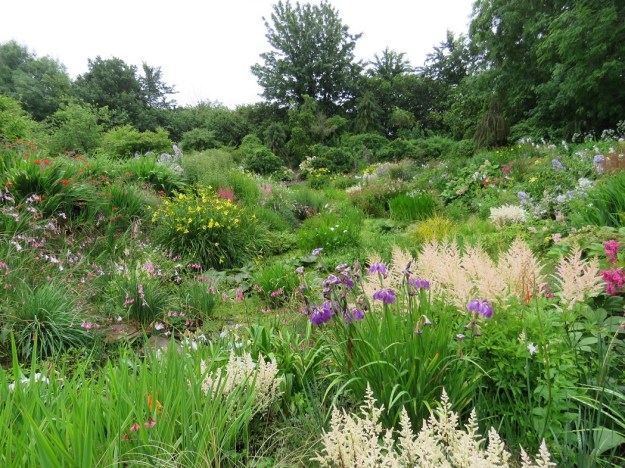
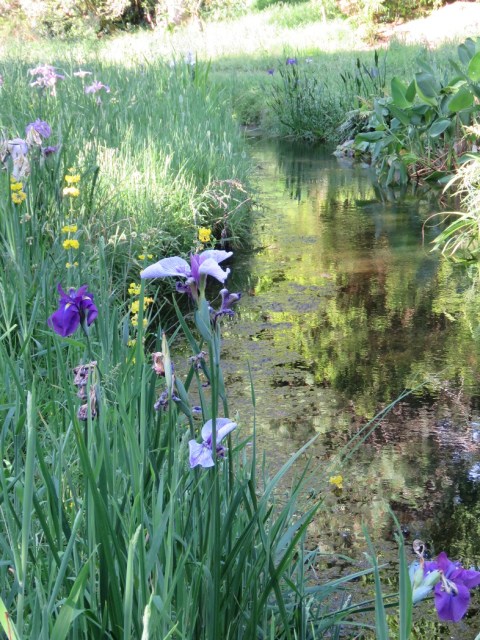

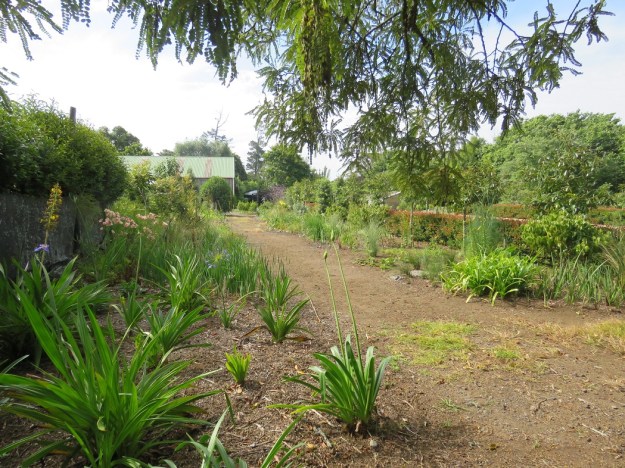

 Finally, on a practical level, I recently raved about my new
 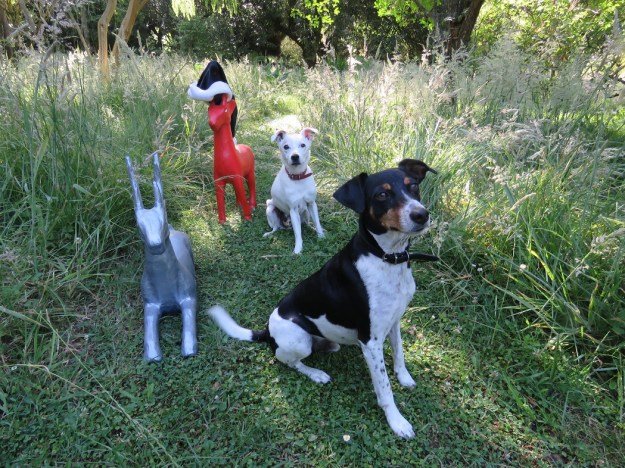 It took a pocket full of dog biscuits to persuade our pair to pose for a festive snap down in the meadow. From left to right, Sharon, Kevin, elderly and deaf Spike and food-focused Dudley at the front. The story of how and why the reindeer are known as Kevin and Sharon is a family joke that may well be lost in the retelling.
 It was doing the final Christmas shop that made me realise how much we had changed the way we eat. We are determinedly reducing the amount of packaging and plastic that comes into our house. And apparently our taste buds change. So that final shop was heavily focused on tropical fruits and good cheeses. And a better class of wine than we used to drink when we were younger and poorer. While we produce the greater part of the food we eat these days (and at least the raspberries are our own), the likes of mangoes, pomegranate and tropical pineapples are beyond us unless we build a tropical house. Nor do we have the right climate to produce peaches and apricots that are shipped here from drier parts of the country with hotter summers. This is now a household that is light on chocolate and junk food, very light on meat but we can offer plenty of good cheese and fruit and wine! And ethical ham….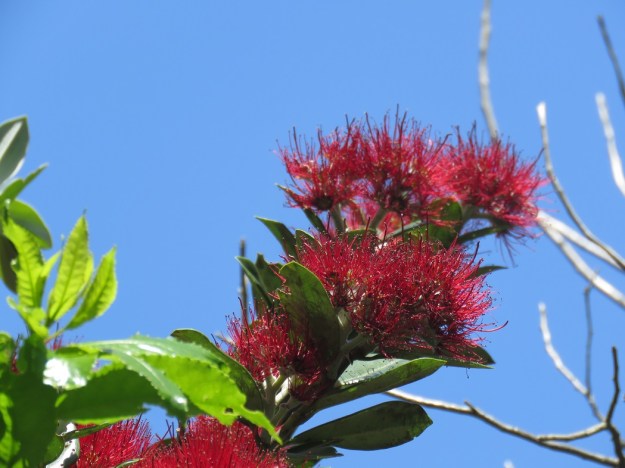

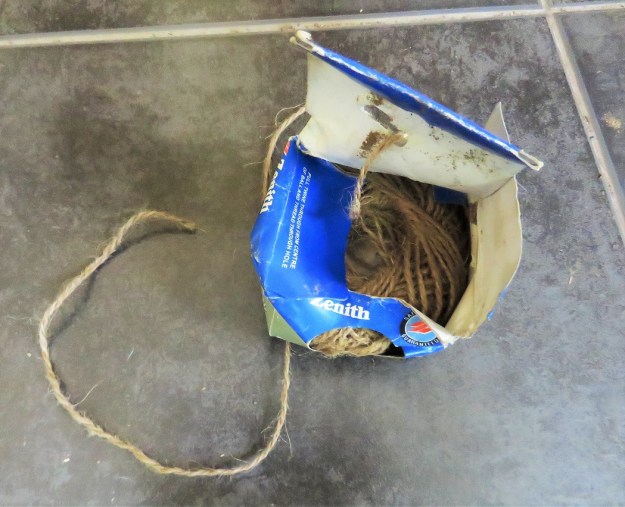 In terms of unobtrusive tying, I have now gone to old fashioned jute string which is apparently still on the market though I have yet to find who is selling it. I shall go looking and stock up because it is one of those traditional products that can suddenly disappear. I have tried many tying options, including black twine (but it was synthetic), nursery tying tape (black plastic) and stockinette ties in muted hues. The jute twine is easy to use as long as you are tying loosely, so unobtrusive it is near invisible and it is a natural product. This means that when it comes to de-staking plants later in the season (I am currently staking some of the lilies), it doesn’t matter if the ties fall to the ground to gently decompose. That is my practical hint of the week. Find some jute twine. We have been horrified at the amount of plastic that has turned up in birds’ nests. Maybe they will find the jute twine instead.
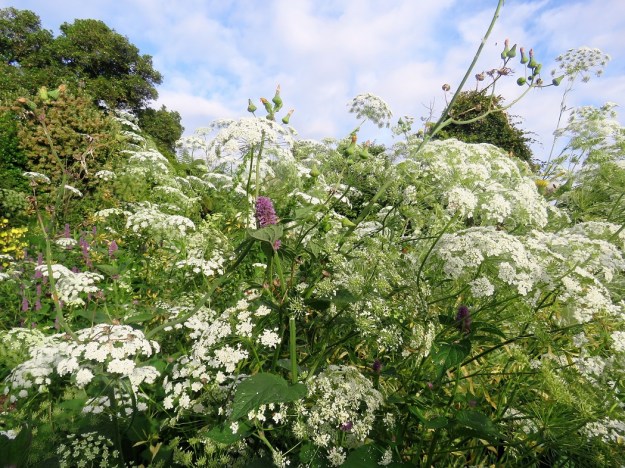
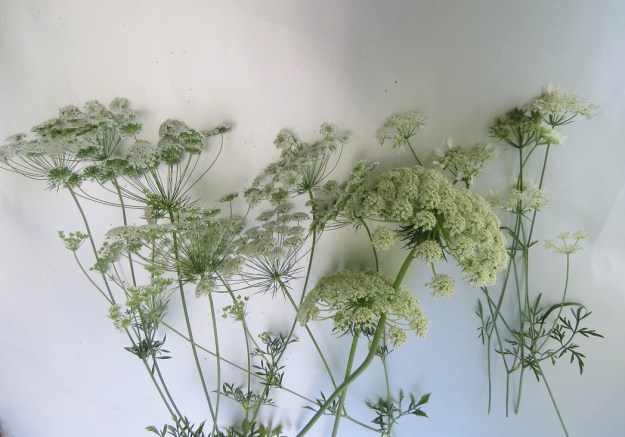
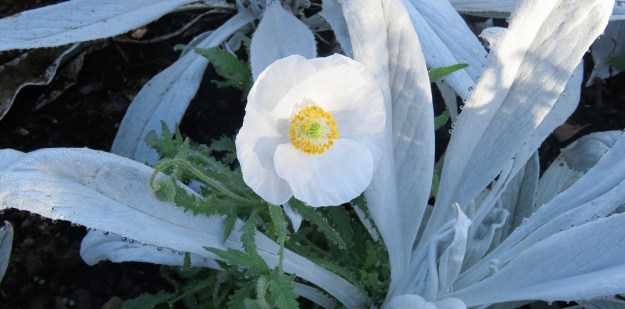
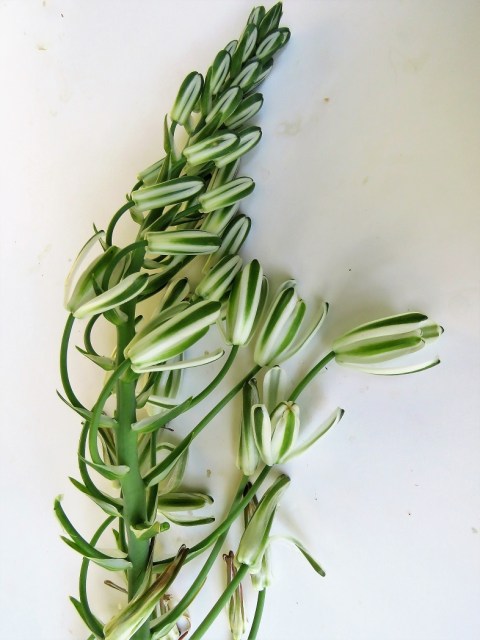 Finally, on the topic of green and white, can any knowledgeable gardener confirm with authority that this is an albuca and put a species name on it? Huge bulbs, as large as any I have seen, which like to sit half out of the ground and flower spikes up to a metre and half tall. The albuca family is a large one that I am having trouble disentangling, especially as we have thought for many years that this plant was in fact an ornithogalum. I am not sure where we got that idea from.
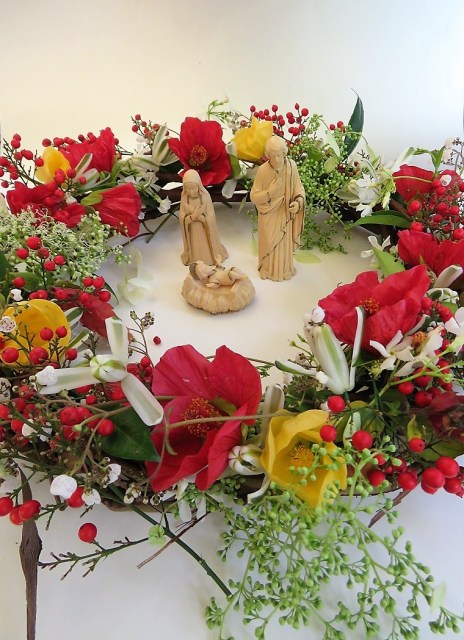 I love Christmas. I love even more the lifetime of memories that come out once a year with the Christmas bric a brac stored in the Harry Potter cupboard beneath the stairs. Our little nativity scene may even pre-date Mark’s birth. It certainly pre-dates mass plastic because it is made from its precursor – bakelite which was not much used after the 1940s. I have to admit that Joseph used to have a teeny tiny lantern that hung from his hand and I can still recall my dismay as I vacuumed it up many years ago and then failed to find it in the cleaner bag.
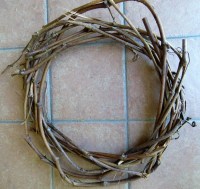 I enjoyed the wreath I made last Christmas in order to display the bakelite holy family. I know you can buy wreathes at shops like Spotlight but we live in the country so I improvise. In this case I retrieved a few grape vine prunings from where they had been thrown to decompose under a hedge. Because I use fresh flowers, my seasonal wreathes are but temporary affairs when compared to the tinsel numbers I see elsewhere, but their carbon footprint is minimal.
 Tikorangi The Jury Garden