

Sunset in Camembert. I am not joking . There is a village of that name in Normandy and I took this photo on a day in late June when the temperature hit 40 celsius. We nearly melted. The cheese did melt.
In all my years of garden writing, I am not sure I have ever looked back on a year just past. Looked forward, yes. Often. But reflecting back – not in the written word until now. Has 2017 been particularly distinctive in gardening terms? Not in extreme terms, but it has certainly been a very full gardening year.
The best gardening book of my year, without a doubt, was the collected columns of contemporary English garden writer, Tim Richardson. Titled ‘You Should Have Been Here Last Week’, it was full of thoughtful and opinionated gems and is a book that is worth going back to read again. For me, it eclipsed the gentle collection of Dan Pearson’s gardening columns, ‘Natural Selection’ which had its own charm but became a little heavy going after a while. I have not seen any New Zealand gardening books to recommend. But I can whisper that I have at least started work on my own, after a year or two’s procrastination.
New Zealand is left high and dry when it comes to TV gardening too and we keep going back to Monty Don and BBC Gardeners’ World. We were not instant Monty fans but have grown to really enjoy his delight in his own garden and his measured approach. I say that even after discovering he has two paid gardeners to assist behind the scenes. Gardeners’ World has been around since the beginning of time (or 1968, so coming up to 50 years) and still delivers quality gardening advice and insights in a low-key style that we appreciate.
While on media matters, a personal highlight has been getting to know Auckland garden designer and current garden media celeb, Tony Murrell. We have a weekly conversation on his Home and Garden Show on Radio Live but even more extended conversations off air. It is a rare privilege to work with someone who is a complete professional in his public life, full of enthusiasm, ideas and delight which carries over into his life off the airwaves too.

Breakfast in Tivoli. Bought in the local market and taken back to our AirBnB
We live in the country so I like to travel and to seek experiences and ideas beyond our self contained little patch of this world. Mark, not so much. In fact, he only participates in my advance planning in the most desultory of ways. But when I crank him out of the country, he is a marvellous companion who focuses 110% on the experience. Our trip to Italy, Normandy and England this year was a real highlight for us. It was my third trip to Italy, Mark’s second and we both fell in love with the place in a way we have not before. Mark credits AirBnB which put us right in the heart of the old town of Tivoli and gave us a far more personal connection to the locals than staying in a hotel can ever do. And while getting to Sermoneta was a traumatic experience that might have driven less staunch couples to divorce , staying there was a delight. Seeing the incidental wildflowers at Villa Adriana, the wonderful old olive grove and experiencing the classic architectural lines of the golden mean visible there were truly memorable, even in the heat.
Garden highlights were Le Jardin Plume in Normandy, the pond and the simplicity of the plantings in front of the villa at La Torrecchia (which, despite being in Italy, is early Dan Pearson work) and the privilege of being able to explore and experience the famed Ninfa Garden all alone and at our own pace. All confirmed for us that our gardening hearts lie with the gentle naturalism of more contemporary styles that is so evident in the approaches taken by many modern European and British garden designers. We have a long way to go in New Zealand in learning to garden so that we walk more lightly upon this fragile environment of ours and see beauty in Nature and her serendipitous ways.
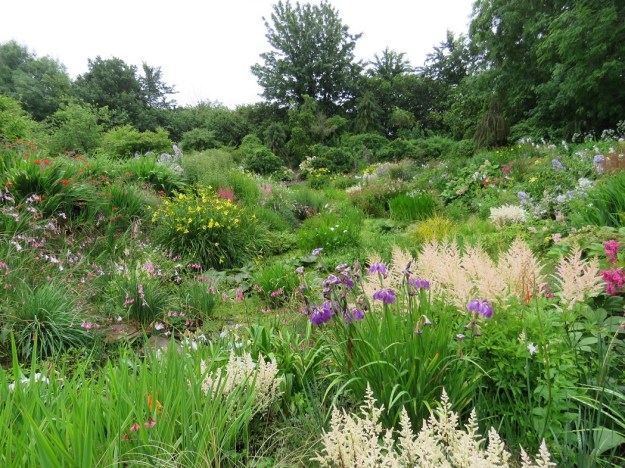
Wildside Garden – still a major highlight for us second time round
When we reached England, we felt we were on more familiar ground. Because we travel so far and pack a great deal in to what are generally just three week excursions, we don’t often go back to see gardens that we have visited before. But on this occasion, we chose to go back to both Bury Court and Wildside and neither disappointed. These are two of the most exciting private gardens we have visited – gardens which delight at the time, stay in the memory and are a rich source of inspiration for how we garden at home. On this trip, we were also privileged to see a private garden that is the work of Dan Pearson and, on the day we visited, as close to a perfect domestic garden as we have ever seen. We can learn from every garden but sometimes it is a revelation to learn from the work of somebody who is at the top of their field right now.
The unexpected highlight of the English section was looking at the work coming out from Sheffield University landscape department and Nigel Dunnett in particular which we saw at the Barbican, at Olympic Park and at Trentham Court. Do a net search on Pictorial Meadows if you want to see more of the commercial work coming out of Sheffield. It is glorious.
The Sheffield style is at the extreme end of naturalistic gardening with lower inputs, low intervention, working in cooperation with the environment and ensuring that plantings enhance eco systems rather than imposing them upon the natural environment. But they generally lack strong design elements which are what give definition and longevity in a gardening environment.
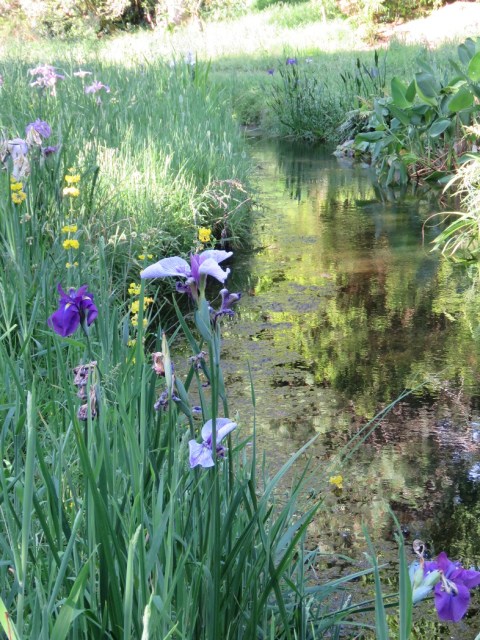
Our meadow where we have reached some level of sustainability and consistency
At home, we have been focused on bringing together elements of the new naturalism style, meadows, sustainable practice and soft-edged romanticism that appeal to us but within a stronger design framework and working in an established garden with a fair swag of notable, long-term trees. Our meadow is progressing beyond the experimental stage as we have refined the low-input techniques we use to manage it and it is a real joy to us. The next step is to look for plants that will enrich the diversity and add visual interest beyond the spring peak. Mark finds the addition of larger flowered, dominant perennials or annuals out of step with the natural look so we are assessing resilient small-flowered options that we can naturalise without creating an environmental disaster of weed potential.

Not our garden. I have this filed under ‘meadow mistakes’ – using an overbred hybrid in a natural setting
Mark’s gardening efforts this year have been dominated by food production and seeing to what point he can keep us self-sufficient in a vegetable-rich diet. It takes a lot of time, effort, skill and space to be this productive and even then the grains and tropical fruits remain on the shopping list. We could, I guess, go without the tropical fruits but we are not that purist.
I have never grown a vegetable in my life and have no plans to start. But I have had a great deal of active pleasure, starting the plantings in our newest garden area which we currently call the Court Garden – on account of the large green space in the middle of the design which currently looks like a somewhat unkempt tennis court but is destined to become a meadow through the seasons in the style of Nigel Dunnett’s Sheffield School plantings. This is former nursery, maybe an acre or more in area.
Mark recently described this new garden area to a neighbour as our last lunge – a major development that we need to do before we get any older and the hard physical labour gets beyond us. In a mature garden, even a very large one such as we have, it is a different experience to be faced with bare space, full sun and open conditions. Years have gone into its planning and it will still take more for it reach the glory we plan. We have also factored in how we integrate this new and different area into the established garden we already have.
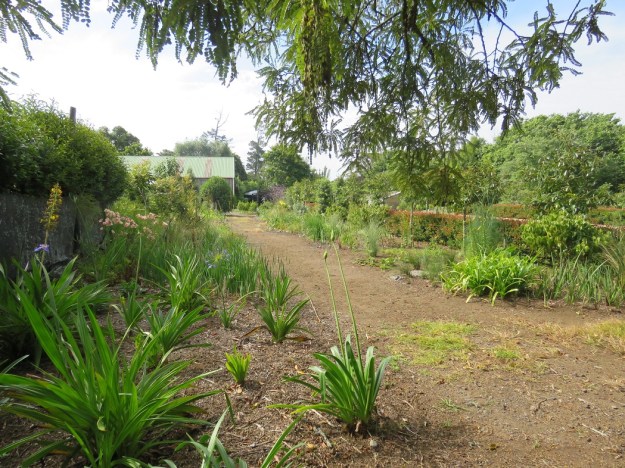
One of the double borders in our new area in its first spring

The court garden, started from a blank canvas
It is a development that we simply could not have done without the accumulated experience we have gained through our gardening lives. It also draws heavily on the inspiration and observations from our gardening travels. And it is possible because of the expertise gained in years of nursery work and Mark’s foresight in setting aside plants and growing them on in field conditions so that we could bring in the framework trees and shrubs as an advanced grade without having to spend money on buying them. We could not have afforded to do it if we had to buy the plants because it takes a lot to furnish a space as large as this.
I have loved developing parts of this area this year and seeing it start to come together as it grows. Mark, too, has been delighted by my efforts because he had not found the time or motivation to start the detailed filling in of spaces himself. I am delighted that he is delighted with my efforts because, in gardening terms, I will always defer to him as the senior partner here. Will there be an end result? There will come a point when we feel ready to show this new garden to other people but gardening to us is always an active process with no plans for an end result. If we found no pleasure in the process, we would lose interest very quickly.
 Finally, on a practical level, I recently raved about my new mini cultivator. It is terrific and I use it often. We have never gone in for all the whistles and bells of garden implements so we are VERY late to the scene with the Niwashi weeder which was a Christmas gift to me. And now, all I can say is, how did I manage so long without one?
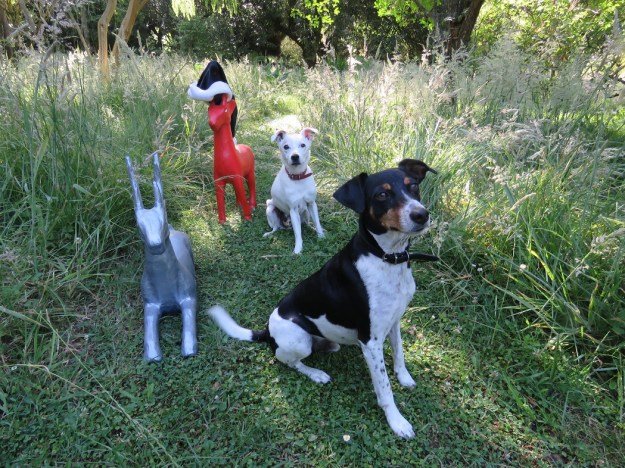 It took a pocket full of dog biscuits to persuade our pair to pose for a festive snap down in the meadow. From left to right, Sharon, Kevin, elderly and deaf Spike and food-focused Dudley at the front. The story of how and why the reindeer are known as Kevin and Sharon is a family joke that may well be lost in the retelling.
 It was doing the final Christmas shop that made me realise how much we had changed the way we eat. We are determinedly reducing the amount of packaging and plastic that comes into our house. And apparently our taste buds change. So that final shop was heavily focused on tropical fruits and good cheeses. And a better class of wine than we used to drink when we were younger and poorer. While we produce the greater part of the food we eat these days (and at least the raspberries are our own), the likes of mangoes, pomegranate and tropical pineapples are beyond us unless we build a tropical house. Nor do we have the right climate to produce peaches and apricots that are shipped here from drier parts of the country with hotter summers. This is now a household that is light on chocolate and junk food, very light on meat but we can offer plenty of good cheese and fruit and wine! And ethical ham….

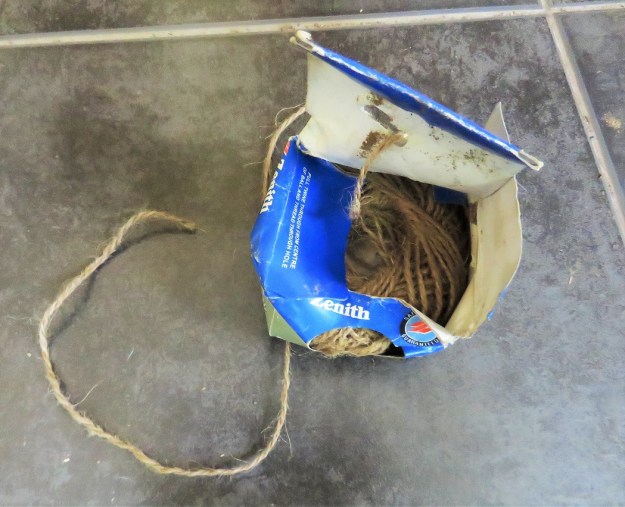 In terms of unobtrusive tying, I have now gone to old fashioned jute string which is apparently still on the market though I have yet to find who is selling it. I shall go looking and stock up because it is one of those traditional products that can suddenly disappear. I have tried many tying options, including black twine (but it was synthetic), nursery tying tape (black plastic) and stockinette ties in muted hues. The jute twine is easy to use as long as you are tying loosely, so unobtrusive it is near invisible and it is a natural product. This means that when it comes to de-staking plants later in the season (I am currently staking some of the lilies), it doesn’t matter if the ties fall to the ground to gently decompose. That is my practical hint of the week. Find some jute twine. We have been horrified at the amount of plastic that has turned up in birds’ nests. Maybe they will find the jute twine instead.
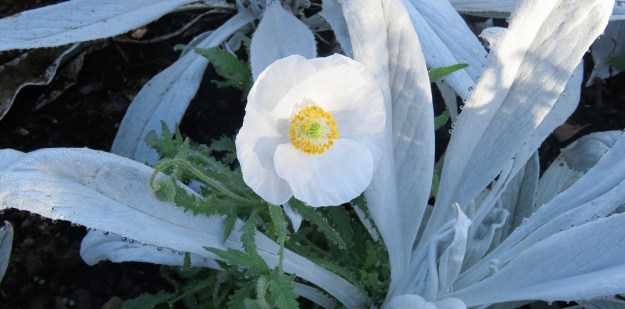
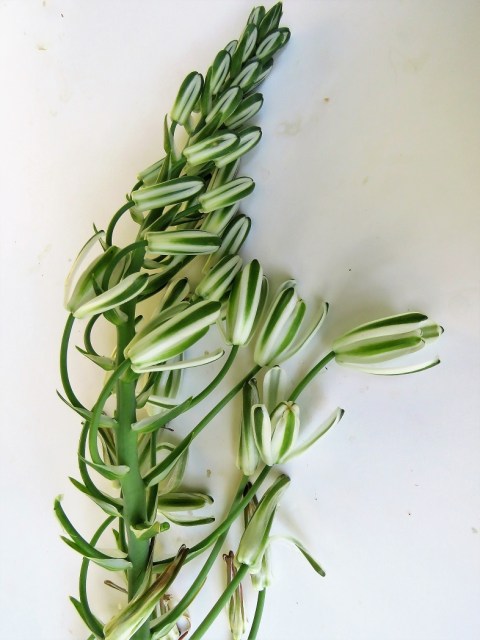 Finally, on the topic of green and white, can any knowledgeable gardener confirm with authority that this is an albuca and put a species name on it? Huge bulbs, as large as any I have seen, which like to sit half out of the ground and flower spikes up to a metre and half tall. The albuca family is a large one that I am having trouble disentangling, especially as we have thought for many years that this plant was in fact an ornithogalum. I am not sure where we got that idea from.
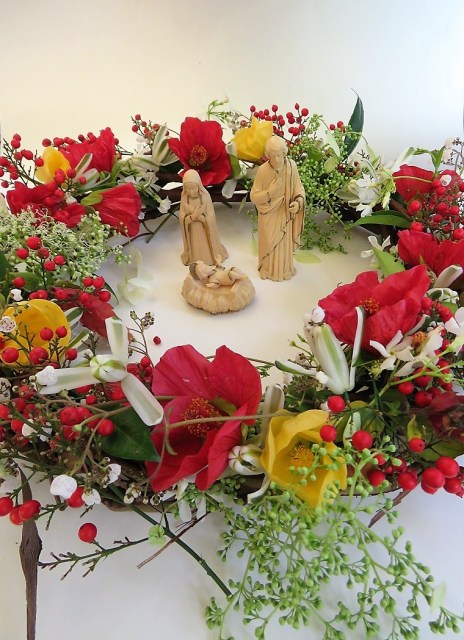 I love Christmas. I love even more the lifetime of memories that come out once a year with the Christmas bric a brac stored in the Harry Potter cupboard beneath the stairs. Our little nativity scene may even pre-date Mark’s birth. It certainly pre-dates mass plastic because it is made from its precursor – bakelite which was not much used after the 1940s. I have to admit that Joseph used to have a teeny tiny lantern that hung from his hand and I can still recall my dismay as I vacuumed it up many years ago and then failed to find it in the cleaner bag.
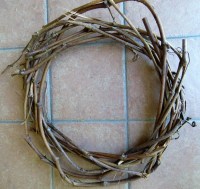 I enjoyed the wreath I made last Christmas in order to display the bakelite holy family. I know you can buy wreathes at shops like Spotlight but we live in the country so I improvise. In this case I retrieved a few grape vine prunings from where they had been thrown to decompose under a hedge. Because I use fresh flowers, my seasonal wreathes are but temporary affairs when compared to the tinsel numbers I see elsewhere, but their carbon footprint is minimal.



 Tikorangi The Jury Garden