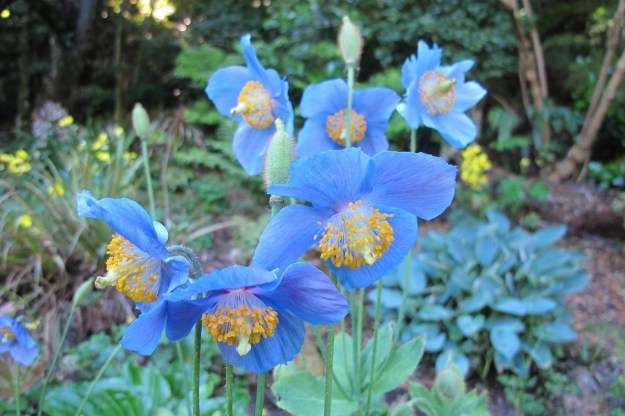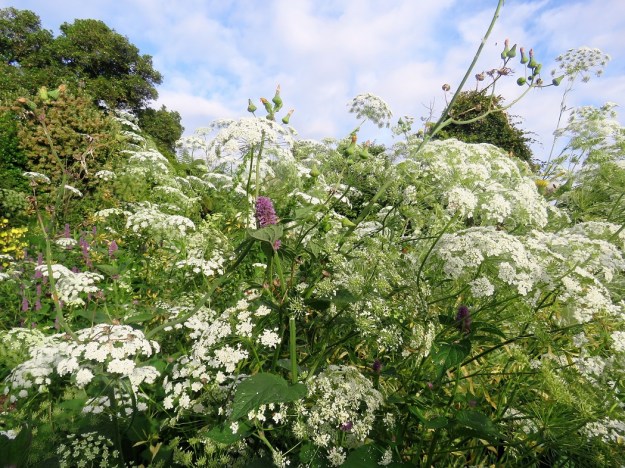
Ammi majus – my seed source currently growing in Mark’s vegetable garden
On our Sunday morning discussions on Radio Live Home and Garden Show, Tony Murrell and I have started an ongoing topic of colour. Last Sunday, we opened with the revered or reviled white gardens. Revered by many because, you know, Sissinghurst and sophisticated. Reviled by those who see it as a contrived and dated cliché which can be very flat, lacking vitality or oomph.
I have pretty much covered all my thoughts on white gardens in recent posts – White Gardens for the New Age and Shades of White in the World of Flower Gardens – and I do not think that I have more to add to that. Just a quick update on my own efforts on a seasonal white border to shine before the auratum lilies bloom in a riot of summer colour.
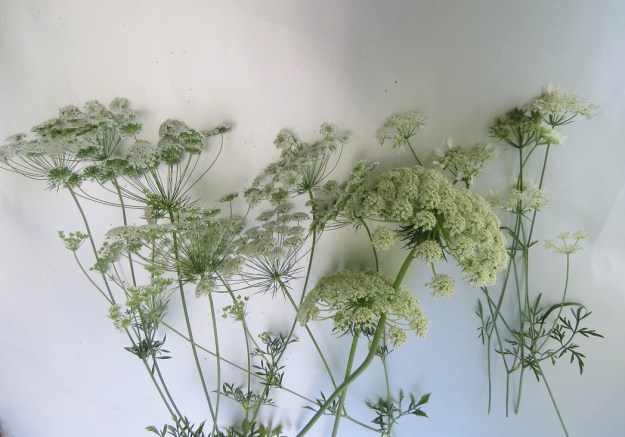
I want white frou frou
I mentioned this to Tony and he asked if I would consider renga renga lilies (Arthropodium cirratum) which are in bloom at the moment and looking very charming at our entranceway. I recoiled in horror but not because I don’t like the plant. I want frou-frou – light white froth dancing in the air. The renga rengas are too heavy, too weighted to the ground. So my plans are for the popular Orlaya grandiflora, Ammi majus (the Bishop’s flower) and even coriander and carrots which have light, white umbelliferous flowers. Maybe I will admit the pure white poppy that is flowering at the moment.
I mentioned in an earlier post that I have started planting this garden. Now it is on hold but in hand. This is a new area and the rabbit problem has been devastating. They have probably taken out half the auratum lilies as they came through the ground and it will be interesting to see how many of the bulbs survive in the ground through until next spring. Mark and the dogs are doing their best. The dogs are particularly highly motivated, having no residual qualms about Peter Rabbit in his little blue jacket. With one dog now elderly, slow and stone deaf and the other dog being a townie in his earlier years and still learning the role of rural estate dog, their enthusiasm is not matched by their success. Mark has by far the greatest hit rate – nine so far. In the meantime, the rabbits had eaten all my early efforts at planting out white umbellifers.
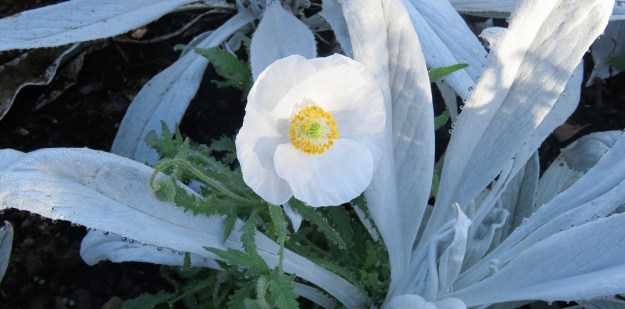
Maybe I will add the white poppy to my frou four mix
Also, being a new garden, there is a mass of weeds germinating so I am assiduously cultivating the area every few days. This is an easy task with my trusty and trusted Wolf-Garten mini cultivator but ongoing. Worth it, I think. Given that I want to sow the area in predominantly self-seeding annuals, if I spend this year getting the area weed free, it is going to save me an awful lot of work in the future when it comes to weeding. In the meantime, I am gathering seed to save for next year so that I will be ready to go when the area is relatively rabbit and weed-free. Gardening has taught me patience in a way in which none of my other life experiences have.
Having ‘done’ white gardens, Tony and I plan to go onto other monochromatic gardens (the blue, red or yellow border), the two-colour schemes (maybe red and white, or blue and yellow), then managing more complex colour schemes and the impacts of whites and pastels as well as the curious colour impacts of orange and yellow in a mixed border. Also the role of greens and whites in colour schemes. Are they colour neutral in garden settings? I am sure I will harp on about my intense dislike of pink and yellow as a colour combination. That will be Sunday mornings through January on Radio Live.

Not all greens are equal or natural, let alone invisible!
While on colour, I was slightly surprised at the suggestion from an esteemed gardening colleague that you could spend your down time in winter painting your garden stakes green to make them less obvious in your garden. To be honest, it had never occurred to me to do this. I mentioned it to Mark and he thought that it would be better to paint them in jungle camouflage rather than straight green.
It is so easy to get the shade of green wrong, in which case your ‘invisible’ stake suddenly becomes highly visible. A friend who trained in design once commented in passing that if you want something to recede into the background, you use black. Not shiny black, I would suggest, and maybe not pure black. Think creosote colouring – matt and dark.
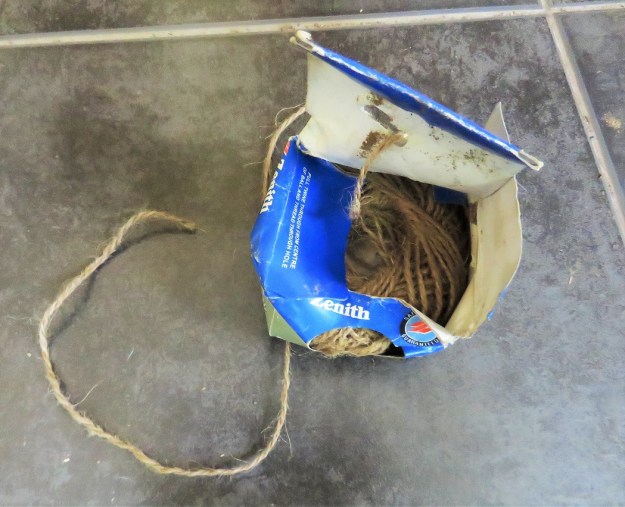 In terms of unobtrusive tying, I have now gone to old fashioned jute string which is apparently still on the market though I have yet to find who is selling it. I shall go looking and stock up because it is one of those traditional products that can suddenly disappear. I have tried many tying options, including black twine (but it was synthetic), nursery tying tape (black plastic) and stockinette ties in muted hues. The jute twine is easy to use as long as you are tying loosely, so unobtrusive it is near invisible and it is a natural product. This means that when it comes to de-staking plants later in the season (I am currently staking some of the lilies), it doesn’t matter if the ties fall to the ground to gently decompose. That is my practical hint of the week. Find some jute twine. We have been horrified at the amount of plastic that has turned up in birds’ nests. Maybe they will find the jute twine instead.
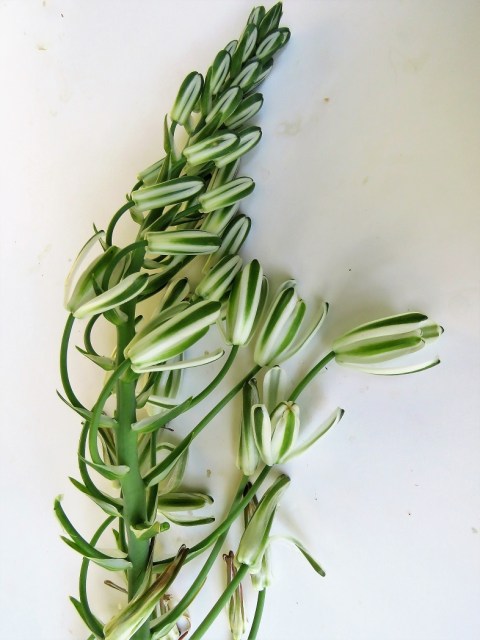 Finally, on the topic of green and white, can any knowledgeable gardener confirm with authority that this is an albuca and put a species name on it? Huge bulbs, as large as any I have seen, which like to sit half out of the ground and flower spikes up to a metre and half tall. The albuca family is a large one that I am having trouble disentangling, especially as we have thought for many years that this plant was in fact an ornithogalum. I am not sure where we got that idea from.
Postscript: a helpful and knowledgeable reader tells me the plant is most likely Albuca nelsonii and from an internet comparison, that certainly appears to be the case. The largest of the albuca family.
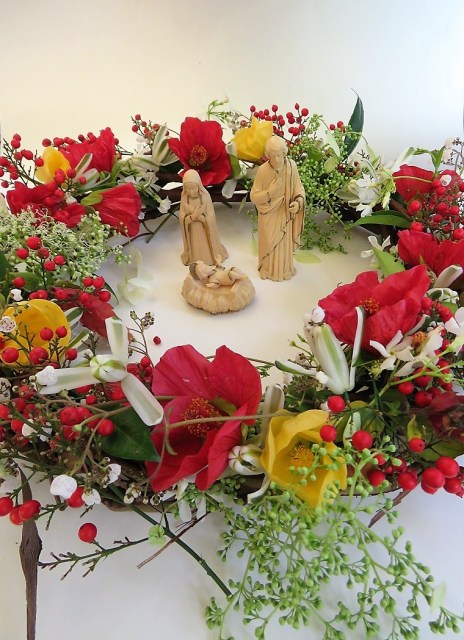 I love Christmas. I love even more the lifetime of memories that come out once a year with the Christmas bric a brac stored in the Harry Potter cupboard beneath the stairs. Our little nativity scene may even pre-date Mark’s birth. It certainly pre-dates mass plastic because it is made from its precursor – bakelite which was not much used after the 1940s. I have to admit that Joseph used to have a teeny tiny lantern that hung from his hand and I can still recall my dismay as I vacuumed it up many years ago and then failed to find it in the cleaner bag.
 I enjoyed the wreath I made last Christmas in order to display the bakelite holy family. I know you can buy wreathes at shops like Spotlight but we live in the country so I improvise. In this case I retrieved a few grape vine prunings from where they had been thrown to decompose under a hedge. Because I use fresh flowers, my seasonal wreathes are but temporary affairs when compared to the tinsel numbers I see elsewhere, but their carbon footprint is minimal.