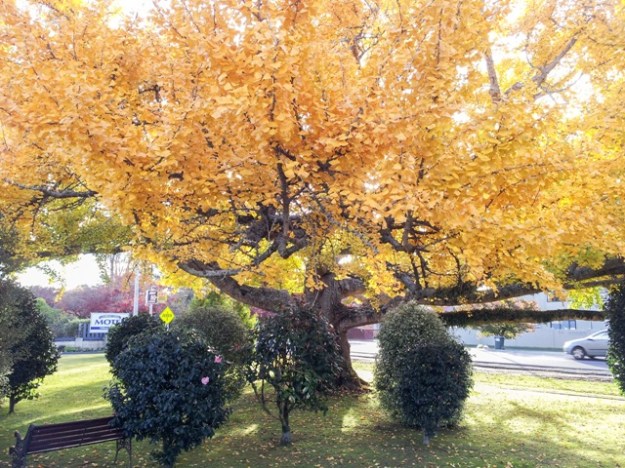
At the front of the Cambrian Lodge Motel in Cambridge on the main road to Hamilton, this ginkgo has been a remarkable sight for many years. Its wide spreading habit of growth belies the usual pyramidal form and may possibly be a result of having been topped and trimmed over several years earlier in its life.
Ginkgos are remarkable trees – botanically, in the landscape and in traditional medicine. They are spectacular at this time of year with their pure golden colour and must be one of the showiest stars of autumn. I am assuming the common name of “maidenhair tree” has come about because of the resemblance of leaf shape to the common maidenhair ferns. The leaves are flat, neat little fans
I say they are remarkable botanically because they are a living fossil and in a family of one. In the kingdom of plants, tracing down from the highest order – the division of Ginkophyta – all the separate classifications descend to one solitary species, Ginkgo biloba. Mind you, it is dioecious which means that specimens are gender specific and both male and female are needed to get viable seed. It is called a living fossil, because it has been around for a length of time variously estimated between 160 and 270 million years. That is such a huge time span that it is a bit irrelevant whether the lower or upper figure is more accurate. Suffice to say, the dinosaurs may have browsed on ginkgo trees and they have outlived all their botanical relatives, surviving not only the dinosaurs but also climate changes and all diseases. That is pretty remarkable.
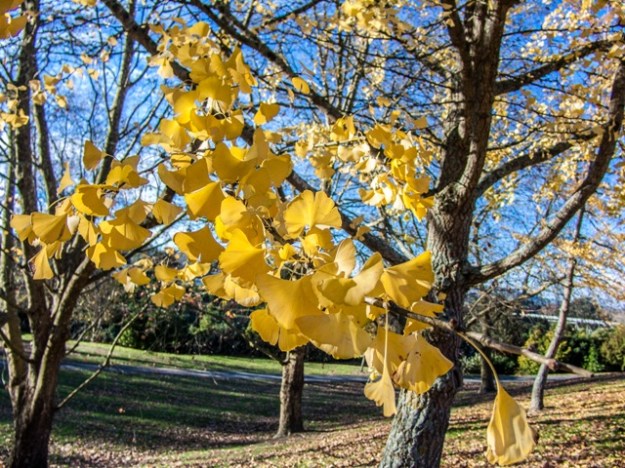
Ginkgo leaves have a distinctive fan shape. These are on a tree in the Gil Lumb Park in Leamington. The foliage has long been used in traditional Asian medicine, particularly for its alleged memory enhancing benefits.
If I hadn’t looked up the tree bible, The Hillier Manual of Trees and Shrubs, I would not have realised they are classified with conifers even though they produce seed, not cones. They are at the primitive end of the evolution of conifers.
Ginkgos originated in China and have long been regarded as sacred trees. This is just as well because they are pretty much extinct in the wild so if they hadn’t been cultivated for thousands of years in Asia and hundreds of years in Europe and North America, they may have been lost to the modern world. They are long-lived and can last well past 1000 years, though not so much in this country where any tree is lucky to last past a few decades at most. In other parts of the world, the populace are not quite so chainsaw-mad and even venerate old trees. The only tree accorded that status in NZ is Tane Mahuta.
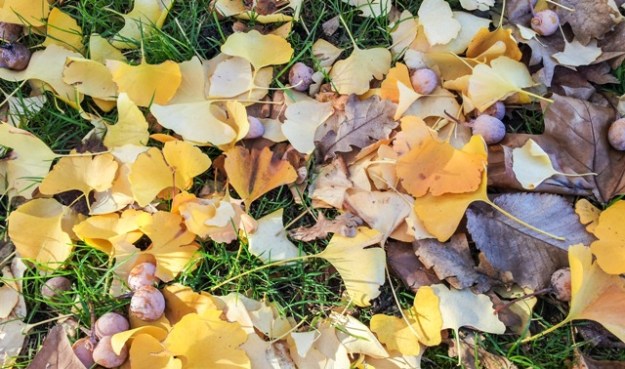
With so many ginkgos planted in the area, there are sufficient specimens of both male and female trees to get consistent crops of the nuts. While the outer casing emits a deeply unpleasant odour, the inner kernel is prized in traditional Chinese cuisine.
Despite the unmistakeable aroma of the fallen seed (variously described as ‘malodorous’ or smelling like vomit), once the soft casing has been removed, the seed inside is a traditional food in China and other parts of Asia. The smell is apparently in the fleshy casing, not the seed.
More interestingly, ginkgo leaves have long played a part in Chinese herbalism. The science on their effectiveness in slowing memory loss has yielded mixed results but research continues. At this stage, it is not looking as if ginkgo offers a magic bullet to reverse or even slow Alzheimers. Even now, most of our modern medications still orginate from plants. It is one reason why maintaining global bio-diversity is so important.
What started me on ginkgos was the sight of some leaves Mark had harvested and left on the back doorstep. I laughed because I knew instantly that he was curious about their memory enhancing reputation. But he forgot to bring them indoors and the wind blew them away.
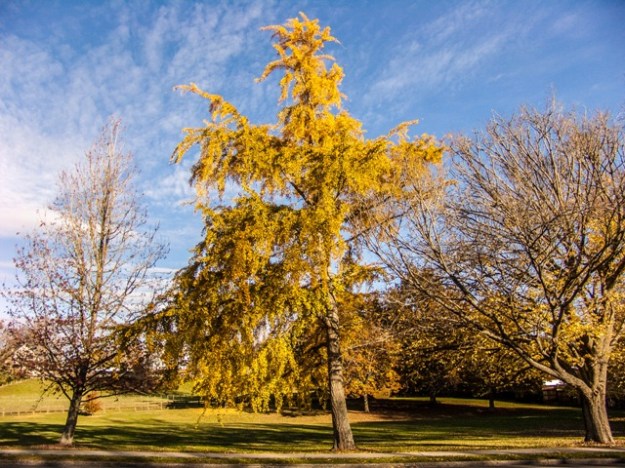
Trees take a while to mature and take on their final form but the usual conical shape can be seen developing in this tree which is in Lindsay Park in Leamington
First published in the Waikato Times and reprinted here with their permission.
All photographs courtesy of my friend Michael Jeans, Photographer, Cambridge.


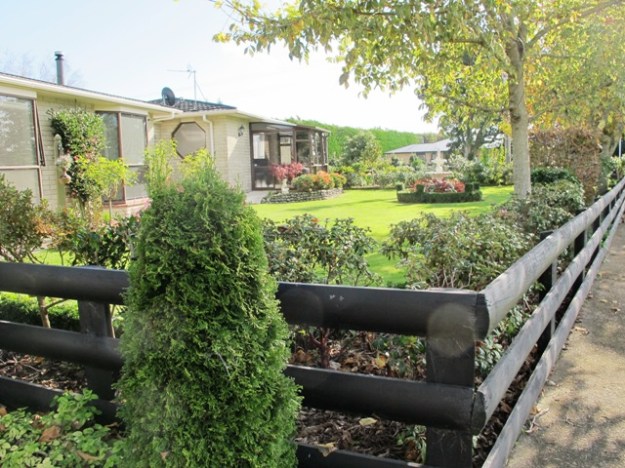 1) In times gone by, this was the norm – a low boundary fence which allows views in while marking the territory. The owner of this house tells me her husband likes to be able to see out too. Some folk enjoy being able to chat to passers-by and like having their front garden visible to people. It is a different mind-set altogether to those who want their space to be completely enclosed. In that case privacy is sometimes only a step away from voluntary imprisonment.
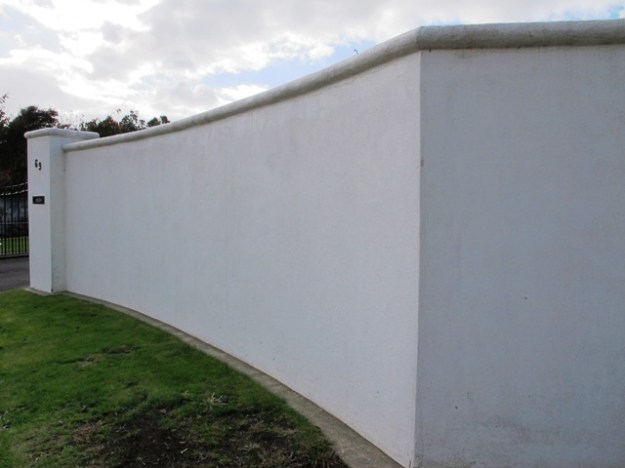 2) The plastered expanse of wall has become increasingly popular with its clean modern lines and the luxury Mediterranean look. It is usually smooth plaster applied to a concrete block construction so is not a cheap option. This one is at the end of a cul de sac where it may be safe. If you construct a wall like this in a more public position, it is like an invitation to taggers, offering a perfect blank canvas.
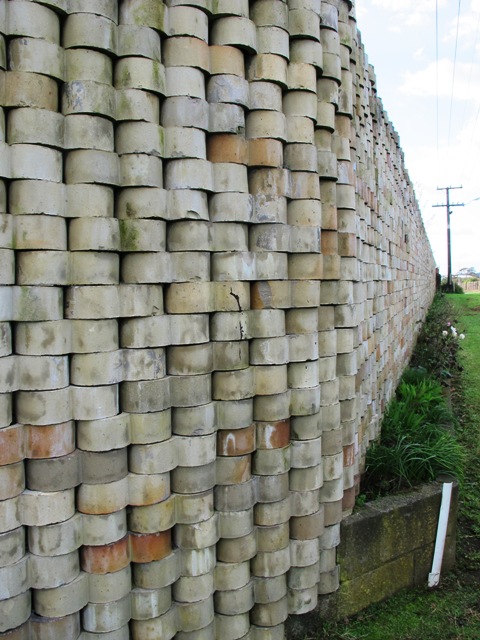 3) We have admired this fence for many years, even though closer inspection shows its construction is pretty rough and ready. It is made out of by-product from some commercial kiln-firing enterprise. The rounds are in joined pairs and we wonder if they were stands for field tiles or similar. There are a lot of them, for this is a large wall. The variation in both colour and texture appeals and it is a creative use of waste material, though probably a one-off.
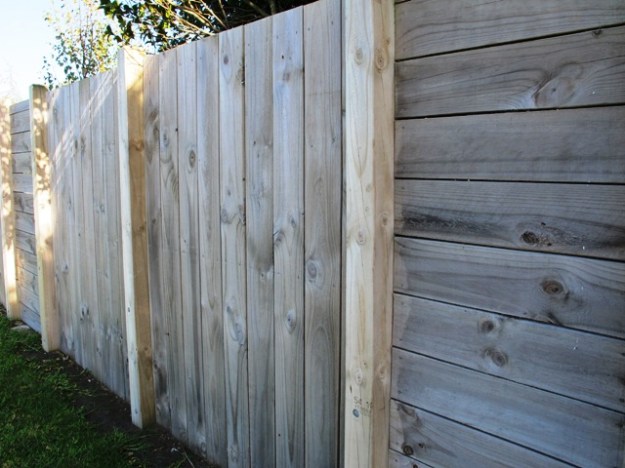 4) I mentioned in
 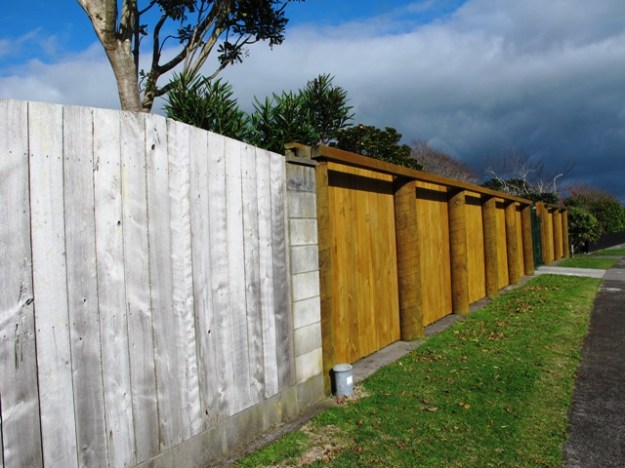 5) These substantial walls also show variations on the timber fence theme. The closer fence has tried for some detail with the use of concrete block pillars and footings and the shaped top to each panel. The second fence is brave although I find the colour a little garish. Maybe it will fade. The use of over-sized round posts and the top railing add emphatic detail which lifts it above cheap utility.
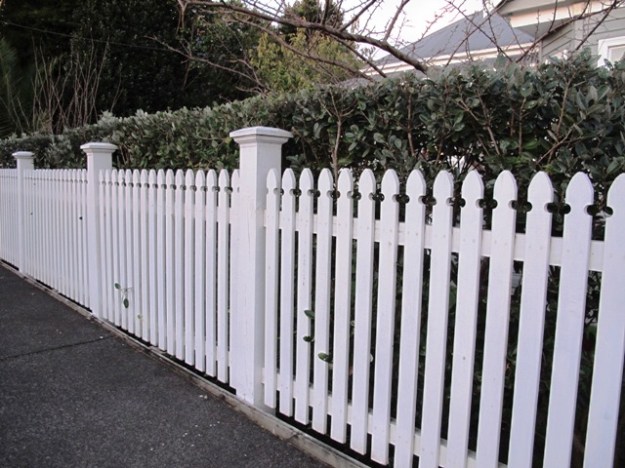 6) I photographed this in Auckland’s Mount Eden where I felt the traditional picket fence sat far more comfortably with the equally traditional villas than the newer options of solid walls closing in the properties. Here the owners have planted an inner hedge which they keep clipped. It gives additional height and privacy without the “in your face” unfriendliness of a solid wall. It is often a fallacy that major walls act as security. Once breached, they can equally give burglars free reign out of sight from passers-by.
